Canada: British Columbia Human Rights Tribunal says rainbow flag ‘promotes inclusivity’
https://www.pinknews.co.uk/2020/04/10/british-columbia-langley-pride-rainbow-flag-kari-simpson/

Canada: British Columbia Human Rights Tribunal says rainbow flag ‘promotes inclusivity’
https://www.pinknews.co.uk/2020/04/10/british-columbia-langley-pride-rainbow-flag-kari-simpson/
USA: Virginia becomes first southern state to enact comprehensive discrimination protections for LGBT+ people
Discrimination makes sick: the case of LGBTI
USA: Canada finally introduces legislation to ban traumatising conversion therapy
Canada finally introduces legislation to ban traumatising conversion therapy
Northern Ireland’s ban on same-sex marriage was ‘unjustified discrimination’, top court finally rules
Pre-doctoral research vacancies: Intersex – New Interdisciplinary Approaches (INIA) (including: The legal aspects of intersex and variation of sex characteristics)
The research vacancies (pre-doctoral) are now open and we invite applications.
Intersex people’s healthcare, social and human rights issues are often overlooked. They continue to face exposure to multiple forms of human rights violations and discrimination, requiring cross-sectoral policy responses in fields including healthcare, education, and the law.
The INIA Consortium aims to develop knowledge that will support the wellbeing and rights of intersex people and those who do not identify as intersex but have some variations of sex characteristics (hereafter: intersex people/people with variations of sex characteristics).
INIA will train a cohort of 10 early stage researchers working collaboratively to develop knowledge that will inform policy making and practice across a range of key sectors. It is being established by the University of Huddersfield, the Université Libre de Bruxelles, Dublin City University, the University of Zurich, the Escuela Andaluza de Salud Pública / Andalusian School of Public Health and the Universitat Autònoma de Barcelona in collaboration with intersex activists and advocates, clinicians, and other specialists. It will enable 21 organisations from more than 10 countries to work together on issues relating to intersex people / people with variations of sex characteristics, in a unique multidisciplinary and transectoral network. The Consortium includes international experts from a wide range of countries across the globe. The INIA work-package themes are shared across the main partners and the INIA projects, and they include:
The INIA project started on 1 March 2020 and will run for 48 months.
We will be hiring 10 Early Stage Researchers (who will become PhD students) across the whole consortium. We will provide a pioneering multi-disciplinary, multiagency international training environment which will prepare the Early Stage Researchers for future careers in academia, NGOs, policy making, or service provision. Brief details about the PhD projects are available on the PhD project tab. Each Early Stage Researcher will benefit from 2-3 secondments to other countries which will be hosted by NGOs, healthcare providers, and/or Universities. More information, and access to the application process, will become available in March 2020. The Early Stage Researchers will start their posts in September 2020.
For any questions about the INIA programme please email s.monro (at) hud.ac.uk.
Information related to the application process during Covid-19 pandemic:
The European Commission is showing support and flexibility about the delivery of this programme, due to the COVID-19 crisis.You might want to know that successful candidates will receive a sum of euro 600 per month (before tax) addition to the generous salary (see individual projects), and if they have dependent/s (child/ren or legally recognised partner) then there is more money available to them. Also, there is the possibility to apply for extra funds if the successful applicants have disabilities that are recognised by medical authorities.
All interviews for the positions will take place via skype or zoom.
Most governments around the world are mobilizing all their resources in the fight against the COVID-19 pandemic. They reach across the aisle in an effort to tackle one of the greatest challenges humanity has faced in recent history.
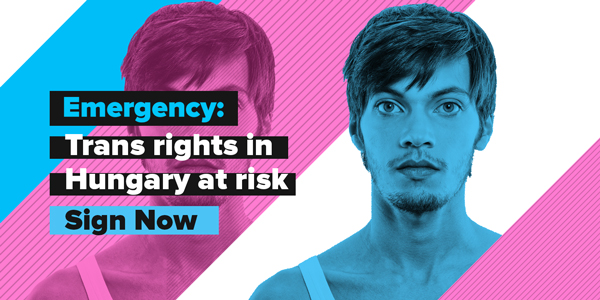
But here in Hungary, our Prime Minister Viktor Orbán has unashamedly used the situation as a pretext to grab unlimited power, enabling him to rule by decree. And while everyone is distracted by the coronavirus, the government also submitted a bill that, among other things, would make it impossible for transgender people to legally change their gender.
If passed, the law would force trans people to live with documents that do not match their true identity. It would expose them to discrimination in employment, housing, and access to services and official procedures. It would also clear the way for medical practice, including surgery, harmful to intersex children.
That’s why I’ve launched a petition to the Hungarian government. Several thousand people have signed it since I launched it earlier this week, but we’ll need many more signatures to break through the noise and get the government’s attention.
OAS Publishes Guide on Safeguarding Rights of Vulnerable Groups (such as women, indigenous peoples, and the LGBTI community) in Context of COVID-19 Response
By: Justine N. Stefanelli | April 7, 2020 – 1:18pm
On April 7, 2020, the Organization of American States published a “Practical Guide to Inclusive Rights-Focused Responses to COVID-19 in the Americas.” As explained in a press release from the OAS, the guide addresses the concern that situation for vulnerable people, such as women, indigenous peoples, and the LGBTI community, worsens in the context of emergency situations, such as the current pandemic. Therefore, the guide stresses the need for states to emphasize the protection of the right to health of vulnerable groups. It consists of ten chapters, each of which addresses specific groups of vulnerable people and issues such as the right to education for children, responding inclusively to internally displaced persons, migrants, and refugees, and how to ensure that prevention, containment, and mitigation efforts include people living in poverty and extreme poverty.
The guide is currently available only in Spanish, but an English version is forthcoming.
IACHR finds Peru responsible for arbitrary detention and rape of transgender woman
The Inter-American Court of Human Rights (IACHR) found in a decision released Monday that Peru owed damages to Azul Rojas Martin, a transgender woman who was imprisoned and tortured by Peruvian authorities.
Rojas Martin was detained by authorities in February 2008 striped of her clothes and beat as authorities screamed and insulted her for being transgender.
In its decision, the court noted the long history of discrimination and abuse against LGBT people. They also reiterated that LGBT people are part of a protected class and that discrimination based on sexual orientation or gender identity will not be tolerated by the court.
The court ordered Peru to investigate and try the officers who attacked Rojas Martin. In addition, they are required to create an efficient way to investigate and punish people who commit anti-LGBT crimes. They also are asked to create educational programs for offenders to create awareness about the LGBT community. Finally, they are required to pay for Rojas Martin’s therapy and an undisclosed amount of money in reparations.
The post IACHR finds Peru responsible for arbitrary detention and rape of transgender woman appeared first on JURIST – News – Legal News & Commentary.
 International and Comparative SOGIESC Law - Professor Andreas R Ziegler