USA: Third Circuit Court rules single attack on gay man sufficient for asylum claim
USA: Third Circuit Court rules single attack on gay man sufficient for asylum claim
Leave a reply

USA: Third Circuit Court rules single attack on gay man sufficient for asylum claim
ECHR communicated new case – same-sex foster and then adoptive parents Communicated on 6 March 2020 (Published on 23 March 2020 – SECOND SECTION)
Application no. 277/20 – J.B. and E.M. against Norway lodged on 20 December 2019
SUBJECT MATTER OF THE CASE
Applicant A is a Nigerian national, and applicant B is a Norwegian national of Liberian origin. Both are currently residing in Sweden. The applicants are former partners and the parents of X, born in January 2013, and Y, born in August 2014.
On 20 June 2013, as X was four months old, a decision on emergency care order and placement in foster home was taken by the Child Protection Service. An ordinary decision on a care order and placement in foster home for X was given on 18 November 2013 by County Social Welfare Board (Fylkesnemnda for barnevern og sosiale saker). Contact rights were set at two hours twice per year.
On 5 June 2014, by judgment of the City Court (tingrett), the decision of the board upheld. The foster parents in the designated foster home were a same sex couple.
On 2 December 2015 the two applicants applied for termination of the care order and placement in foster home, and, if the placement in foster home was not discontinued, that X should be placed in a foster home where the foster parents were not a same sex couple. On 29 March 2016, by decision by the Board, the application was declined. The applicants appealed against the decision.
On 3 January 2017, by judgment of the City Court, the decision not to terminate the care order was upheld. Contact rights were set at two hours twice a year for B, and two hours once a year for A. On 31 March 2017 the High Court (lagmannsrett) refused the applicant leave to appeal.
On 27 June 2018 the Board granted the request of the Child Protection Service that the applicants’ parental responsibilities for X should be withdrawn and adoption should be approved. The applicants appealed against the decision.
On 2 January 2019 the City Court quashed the decision of the Board. The Child Protection Service appealed against the judgment.
On 24 April 2019 the High Court in a judgment withdrew the applicants’ parental responsibilities for X and allowed for his foster parents to adopt him.
On 21 June 2019 the Supreme Court (Høyesterett) refused leave to appeal.
Relying on Article 8 of the Convention, the applicants submit that their right to respect for their family life was violated by the decision to withdraw the applicants’ parental responsibilities for their son and allow for his foster parents to adopt him.
Furthermore, relying on Article 9 (1) in conjunction with Article 2 of Protocol No. 1, and Article 9 (2) of the Convention, the applicants submit that the placement of X in foster home of a same sex couple constitutes a breach of the parents’ right to respect for their freedom of religion, and that adoption of their child by foster parents being a same sex couple does not meet the criteria of “necessary in a democratic society” in Article 9 (2) of the Convention as there are other foster families readily available.
QUESTIONS TO THE PARTIES
1. Has there been a violation of the applicant’s rights under Article 8 of the Convention as a result of the decision to withdraw the applicants’ parental responsibilities in respect of their son and allow for his foster parents to adopt him, see Strand Lobben and Others v. Norway [GC], no. 37283/13, 10 September 2019?
2. Having regard to the fact that X was adopted by foster parents being a same sex couple, does a separate issue arise under Article 9 of the Convention as regards to the applicants’ freedom of religion? If so, are the admissibility criteria for such a complaint fulfilled, in particular the criterion on exhaustion of domestic remedies? If so, has there been a violation of the applicants’ rights under Article 9 of the Convention?
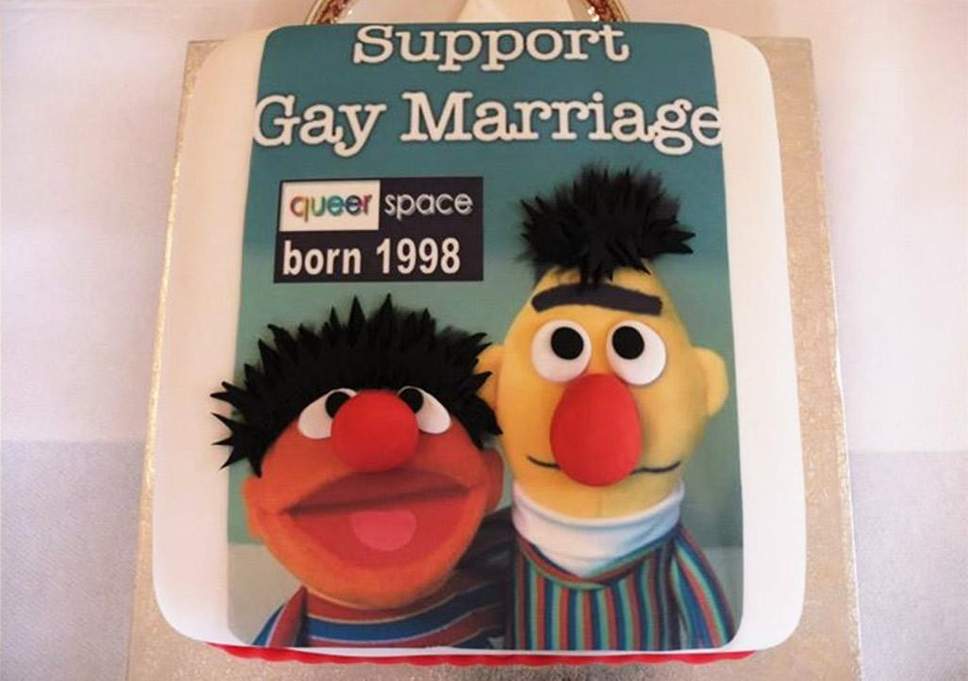
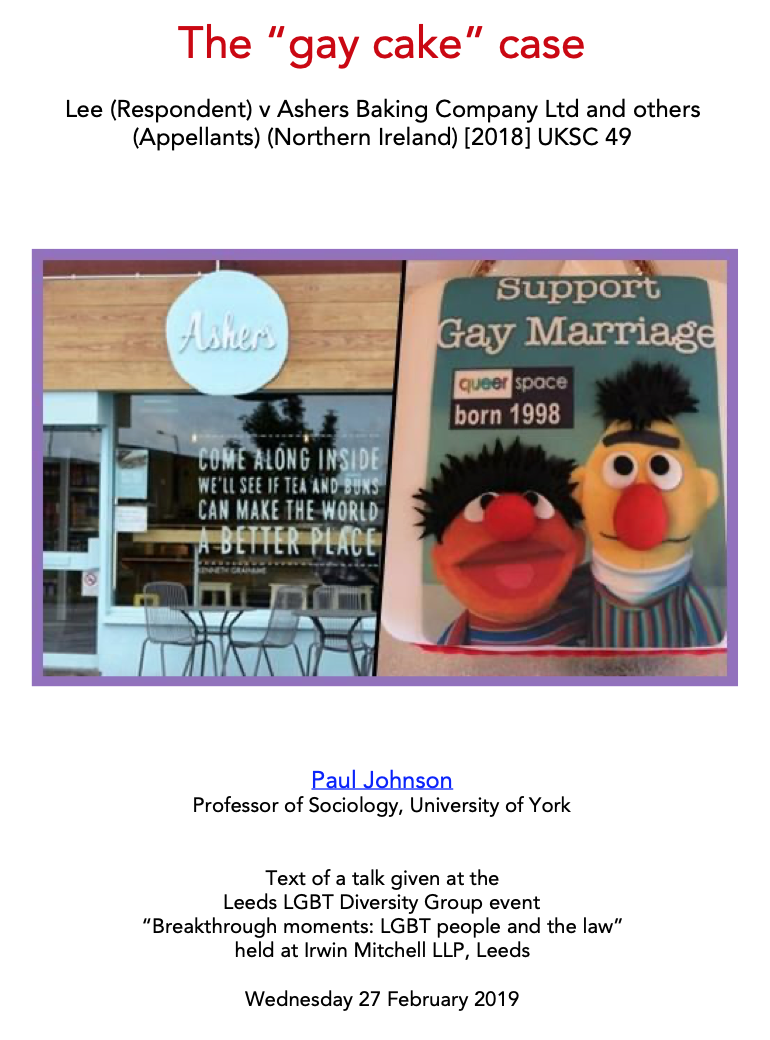
| Paul Johnson: “Gay cake” case communicated by European Court of Human Rights Posted: 30 Mar 2020 03:38 AM PDT The First Section of the European Court of Human Rights has communicated the case of Lee v the United Kingdom. The case is brought by Mr Gareth Lee who, in 2014, placed an order for a cake from Ashers Baking Company Limited with the words “Support Gay Marriage” on it and later received a telephone call from Ashers indicating that the order could not be fulfilled. The reason given was that Ashers is a Christian business and, on that basis, should not have taken Mr Lee’s order. Mr Lee’s claim that he had, inter alia, suffered discrimination on the grounds of sexual orientation – as prohibited by domestic legislation in force in Northern Ireland – was upheld by the County Court, and affirmed by the Court of Appeal. However, the Supreme Court subsequently found in favour of Ashers because “the objection was to the message and not to any particular person or persons”. Complaint to the Court Mr Lee complains under Articles 8, 9, 10, and under Article 14 in conjunction with those Articles, of the European Convention on Human Rights, that his rights were interfered with by a public authority (namely, the Supreme Court) by its decision to dismiss his claim for breach of statutory duty due to discrimination contrary to the provisions of the Equality Act (Sexual Orientation) Regulations (Northern Ireland) 2006 and the Fair Employment and Treatment (Northern Ireland) Order 1998. Mr Lee argues that the interference was not proportionate and that the Supreme Court disregarded the democratically chosen resolution to the conflict of rights between religious organisations and persons of same sex orientation, and those supporting the aspirations of such persons. Questions to the Parties The Court has asked the parties the following questions: 1. Has the applicant exhausted domestic remedies in respect of his complaints under Articles 8, 9, 10 and 14 of the Convention by presenting his complaints in so far as they are different to his complaints under domestic legislation, either explicitly or in substance, in a manner to allow his allegations of violations of Convention rights to be addressed and, where appropriate, to afford redress before those allegation were submitted to the Court (see Peacock v. the United Kingdom (dec.), no. 52335/12, § 33, 5 January 2016 and Nak Naftogaz Ukrainy v. the United Kingdom (dec.) no. 62976/12, § 50, 23 May 2017)? 2. If so, has there been an interference with the applicant’s rights under Articles 8, 9 and 10 of the Convention, both alone and in conjunction with Article 14 of the Convention? Was that interference in accordance with the law and necessary in a democratic society? 3. In this context, what is the appropriate test to be applied by the Court in a case concerning a dispute of a “purely private nature” (see mutatis mutandis Plaand Puncernau v. Andorra, no. 69498/01, § 59, ECHR 2004 VIII, i.e.)? My previous comments on this case I entirely agree with Mr Lee’s argument that the Supreme Court, through its judgment in Lee (Respondent) v Ashers Baking Company Ltd and others (Appellants) (Northern Ireland), “disregarded the democratically chosen resolution to the conflict of rights between religious organisations and persons of same sex orientation”. I expressed the same view on the day the Supreme Court handed down it judgment here – where I said that I thought the judgment was wrong – and expanded my reasons for that view later here. In February 2019, I gave a talk at the Leeds LGBT Diversity Group event “Breakthrough moments: LGBT people and the law” (held at Irwin Mitchell LLP, Leeds) on the case, the full text of which is available here. |
Fully-funded PhD opportunity at Birmingham City University: LGBTQ teaching row
I wanted to let you know that we’ve got an excellent opportunity for a fully-funded PhD study on the LGBTQ teaching row in Birmingham and beyond. I was hoping you might be able to help me disseminate this information? Details below.
Some exciting news for anyone thinking of doing a PhD in the area of LGBTQ inclusion:
BCU School of Social Sciences has secured funding for an excellent candidate to work on an interdisciplinary research project entitled ‘What can we learn from the LGBTQ teaching row in Birmingham?’
Birmingham has hit the headlines because of protests against the inclusion of same sex relationships in sex and relationship education in schools. This PhD aims to understand the debates, the anti-LGBTQ rhetoric, their effects on LGBTQ people (including hate crime), as well as teachers’ confidence in incorporating LGBTQ content into their teaching.
We strongly encourage to apply candidates with the ability to analyse the teaching row in Birmingham in an international perspective, taking into account the ongoing fundamentalist, anti-gender and anti-LGBTQ campaigns in other countries.
Essential qualifications are:
Supervisory Team: Dr Lesley Storey, Dr Piotr Godzisz, Dr Keeley Abbott
The funding consists of a tax-free stipend paid monthly and has a current value of £15,285 per annum. The bursary is renewable annually for up to 36 months in total, subject to you making satisfactory progression within your PhD research.
Successful applicants for our funded PhD studentships will receive a tax-free research stipend that tracks UK Research Council rates (currently £15,285) and a fee waiver to the value of Home / EU student PhD fees (currently £4,407).
The closing date for applications is 23.59 on Sunday 31 May 2020.
More info: https://www.bcu.ac.uk/social-sciences/research/phd_opportunities
Tiny nation of Andorra to introduce same-sex marriages by making one simple change to the law
https://www.pinknews.co.uk/2020/03/20/andorra-same-sex-marriage-legal-change-weddings-europe/
USA. Idaho lawmakers approve transgender restrictions
Two bills restricting the rights of transgender people in Idaho were sent to Governor Brad Little for signature this week. HB 509 prevents transgender people from changing the sex listed on their birth certificates. HB 500 bans transgender women and girls from competing on female sports teams.
Idaho’s government has been warned that both bills will face lawsuits in federal courts as they violate the Constitution’s equal protection clause. In 2018 the US District Court for the District of Idaho struck down an almost identical law to HB 509. The court held that the prior law unconstitutionally discriminated against transgender people. Idaho did not appeal the ruling. Lambda Legal, the law firm that represented the plaintiffs, issued a press release calling for Little to veto the law on Thursday.
Supporters of HB 509 say it is necessary to ensure the health and safety of Idahoans and for the accuracy of government records. Opponents say the bill flouts a court order and disregards the rule of law, in addition to being inherently discriminatory. Deputy Attorney General Brian Kane outlined a number of concerns and potential issues in a letter sent to the Idaho Legislature. Among other things, he called the law inconsistent with court precedent and said that the bill would face higher scrutiny when reviewed by judges.
Similar concerns have been raised regarding HB 500. Five former Attorneys Generalsfrom Idaho have called for Little to veto the bill, citing the law’s unconstitutionality and the inevitable lengthy and costly legal battles. HB 500 prohibits transgender women and girls from competing on female sports teams sponsored by public schools, colleges or universities. Supporters claim the law will protect the advances gained for female athletes by Title IX, and that transgender women would have advantages over their teammates and opponents. Opponents say the law is discriminatory and would subject female athletes to invasive testing in order to prove their gender. This, they argue, could discourage women from participating in sports.
The law requires proof of the athlete’s gender if it is disputed. Critics worry that athletes could be subjected to humiliating tests solely because someone has a grudge against them. In response to these concerns, supporters of the bill added an amendment that gave any athlete who loses an opportunity, or is forced to prove their gender due to a false claim a cause of action against their accuser. The amendment has not mollified opponents of the bill.
Further, despite what supporters of the bill claim, the issue of whether transgender women would have an advantage due to their inherently higher testosterone levels has not been resolved. The International Olympic Committee permits transgender women who have been on hormone therapy for a year and have testosterone levels under a certain threshold to compete on against other women.
The post Idaho lawmakers approve transgender restrictions appeared first on JURIST – News – Legal News & Commentary.
USA: US Naval officer files suit against transgender military ban
A US Naval officer in Massachusetts filed suit against the Department of Defense for discrimination under the current administration’s transgender military ban Tuesday.
The plaintiff is going by the name James Doe in the interest of privacy. Doe came out as transgender after the ban went into effect in 2019, so she was not protected by the military’s grandfather clause. This clause allowed transgender individuals to continue their service if they came out before the ban.
Jennifer Levi, project director at GLBT Legal Advocates and Defenders (GLAD) stated that, “As an experienced officer, all she seeks is the ability to continue serving her country.”
The complaint states that, “The Due Process Clause of the Fifth Amendment grants Plaintiff constitutional liberties and a fundamental right to privacy that encompasses and protects Plaintiff’s right to self identification and self-determination as a transgender person.” The lawsuit was filed Tuesday in a federal district court in Massachusetts.
The post US Naval officer files suit against transgender military ban appeared first on JURIST – News – Legal News & Commentary.
A new report by the Commission against Racism and Intolerance (ECRI) calls on Switzerland to increase funding and human resources for counselling centres for victims of racism, and to deal more effectively with discrimination, as well as promoting integration. ECRI notes significant progress since its last report in 2014, but some issues continue to give […]
EUROPEAN COMMISSION AGAINST RACISM AND INTOLERANCE (ECRI) publishes new report on Switzerland — International Law in Switzerland – Professor Andreas R Ziegler
10 PhD positions in the field of Intersex Studies as part of the INIA Marie Sklodowska-Curie Actions ITN at University of Huddersfield
https://www.jobs.ac.uk/job/BZE512/10-phd-positions-in-the-field-of-intersex-studies-as-part-of-the-inia-marie-sklodowska-curie-actions-itn
 International and Comparative SOGIESC Law - Professor Andreas R Ziegler