Author Archives: Andreas R. Ziegler

Uganda LGBTQ+ rights activist stabbed

Uganda LGBTQ+ rights activist stabbed

A dedicated advocate for LGBTQ+ rights in Uganda was [WARNING: GRAPHIC VIDEO] stabbed Wednesday and is in critical condition in hospital. The brutal assault comes as attacks on LGBTQ+ people in the country have surged following the implementation of a harsh anti-homosexuality law.

Steven Kabuye, a champion for LGBTQ+ rights in Uganda, posted the video to his X (formerly Twitter) account on Wednesday morning, which showed his injury. Hans Senfuma, an ally of Kabuye and an LGBTQ+ activist, posted that the activist had been stabbed with a knife in the early morning by two unknown individuals on a motorcycle. He said that Kabuye believed the men were trying to kill him and that they had been following him for several days. Senfuma later posted that Kabuye was out of surgery.

In May 2023, Uganda passed the Anti-Homosexuality Act, igniting widespread condemnation from the international community. The law criminalized same sex conduct and introduced a possible death penalty for the offense of “aggravated homosexuality.” Numerous governments and human rights organizations expressed their opposition to the law, with Human Rights Watch stating that the law violated “multiple fundamental rights guaranteed under Uganda’s constitution and breaks commitments made by the government as a signatory to a number of international human rights agreements.”

Since the passing of the act, Uganda has seen a huge rise in human rights violations of LGBTQ+ individuals, as well as assaults. A report issued by the Strategic Response Team Uganda showed that between January and August 2023, “real and perceived LGBTIQ+ persons were exposed, tortured, beaten, arrested, outed and suffered physical, sexual and psychological violence, including evictions and banishments, blackmail, loss of employment and health service disruptions.” There are currently legal challenges to the law underway and a trial is expected soon, with petitioners arguing that the law not only breaks rights under the Ugandan Constitution but also reneges on their international human rights obligations.

Kabuye has been an outspoken critic of the law and a fierce proponent for LGBTQ+ rights in Uganda. At the time of the act’s passing, he tweeted:

I am deeply concerned about the consequences of Uganda’s Anti-Homosexuality Act 2023. This law violates basic human rights and sets a dangerous precedent for discrimination and persecution against the LGBTQ+ community. Let us stand together in solidarity and fight against bigotry and hate.

According to Reuters, the Coloured Voices Media Foundation – Truth to LGBTQ Uganda, made a statement on X regarding the assault on Kabuye. However, the statement is no longer available as the X account is no longer active. The organization’s website is also inaccessible. Dr Frank Mugisha, a prominent human rights activist and civil rights defender, stated on X that “hate crimes have no place in Uganda. We urge the police to conduct a thorough investigation.”

The post Uganda LGBTQ+ rights activist stabbed appeared first on JURIST – News.
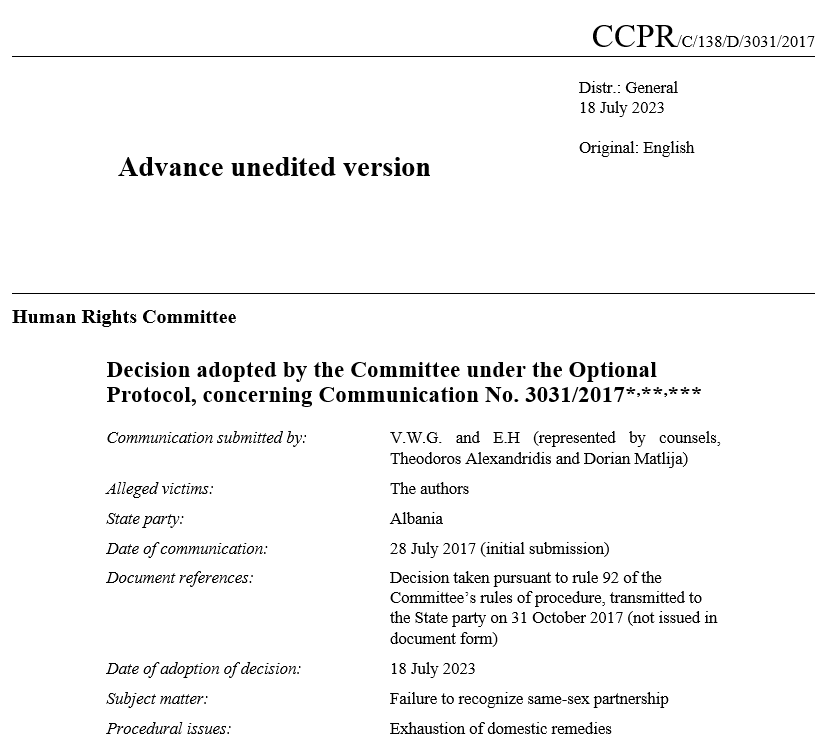
UN Human Rights Committee finds case relating to refusal to recognise same-sex partnership inadmissible

UN Human Rights Committee finds case relating to refusal to recognise same-sex partnership inadmissible

View of the UN Human Rights Committee in E.H. v. Albania, a decision adopted in July 2023 and published on 28 November 2023. 

The case involves a bi-national same-sex couple seeking recognition of their relationship in the State party.  The Committee found the case inadmissible for failure to exhaust domestic remedies.  Laurence R Helfer authored a joint dissenting opinion explaining that the Committee should have declared the case admissible and found violations of articles 17, 23 (1) and 26 of the ICCPR, read alone and in conjunction with article 2 (3).

See: https://tbinternet.ohchr.org/_layouts/15/TreatyBodyExternal/DownloadDraft.aspx?key=+nxllx+jasD+ilsd0u1hw9XiCV1fTHIVOT+ruixx1QuBJkvqhQranhCWVPVpJlAh79QTGeVFyM7m19zPrxe77w==

Case Note: Jaroszyński T, Łacny J. Further Extension of Protection against Discrimination on Grounds of Sexual Orientation under Directive 2000/78/EC: Court of Justice (Second Chamber) 12 January 2023, Case C-356/21, J.K. v TP S.A., ECLI:EU:C:2023:9. European Constitutional Law Review. Published online 2023:1-19. doi:10.1017/S1574019623000184

Case Note: Jaroszyński T, Łacny J. Further Extension of Protection against Discrimination on Grounds of Sexual Orientation under Directive 2000/78/EC: Court of Justice (Second Chamber) 12 January 2023, Case C-356/21, J.K. v TP S.A., ECLI:EU:C:2023:9. European Constitutional Law Review. Published online 2023:1-19. doi:10.1017/S1574019623000184

See: https://www.cambridge.org/core/journals/european-constitutional-law-review/article/abs/further-extension-of-protection-against-discrimination-on-grounds-of-sexual-orientation-under-directive-200078ec/E4B63CE43F3A0D200D2CF7286B7E3870

USA: Federal judge blocks portions of Iowa book ban

USA: Federal judge blocks portions of Iowa book ban

US federal Judge Stephen Locher on Friday blocked key provisions of SF 496, an Iowa law prohibiting school libraries from distributing books containing LGBTQ+ and gender identity issues. Judge Locher stated that the law “sweeps so broadly,” that more than 500 books, including literary classics and self-help books, faced removal.

Iowa claimed that the selection of books contained in a library constituted “government speech.” Under the governmental speech doctrine, the government, “is entitled to say what it wishes and select the views it wants to express.” Government speech is not subject to First Amendment free speech protections given that the government functions by passing laws either “favoring or disfavoring” different positions.

Judge Locher rejected the claim. He cited several federal cases designating libraries as “limited public forums” subject to First Amendment scrutiny. As such, “the government may not impose unreasonable or viewpoint-specific restrictions.” Judge Locher stated that a total ban of a book in place of an age or parental permission restriction created an unreasonable burden on students.

The ACLU of Iowa, who represented the plaintiffs, praised the decision, stating that their clients are now “able to continue the school year free from the harm caused by this unconstitutional law.” Iowa Governor Kim Reynolds (R) responded to the ruling by saying that “[b]ooks containing sexually explicit content do not belong in a school library.”

SF 496 was passed in May and scheduled to go into effect on January 1. The law prohibited educators from raising gender identity and sexual orientation issues with students through grade six. The law also removes all books depicting sexual acts from school libraries. Religious books were exempted from the ban. Additionally, school administrators are required to notify a student’s parent(s) or guardian(s) if they changed their name or pronouns. This portion of the law remains in effect and was not blocked by Judge Locher’s order.

Several states have been sued over book ban laws. Texas is currently being sued for a “book rating system” that will grade a book based on its sexual content. Arkansas‘ book ban was halted by a federal judge in July for being overly vague. However, some states have passed laws banning book bans. Illinois passed a law in June that eliminated book bans, requiring public libraries in the state to ensure they offer a diverse range of materials.

The post US federal judge blocks portions of Iowa book ban appeared first on JURIST – News.

Ohio governor vetoes bill banning gender-affirming care for minors and transgender participation in girls’ sports

Ohio governor vetoes bill banning gender-affirming care for minors and transgender participation in girls’ sports

Ohio Governor Mike DeWine vetoed House Bill 68 on Friday, which would have banned gender-affirming care for minors and transgender athlete participation in girls and women’s sports in high school and college in the state.

Under the proposed bill, it would be illegal for medical health professionals to perform gender reassignment surgery on an individual under 18, prescribe a cross-sex hormone or puberty-blocking drug for a minor individual to assist with gender transition or engage in conduct that aids or abets in these practices. Additionally, the bill would require high school and collegiate sports teams to be designated as male, female or co-ed. House Bill 68 combines and edits the Save Adolescents from Experimentation (SAFE) Act and the Save Women’s Sports Act

DeWine’s veto message stated:

Ultimately, I believe this is about protecting human life. Many parents have told me that their child would be dead today if they had not received the treatment they received from an Ohio children’s hospital. I have also been told, by those that are now grown adults, that but for this care, they would have taken their lives when they were teenagers. What so many of these young people and their families have also told me is that nothing they have faced in life could ever prepare them for this extremely tough journey. Parents are making decisions about the most precious thing in their life, their child, and none of us should underestimate the gravity and the difficulty of those decisions.

Additionally, in response to the veto, Human Rights Campaign President Kelley Robinson stated:

Ohio families don’t want politicians meddling in decisions that should be between parents, their kids and their doctors. Instead, parents, schools and doctors should all do everything they can to make all youth, including transgender youth, feel loved and accepted, and politicians should not be making it harder for them to do so. Thank you to Gov. DeWine for listening to the people of his state and making the right decision for young trans Ohioans.

Under Article II Section 16 of the Ohio Constitution, if the governor vetoes a bill, the bill gets sent back to the legislative house that it originated in. That house must vote to repass the bill by a three-fifths vote to send it to the other house to get another three-fifths vote to repass. If the bill gets a three-fifths vote to repass from both houses, the bill becomes law without the governor’s approval. That means this bill will be sent back to the Ohio House of Representatives, since that is where it was introduced.

Other states that have successfully passed bans on gender-affirming care for minors have faced litigation. A federal judge in Alabama declined to pause a challenge to an Alabama law that criminalized gender-affirming care for minors on Tuesday. Additionally, in October, a federal judge allowed Oklahoma’s ban on gender-affirming care for minors to take effect.

The post Ohio governor vetoes bill banning gender-affirming care for minors and transgender participation in girls’ sports appeared first on JURIST – News.

European Court of Human Rights finds Poland failure to recognize same-sex couples

European Court of Human Rights finds Poland failure to recognize same-sex couples

The European Court of Human Rights (ECHR) ruled Tuesday that Poland’s failure to recognize same-sex couples violates its obligations to human rights.

Przybyszewska and Others v. Poland involved several same-sex couples who had all attempted to obtain formal recognition of their relationships from the civil registry office and were denied by Polish authorities. The court found that Poland’s failure to provide a legal framework for the recognition and protection of the couples’ unions created significant hardship. These hardships included the inability to regulate important aspects of their lives, such as property, taxation and the rights and duties of mutual assistance. The Court concluded that the denial of legal recognition for same-sex couples amounted to a violation of Article 8 of the European Convention on Human Rights, which provides for the right to privacy. According to the court, Article 8 does not require Poland to allow same-sex couples to get married. Rather, the issue was “the absence in Polish law of any possibility of legal recognition and protection of the relationship of same-sex couples.” Poland ratified the convention in 1993.

The government of Poland argued that the lack of formal recognition under the Polish constitution was an “omission” that should be at the discretion of Polish legislators. They also argued that there had been no serious injury to the parties as a result of the lack of recognition.

The court responded to these arguments, stating:

It is important to note that the Court has consistently declined to endorse policies and decisions which embodied a predisposed bias on the part of a heterosexual majority against a homosexual minority. It has also held, under Article 14 of the Convention, that traditions, stereotypes and prevailing social attitudes in a particular country cannot, by themselves, be considered to amount to sufficient justification for a difference in treatment based on sexual orientation. The Court has also held that the allegedly negative, or even hostile, attitude on the part of the heterosexual majority cannot be set against the applicants’ interest in having their respective relationships adequately recognised and protected by law. It therefore rejects those arguments in the instant case.

In their opinion, the court noted a recent trend of anti-LGBTQIA+ rhetoric taking hold in some regions of Europe, including Poland. In 2019, Swidnik county passed a resolution declaring itself “free from LGBT ideology” and committed itself to preventing “the sexualization of Polish children” in schools through “homopropaganda.”  The resolution was supported by the conservative Law and Justice (PiS) party, but was withdrawn by the county earlier this year. The change was apparently made after funding for any Polish counties that supported the resolution was “put on hold” by the EU, as it violated non-discrimination law.

Poland’s Minister of Equality, Katarzyna Kotula, has announced that she will make the regulation of same-sex unions a “priority.” She went on to state that equality is guaranteed under Article 32 of the Polish Constitution.

The post European Court of Human Rights finds Poland failure to recognize same-sex couples violates right to privacy appeared first on JURIST – News.