This is a blog is related to my academic work in the International Academic Forum on SOGIESC Law but meant to serve anyone who wants to contribute to improve the protection of human rights worldwide. It is intended to keep interested readers informed about legal developments relating to sexual orientation, gender expression and identity and sex characteristics (SOGIESC). Hopefully, it will make it easier to find correct legal information about the developments in all regions of the world and, in particular, with regard to international law.
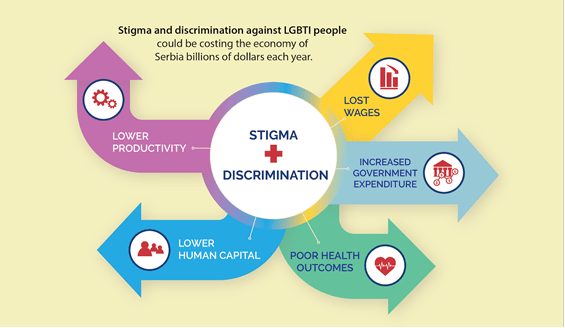
World Bank: The economic cost of LGBTI exclusion in Serbia and North Macedonia
Two new reports by the Williams Institute in collaboration with the World Bank find that the exclusion of LGBTI people costs the economies of Serbia and North Macedonia millions of dollars each year. While both countries have introduced important reforms to protect the rights of LGBTI people, sexual and gender minorities continue to face discrimination and exclusion.
The annual economic loss due to LGBTI exclusion totaled $293 million in Serbia and $64 million in North Macedonia in 2021.
Attacks on LGBTI rights strongly associated with democratic backsliding globally
New research finds countries that are highly accepting of LGBTI people tend to have high levels of liberal democracy, such as free and fair elections and the protection of civil liberties. More accepting countries also tend to have higher GDP per capita and a greater share of their population residing in urban environments.
Attacks on LGBTI people and their rights are strongly associated with democratic backslide. A decline in LGBTI acceptance may, under some conditions, be a bellwether of democratic decline.
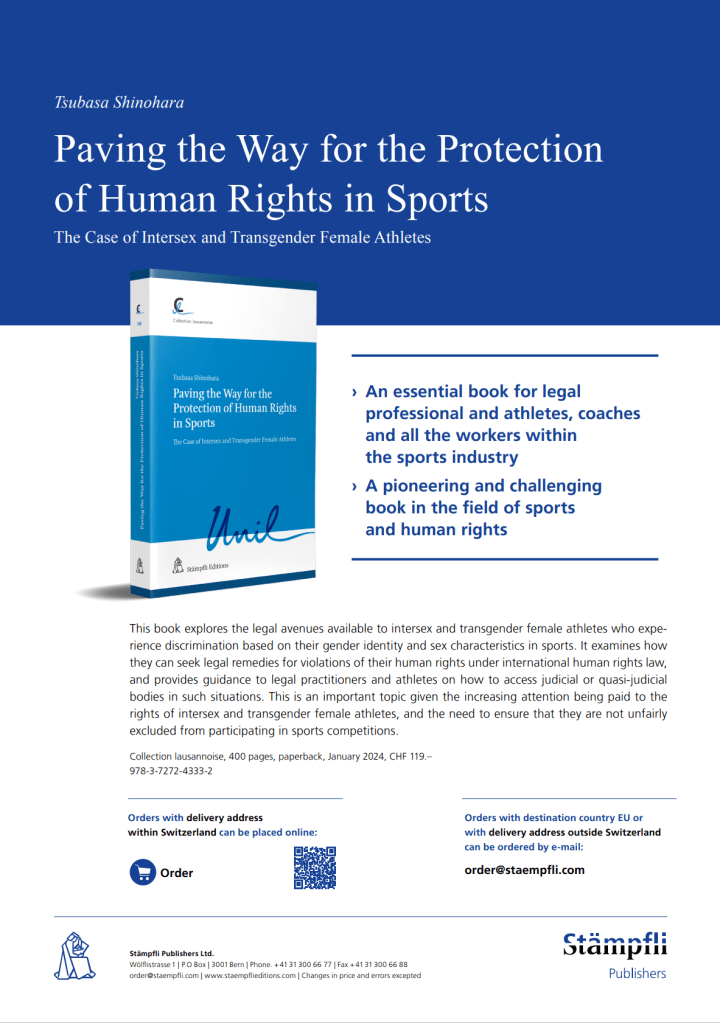
New Book (PhD Thesis Lausanne) Tsubasa Shinohara, Paving the Way for the Protection of Human Rights in Sports – The Case of Intersex and Transgender Female Athletes
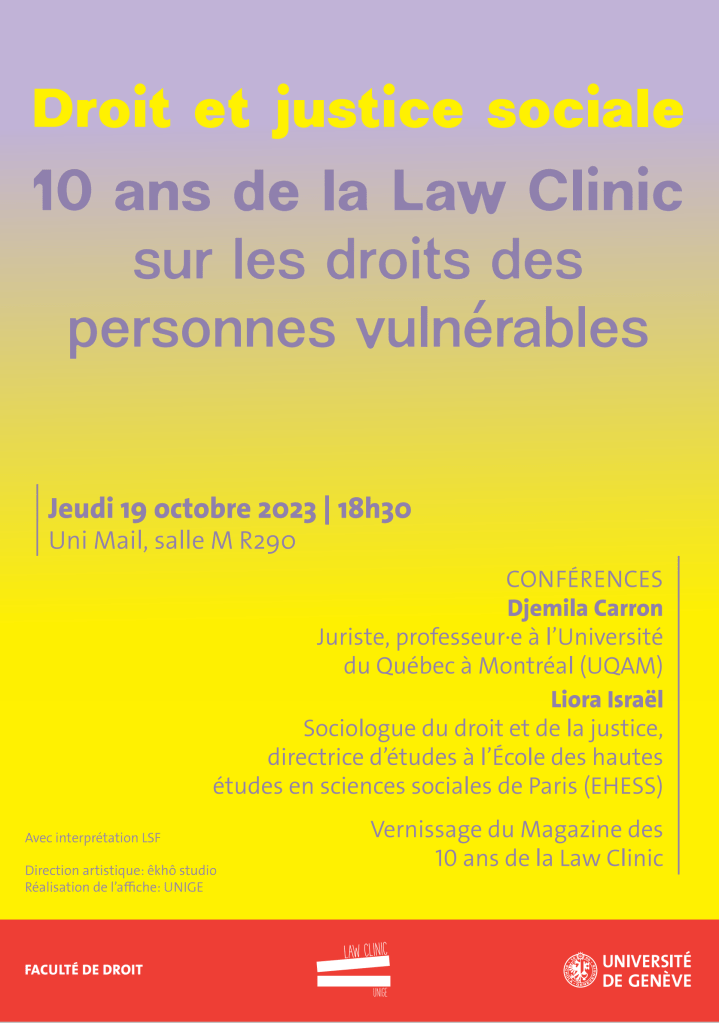
Droit et Justice sociale – Conférence des 10 ans de la Law Clinic et publication anniversaire, 19 octobre 2023 à 18h30 en salle M R290 à Uni-Mail, Genève
Cette année 2023 marque les 10 ans d’enseignement de la Law Clinic sur les droits des personnes vulnérables de l’Université de Genève. Pour célébrer cet anniversaire hautement symbolique et mettre en lumière le riche travail accompli au cours d’une décennie par cette clinique juridique pionnière en Suisse, nous organisons une conférence académique à laquelle nous avons le grand plaisir de vous convier :
Droit et justice sociale : 10 ans de la Law Clinic sur les droits des personnes vulnérables
Le 19 octobre 2023 à 18h30 en salle M R290 à Uni-Mail,
avec les interventions de
Djemila Carron, juriste et co-fondateurice de la Law Clinic, professeur·e à l’Université du Québec à Montréal
Et
Liora Israël, sociologue du droit et de la justice, directrice d’études à l’École des hautes études en sciences sociales de Paris
Suivi du vernissage du Magazine des 10 ans de la Law Clinic
Couvrant l’ensemble des thématiques traitées par la Law Clinic, le Magazine des 10 ans de la Law Clinic réunit les contributions d’alumni·ae, de personnes concernées, de professionnel·le·x·s, et d’associations ayant travaillé avec cette clinique juridique qui, depuis sa création, œuvre pour la mise en pratique des savoirs juridiques et la justice sociale. Cet ouvrage se veut également être le reflet de la synergie au cœur d’un programme académique qui a permis de bâtir des ponts entre l’Université, les associations/personnes concernées et la Cité.
Nous nous réjouissons de vous retrouver à cette occasion.
L’équipe de la Law Clinic sur les droits des personnes vulnérables
Law Clinic sur les droits des personnes vulnérables
Turkey President Erdogan ‘bothered by LGBT colours’ at UN headquarters
Some diplomats suggest the president may have confused the 17 different colours associated with a global “to do” list and the subject of a summit in New York this week, with the rainbow Pride flag.
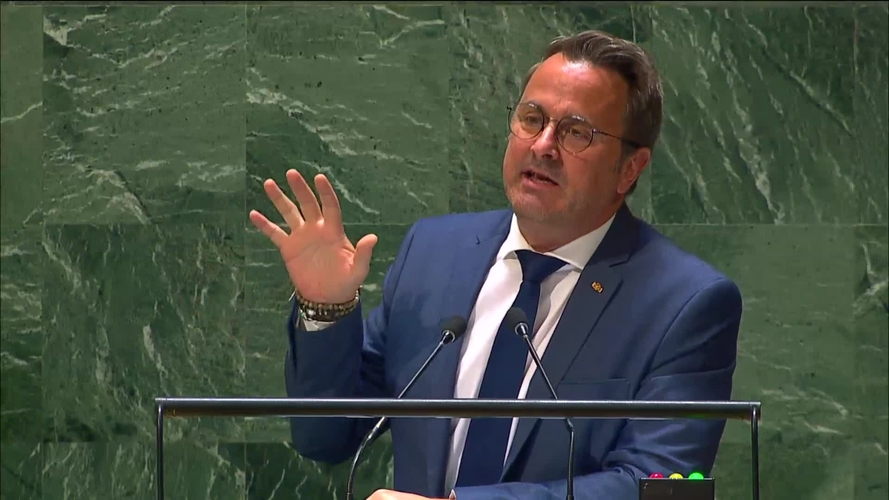
Prime Minister of Luxembourg addresses UNGA: “being gay is not a choice, but being homophobic is [a choice]”
22 September 2023 – XAVIER BETTEL, Prime Minister of Luxembourg, stressing that States must act together as “truly united nations”, said: “I have an impression that everyone has their own definition of what it means to be united.” … He also noted that “being gay is not a choice, but being homophobic is [a choice]”, pointing out that he had to confront people who do not accept diversity.
Protests, counter-protests held across Canada over sexual orientation and gender identity in school curriculums
Protests and counter-protests were held across Canada on Wednesday over the sexual orientation and gender identity (SOGI) curriculum in schools, with numbers ranging from several hundred to over 1,000 participants in some cities. Arrests were made in Ottawa, Halifax, Vancouver and Victoria, including three in Ottawa for “public incitement of hatred.”
Rallies organized by the “1 Million March 4 Children” group took aim at SOGI-inclusive education policies, which they termed “the sexualization and indoctrination of our children in schools.” The governments of New Brunswick and Saskatchewan have recently implemented policies that require parental permission for students’ formal names to be changed, echoing similar views found in the United States.
The Wednesday protests have been roundly criticized as being discriminatory towards LGBTQIA+ people, and for advancing a view of parental rights that prioritizes parents opposed to SOGI-inclusive education policies. Large crowds of counter-protesters formed to meet the “1 Million March” rallies, including a march led by NDP Party leader Jagmeet Singh.
Politicians, public figures, and education boards across the country released statements condemning the protests as being hateful and permissive of violence against LGBTQIA+ people. Prime Minister Justin Trudeau wrote on X (formerly Twitter) “We strongly condemn this hate and its manifestations, and we stand united in support of 2SLGBTQI+ Canadians across the country – you are valid and you are valued.” Ottawa mayor Mark Sutcliffe, whose city saw the largest clash of protests in Canada, stated that “the protests taking place today will only cause harm to youth who are looking for our support and acceptance.”
More broadly, the rise in movements opposing SOGI curriculums mirrors a worldwide rise in laws targeting LGBTQIA+ people, notably including “Don’t Say Gay” laws in US states such as Florida and bans on transgender youths in sports. Human Rights Campaign (HRC), an LGBTQIA+ rights group, declared a state of emergency for LGBTQIA+ people in the US earlier this year, and reported that 32 transgender and gender non-conforming individuals were killed in the US in 2022.
While Canada has traditionally been considered one of the safest countries in the world for LGBTQIA+ people, it has not been immune to the growth of anti-LGBTQIA+ policies and sentiments seen south of the border and elsewhere. Statistics Canada recently reported that while Canada’s LGBTQIA+ population is growing, the number of anti-LBGTQIA+ crimes has risen as well.
New Article: International Regulation of Sexual Orientation, Gender Identity, and Sexual Anatomy
Y ZHANG, S BRINKER, M CHHOY, H GHARIA – … JOURNAL OF GENDER AND THE LAW Lesbian, gay, bisexual, transgender, and intersex (LGBTI) 1 persons continue to experience human rights violations directly linked to lack of acceptance by society and States of their sexual orientation, 2 gender expression, 3 and/or gender identity
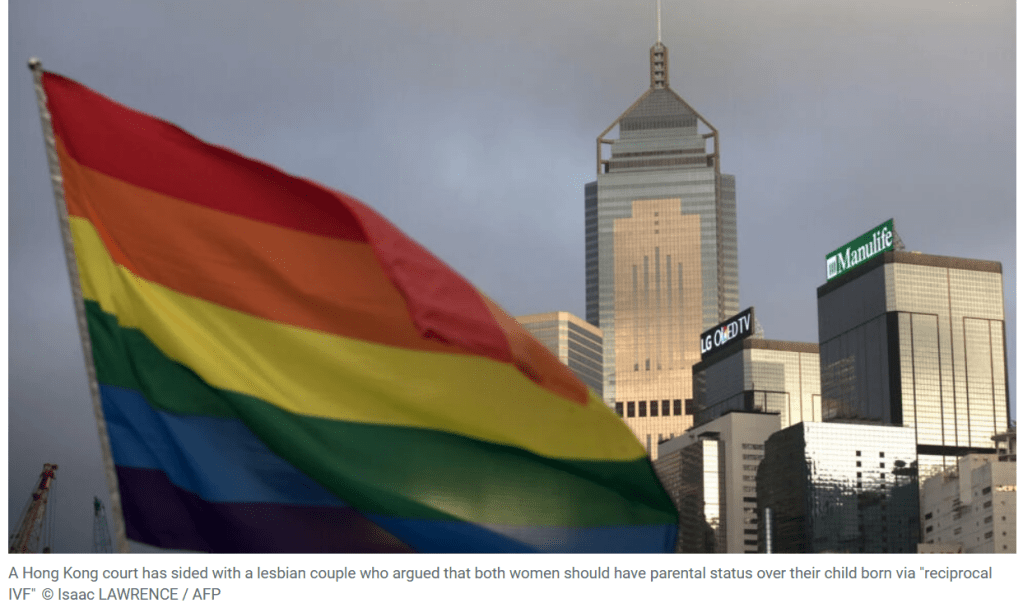
Lesbian couple win Hong Kong court victory in IVF case
Two women who took part in RIVF launched a legal challenge last year after the Hong Kong government recognised only one of them as the mother of their son, citing existing family laws.
On Friday, judge Queeny Au-Yeung at the court of first instance ruled that the government’s non-recognition was a form of discrimination against the couple’s son.
Their child was “discriminated as to his birth in the sense that, unlike other children, he does not have a co-parent, genetically linked to him,” the judge wrote in her ruling.
The court declared that the woman initially denied legal status should be recognised as a “parent at common law”, saying the move would align her legal status with reality.
“The court should be astute to the changing world where people build families in different manners other than through a married or heterosexual relationship,” the judge added.
In RIVF, a lesbian couple can jointly take part in childbearing as one woman’s egg, fertilised externally with the aid of a sperm donor, is transferred to the other woman who carries the pregnancy to term.
The procedure was introduced in the late 2000s and can now be performed without restriction in more than a dozen European countries, according to an academic survey.
As Hong Kong does not recognise same-sex marriages, the two women in the case — who were granted anonymity by the court — were married and underwent RIVF in South Africa.
Lawyer Evelyn Tsao, who represented one of the women, called the ruling “one giant step for the rainbow families in our LGBTQ community”.
“For the first time, the court expressly states that children of same-sex couples are discriminated by the current legislation,” Tsao told AFP.
Barrister Azan Marwah, one of the lawyers who argued the case in court, said on social media that the ruling was a first in the common law world.
The Department of Justice told AFP it was “studying the judgment in detail and considering the way forward”.
Earlier this month, Hong Kong’s top court ruled against same-sex marriage but ordered the government to provide an “alternative framework”, such as civil unions, to protect the rights of homosexual couples.




 International and Comparative SOGIESC Law - Professor Andreas R Ziegler