Author Archives: Andreas R. Ziegler

Kenya Supreme Court reaffirms LGBTQIA+ organizations’ right to registration

Kenya Supreme Court reaffirms LGBTQIA+ organizations’ right to registration

The Supreme Court of Kenya (SCORK) upheld its earlier decision Tuesday that the LGBTQIA+ community has the freedom to associate, which extends to the formation of associations.

This case began when an application was made to the court by George Kaluma, an advocate of the High Court of Kenya, seeking the review and setting aside of a judgment delivered February 24th on whether refusal by the NGO coordination Board to register the National Gay and Lesbian Human Rights Commission (NGLHRC) as an organization was discriminatory and thus unconstitutional.

The court dismissed the application on two grounds. First, the applicant was not a party in the previous matter, and, second, the threshold for reviewing a matter as stipulated in Section 21A of the Supreme Court Act of Kenya had not been met.

The court stated:

Section 21A of the Supreme Court Act provides for the circumstances pursuant to which this court may review its own decision on an application filed by “a party.” The court cannot entertain an application for review of its judgment filed by an applicant who was not a party to the proceedings as this goes to the root of the matter and sanctity of the already determined suit which was contested by the parties.

The court went on to hold:

Both the Act and stated case law stipulate the circumstances under which this court may review its decisions, either on its own motion or upon application by a party. The applicant has not demonstrated how this matter conforms to the specific parameters enumerated under Section 21 A of the Supreme Court Act…neither has he demonstrated to our satisfaction that the impugned judgment was obtained by fraud or deceit, is a nullity or that the court was misled into giving its judgment under a mistaken belief that the parties had consented thereto. In our view, the application is a disguised appeal from this court’s judgment and does not fall within the confines of the parameters prescribed for review by statute and applicable case law.

Commenting on the ruling, George Kaluma stated, “In dismissing my application, the court disregarded the substance/merits of the application and proceeded on the technicality that I was not a party to the earlier proceedings and therefore could not apply or be heard on the substance of the matter.” Religious organizations have also expressed their disapproval of the ruling, claiming that the Supreme Court judges have “gone against God” by reaffirming their decision and allowing registration of LGBTQIA+ associations in Kenya.

NGLHRC celebrated the ruling, stating, “Today’s decision is not just a victory for NGLHRC or the LGBTIQ+ community but for the enduring principles of freedom of association and assembly encapsulated in Article 36 of the Kenyan Constitution thirteen years after its promulgation.”

Kenya has been embroiled in conflict over LGBTQIA+ rights for some time, with the legislature considering a bill to make homosexuality punishable by ten years in prison and “aggravated” homosexuality punishable by death. Currently, homosexuality is penalized under section 162 of the Kenyan penal code

The post Kenya Supreme Court reaffirms LGBTQIA+ organizations’ right to registration appeared first on JURIST – News.
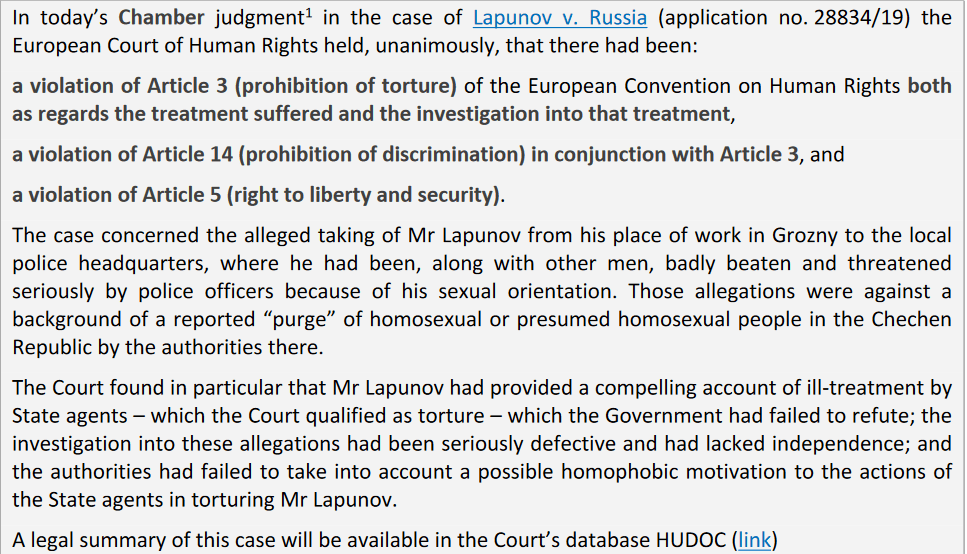
Two unanimous decision by the ECtHR gains Russia relating to homophobia

Two unanimous decision by the ECtHR gains Russia relating to homophobia

12.09.2023 Judgments of 12 September 2023

The European Court of Human Rights has today given notification in writing of 15 judgments (link).

Applicant tortured by State agents in Chechnya because of sexual orientation
Lapunov v. Russia


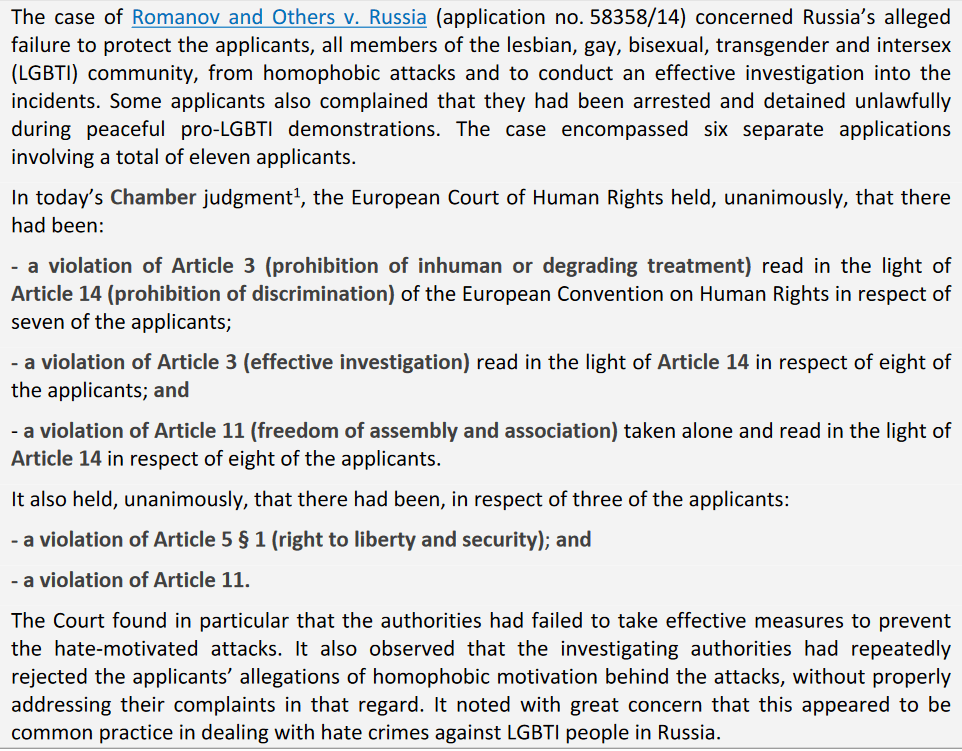
Russia failed to prevent and investigate hate attacks on members of the LGBTI community
Romanov and Others v. Russia  
The European Court of Human Rights was set up in Strasbourg by the Council of Europe Member States in 1959 to deal with alleged violations of the 1950 European Convention on Human Rights
Details:

EU’s ongoing funding of Uganda sparks criticisms among LGBTQ+ activists

EU’s ongoing funding of Uganda sparks criticisms among LGBTQ+ activists

In June, the European Union (EU) announced its decision to continue funding Uganda despite the nation’s recent adoption of a highly controversial anti-LGBTQ+ law in May, which has garnered significant international attention due to its prescription of the death penalty for specific same-sex acts. This move has ignited a massive outcry and backlash from the global LGBTQ+ community.

Under this new legislation, at least five individuals have been charged, with two facing the most severe charge of “aggravated homosexuality.”  The law also prescribes punishment for the promotion of homosexuality. The international response to this law has been varied, including the World Bank’s suspension of new public loans to Uganda last month and the United States imposing visa restrictions on specific Ugandan officials in June.

In a written statement delivered to the European Parliament on Wednesday, Jutta Urpilainen, the European Commissioner for International Partnerships, expressed that withholding financial assistance from Uganda due to its legislation, which mandates the death penalty for specific same-sex activities, would result in the withholding of crucial support from vulnerable communities. She also clarified that “high-level EU officials have raised the issue with the Ugandan Government, Parliament, and President. In this dialogue, the EU emphasised that the criminalisation of homosexuality is contrary to the principles of equality and non-discrimination in the Universal Declaration of Human Rights and the African Charter on Human and People’s Rights.”

In response to the statement, Convening for Equality Uganda stated “The recent EU announcement misses a critical opportunity to take more strategic action to protect the fundamental principle of non-discrimination – something the EU and EU member states profess a deep commitment to.”

The EU is one of Uganda’s biggest donors, funding infrastructure projects, health programmes and food assistance.

The post EU’s ongoing funding of Uganda sparks criticisms among LGBTQ+ activists appeared first on JURIST – News.

USA: Nebraska governor signs contentious executive order defining ‘male’ and ‘female’

USA: Nebraska governor signs contentious executive order defining ‘male’ and ‘female’

Nebraska Governor Jim Pillen signed an executive order Wednesday defining the words male and female, regulating how state agencies apply rules relating to sex. While Pillen asserted that the order would safeguard women’s sports and safety, opponents have criticized it as an attack on transgender rights.

Called the Women’s Bill of Rights, the order states there are biological differences between males and females in athletic abilities as well as safety concerns which warrant sex-based segregation for some athletic, social and educational spaces.

Specifically, the executive order defines the terms sex, female, male, woman, girl, man, boy, mother and father for use by state agencies. According to the order:

A “female” is an individual whose biological reproductive system is developed to produce ova; a “male” is an individual whose biological reproductive system is developed to fertilize the ova of a female.

Additionally, the terms woman, mother, and girl refer to a human female, while the terms man, father and boy refer to a human male. Finally, sex refers to a person’s sex assigned at birth.

Pillen said in a statement: “As Governor, it is my duty to protect our kids and women’s athletics, which means providing single-sex spaces for women’s sports, bathrooms, and changing rooms.”

Many advocates say this executive order unjustly targets transgender people and doubles down on bans prohibiting transgender individuals from playing on sports teams that match their gender identity. Nebraska State Senator Megan Hunt responded to the order on X (Twitter). “The truth is, no executive order can erase trans people. They have always existed and always will,” she said.

Wednesday’s order mirrors similar states’ efforts to define sex and gender terms. This year, Alabama’s legislature advanced a bill and Oklahoma’s governor signed an executive order using identical definitions.

The post Nebraska governor signs contentious executive order defining ‘male’ and ‘female’ appeared first on JURIST – News.

Czech businesses urge PM to support same-sex marriage

Czech businesses urge PM to support same-sex marriage

Dozens of companies are calling on Czech Prime Minister Petr Fiala (ODS/ECR) to legalise same-sex marriage so that their employees can live and work in the Czech Republic without discrimination and prejudice, an open letter signed by major international and Czech companies said on Wednesday.

The letter was signed by 66 entities, including multinational companies like Microsoft, IBM, Ikea, banks, breweries and Czech automotive.

“As employers who collectively employ tens of thousands of people in the Czech Republic, we support and welcome their diversity. We share the wishes of lesbian, gay, bi and trans (LGBT) people to live and work in the Czech Republic without discrimination and prejudice,” the letter says.

Companies argue that unequal conditions cause unnecessary expenses.

More: https://www.euractiv.com/section/politics/news/czech-businesses-urge-pm-to-support-same-sex-marriage/

Hong Kong top court affirms government obligation to recognise same-sex couples

Hong Kong top court affirms government obligation to recognise same-sex couples

The Hong Kong Court of Final Appeal handed down a judgment on Tuesday finding that the Hong Kong government has a duty to provide an “alternative legal framework for recognition of same-sex relationships.” The court also held that the government’s longstanding failure to do so amounts to a violation of the constitutional right to privacy, but it denied that the right to same-sex marriage is constitutionally guaranteed.

The appellant is Jimmy Sham Tsz Kit. He and his husband got married in New York 10 years ago and have been challenging Hong Kong’s refusal to recognize same-sex marriage since 2018.

By a majority of 3 to 2, the court acknowledged same-sex couples’ need for an alternative legal framework in order to meet basic social requirements as well as to have a sense of legitimacy. Following previous challenges surrounding same-sex couples’ access to dependent visas, spousal benefits for civil servants and access to public housing, the court observed that litigation and court proceedings have subjected same-sex couples to publicity, stress and expenses, while they still suffer from difficulties due to the non-recognition of their relationships.

However, the five-judge panel unanimously upheld lower court rulings which held that the constitutional freedom of marriage guaranteed and protected under Hong Kong’s Bill of Rights and the Basic Law (the “mini constitution”) is confined to opposite-sex marriage. Further, as same-sex couples lack the capacity to enter into a legally recognised marriage in Hong Kong, any recognition of foreign same-sex marriages is also denied according to the lex specialis principle.

Sham’s initial attempt and his first appeal failed, as lower courts were unwilling to recognise a constitutional right for same-sex couples to enter into a marriage in Hong Kong. The courts were also unwilling to recognise foreign same-sex marriages under Hong Kong law, and they denied that authorities have a constitutional obligation to enable official recognition of same-sex partnerships.

In fact, Sham was not the first to challenge the failure of the laws in Hong Kong to recognise and accept same-sex marriage. In 2019, the Court of First Instance ruled that the definition of marriage is confined to the “voluntary union for life of a man with a woman” and that the constitutional freedom of marriage guaranteed and protected under the Bill of Rights and the Basic Law is confined to opposite marriage. Since then, Hong Kong Courts, even the higher courts, have been reluctant to depart from this ruling.

Other than an LGBTQ+ activist, Sham is also a pro-democracy activist. He used to be the former convenor of Civil Human Rights Front, the pro-democracy organisation which organised the demonstration which started the 2019 Anti-Extradition protests in Hong Kong. He was arrested in 2021 for violating the National Security Law, which was enacted by the government to suppress anti-government activists after the Anti-Extradition protests in 2019, and has been remanded in custody since then. Last year, he pleaded guilty to violating the National Security Law.

The post Hong Kong top court affirms government obligation to recognise same-sex couples appeared first on JURIST – News.

USA: Federal judge finds Maryland parents have no right to ‘opt-out’ of LGBTQ+ education for their children

USA: Federal judge finds Maryland parents have no right to ‘opt-out’ of LGBTQ+ education for their children

A Maryland federal judge denied Thursday a parents’ request to have their children “opt-out’ of education on LGBTQ+ history and topics. In Mahmoud v. McKnight, three families parenting elementary-aged children in Maryland, objected on religious grounds to the use of storybooks featuring LGBTQ+ characters in the Montgomery County Public School (MCPS) system. The court rejected the parents’ request, stating, “Public schools are not obliged to shield individual students from ideas which potentially are religiously offensive, particularly when the school imposes no requirement that the student violate his or her faith during classroom instruction.”

The lawsuit began when the school board announced in 2023 that parents would no longer receive the option to opt their children out of instruction on certain LGBTQ+ storybooks in the MCPS system. Originally, when the curriculum was adopted in October 2022, parents received notice of the use of these books, and could opt their children out of instruction involving the books. The MCPS school board also enacted religious diversity guidelines that suggested that schools adjust their instruction or accommodate requests from students who wish to be excused from classroom discussions which would “impose a substantial burden on their religious beliefs.” The same guidelines stated, “[I]f such requests become too frequent or too burdensome, the school may refuse to accommodate the requests.”

The school board eliminated the opt-out policy because principals and teachers “could not accommodate the growing number of opt-out requests without causing significant disruptions” to the educational environment. The decision to end opt-outs provoked contentious school board meetings on January 12, March 28, and May 25. The books at issue included Pride Puppy!, Uncle Bobby’s Wedding, My Rainbow, and Born Ready: The True Story of a Boy Named Penelope.

Three families sued MCPS and related parties claiming the new policy violated their children’s free exercise and free speech rights under the US Constitution’s First Amendment. Parents also claimed it violated their substantive due process rights under the Fourteenth Amendment. Central to the parents’ religious objections was the storybooks’ teachings about transgender individuals. In their lawsuit, parents asked the court for a preliminary injunction, which would require the school board to give them advance notice of the use of the materials, as well as the ability to opt their children out of instruction using those materials.

On Thursday, US District Judge Deborah Boardman dismissed the parents’ First and Fourteenth Amendment claims.

She dismissed the First Amendment claims on the grounds that MCPS’s reversal of the opt-out policy did not burden the religious exercise of students or parents because “mere exposure in public school to ideas that contradict religious beliefs does not burden the religious exercise of students or parents.” The court found that all but one of the parents had failed to show the no-opt-out policy would likely result in the indoctrination of their children.

Boardman also found the Fourteenth Amendment claims were unlikely to succeed since she found that the MCPS system had a “legitimate interest in fostering social integration and cultural inclusiveness of transgender and gender nonconforming students.”

The parents also brought claims under Maryland law. They contended that Maryland state law requires the MCPS system to provide opt-out for storybooks “concerning family life and human sexuality.” Parents claimed that the MCPS system had an obligation to provide parents and guardians with an opportunity “to view instructional materials to be used in the teaching of family life and human sexuality objectives.” The MCPS system contended that the Maryland law applied only to their curriculum on sexuality, whereas the books complained about were taught in the literary curriculum.

Thursday’s decision did not address the Maryland state law claims, but rather relied upon the parents’ US Constitution claims in rejected their request for a preliminary injunction.

The post Federal judge finds Maryland parents have no right to ‘opt-out’ of LGBTQ+ education for their children appeared first on JURIST – News.