Switzerland: Gay men to achieve parity when it comes to blood donation
Leave a reply

23 applicants v. Italy: EConHR does not require recognition of foreign birth certificate with name of non-genetic parent
On 30 May 2023, the ECtHR declared all of the applications inadmissible. Applying its judgment in D.B. & Others v. Switzerland (22 November 2022), https://hudoc.echr.coe.int/eng?i=001-220955, the ECtHR concluded that the possibility of a second-parent adoption in Italy is enough. Registration of the non-genetic parent as a legal parent of a child, born abroad or in Italy, is not required, as in Boeckel v. Germany (7 May 2013), https://hudoc.echr.coe.int/eng?i=001-120617.
https://hudoc.echr.coe.int/eng?i=001-225716
DÉCISION
Requête no 59054/19
MODANESE contre l’Italie
et 2 autres requêtes
(voir liste en annexe)
1. Les présentes requêtes concernent le refus des autorités italiennes de reconnaître des actes de naissance délivrés en Californie et au Canada pour des enfants qui y étaient nés d’une gestation pour autrui (« GPA ») pour autant que ces actes établissaient un lien de filiation à l’égard des pères d’intention, le second parent, à savoir les pères biologiques respectifs des enfants en question, étant quant à lui reconnu.
https://hudoc.echr.coe.int/eng?i=001-225717
DÉCISION
Requête no 10810/20
Stefano Maurizio BONZANO et autres contre l’Italie
et 2 autres requêtes
(voir liste en annexe)
1. Les requêtes concernent le refus des autorités italiennes de transcrire sur les registres de l’état civil italien les actes de naissance américains d’enfants légalement conçus aux États-Unis par gestation pour autrui (GPA) et dont les parents d’intention (trois couples homosexuels) sont italiens, au motif que la gestation pour autrui est contraire au droit italien.
https://hudoc.echr.coe.int/eng?i=001-225622
DÉCISION
Requêtes nos 47998/20 et 23142/21
Ettore NUTI contre l’Italie
et Sara DALLABORA et autres contre l’Italie
1. Les requêtes concernent le refus de transcrire sur les registres de l’état civil italien l’acte de naissance d’enfants nés en Italie de couples homosexuels par procréation médicalement assistée (PMA) effectuée à l’étranger pour autant qu’ils désignent la mère d’intention comme étant leur mère.
Kenya set to introduce cruel anti-homosexuality law
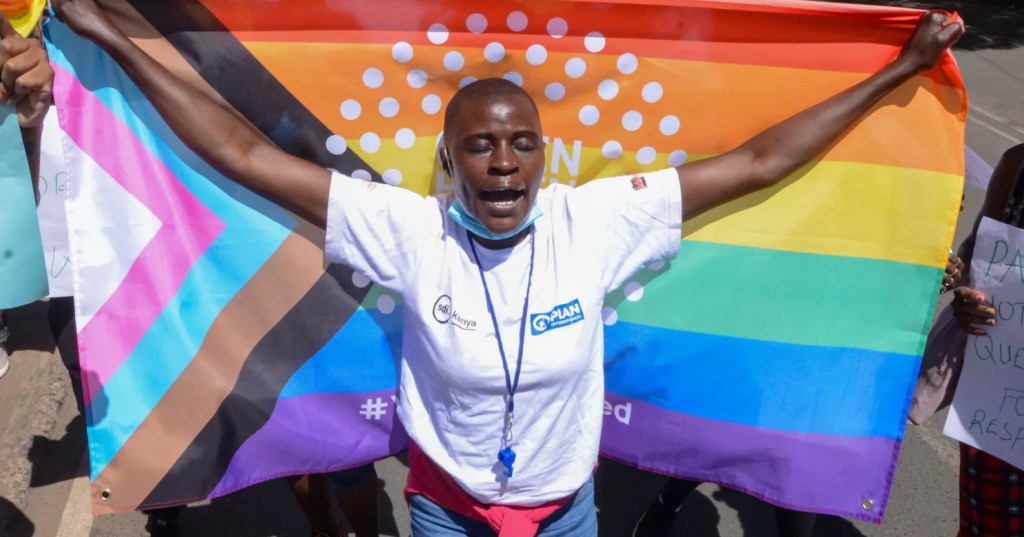
Kenya is on the verge of introducing legislation that would criminalise openly identifying with, or supporting, the LGBTQ+ community, with punishments including the death penalty.
More: https://www.thepinknews.com/2023/07/20/kenya-anti-homosexuality-law-africa/
HRW: LGBTQ+ people in Saint Vincent and Grenadines regularly subjected to discrimination and violence
Human Rights Watch (HRW) warned Thursday of violence and discrimination against LGBTQ+ people in Saint Vincent and the Grenadines. According to a new report, six of the twelve Anglophone countries in the Caribbean region continue to criminalize consensual same-sex intimacy, including Saint Vincent and the Grenadines.
HRW called upon the country to repeal the colonial-era laws that criminalizes consensual same-sex conduct and push for the passage of legislation prohibiting discrimination based on sexual orientation and gender identity. Same-sex activity is prohibited under the Criminal Code 1988 which criminalizes acts of “buggery” and “gross indecency.” The law was inherited from the British during their colonial rule over Saint Vincent and the Grenadines.
Cristian Gonzalez Cabrera, LGBT rights researcher with HRW, commented, “[T]he criminalisation of gay sex gives tacit state sanction to the discrimination and violence that LGBT people experience in their daily lives.” Cabrera continued to say that repeal of the law “will not only create a more equal society for LGBT people in Saint Vincent and the Grenadines, but it will strength the rule of law for everyone living there.”
While there have been no recent reported convictions under the laws, HRW argued that the laws stigmatizes LGBTQ+ people and creates an obstacle to full equality. Furthermore, as Saint Vincent and the Grenadines are signatories of the International Covenant on Civil and Political Rights, which protects LGBTQ+ people from discrimination, the continued existence of these colonial laws runs contrary to their international obligations.
One of the most recent legal challenges involving the laws occurred in 2019. Two gay men filed court proceedings to challenge the law, stating that they had been exiled from the Caribbean nation “due to the severely draconian and damaging effects of these laws.”
Nearly all LGBTQ+ interviewees reported at least one recent incident of discrimination, which for many “is part of everyday life.” Every interviewee also stated that had either wished to leave the country or envisioned a future abroad due to the presence of homophobic or transphobic violence and discrimination.
Recently, some countries in the region have taken strong steps to protect LGBTQ+ people. In 2022, courts in Antigua and Barbuda, Barbados as well as Saint Kitts and Nevis struck down laws that criminalized consensual same-sex conduct. In 2016 and 2018, Trinidad and Tobago similarly overturned discriminatory laws against LGBTQ+ people.
The post HRW: LGBTQ+ people in Saint Vincent and Grenadines regularly subjected to discrimination and violence appeared first on JURIST – News.
Swatch takes on Malaysian authorities in LGBT lawsuit

Swiss watchmaker Swatch Group has filed a lawsuit against the Malaysian government for confiscating rainbow-coloured watches that celebrate LGBT rights, in an act the company says has damaged its reputation. Homosexuality is a crime in Muslim-majority Malaysia, and rights groups have warned of growing intolerance in the country towards the lesbian, gay, bisexual, transgender and queer (LGBTQ) community. In May, Malaysian authorities confiscated watches from Swatch’s ‘Pride collection’ because of the presence of the letters ‘LGBTQ’ on the watches, the home minister said. Home ministry officials “illegally” seized 172 watches from 16 outlets, Swatch said in court documents seen by Reuters. The lawsuit, filed on June 24 at the Kuala Lumpur high court, was first reported on Monday by the Malay Mail, a Malaysian news website. + Read more: Malaysian authorities raid Swatch stores “Without a doubt, the seized watches did not and are not in any way capable of causing any disruption to…
More: https://www.swissinfo.ch/eng/business/swatch-takes-on-malaysian-authorities-in-lgbt-lawsuit/48667296
Human rights groups condemn Russia legislation targeting transgender people
Human rights groups, including Amnesty International and Human Rights Watch, released statements on Friday condemning Russia’s newly adopted bill that targets transgender people. The new legislation states that citizens who have already changed their sex will be prohibited from adopting children and their marriage will be annulled. It also prohibits surgery and hormonal therapy, as well as gender changes in documents.
Amnesty International’s Russia Director, Natalia Zviagina said that this recent legislation shows an “utter disregard” for the rights of transgender people in Russia. She further stated that the ban on gender affirming care will discriminate against transgender people’s right to healthcare and impact their mental health, and will “damage the Russian society for generations.”
Similarly, the Human Rights Watch LGBT rights director Graeme Reid stated that Russia was attacking sexual and gender minorities for political purposes and because of this, the bill needs to be dropped. Reid continued to stress the importance of inclusivity and protection of LGBT people in Russia and asserted that the first step towards this is to reverse the anti-trans law.
The Chairman of State Duma, the lower chamber of Russia’s legislature, Vyacheslav Volodin told state news that the bill protects Russian citizens and children. He cited the United States’ growing transgender population, calling it a “monstrous trend” that leads to a “degenerate” nation.
The new law is part of Russia’s intensifying crackdown of LGBT people, and went into force starting July 14.
The post Human rights groups condemn Russia legislation targeting transgender people appeared first on JURIST – News.
More than 30 embassies [including Switzerland] urge Hungary to protect LGBTQ+ rights ahead of Pride Festival
Multiple embassies and various cultural institutions from over 30 countries released a joint statement on Friday supporting the rights of LGBTQ+ people in Hungary, ahead of the 28th Budapest Pride Festival. Signatories to the statement included the US, the UK, Ukraine, France, Germany, Italy and others. The group emphasized the importance of revoking laws that discriminate against LGBT people. The statement says that signatories reject and condemn all acts of violence, stigmatization and discrimination against LGBT people. It also stresses the need to eliminate political rhetoric that contributes to discrimination.
Hungarian prime minister Viktor Orban has banned “gay propaganda,” which he defines as any content that is believed to “promote” homosexuality in schools or in the media. His government fined Hungary’s largest booksellers for selling the LGBT novel “Heartstopper” without closed wrapping. Orban and his right-wing Fidesz party have pushed many anti-LGBT actions, including urging voters to redefine the definition of marriage to exclude same-sex couples, limiting the ability of those couples to adopt and revoking the legal recognition of transgender individuals.
The European Commission launched a lawsuit last year saying that Hungary’s anti-LGBTQ+ laws are highly discriminatory. The lawsuit was supported by 15 EU governments including France, Germany and Slovenia. Italy and Poland were not in support of the lawsuit. Despite this lawsuit and the reaction of the international community, Orban continues to defend his style of governance.
The post More than 30 embassies urge Hungary to protect LGBTQ+ rights ahead of Pride Festival appeared first on JURIST – News.
___________________________________________________
July 14, 2023
On the occasion of the 28th Budapest Pride Festival, we the undersigned embassies and cultural institutes express our full support for members of the lesbian, gay, bisexual, transgender, queer and intersex (LGBTQI+) community in Hungary and their rights to equality and non-discrimination, freedom of expression and peaceful assembly, and freedom from violence. Respect for the rule of law and universal human rights are the foundations upon which democratic states are built. International human rights law is grounded on the broad premise that all individuals have the same rights and freedoms without discrimination.
We reject and condemn all acts of violence, hate speech, harassment, stigmatization and discrimination committed against individuals and communities on the basis of their sexual orientation, gender identity or expression, or sex characteristics and support the fight against such acts. In this regard, we are concerned with legislation and political rhetoric, including in Hungary, that is in tension with principles of non-discrimination, international human rights law and human dignity, and contributes to stigmatization of the LGBTQI+ community. We stress the need for leaders and governments, here and elsewhere, to show respect for and protect the rights of LGBTQI+ individuals and communities, and to eliminate laws and policies that discriminate against them.
We stress the inviolability of human dignity, the right to freedom of expression and information, the right to private and family life, and the right to non-discrimination for all.
Furthermore, we welcome the important advocacy of LGBTQI+ grassroots human rights defenders, activists, journalists, media workers and civil society organizations working to ensure that all individuals, regardless of sexual orientation, gender identity or expression, or sex characteristics, receive equal treatment and the full protection of the law.
Celebrating diversity is an important way to promote respect for human rights for all. Budapest Pride has the longest history of such events in the region, and we highlight its role in promoting equality of treatment and social acceptance for all LGBTQI+ persons, and contributing to the creation of a more open, just, inclusive and equal society.
Signed by the Following Embassies and Cultural Institutes:
Australia, Austria, Belgium, Bulgaria, Canada, Croatia, Cyprus, Czechia, Denmark, Estonia, Finland, France, Germany, Greece, Iceland, Ireland, Italy, Kosovo, Latvia, Lithuania, Luxembourg, Malta, Montenegro, New Zealand, North Macedonia, Norway, Portugal, Romania, Slovakia, Slovenia, Spain, Sweden, Switzerland, The Netherlands, The United Kingdom, The United States, Ukraine, Uruguay, General Delegation of Flanders, Wallonie-Bruxelles International, Austrian Cultural Forum Budapest, British Council, Czech Center, Estonian Institute, FinnAgora, Goethe-Institut, Institut Français, Instituto Camões, Instituto Cervantes
Source: https://hu.usembassy.gov/news-joint-statement-on-the-occasion-of-the-28th-budapest-pride-festival/
Transgender women barred from female events as UCI takes ‘precautionary measure’

Russia Duma passes ban on gender-affirming surgeries
Russian lawmakers unanimously passed a bill on Friday to ban gender-affirming surgeries for transgender people in the country. The Chairman of the Russian State Duma Viacheslav Volodin announced the bill’s passage on his Telegram channel, claiming the bill will protect Russian citizens and children.
The bill prohibits surgery and hormone therapy for transgender individuals as well as any gender changes on official Russian documentation. The bill also applies retroactively, barring any Russians who have already transitioned from adopting children. The bill also annuls transgender individuals’ marriages.
The only exceptions to the bill’s wide-reaching language apply in cases of medical interventions for congenital anomalies or children born intersex.
Speaking to the Associated Press ahead of the bill’s final reading, Executive Director of Russia’s Independent Psychiatric Association Lyubov Vinogradova said gender-affirming procedures “shouldn’t be banned entirely, because there are people for whom it is the only way to … to exist normally and find peace with themselves.”
The law’s passage through the Russian Duma reflects theescalating persecution of LGBTQ+ people within the country, despite international pressure to reverse course. In December, Russia enacted a sweeping law banning “LGBT propaganda,” including any and all positive displays of LGBT relationships and lifestyles for all age groups. In April, Russian authorities arrested two men and charged them with violating the law because the two released videos to YouTube and TikTok where they can be seen touching.
The law also reflects a global rise in the persecution of transgender and LGBTQ+ people, including broad restrictions on gender-affirming care in the US and laws elsewhere, which criminalize LGBTQ+ people entirely.
The bill now goes to Russian President Vladimir Putin for final approval, at which time the law will come into effect.
The post Russia Duma passes ban on gender-affirming surgeries appeared first on JURIST – News.
The latest issue of the Australian Feminist Law Journal (Vol. 49, no. 1, 2023) focuses on “International Law Dis/oriented: Sparking Queer Futures in International Law”
Contents include:
 International and Comparative SOGIESC Law - Professor Andreas R Ziegler