This is a blog is related to my academic work in the International Academic Forum on SOGIESC Law but meant to serve anyone who wants to contribute to improve the protection of human rights worldwide. It is intended to keep interested readers informed about legal developments relating to sexual orientation, gender expression and identity and sex characteristics (SOGIESC). Hopefully, it will make it easier to find correct legal information about the developments in all regions of the world and, in particular, with regard to international law.
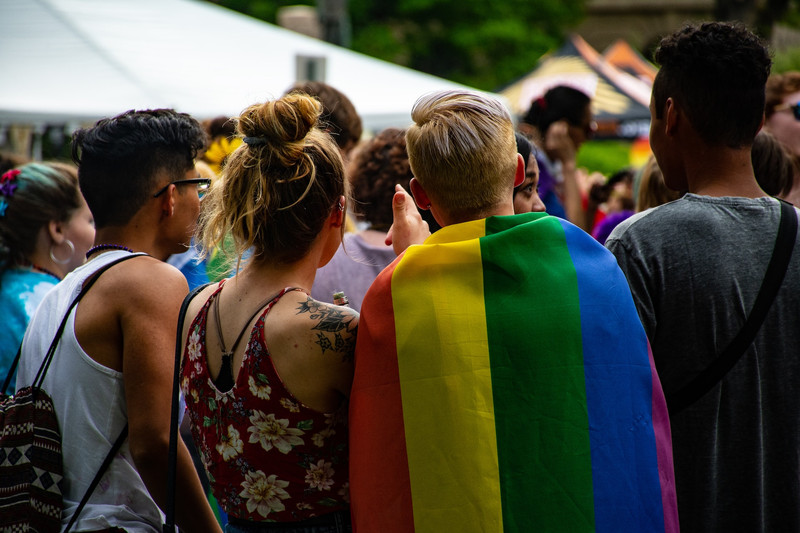
Far right in Italy and Spain target rainbow families and flags
Italy is debating a crackdown on surrogate parents, seen as an attack on LGBTI families, while Spain’s far-right party goes after the rainbow flag.
Italian MPs are debating a law that would make it illegal for Italian citizens to engage a surrogate mother in another country, with prison terms of up to three years and fines of up to €1m.
A 2004 law already banned surrogacy in Italy.
The new surrogacy regime is backed by prime minister Georgia Meloni and adds to fears in Italy’s LGBTI community that her far-right government will erode their civil rights.
The proposed ban would also apply to opposite-sex couples, but critics see that as camouflage for its real intention — to stop homosexual couples raising children.
The surrogacy bill comes in a wider context of curbs on non-biological parents, which have already hurt many ‘rainbow families’.
A top court in Italy ruled last year that non-biological parents cannot automatically be listed on children’s birth records, and need to go through the long legal process of adoption in order to be formally recognised.
Some mayors did add non-biological parents when processing birth certificates from abroad, in defiance of the ruling.
And Italian opposition MP Chiara Appendino, who did so when serving as mayor of Turin, warned that the harsh consequences of the new surrogacy law “will be paid by the children”, AP reported.
The prosecutors’ office in the Italian city of Padua this week also demanded that non-biological parents be removed from the birth certificates of 33 children registered to lesbian couples since 2017.
The children can no longer even use their non-biological parent’s surname.
“The Italian decision is monstrous, because it simply amounts to the administrative removal of a child from one of its parents on the grounds of homosexuality,” French liberal MEP Pierre Karleskind said earlier this week.
“We cannot let children be the victims of this despicable far-right crusade against rainbow families,” he said.
‘Deserves the best’
Meloni was raised by a single mother and is herself an unmarried parent.
But she wants to be seen as a defender of Christian values against what she calls “gender ideology” and the “LGBTI lobby”.
“A child deserves only the best: a mother and a father,” she said in March.
But if her anti-LGBTI rhetoric is meant to be populist, that kind of discourse appears to be less and less popular with Italian public opinion.
An Ipsos poll last June showed that 63 percent of Italians backed marriage rights for gay people — up 15 points from 2013.
It also said 59 percent were in favour of gay adoptions — an increase of 17 points from nine years ago, Reuters reported.
The EU has not passed any laws specifically on the rights of rainbow families, as it has no competence in family law in general.
But EU jurisprudence and the political mood in the EU capital also go against Meloni-type anti-rainbow attacks.
“Family law is a national competence,” said EU Commission spokesman Christian Wiegand.
But he also said: “Our position on parental rights in cross-border cases is that if one is a parent in one member state and is recognised as such in one member state, other member states must recognise that parenthood”.
In a landmark ruling, the European Court of Justice (ECJ) said in December 2021 that same-sex parents and their children should be recognised as a family in all EU member states.
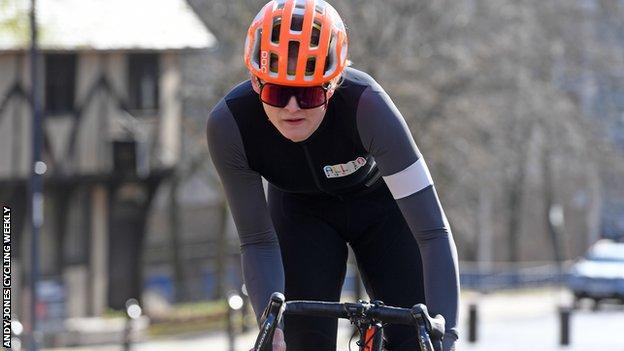
British Cycling is to ban transgender women from the female category of its competitions following a nine-month review and consultation.
Under a new participation policy that the governing body said was “predicated on fairness”, such athletes will compete in an ‘open category’ with men.
Female races will be “for those whose sex was assigned female at birth”.
The changes will prevent riders such as Emily Bridges potentially being part of the British women’s team.
Last year Bridges – the country’s highest-profile transgender cyclist – was stopped from competing in her first elite women’s race by the UCI, cycling’s world federation, despite meeting the rules at the time.
Bridges reacted to the announcement with a statement on social media, calling the change a “violent act” by a “failed organisation” that was “controlling” the conversation on transgender inclusion.
She added that the racing scene was “dying under its watch” and that British Cycling was engaged in “culture wars”.
British Cycling’s policy had allowed transgender women to take part in elite female events if they met testosterone-based regulations.
But with the governing body at the heart of the debate over balancing inclusion with fairness, its regulations were suspended amid mounting controversy about Bridges and a review was launched.
ADVERTISEMENT
“Research studies indicate that even with the suppression of testosterone, transgender women who transition post-puberty retain a performance advantage,” said British Cycling.
“Our aim in creating our policies has always been to advance and promote equality, diversity and inclusion, while at the same time prioritising fairness of competition.
“We recognise the impact the suspension of our policy has had on trans and non-binary people, and we are sorry for the uncertainty and upset that many have felt during this period.”
Transgender women will be able to participate in non-competitive recreational and community cycling without restriction.
The new policies will be implemented by the end of the year.
‘You have no right to tell me when I am done’ – Bridges response
In her statement, Bridges was critical of the state of British Cycling and its treatment of transgender riders.
“Cycling is still one of the whitest, straightest sports out there and you couldn’t care less,” she said. “I agree there needs to be a nuanced policy discussion and continue to conduct research. This hasn’t happened.
“Research isn’t being viewed critically, or any discussion about the relevance of the data to specific sports.
“I’ve given my body up to science for the last two years, and this data will be out soon.
“There is actual, relevant data coming soon and discussions need to be had.”
Bridges claimed discussion of the debate is “inherently political” and “framed by the media who are driven through engagement by hate”, saying she was “terrified to exist”.
She claimed British Cycling was “furthering a genocide against us. Bans from sport is how it starts”.
She added: “I know a lot of people will think I’m being dramatic, or overplaying how scary things are at the moment. I don’t even know if I want to race my bike any more… but you have no right on telling me when I am done.”
British Cycling is not commenting on Bridges’ statement.
What’s the background?
Having been a highly promising competitor in junior men’s events, Bridges came out as transgender in 2020, starting hormone therapy as part of her gender dysphoria treatment.
She then became eligible to compete in elite women’s events under British Cycling’s transgender regulations, which required riders to have had testosterone levels below five nanomoles per litre for a 12-month period prior to competition.
But days before the 2022 National Omnium Championships, the UCI said Bridges’ participation could only be allowed once her eligibility to race in international competitions was confirmed, dashing her hopes of competing for Wales in the Commonwealth Games.
A group of elite female cyclists called on the UCI to “rescind” its rules around transgender participation, claiming female athletes in the UK were “willing to boycott” events over their “concerns about fairness in their sport”.
Bridges said she felt “harassed and demonised” and had “little clarity” on her eligibility. She added that she “does not have any advantage” over her competitors, and could prove it with data.
While British Cycling suspended its rules, the UCI then toughened its regulations, doubling the qualification period to two years and lowering the required testosterone threshold for transgender women riders to 2.5nmol/L.
But this month, after Austin Killips became the first transgender woman to win a UCI women’s stage race at the Tour of the Gila, the world governing body re-opened consultation on the issue, saying it “hears the voices of female athletes and their concerns about an equal playing field for competitors”.
“We acknowledge the paucity of research at this time, but can only look at what’s available to use,” said British Cycling chief executive Jon Dutton.
“I am confident that we have developed policies that both safeguard the fairness of cycle-sport competition, whilst ensuring all riders have opportunities to participate.
“We have always been very clear that this is a challenge far greater than one sport. We remain committed to listening to our communities, to monitor changes in the scientific and policy landscape, to ensure that sport is inclusive for all.”
Fiona McAnena from Fair Play For Women told BBC Radio 4’s World at One she was “concerned about all the women and girls who need to know that sport will be fair so I think an open category is a great solution because it doesn’t negate anyone’s identity…[and] the female category can be protected.”
“We’re finally reverting to fairness. We are going to see it across all sports.”
However Joanna Harper – a sports scientist who studies the effects of transition on transgender athletes, and who is transgender herself – said she was “disappointed but not surprised”.
“I don’t think it’s necessary” she told BBC Radio 5Live. “Trans women have been competing in cycling for many years…and although they have achieved some success in the sport, they are under-represented and are not anywhere near taking over the sport.”
A number of studies have suggested transgender women retain cardiovascular and strength advantages compared to female athletes, even after taking testosterone-suppressing hormones.
Critics of transgender athletes’ participation in some women’s sports argue that gives them a disproportionate advantage over their peers and limits opportunities for their rivals.
However, others argue there is not enough detailed research in the area, that the science is not clear, and that with very few elite transgender athletes, sport should be more inclusive, with open categories criticised for being discriminatory.
British Cycling said its women-only community programme “will continue to remain open and inclusive for transgender women and non-binary people” who can “continue to participate in a broad range of British Cycling activities in line with their gender identities”.
Interesting Article. The Dynamics of the Debate About Gay Rights: Evidence from US Newspapers
Alan Manning , Paolo Masella, The Dynamics of the Debate About Gay Rights: Evidence from US Newspapers, The Journal of Law, Economics, and Organization, Volume 39, Issue 2, July 2023, Pages 456–492, https://doi.org/10.1093/jleo/ewab043
Abstract
Changing attitudes are the result of a battle for hearts and minds in which agents for and against change try to persuade others. We know very little about this process. We develop a methodology for measuring the intensity and the contents of media coverage for and against an idea which we apply to attitudes to gay rights. We uncover several stylized facts: First, the diffusion process of both pro- and anti-gay rights language in the US newspapers follow an S-shaped pattern, characteristic of diffusion processes. Anti-gay rights coverage starts its diffusion process later but then catches up. Second, in the year gay marriages are introduced, we observe a dramatic increase in coverage of both pro- and anti-gay rights language; the increase in the latter is larger. The rise in coverage is still present in the 3 years after the institutional change. Third, there is substantial spatial autocorrelation in media coverage (JEL J15, Z1).
Argentina, Brazil, Britain, Canada, Germany, Mexico, Spain and the United States were among the signatories. (Photo: AFP/Henry Nicholls)
21 Jun 2023 04:40AM
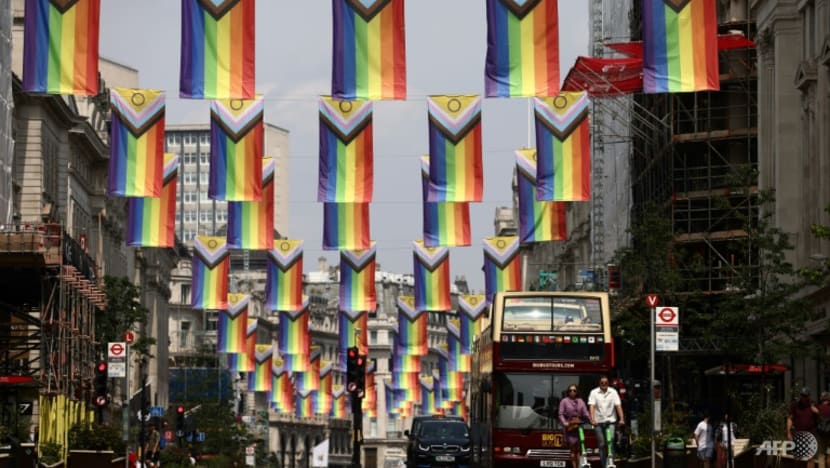
GENEVA: Nearly 40 countries at the United Nations backed LGBTQ families on Tuesday (Jun 20), at a time when some Muslim and African nations are contesting sexual orientation and gender identity language in UN forums.
“Families play a fundamental role in society. Supporting families is an important element in promoting and protecting human rights,” 37 countries said in a statement at the UN Human Rights Council.
“This support must be inclusive of all family compositions, including multigenerational and extended families, single parent households, LGBTIQ+ families and Indigenous kinship groups,” Australia’s representative said on behalf of several countries. They were mainly from Europe and the Americas, plus Israel, New Zealand and East Timor.
They called on countries and UN bodies “to continue to apply an inclusive lens to families, and to ensure that equality, non-discrimination, and the universality of human rights remain at the centre of engagement in supporting families”.
Argentina, Brazil, Britain, Canada, Germany, Mexico, Spain and the United States were among the signatories.
The statement comes as several other countries, notably from the Middle East, are mounting a defence of the traditional family in UN forums.
Sexual orientation and gender identity issues will be at the heart of the 53rd Human Rights Council session, which started on Monday and runs until mid-July.
Such issues have become a contentious in several branches of the UN.
Countries in the Organisation of Islamic Cooperation and many African nations, plus Russia and China, are trying to roll back concepts and language which have been embedded in UN documents for at least a decade.
Earlier this month, OIC and African countries were blocking the adoption of the UN labour agency’s budget, before agreeing to a last-minute compromise over references to discrimination based on gender identity and sexual orientation.
“Promoting a framework around discrimination that does not have international consensus and reflects priorities of the few risks undermining the spirit of cooperation,” said Pakistan’s Khalil Hashmi, on behalf of the OIC group, before the vote was finally passed.
The World Health Organization has since last year seen attempts to remove such references from its strategy on infection prevention, while the Human Rights Council faces growing opposition to long-standing efforts to monitor for discrimination based on sexual orientation and gender identity.
Human Rights Council Holds Interactive Dialogue with the Independent Expert on Protection against Violence and Discrimination Based on Sexual Orientation and Gender Identity
…
The Council also held an interactive dialogue on the report of the Independent Expert on sexual orientation and gender identity, Victor Madrigal-Borloz.
Presenting the report, Mr. Madrigal-Borloz said it was about the intersections between the right to freedom of religion or belief and the right to be free from violence and discrimination based on sexual orientation and gender identity. Religion was not inherently pro- or anti-lesbian, gay, bisexual or transgender. Yet, religion and the human rights of lesbian, gay, bisexual, trans and gender-diverse persons were often placed in antagonistic positions in social and political discourse. In some cases, religious narratives had been deliberately used to justify violence and discrimination, often in defiance of the doctrine of those faiths. The resulting sense of conflict undermined the ideal of peaceful human coexistence. The world needed to condemn the wrongful use of religious beliefs as an excuse for violence or discriminatory denial of the human rights of lesbian, gay, bisexual and transgender persons.
Mr. Madrigal-Borloz also reported that he had undertaken three country visits to the United States, Cambodia and the United Kingdom. He planned to publish reports on these visits before the end of his tenure in October of this year.
In the ensuing discussion, many speakers thanked the Independent Expert for his valuable work and reaffirmed the importance of the protection of lesbian, gay, bisexual, transgender and intersex persons from violence and discrimination, and for the progressive development of international human rights norms and standards. Speakers expressed concern about the alarming rates of violence, discrimination, and stigmatisation against this group worldwide, including discrimination based on religion or belief. Speakers said they condemned any invocation of freedom of religion or belief to justify violations against persons on the basis of their sexual orientation and gender identity, as well as any violence against these people under the pretext of a religious practice. Some speakers were concerned that some States were invoking religious and traditional values to adopt laws that coerced and discriminated against lesbian, gay, bisexual, transgender and intersex people, such as those criminalising consensual same-sex sexual relations with penalties, including death. States that had not done so should decriminalise consensual same-sex conduct in line with their obligations under international human rights law.
Speaking in the dialogue were Brazil, European Union, Argentina on behalf of a group of countries, Netherlands, Portugal, Liechtenstein, United Nations Women, United Kingdom, Israel, Peru, Luxembourg, United Nations Children’s Fund, Viet Nam, Costa Rica, Belgium, Czech Republic, Slovenia, Ecuador, Iceland on behalf of group of countries, Germany, United States, France, Spain, Australia, Colombia, Canada, Malta, Venezuela, New Zealand, Ireland, South Africa, United Nations Educational, Scientific and Cultural Organization, Austria, Greece, Switzerland, Chile, Albania, Georgia, Cuba, Italy, Montenegro, Bolivia, Cyprus, Nepal, Uruguay, Hungary and Thailand.
Also speaking were Federatie van Nederlandse Verenigingen tot Integratie Van Homoseksualiteit – COC Nederland, International Lesbian and Gay Association on behalf of Southeast Asia Sexual Orientation, Gender Identity and Expression Caucus Inc., GIN SSOGIE NPC on behalf of Southeast Asia Sexual Orientation, Gender Identity and Expression Caucus Inc., British Humanist Association, Humanists International, Swedish Federation of Lesbian, Gay, Bisexual and Transgender Rights on behalf of Southeast Asia Sexual Orientation, Gender Identity and Expression Caucus, Inc., International Organization for the Right to Education and Freedom of Education, Swedish Association for Sexuality Education, International Service for Human Rights on behalf of Southeast Asia Sexual Orientation, and Right Livelihood Award Foundation.
The webcast of the Human Rights Council meetings can be found hereOpens in new window. All meeting summaries can be found here. Documents and reports related to the Human Rights Council’s fifty-third regular session can be found hereOpens in new window.
Estonia Parliament passes bill allowing gender-neutral marriage
Estonia’s Parliament, the Riigikogu, passed a bill Monday to allow gender-neutral marriage in the country. The bill was sent to President Alar Karis for approval on Tuesday. Estonia is the first Baltic nation and the first former Soviet Union nation to legalize gender-neutral or same-sex marriage.
The bill defines marriage as being between two people of legal age—regardless of sex or gender. The bill also allows a “cohabitation” option for couples, which will allow much of the same privileges of marriage, with an accessible process to transition from a state-sanctioned “cohabitation” to a marriage. The bill also protects the inheritance rights of children raised in a same-sex marriage, as well as the adoption rights of same-sex couples.
The Riigikogu celebrated the bill, calling it a “fully realized” version of previously passed laws such as the Cohabitation Act passed in 2014. Estonian Prime Minister Kaja Kallas also lauded the milestone the bill represents in European history, saying, “We join other Nordic nations with this historic decision. I’m proud of my country. We’re building a society where everyone’s rights are respected and people can love freely.”
LGBTQIA+ people in Estonia celebrated the decision, with Annely Lepamaa, a lesbian living in Estonia, telling Reuters, “Until now, I needed to fight for everything. I had to go to court to adopt my own children, which is like, why? Now, I’m a human with rights.”
The Estonian Human Rights Centre conducted a poll in May, which found that over half of the country supported same-sex or gender-neutral marriage. The poll also found a significant increase in support for LGBTQIA+ people since 2012. Executive Director for the Human Rights Centre Egert Rünne stated, “Support of marriage equality among people aged 20-29 is 75%. This is a clear message to political parties: if they want to attract younger voters, they have to stand up for the human rights of all people in Estonia.”
Other Baltic countries have struggled to build political coalitions to support same-sex or gender-neutral marriage. Latvia currently allows “civil unions,” which confer some of the same rights as marriage onto same-sex couples. However, a bill that would extend the right to marriage has been stuck in the country’s Parliament for some time. This is despite Latvian President Edgars Rinkevics being the first openly LGBTQIA+ head of state in the EU. Lithuania has also struggled to affirm same-sex or gender-neutral marriage, currently only recognizing same-sex marriage from outside of the country. Lithuania also has a bill that would allow same-sex marriage stuck in Parliament for a lengthy period.
Assuming Karis approves the bill, it will become law in Estonia in 2024.
US federal court strikes down Arkansas ban on gender-affirming care for transgender youth
A federal court in Arkansas struck down an Arkansas law on Tuesday that banned gender-affirming care for transgender youth, finding the ban was unconstitutional. The law, Act 626, banned gender-affirming care for transgender youth and punished doctors that referred patients to such care. The ruling is the first case about gender-affirming care to reach a final decision.
Opponents of the law celebrated the US District Court for the Eastern District of Arkansas’s decision, with Deputy Director for Transgender Justice at the ACLU’s LGBTQ & HIV Project Chase Strangio saying:
This ruling offers an enormous relief to transgender youth and their families across Arkansas and across the country. In state after state, transgender people are being forced to fight for our most basic rights, including access to the health care many of us need to live. This victory shows that these laws, when tested by evidence, are indefensible under any standard of constitutional review.
In his decision, Judge James Moody, Jr. said that Act 626 violated the First Amendment of the US Constitution, as well as the Equal Protection and Due Process clauses of the Fourteenth Amendment. Act 626 violated doctor’s First Amendment right to free speech by limiting their ability to refer patients to safe and necessary medical care in line with their professional judgment. It violated the Equal Protection clause on two fronts: by determining what medical care is available to people based on their sex at birth, and by discriminating against transgender people. The interests asserted by the state of Arkansas, like protecting youth or ensuring medical safety, did not pass the heightened scrutiny that applies in cases of sex and gender discrimination.
The Due Process clause protects certain liberty rights. Moody noted that parents’ rights to raise their children are one of the most recognized and protected liberty rights. In this case, he ruled that parents “have a fundamental right to seek medical care for their children and, in conjunction with their adolescent child’s consent and their doctor’s recommendation, make a judgment that medical care is necessary.” Act 626 violated the Due Process clause because it interfered with parents of transgender youth’s ability to seek medical care for their children.
Moody rejected many of Arkansas’s arguments about the need for caution when it comes to transgender medical care, saying that “there is no evidence that the Arkansas healthcare community is throwing caution to the wind when treating minors with gender dysphoria.”
Parents and transgender youth expressed relief, with Dylan Brandt, a 17-year-old transgender boy from Arkansas and the lead plaintiff, saying:
I’m so grateful the judge heard my experience of how this health care has changed my life for the better and saw the dangerous impact this law could have on my life and that of countless other transgender people. My mom and I wanted to fight this law not just to protect my health care, but also to ensure that transgender people like me can safely and fully live our truths.
The Arkansas legislature passed Act 626 in 2021. It was the first law in the country that targeted gender-affirming care for transgender youth. The then-Governor Asa Hutchinson vetoed the bill, expressing concerns about government interference in healthcare. In an op-ed after legislators overrode his veto, Hutchinson explained that the law “puts the state as the definitive oracle of medical care, overriding parents, patients and health-care experts.”
A number of states followed Arkansas’s lead in passing bills targeting gender-affirming care and transgender youth. The degree of legislation targeting transgender people and the LGBTQ+ community more broadly led a prominent LGBTQ+ rights group to declare a state of emergency.
Moody’s decision adds to LGBTQ+ advocates’ recent victories in court, including temporary injunctions against similar laws in Indiana and Florida. “This decision sends a clear message,” said Executive Director of the ACLU of Arkansas Holly Dickson. “Fear-mongering and misinformation about this health care do not hold up to scrutiny; it hurts trans youth and must end.”
ECtHR: CASE OF BEUS v. CROATIA – No proper proceedings agains persons responible of hate crimes agains gay victims constitute violation of Articles 14 and 3 ECHR
28. The relevant principles concerning the adequacy of the State’s procedural response to violent homophobic attacks have been summarised in Sabalić (cited above, §§ 63-70 and 90-98).
29. In the present case, following the verbal and physical attack on the applicant on 10 May 2014, the police, who had immediately responded at the scene, established that the applicant had been subjected to threats and had sustained physical injuries as a result of a violent attack by several men uttering homophobic insults (see paragraph 5 above). These initial findings sufficed as prima facie indications of violence motivated or at least influenced by the applicant’s sexual orientation (compare Sabalić, cited above, § 105, and the cases cited therein). According to the Court’s case-law, this required the effective application of domestic criminal-law mechanisms capable of elucidating the possible hate motive with homophobic overtones behind the violent incident and of identifying and, if appropriate, adequately punishing those responsible (ibid.).
30. The police then filed a complaint against the two suspects with the State Attorney’s Office for threatening the applicant, and another complaint with the Minor Offences Court for disturbing public order and peace. The State Attorney decided not to prosecute the suspects because T.B. and F.Z. had had alibis and the latter had been recognised with only 90% certainty by the applicant. Despite the fact that M.M. had no alibi and had been recognised with 90% certainty by the applicant and 100% certainty by his friend, the State Attorney considered the identification parade to be unreliable evidence and dismissed the criminal complaint against M.M., without explaining why no criminal proceedings had ever been instituted against him.
31. On the other hand, the Minor Offences Court found M.M. guilty on the basis of the same evidence. It sentenced him to community service and ordered him to make an apology, while at the same time acquitting F.Z.
32. Although it is not for the Court to address issues of domestic law concerning individual responsibility, the Court observes that the minor‑offence proceedings did not in any manner address the hate crime element to the physical attack against the applicant, nor was M.M. indicted or convicted of any charges related to violence motivated by discrimination (compare Sabalić, cited above, § 108, and the cases cited therein).
33. Moreover, the Court notes that in the minor-offence proceedings M.M. was ordered to perform community service and to make an apology, a sentence which, it appears, was not enforced until more than two years after his conviction. In the Court’s view, such a sentence, despite M.M. being a minor at the relevant time, was manifestly disproportionate to the gravity of the ill-treatment suffered by the applicant (compare Identoba and Others v. Georgia, no. 73235/12, § 75, 12 May 2015, and Stoyanova v. Bulgaria, no. 56070/18, § 68, 14 June 2022).
34. The Court further notes that M.M.’s conviction and his very lenient punishment in minor-offence proceedings was the only concrete result of the authorities’ efforts to identify the perpetrators of a number of attacks on the applicant over a period of two years. As regards the remaining incidents, the police were never able to identify any of the perpetrators. Although the State’s investigative obligation is one of means and not of result, the Court cannot but note the numerous flaws in their investigations, as identified in the Ombudsperson’s report (see paragraph 22 above), including the failure to take fingerprints, interview neighbours and obtain the personal information of the witness who wished to remain anonymous. As a consequence, the police responses to the applicant’s numerous complaints could be regarded as responses fostering a sense of impunity for the acts of harassment and violent hate crime to which the applicant was subjected at the hands of private individuals, rather than as a procedural mechanism showing that such acts could in no way be tolerated (compare Sabalić, cited above, § 111, and the cases cited therein).
35. The foregoing is sufficient for the Court to conclude that there has been a violation of Article 14 in conjunction with Article 3 of the Convention under its procedural aspect in the present case.
Repost: Florida and the New Assault on LGBT Rights (Ryan Thoreson)
On May 17, Governor Ron DeSantis signed into law a raft of bills that will dramatically change the legal landscape for lesbian, gay, bisexual, and transgender (LGBT) people. While this marks the latest escalation of Florida’s crusade against LGBT people, it is not an isolated case. As state legislative sessions across the United States draw to a close, the scope and severity of legislation regulating the lives of lesbian, gay, bisexual, and transgender (LGBT) people has been unprecedented. In 2023 alone, state lawmakers filed more than 650 bills aiming to restrict LGBT rights. In states where Republicans control both chambers of the legislature, often by wide margins, many bills have sailed into law with little scrutiny or opposition, with devastating consequences. This post maps the scope of current anti-LGBT panic across the US, contextualizes its rise, and evaluates the potential for legal protection under the current state of the law.
Florida as a Case Study
DeSantis’ attack on LGBTQ rights is particularly comprehensive and provides a useful case study to understand the scope and severity of the threat they are under. One law criminalizes medically indicated gender-affirming care for minors and even authorizes the state to seize custody of children whose parents help them obtain that care. It limits options for transgender adults as well, prohibiting the use of state funds for gender-affirming care and restricting which medical professionals can provide it. Earlier this year, Governor DeSantis signed a separate law permitting medical providers to refuse service based on their moral or ethical beliefs, threatening the rights and health of LGBT people, women, people living with HIV, and others.
Another law aimed at students in schools redefines “sex” to mean a person’s sex assigned at birth, prohibits schools from asking about or being required to use students’ pronouns, prohibits classroom discussions of sexual orientation and gender identity through the eighth grade, requires sexuality education to include instruction that sex is “binary, stable, and unchangeable,” and makes it easier for parents to object to classroom materials and have those materials removed. Proponents of these restrictions have continued to smear their critics as “groomers,” and publicly accused them of sexualizing or preying upon children for defending LGBT youth.
Other laws curb participation in public life. One bans transgender people from accessing restrooms consistent with their gender identity in a wide array of schools and universities, correctional facilities, and government buildings. Another punishes those who allow minors to witness “live adult performances,” which advocates warned would be used to deter businesses from hosting drag events even if those events were family-friendly. One municipality already cancelled its annual Pride parade for fear that it might inadvertently run afoul of the new law.
For a period of time, concerns about the cost, unpopularity, and potential illegality of similar measures prevented them from becoming law. Around 2020, that changed. As lawmakers and the media fueled anti-LGBT rhetoric, significantly more bills were introduced, and some of those bills were enacted into law in spite of concerns about their constitutionality. Once the dam broke, other lawmakers enthusiastically followed suit.
The fixation on transgender rights is troubling but also puzzling. One recent study found that only one half of one percent of the U.S. public identify as transgender, and successful battles for transgender rights have long been fought without prompting this level of blowback.
Recent campaigns against LGBT rights should first be understood in historical perspective, as the latest in a long line of panics that capitalize on fear and a lack of understanding of LGBT people. One can think of the Briggs Initiative and Save Our Children campaigns in the 1970s that framed gay and lesbian adults as a threat to children, or Don’t Ask Don’t Tell and the framing of gay and lesbian soldiers as a threat to combat readiness and national security, or the raft of constitutional amendments in the early 2000s that situated marriage equality as a threat to heterosexual marriage. The last of these, the battle for marriage equality, not only culminated in a constitutional right to marry in Obergefell v. Hodges, but in an apparent sea change in public opinion and increasing familiarity among the public with lesbian, gay, and bisexual people.
Far fewer Americans know a transgender person or understand transgender issues, and conservatives’ sharp pivot in part reflects that demonizing transgender people or sensationalizing topics like gender-affirming care can resonate with voters in a way that rank homophobia rarely does. While data suggest that 8 in 10 people support laws that protect LGBT people from discrimination in employment, housing, and public accommodations – including a strong majority of Republicans and a strong majority in every U.S. state – recent polling shows less support for trans inclusion in sport, gender-affirming care for minors, access to bathrooms consistent with a person’s gender identity, and teaching about gender identity in schools. (Of course, this public opinion is itself influenced by recent attacks on transgender rights; the share of respondents who said that sex is fixed at birth and cannot be changed has increased from 2017 to 2022.)
Nor do efforts to stoke anti-transgender sentiment, in Florida or elsewhere, occur in a vacuum. Advocacy groups have found fertile ground in a political system that has become more polarized, more populist, and less responsive to public criticism. The number of competitive congressional seats has shrunk as a product of redistricting and partisan gerrymandering; this has also been evident in many state legislatures as parties in power have locked in maps that are favorable to their continuing dominance. (In Florida, for example, Republicans have secured supermajorities in both chambers of the legislature, allowing them to enact legislation without meaningful input from Democrats.) With seats safely in one party’s hands, both state and federal lawmakers often have more to fear from primary challengers than they do from the opposition party in a general election. This dynamic is exacerbated by the nationalization of state and local politics through social media, partisan media, and fundraising platforms, which too often create incentives for lawmakers to adopt extreme positions rather than seeking out opportunities for nuance and compromise. (The fact that Florida’s anti-LGBT crackdown has occurred as Governor Ron DeSantis declares a “war on woke” and prepares to run for the presidency, for example, is not coincidental.)
As checks on populist policymaking crumble, LGBT and civil rights activists have turned to courts for relief. Just seven years ago, the likely outcomes of these cases seemed clear: the Obama Administration understood sex discrimination to include discrimination based on gender identity. The Trump Administration subsequently rejected that understanding of sex, however, and rolled back administrative guidance protecting transgender people under that rationale.
The Obama Administration’s rationale was best grounded in precedent and seemed like it would carry the day. Many federal courts had understood gender identity discrimination as a form of sex discrimination, and in the 2020 case of Bostock v. Clayton County the U.S. Supreme Court embraced that understanding to hold that Title VII of the Civil Rights Act protects LGBT employees from discrimination.
As recent anti-LGBT litigation has been challenged in court, however, it is not totally clear that that consensus will hold. The judiciary shifted sharply rightward under President Trump, with the confirmation of numerous judges who had previously expressed skepticism or hostility toward transgender rights. It remains to be seen whether federal courts – including the Supreme Court – will adopt a sex discrimination rationale in these cases or will find ways to distinguish them from the employment context and uphold restrictions in other domains.
Litigation around access to bathrooms is illustrative. The Fourth and Seventh Circuits have both held that dividing bathrooms based on sex assigned at birth is a form of sex discrimination that is inconsistent with Title IX and the Fourteenth Amendment’s Equal Protection Clause. At the end of 2022, however, the more conservative Eleventh Circuit disagreed and found that the practice comports with both Title IX and the Equal Protection Clause. The split between the circuits makes it far more likely that the Supreme Court will step in to resolve the question.
Other recent laws are working their way through the courts but have met resistance. Courts have enjoined the sports bans in Idaho and Utah, and have stayed the sports ban in West Virginia pending appeal. They have enjoined at least part of the health bans in Alabama and Arkansas and issued a temporary restraining order against an emergency rule restricting gender-affirming care in Missouri. Courts have also taken action to stop Texas from treating gender-affirming care as a form of child abuse, and to prevent Tennessee from enforcing a new law designed to deter performers and businesses from hosting drag performances.
But these challenges are still being adjudicated, and some – like challenges to Florida’s restrictions on classroom discussions of sexual orientation and gender identity enacted last year – have been unsuccessful thus far. Some elements of the challenged laws, like prohibitions on exceedingly rare surgical interventions for transgender youth, have been allowed to stand. And even with good precedent affirming that anti-trans discrimination is sex discrimination, the sheer volume of anti-LGBT legislation enacted this session and the rightward tilt of the federal courts make it likely that at least some of these recent laws will be allowed to take effect unless and until the Supreme Court intervenes.
As lawmakers in Florida and elsewhere move to curb LGBT rights, judicial intervention to shore up those rights is urgently needed. As Justice Gorsuch recognized in Bostock, there is a strong textualist rationale for understanding gender identity discrimination as a form of sex discrimination under federal law. But the hostility that has been evident in this past legislative session threatens more than just statutory guarantees of equality. Recent laws target the rights of LGBT people to manage their health care, to participate in public life, and to express and receive information.
Courts are beginning to recognize anti-transgender laws as constitutional violations, fueled first and foremost by animus toward transgender people and not by any genuine state interest that has suddenly arisen in the past three years. The Supreme Court has not yet gone that far; it has not expressly said how anti-transgender discrimination should be evaluated under the Equal Protection Clause, and its decision in Dobbs v. Jackson Women’s Health Organization invites skepticism that it will understand bodily autonomy and access to health care services as a fundamental right. But the Court has been reluctant thus far to intervene in lower court decision-making around transgender rights, allowing these cases to be litigated more fully. With the current composition of the Court, a great deal is riding on what district and circuit courts decide – and whether judges adjudicating these challenges can recognize that these laws are not carefully calibrated to respond to real problems, but are the products of an unprecedented political assault on LGBT rights that puts core constitutional values at risk.
Inter-American Court of Human Rights: PERU IS RESPONSIBLE FOR DISCRIMINATION DUE TO SEXUAL ORIENTATION
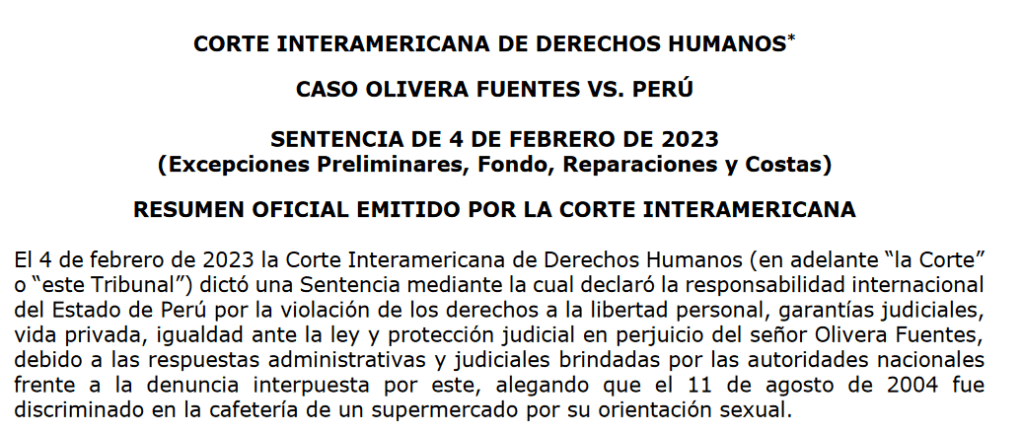
San José, Costa Rica, April 11, 2023.- In the Judgment notified today in the Case Olivera Fuentes v. Peru, the Inter-American Court of Human Rights found the State of Peru internationally responsible for the violation of the rights personal liberty, judicial guarantees, private life, equality before the law and judicial protection to the detriment of Mr. Olivera Fuentes, due to the administrative and judicial responses granted by the national authorities to the complaint filed by him, alleging that on August 2004, he was discriminated against in a supermarket cafeteria because of his sexual orientation.
On August 11, 2004, Crissthian Manuel Olivera Fuentes and his same-sex partner were in a cafeteria located in a supermarket in Lima. During his stay at the commercial establishment, Mr. Olivera and his partner were making demonstrations of affection. A customer of the establishment filed a complaint with the supermarket manager, stating that he was “uncomfortable and annoyed” by the “attitude” of Mr. Olivera and his partner. As a result of said complaint, the manager of the store, together with members of the security personnel, approached the couple and urged them to stop “their love scenes out of respect for the other customers”, since one of them complained because “there were children who were circulating for the games.” The store manager told them that they had to buy merchandise from the cafeteria and refrain from their affective behavior in order not to bother the customers, or else, they had to leave the establishment.
El resumen oficial de la Sentencia puede consultarse aquì y el texto ìntegro de la Sentencia puede consultarse aquì.


 International and Comparative SOGIESC Law - Professor Andreas R Ziegler