Author Archives: Andreas R. Ziegler

Interesting New Article: The Fight Against Discrimination on the Grounds of Sex, Sexual Orientation and Gender Identity in the External Relations of the European Union

Interesting New Article: The Fight Against Discrimination on the Grounds of Sex, Sexual Orientation and Gender Identity in the External Relations of the European Union
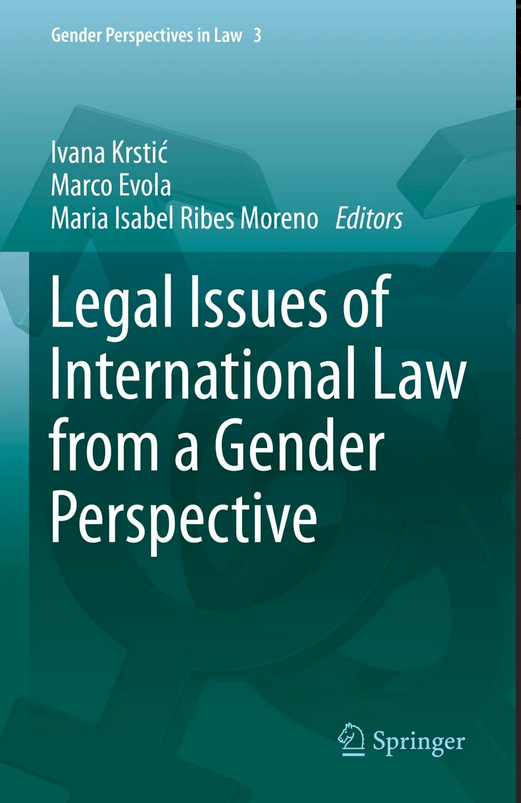
Evola, M. (2023). The Fight Against Discrimination on the Grounds of Sex, Sexual Orientation and Gender Identity in the External Relations of the European Union. In: Krstić, I., Evola, M., Ribes Moreno, M.I. (eds) Legal Issues of International Law from a Gender Perspective . Gender Perspectives in Law, vol 3. Springer, Cham. https://doi.org/10.1007/978-3-031-13459-3_1

  • 35 Accesses

Part of the Gender Perspectives in Law book series (GPL,volume 3)

Abstract

The paper assesses how non-discrimination on the grounds of sex, sexual orientation and gender identity is conceived within European Union (EU) external relations and the legal issues it encompasses. An analysis of the multifarious instruments the EU avails itself in shaping its external action makes it clear that the EU approach towards equality is neither holistic nor homogeneous.

The EU promotes gender equality in all fields of its external relations, but action to outlaw discrimination on grounds of sexual orientation and gender identity is limited to accession to the EU and the European Neighbourhood Policy. EU external action to advance equality of women and LGBTIQ persons is suspended in a limbo between the protection of human rights and the economic rationale, which has rooted internal action in non-discrimination. The paper argues that the tension between the two approaches and the inconsistencies in promoting human rights in its external relations have prevented EU external action from eradicating the prejudices and stereotypes regarding discrimination on the grounds of sex, sexual orientation, and gender identity.
India Supreme Court orders special constitutional panel to consider same-sex marriage laws

India Supreme Court orders special constitutional panel to consider same-sex marriage laws

The Supreme Court of India on Monday ordered a special constitutional panel of five judges to consider a series of petitions related to same-sex marriage. The 15 petitions at issue were filed by same-sex couples and LGBTQ+ activists between 2020 and 2022. Collectively, they aim to change provisions in the secular Special Marriage Act (SMA) and Foreign Marriage Act (FMA) to be interpreted in a gender-neutral manner or, alternatively, to be held unconstitutional for violating the right to equality. The Constitution Bench will comprise five judges. Panels such as these can be established by India’s top court to rule on matters of law requiring constitutional interpretation or involving significant legal questions.

The SMA and FMA were introduced to provide civil marriages for inter-faith couples or those who choose not to marry in accordance with the religious standards applicable to their situations. Although the Acts do not explicitly prohibit same-sex marriages, Sections 2(b) and 4(c) of both Acts, which cover degrees of prohibited relationships and the minimum age for marriage, have been interpreted as stipulating heterosexual marriages since they refer to a “man” and “woman”.

The petitioners argued that this interpretation discriminates against same-sex couples by denying them matrimonial benefits such as adoption, surrogacy, inheritance, maintenance, pension, health insurance, compassionate appointments, being able to take medical or end-of-life decisions on behalf of the other, and tax benefits. “More importantly,” one of the petitions stated, “marriage is one of the key ways in which society accepts, respects, and validates a couple”.

The petitioners argued that excluding LGBTQ+ individuals from marriage violates the fundamental rights to equality, privacy, dignity, and liberty under Articles 14, 15, 19, and 21 of the Constitution of India. They placed reliance on progressive judgments such as Navtej Singh Johar v. Union of India (excluding consensual same-sex relationships from criminalization), NALSA v. Union of India, (recognizing non-binary gender identities), and S. Sushama v. Commissioner of Police (banning conversion therapy). 

Some of these petitions also prayed for the striking down of Sections 5 through 10 of both Acts, which require a couple to have their information displayed publicly for a month in advance of the wedding. These provisions have been judicially recognized as providing options for families to thwart inter-caste or inter-community marriages, and are likely to have a similar impact on LGBTQ+ couples.

The counter-affidavit filed by the Indian government on Sunday asserted its opposition to recognizing same-sex marriages, stating the recognition of same-sex relationships in Navtej Singh Johar should not translate into a recognition of same-sex marriage since the latter did not align with the heterosexual and cis-gendered “Indian family unit concept of a husband, wife, and children”. It also argued the issue falls within the powers of the Parliament and not the judiciary. The counter-affidavit drew criticism from LGBTQ+ individuals and organizations. 

The Constitution Bench will begin hearing the case on April 18.

The post India Supreme Court orders special constitutional panel to consider same-sex marriage laws appeared first on JURIST – News.

USA: Michigan passes bill that incorporates LGBTQ protections into state’s civil rights law

USA: Michigan passes bill that incorporates LGBTQ protections into state’s civil rights law

Michigan Governor Gretchen Whitmer Thursday signed Senate Bill No. 4, which incorporates LGBTQ rights into Michigan’s civil rights law. This bill broadens the Elliot-Larsen Civil Rights Act (ELCRA), which was passed in 1976 and drafted by Mel Larsen (Republican) and Daisy Elliot (Democrat). The act originally prohibited discriminatory practices or policies against individuals based on religion, race, nationality or age. This bill amends the act to include sexual orientation and gender identity/expression.

The new bill outlines that employers, schools, real estate brokers, political subdivisions and other public bodies are prohibited from inquiring or advertising about an individual’s sexual orientation and/or gender identity. Furthermore, under the legislation, businesses and landlords cannot deny services or goods based on sexual orientation or gender identity.

The Executive Governor’s office released a statement calling the new bill a “long overdue step” and calling Michigan “the place that will fight for your freedom to be yourself.” The Detroit Regional Chamber supported the ELCRA and issued a coalition letter to support the act’s expansion, which businesses across Michigan have agreed to implement. Also, this new law will allow citizens to file complaints to the Michigan Department of Civil Rights if they feel that they have been discriminated against in various public bodies. Similar bills were unsuccessful when Republicans controlled the chambers, and with this new expansion of the ELCRA, there could be significant pushback from republican faith-based organizations.

The post Michigan passes bill that incorporates LGBTQ protections into state’s civil rights law appeared first on JURIST – News.

USA: Tennessee Senate passes chilling bill that redefines sex and legally erases trans people

USA: Tennessee Senate passes chilling bill that redefines sex and legally erases trans people

USA: Minnesota passes urgent bill to protect life-saving trans healthcare – putting most of US to shame

USA: Minnesota passes urgent bill to protect life-saving trans healthcare – putting most of US to shame

India central government asserts opposition to same-sex marriages amid legal challenge to current framework

India central government asserts opposition to same-sex marriages amid legal challenge to current framework

The Indian government Sunday asserted in a filing to the Indian Supreme Court that it opposes recognising same-sex marriages and pushed the court to disregard pushback from LGBTQ couples on the current legislation. Parts of the filing were leaked but the full filing was not made available to the public.

However, in the filing, the government cited section 377 of the Indian Penal Code (IPC) and stated that petitioners “cannot claim a fundamental right for same-sex marriage to be recognised under the law.” Similarly, in 2018, the Supreme Court ruled that individuals have a right to a union of companionship under the constitution but not the union of marriage (Navtej Singh Johar v. Union of India). Furthermore, the government argues that numerous marriage and divorce acts are not applicable to same-sex couples as they do not align with the heterosexual and cisgendered “Indian family unit concept of a husband, wife and children.” Despite homosexual sex and relationships being decriminalised in 2018, marriage is only recognised for heterosexual couples. Regarding civil rights, the government detailed that legal recognition of homosexual marriage is not a fundamental right and under article 19 of the IPC there are no related rights suggesting that these unions should be recognised.

Many LGBTQ groups, such as Queer Hindu Alliance, have issued statements against the government and Supreme Court, petitioning the recognition of same-sex marriage and the encouragement of LGBTQ rights. Ashok Row Kavi, founder of the Humsafar Trust (LGBTQ group) suggested that section 377 of the Penal Code is hard to implement and fear of incarceration and lack of protection makes LGBTQ people very vulnerable.

There will be a hearing about the recognition of same-sex marriage in the Supreme Court on Monday.

The post India central government asserts opposition to same-sex marriages amid legal challenge to current framework appeared first on JURIST – News.

Hungary defends anti-LGBT education law before Court of Justice of the EU

Hungary defends anti-LGBT education law before Court of Justice of the EU

Hungary’s Justice Minister Judit Varga Wednesday promised that Budapest will defend an education law against criticism by the EU that it discriminates against people on the basis of sexual orientation and gender identity.

Varga filed a counterclaim with the Court of Justice of the European Union regarding her nation’s alleged breach of obligations initiated under the Hungarian Child Protection Act 2021. The European Commission referred Hungary to the court over the anti-LGBTQ+ law in mid-2022, considering it as violating the fundamental rights of individuals and EU values.

Varga argues that “education is a national jurisdiction and it is the right of the parents of decide on the upbringing of children.” Passed in June 2021, the law bans the use of materials seen as “promoting” or “portraying” homosexuality or gender transition in schools. Prime Minister Viktor Orban has asserted that the law is about the education of children regarding any sexual content, calling himself “a committed defender of rights,” including for LGBTQ+ people.

Critics argue that the law contravenes the rights of the child and stigmatises LGBTQ+ people. Eurochild, a network of organisations and individuals that campaign for the rights of the child, condemned the law as “us[ing] child protection as an excuse to curtail the rights of children” and argued that it “contributes to a climate of fear.”

Amnesty International argued that the law “amounts to discrimination based on sexual orientation and gender identity,” constituting a violation of the European Convention of Human Rights (ECHR). The law requires media content that depicts “pornography or sexuality for its own sake” to be prohibited to minors. Amnesty International says this provision creates a “false narrative” by comparing depictions of LGBTQ+ people to depictions of pornography or extreme violence.

In 2017, the European Court of Human Rights previously found that Russia’s prohibition of the “promotion of homosexuality” among minors is a violation of Article 10 (freedom of expression) and Article 14 (prohibition of discrimination) of the ECHR.

The post Hungary defends anti-LGBT education law before Court of Justice of the EU appeared first on JURIST – News.

Ukrainian MP submits bill to legally recognise same-sex partnerships: ‘There is no time for hesitation’

Ukrainian MP submits bill to legally recognise same-sex partnerships: ‘There is no time for hesitation’