This is a blog is related to my academic work in the International Academic Forum on SOGIESC Law but meant to serve anyone who wants to contribute to improve the protection of human rights worldwide. It is intended to keep interested readers informed about legal developments relating to sexual orientation, gender expression and identity and sex characteristics (SOGIESC). Hopefully, it will make it easier to find correct legal information about the developments in all regions of the world and, in particular, with regard to international law.
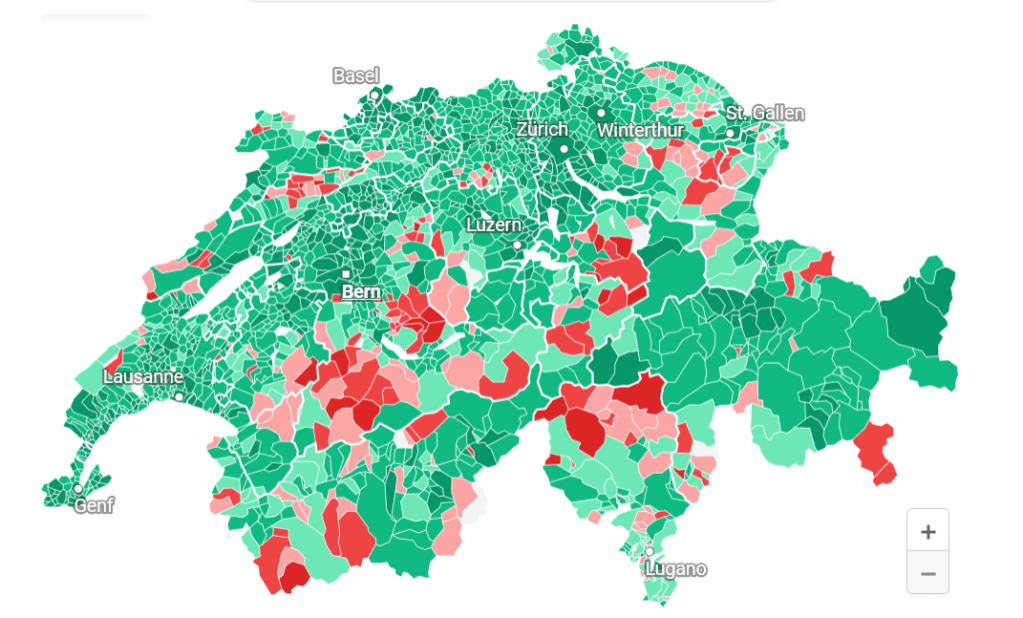
Swiss citizens voted on Sunday to amend the Swiss Civil Code to legalize same-sex couples’ right to marry and to adopt children. Voters accepted the proposal in a 64 to 36 percent vote.
The Swiss Federal Council and Parliament called for a referendum and endorsed same-sex marriage. They explained that although same-sex Swiss couples could enter into registered partnerships, and about 700 couples did so every year, such couples could not marry. The council and Parliament proposed eliminating family inequality by opening marriage to all couples, granting same-sex couples the right to adopt children, and allowing all couples access to legally regulated semen.
Opponents challenged the proposed amendment, arguing that granting same-sex couples the right to marry would violate the Swiss constitution. They reasoned that their constitution grants opposite-sex couples the right to marry because opposite-sex couples can “pass on life.” Opponents further contended that marriage should be limited to opposite-sex couples so as to “protect the cornerstone of society and the state.” In support of this contention, they said that children’s best interests should be protected in a household with “role models from both genders.”
The Swiss Federal Council and Parliament countered, observing that children were already growing up in households with two mothers or two fathers. Hence, they argued that allowing same-sex couples to marry and legitimately raise children in attentive and caring homes served children’s best interest. The council and Parliament also noted that this right would not change marriage between a woman and man, and it would limit the government’s ability to interfere with citizen’s private lives.
After Swiss voters accepted the amendment in a two-thirds majority, Director of Amnesty Switzerland Alexandra Karle expressed support for the “historic vote,” which will make Switzerland the 29th country to legally permit same-sex marriage. Karle said, “Marriage—and with it the right to found a family—will finally be open to all couples in Switzerland. This is an important step towards equality, which was long overdue.”
Poland region repeals ‘anti-LGBT ideology’ resolution
The Polish region of Swietokrzyskie repealed its “anti-LGBT ideology” resolution Wednesday—one of several anti-LGBT resolutions passed in dozens of Polish regions in 2019. The resolution was a symbolic statement by Swietokrzyskie, which had sought to establish itself as an “LGBT-free zone,” clarifying its ideological stance against the LGBT community and symbolizing how LGBT persons were unwelcome in their territory.
Earlier this month, the European Commission had sent formal notices to five Polish regions that had adopted such resolutions, asking for response on the notices and suspending talks about the disbursement of funds under the REACT-EU program, should these resolutions continue to be in place. The Wednesday decision to repeal comes in response to threats of losing funding from the European Commission, which had observed such resolutions to be discriminatory against LGBT persons.
Such resolutions have been argued by Polish regions to be in the interest of family rights and promotion of union between a man and a woman. However, the newly adopted Wednesday resolution in Swietokrzyskie withdraws its anti-LGBT ideology stance and pledge to “respect the centuries old tradition and culture of the Republic of Poland as well as equality and fair treatment.” This makes Swietokrzyskie the first Polish region to withdraw its “anti-LGBT ideology” resolution.
Spokesperson for the European Commission Christian Wigand commented on the development:
We are closely following the latest developments related to the so-called LGBT-free zones in Poland. We see a move in the right direction and expect other regions to move in the same direction. The Commission has a clear position on such resolutions and zones. Let me recall the words of President [Ursula] von der Leyen [that] LGBTQI-free zones are zones free from humanity and there is no place for them in our Union.
It is expected that around PLN 47.5 billion worth of funds under the REACT-EU program will remain suspended in case such resolutions continue in other regions.
Die Regierung hat an ihrer Sitzung vom 21. September 2021 einen Vernehmlassungsbericht betreffend die Abänderung des Partnerschaftsgesetzes und des ABGB verabschiedet.
Hintergrund dieser Abänderung ist ein Urteil des Staatsgerichtshofes vom 10. Mai 2021 (StGH 2020/097), wonach die Unzulässigkeit der Stiefkindadoption für gleichgeschlechtliche Paare gemäss der aktuellen liechtensteinischen Rechtslage gegen Art. 8 i.V.m. Art. 14 der Europäischen Menschenrechtskonvention (EMRK) verstosse, weil die Stiefkindadoption in Liechtenstein nur für heterosexuelle, nicht aber für gleichgeschlechtliche Paare möglich sei.
Aufgrund dessen hat der Staatsgerichtshof die Bestimmung im Gesetz über die eingetragene Partnerschaft gleichgeschlechtlicher Paare (Partnerschaftsgesetz), gemäss welcher Personen, die in einer eingetragenen Partnerschaft leben, nicht zur Adoption zugelassen sind, aufgehoben. Die Rechtswirksamkeit der Aufhebung dieser Bestimmung wurde um ein Jahr nach Kundmachung, welche am 13. Juli 2021 erfolgte, aufgeschoben.
Mit dem von der Regierung verabschiedeten Vernehmlassungsbericht soll in Umsetzung des erwähnten Urteils des Staatsgerichtshofes die Stiefkindadoption für eingetragene Partner/Partnerinnen und Lebensgefährten/Lebensgefährtinnen ermöglicht werden. Zu diesem Zweck bedarf es entsprechender Anpassungen im Partnerschaftsgesetz sowie im ABGB.
Der Vernehmlassungsbericht kann bei der Regierungskanzlei oder über www.rk.llv.li (Vernehmlassungen) bezogen werden. Die Vernehmlassungsfrist endet am 21. Dezember 2021.
Pressekontakt:
Ministerium für Infrastruktur und Justiz Generalsekretariat T +423 236 64 42
USA: Court Rules College Must Rehire Professor Fired for Being Trans
The 10th Circuit Court of Appeals has ruled that an Oklahoma college must rehire a professor who was fired for being transgender.
Dr. Rachel Tudor was terminated from her position at Southeastern Oklahoma State University in 2011 after the school’s Vice President for Academic Affairs told the school’s HR department that her “lifestyle” offended him, according to the local news publication TulsaWorld. Tudor had been working for the school since 2004 and came out as transgender in 2007.
Two years before being fired, McMillan and another Dean denied Tudor tenure, despite the fact that she received a 4-1 vote in her favor from a faculty committee. Because she did not receive tenure, she lost her job.
In 2015, the Department of Justice (DOJ) sued Southeastern Oklahoma State on Tudor’s behalf, alleging the school violated Title VII of the Civil Rights Act of 1964 by terminating her. The Supreme Court ruled in 2020 that the 57-year-old federal legislation, which prohibits employment discrimination on the basis of sex, also pertains to cases of LGBTQ+ workplace bias. The Obama administration shared the same opinion regarding Title VII, which it outlined in a 2014 executive order.
Free publications and events on Asylum and Sexual Orientation/Gender Identity
The SOGICA project was completed in October 2020. We are sending this newsletter to give you the exciting news that the SOGICA book – actually books as it is in two volumes – has now been published (see below). It is open access, so please disseminate it widely and tell us what you think. We hope you enjoy it and see it as a valuable contribution to knowledge and also to European policy and practice in the area of SOGI asylum.
This is also an update on our other publications and events. Since the end of the project we have been busy working on articles and taking part in conferences and workshops to ensure our project findings are put to good use.
Dustin, M. and Held, N., ‘”They sent me to the mountain”: the role of space, faith and support groups for LGBTIQ+ asylum claimants’, in Richard Mole (ed.), Queer migration and asylum in Europe, UCL Press, 2021, pp. 184-215.
Ferreira, N., ‘An exercise in detachment: the Strasbourg Court and sexual minority refugees’, in Richard Mole (ed.), Queer migration and asylum in Europe, UCL Press, 2021, pp. 78-108.
Held, N. (forthcoming): ‘”As queer refugees, we are out of category, we do not belong to one, or the other”: LGBTIQ+ refugees’ experiences in “ambivalent” queer spaces’, Ethnic and Racial Studies, Special Issue Queer Liberalisms and Marginal Mobility, 2021.
As usual, all publications by the SOGICA team and individual members can be found on the SOGICA website publications page. If you would like access to any of these publications and they are not publicly accessible, please email us and we will be happy to send them to you.
Forthcoming events
C. Danisi and N. Ferreira, Legal violence and (in)visible families: How law shapes and erases families in SOGI asylum in Europe, UACES annual conference, 6-8 September 2021.
N. Ferreira, presentation at ‘P v S at 25: Exploring LGBT rights at the Court of Justice of the European Union’, Annual SLS seminar, University of Bristol, 18-19 November 2021.
N. Held, Roundtable Queer migrants & asylum seekers – Everyday bordering and negotiating belonging, GenSeM Online Symposium, 22-23 September 2021.
…. and previous events (in case you have missed them)
N. Ferreira, Seeking asylum in Europe: Recommendations on sexual orientation and gender identity asylum claims, IPSA 26th World Congress of Political Science, Lisbon, Portugal, 10-14 July 2021.
N. Ferreira, participation at seminar ‘Credibility assessment in refugee status decision-making: Insights from law and psychology’, Royal Holloway University of London Centre for Study of Emotion and Law (CESL), 22 June 2021.
SOGICA exhibition at the Jubilee Library, Brighton & Hove, 12-24 June 2021 – see the exhibition’s panels here.
N. Held, Queer Asylum, Space and Intersectionality, lecture series ‘New Insights in Gender and Trans-Studies’, Justus-Liebig-Universität Gießen, 7 June 2021.
C. Danisi, ‘SOGICA recommendations on SOGI claims’, EASO Webinar on ‘Asylum procedures related to SOGI claims’, 2 February 2021.
N. Ferreira, Seeking asylum in Europe: ‘European values’ and queer claims, in lecture series European values, citizenship and belonging, University of Antwerp, 16 December 2020.
M. Dustin, member of panel on migrants’ experiences and intersectionality, University and College Union Migrant Members’ Annual Conference, 3 December 2020.
M. Dustin and N. Ferreira, ‘SOGICA recommendations on reception’, EASO Webinar on ‘Identification, outreach and reception of LGBTI applicants’, 25 November 2020.
N. Held, Queer Asylum in Europe: Intersectional human rights challenges, UCLan Research Centre for Migration, Diaspora and Exile (MIDEX) research seminar, 7 October 2020.
Please visit the events page of the website for further information about events over the course of the SOGICA project, including our final conference in July 2020.
Other resources Since our last mailing, we have added a further 150 items to the SOGICA database which now contains more than 1,240 academic and NGO articles, official reports, case law decisions and other items.
The Life Stories section of our website contains some individual accounts of LGBTQI+ people claiming asylum. In this way, we hope to keep sight of the human cost of flawed asylum processes and provide a space for some of the people involved to share their experiences. If you are seeking international protection on sexual orientation or gender identity grounds, or have done so, feel free to send us contributions (by email to info@sogica.org) to be considered for publication on our website.
Finally … Our thanks to all our newsletter subscribers and project friends and colleagues. It is wonderful to have had the opportunity to get to know so many of you. We are maintaining our website and our Twitter and Facebook accounts, and hope you will continue to use these to keep in touch with us. And we may well be in touch again in the future with more news about the SOGICA project and SOGI asylum in Europe…
Please feel free to email us with any questions you have about the SOGICA project, or any news which you would like to share.
Vicky Hernández et al. v. Honduras: A Landmark Victory with a Bitter Aftertaste
On June 28, on International LGBT Pride Day, the Inter-American Court of Human Rights (IACtHR) issued its ruling in Vicky Hernández et al. v. Honduras, the first case involving lethal violence against an LGBT person, specifically a trans woman, to reach the highest body of the Inter-American regional system.
During the proceedings, Honduras denied that its police force had any part in Vicky Hernández’s murder, which occurred on another June 28, this time in 2009, on the first night of the curfew imposed during the coup d’état against then-president Manuel Zelaya. The decision sparked considerable anticipation: the Inter-American Commission on Human Rights (IACHR) and representatives of Hernández’s family had requested the IACtHR to apply the Inter-American Convention on the Prevention, Punishment and Eradication of Violence Against Women (“Convention of Belém do Pará”) to the case. Previously the treaty had only been applied to instances of violence against cisgender women. Furthermore, the petition was submitted to the IACHR in 2012, before Advisory Opinion OC-24/17 had been issued.
The First Section of the European Court of Human Rights has issued its judgment in the case of X v Poland. The case concerns the applicant’s claim that she had been discriminated against on the basis of her sexual orientation in proceedings for full parental rights and custody rights over her youngest child.
The Court held, by six votes to one, that there had been a violation of Article 14 (prohibition of discrimination) in conjunction with Article 8 (right to respect for private and family life) of the European Convention on Human Rights. Facts of the case
The applicant, Ms. X, is a Polish national who was born in 1970 and lives in Poland. She has four children from her marriage in 1993 with Mr. Y.
After becoming involved in a relationship with another woman, Ms. Z, Ms. X applied for a divorce in April 2005. Her parents, who did not approve of their daughter’s decisions, subsequently sought custody of the children. Temporary custody was granted to them by the District Court, sitting as a single judge – a judge who was allegedly well acquainted with her parents.
Following an appeal by both Ms. X and Mr. Y, in June 2005 the Regional Court quashed that decision. In the same month it pronounced a no-fault divorce and granted Ms. X full parental rights and custody of the four children.
In October 2006 the applicant’s former husband applied to change the custody arrangement. After assessment of their respective parenting abilities, during which the applicant was asked directly whether she was homosexual and had had sexual intercourse with Ms. Z, the District Court granted full parental rights to Mr. Y and restricting those of Ms. X.
Ms. X appealed, emphasising that she had always been the main carer for the children and that her former husband had not spent time with the children since the divorce, either not using his contact rights or leaving the children in the care of her parents. The appeal was dismissed.
In April 2008, Ms. X requested that the custody order be revised in respect of her youngest child. The District Court, sitting as the same single judge, and relying on the expert opinions issued in the previous proceedings, held that the applicant “had concentrated excessively on herself and her relationship with her girlfriend”, and rejected her request for an interim measure allowing her to retain custody during the proceedings.
In May 2008, Ms. X lodged an application challenging the impartiality of the judge. The following day, the same judge ordered that the child be removed from her care.
In June 2009, the District Court dismissed Ms. X’s application for amendment of the custody order and for parental and custody rights over the youngest child. The court decided that the seven-year-old should continue to live with his siblings and father so that his correct emotional and social development needs could be met, stating that that decision was “justified by the current stage of the child’s development and the father’s larger role in creating [the child’s] male role model”.
Ms. X appealed, claiming that the child was being looked after mainly by Mr. Y’s sisters and grandparents. She considered that the court had failed to recognise the interests of the child and had taken her husband’s homophobic opinions into account, opinions which he had voiced to the children, the courts and the experts. She argued that the main grounds for the court’s decisions had been her relationship with another woman and was discriminatory on the basis of her sexual preferences. The Regional Court dismissed the appeal.
Complaint to the Court
Ms. X complained that the domestic courts had refused to grant her custody of her child on the grounds of her sexual orientation, which amounted to discrimination in the enjoyment of her Convention rights, in breach of Article 14 taken in conjunction with Article 8 of the Convention.
Judgment of the Court
The Court applied its general approach to complaints brought under Article 14 of the Convention, which includes the principle that, in order for an issue to arise under Article 14, there must be a difference in the treatment of persons in analogous or relevantly similar situations.
The Court, therefore, considered whether there was a difference in treatment relevant to Article 14. In examining the domestic proceedings the Court found, for instance, that “references to the applicant’s homosexuality and relationship with Z were predominant in the first set of proceedings” (§ 76). The Court’s “inescapable conclusion” was that Ms. X’s “sexual orientation and relationship with another woman was consistently at the centre of deliberations in her regard and omnipresent at every stage of the judicial proceedings” (§ 79). The Court therefore concluded that there was a difference in treatment between Ms. X and any other parent wishing to have full custody of his or her child. This difference was based on her sexual orientation, a ground which is covered by “other status” in Article 14 of the Convention.
The Court then turned, as is standard in an Article 14 issue, to ask whether the difference in treatment was justified.
The Court focused on the fact that, in the most recent set of proceedings, the domestic courts refused to alter the status quo as regards custody on the basis of two main arguments: the advantages of all the siblings living together, and the importance of a “male role model” in the boy’s upbringing. The Court considered whether these arguments were appropriate to fulfil the purpose declared in these proceedings, namely to protect the best interests of the child. In so doing, the Court evaluated whether either or both reasons were based on discriminatory considerations.
The Court’s conclusion was that the reference to the importance of a male role model for the boy’s upbringing, the need for which would apparently increase as the child grew older, was discriminatory and a decisive factor in the dismissal of Ms. X’s requests for custody. Moreover, the Court noted that the domestic courts considered that a positive assessment of Ms. X’s competencies as a primary carer for her children depended on her stopping her relationship with Ms. Z. In this respect, the domestic courts referred to her relationship as “excessive involvement” and an “attitude” which needed to be “corrected” and expected the relationship to be “abandoned” and Ms. Z to be “excluded from family life”.
The Court concluded that in refusing to grant Ms. X full parental rights and custody rights the domestic authorities “made a distinction based solely or decisively on considerations regarding her sexual orientation, a distinction which is not acceptable under the Convention” (§ 92).
As such, there had been a breach of Article 14 of the Convention taken in conjunction with Article 8.
Dissenting opinion of Judge Wojtyczek (Poland)
Judge Wojtyczek filed a dissenting opinion, criticising the majority on three grounds, namely that (i) the proceedings raise serious reservations from the viewpoint of procedural justice, (ii) the factual findings made by the Court are not fully accurate, and (iii) the legal assessment of the merits of the case appears incorrect. Judge Wojtyczek argued that the proceedings in this case are “fundamentally flawed from the standpoint of procedural justice” and that the majority “have established a difference in treatment without providing sufficient evidence that the applicant was treated differently from another class of parents in a similar situation”. Judge Wojtyczek concludes: “In any event, the contested domestic judgments remain within the scope of the margin of appreciation of the respondent State”.





 International and Comparative SOGIESC Law - Professor Andreas R Ziegler