‘Laughing-stock’ Polish town revokes ‘LGBT-free’ status so it can keep lucrative EU grants
‘Laughing-stock’ Polish town revokes ‘LGBT-free’ status so it can keep lucrative EU grants
Leave a reply

‘Laughing-stock’ Polish town revokes ‘LGBT-free’ status so it can keep lucrative EU grants
ILGA Rainbow Digest April 2021
 Help transform realities for LGBTI communities across Europe and Central Asia. With your support we can do more. Make change happen here. No. 307. April 2021. In this issue… ILGA-Europe Join The Hub, ILGA-Europe’s free resource sharing centre for LGBTI activists in Europe and Central Asia Responding to anti-LGBTI forces: ILGA-Europe’s call for project proposals New report on the communications strength of the movement in our region Save the date for The ILGA-Europe Equality Gala Online MEMBERS ONLY: A busy year with two General Meetings! Decriminalisation “49 people are in jail for same-sex conduct in Uzbekistan” Equality and non-discrimination New Constitution in Kyrgyzstan could potentially harm NGOs and LGBTI activists New report on the economic case for LGBT+ inclusion in Central and Eastern Europe Family Opinion from European court: same-sex parented families should be officially recognised in all EU member states Listen to the podcast mini-series on rainbow family rights Freedom of expression Yulia Tsvetkova will stand trial again under absurd criminal charges Hate speech and hate crime Violence against LGBTI people in Kyrgyzstan intensifies Health New research into harm caused by gender identity conversion therapy in the UK How to build a fairer, healthier world during a global pandemic WHO released new information note about COVID-19 vaccines and people living with HIV Housing Survey finds that LGBTIQ organisations and homeless services across Europe are dealing with large numbers of LGBTIQ youth homelessness Notice board European Commission to support proposals in the field of gender-based violence IGLYO’s job vacancy for a Policy & Research Officer Survey on experiences of LGBTQI+ students and youth during their mobility “Don’t let COVID-19 stop you from tackling Cancer” To the top ILGA-Europe Join The Hub, ILGA-Europe’s free resource sharing centre for LGBTI activists in Europe and Central Asia The Hub is an easily accessible online platform for LGBTI activists in Europe and Central Asia. Through it, ILGA-Europe offers various resource ‘cards’ that contain information and guides around certain thematic areas of work. You will find dozens of resources already in the thematic sections on campaigning, communications, community, fundraising, management, security, wellbeing and Russian language cards. Each card contains comprehensive information around a particular area of work. Join today – by creating your own account at hub.ilga-europe.org Read our blog on why online resource sharing is the way forward for the LGBTI movement. Responding to anti-LGBTI forces: ILGA-Europe’s call for project proposals We have launched a re-granting programme to strengthen the capacities of LGBTI organisations in Europe to achieve change in the current landscape of growing populist anti-LGBTI rhetoric and state-led anti-LGBTI attacks. If you are an LGBTI organisation currently working, or planning to work on communication, alliance and resilience building to counter anti-LGBTI forces. Proposals should be submitted by 23 May, Sunday, 23:59 CEST. Read more and submit your proposal. New report on the communications strength of the movement in our region On 15 April, ILGA-Europe held an online event for the activist launch of ‘Communicating for Change: a communications needs assessment of the LGBTI movement in Europe and Central Asia’. Consisting of surveys, focus groups, interviews and webinars with 190+ activists from 45 countries, this is the most in-depth investigation into the communications strength of the movement in our region. Download your own copy of the summary report in English. Download your own copy of the summary report in Russian. Save the date for The ILGA-Europe Equality Gala Online We are excited to announce ILGA-Europe’s second annual online fundraising Gala, which will feature a range of exciting guests from the worlds of sports, arts and entertainment, alongside a diverse range of activists from across the LGBTI movement, all to be announced over the coming months. In the meantime, please save this date in your diary, Tuesday June 22 at 7pm CEST. Add the date to your calendar now by clicking here. MEMBERS ONLY: A busy year with two General Meetings! Is your organisation a member of ILGA-Europe? This year, we will not be short on opportunities to connect as there will be not one but two Annual General Meetings (AGMs)! So mark your calendars for the two AGMs – which will of course be held online: Saturday 12 June 2021 – Extraordinary GM; Saturday 30 and Sunday 31 October 2021 – Regular AGM. Read more and look at the timeline explaining what to expect and when. To the top Decriminalisation “49 people are in jail for same-sex conduct in Uzbekistan” For the first time in Uzbekistan’s history, the Interior Ministry revealed the number of people convicted under article 120 of the Uzbek Criminal Code, which penalises consensual same-sex conduct between men. On April 23, the Uzbek language news outlet Qalempir.uz published the statistics referring to the law enforcement agency. Under article 120, six people were convicted in 2016, 15 in 2017, seven in 2018, also seven in 2019, nine in 2020. As many as 49 people are currently in jail for “homosexuality”. When questioned previously by relevant UN Treaty bodies and EU institutions, Uzbek officials would deny the existence of LGBT people convicted under article 120 and would always claim that Uzbekistan does not exercise the article in reality. The statistics were revealed as Uzbekistan came under international criticism for penalising consensual same-sex conduct between men following ILGA-Europe’s campaign on decriminalisation in March. Read the article that revealed the statistics (in Russian). To the top Equality and non-discrimination New Constitution in Kyrgyzstan could potentially harm NGOs and LGBTI activists On 11 April, Kyrgyzstan adopted yet another Constitution in a nationwide referendum. Nearly 80% of the voters, who came to the polls, supported the new Constitution containing provisions that could potentially restrict LGBTI activism. One such provision is Article 8(4): public associations shall ensure transparency of their financial and economic activities. LGBTI organisations compare this article to the law on “foreign agents”, which has been practiced in Russia and has significantly restricted operation of LGBTI organisations. Another harmful provision is Article 10, which deals with mass media, and includes: “in order to protect the younger generation, activities that contradict moral and ethical values and public conscience of the people of the Kyrgyz Republic may be restricted by law”. This provision might prohibit any LGBTI community organising and movement building activities in Kyrgyzstan. Read more. New report on the economic case for LGBT+ inclusion in Central and Eastern Europe ILGA-Europe member organisation Open For Business have published a new report ‘The Economic Case for LGBT+ Inclusion in Central and Eastern Europe (CEE): Hungary, Poland, Romania and Ukraine’. The report finds that LGBT+ discrimination comes at a high cost to countries in the region, but also shows how embracing inclusion can be a path for greater economic growth. The report includes a study of 190 businesses in the four countries, and features case studies. Download your own copy of the report. To the top Family Opinion from European court: same-sex parented families should be officially recognised in all EU member states ILGA-Europe and NELFA are very encouraged by the Advocate General of the Court of Justice of the European Union’s (CJEU) opinion, published on 15 April in the case of V.M.A. v Stolichna obshtina, in which a same-sex couple who were refused a birth certificate in Bulgaria for their newborn daughter claim the Bulgarian authorities are violating the rights of a European citizen on the grounds of sexual orientation, namely to free movement, and to private and family life. This constitutes a breach of the fundamental principles of the EU. (Photo: Court of Justice of the European Union) Read more. Listen to ILGA-Europe’s podcast mini-series on rainbow family rights In the latest offering of the ILGA-Europe podcast, The Frontline, we present a mini-series on rainbow family rights in 2021, looking at the issues affecting LGBTI parents and their children across Europe. We’re exploring two landmark cases being taken to the European courts right now, looking at the growth of partnership rights in the Western Balkans, and the lack thereof in Ukraine, the situation for trans parents, and the issues that are coming up beyond 2021, including multi-parenting. Listen to the mini-series and subscribe to The Frontline on your favourite podcast platform. Find previous episodes. To the top Freedom of expression Yulia Tsvetkova will stand trial again under Russian criminal charges On 6 May, Russian LGBT+ and feminist activist, Yulia Tsvetkova will stand trial again under absurd criminal charges for sharing body positive art online. She is currently under a gag order and cannot leave her town. Yulia’s trial in the “pornography” case started on 31 March 2021, and she is set to appear in court several times throughout April to June. The trial is happening behind closed doors, contrary to Yulia’s defense demands. Read more about her story and how you can support her. To the top Hate speech and hate crime Violence against LGBTI people in Kyrgyzstan intensifies On 23 April, an ILGA-Europe member organisation in Kyrgyzstan was bullied online by unknown social media trolls. A video was released demonising the LGBT+ organisation, revealing the names of most of the staff members, misgendering and publicly outing them. The video, which was later deleted by Youtube, contained anti-LGBTI messages and bias-motivated speech, misinformation about the organisation and mislead viewers by manipulating factual information. Targeted activists believe this was done to deter public attention from socio-economic and political failures of the recently elected President Sadyr Japarov. The release of the video comes as a continuation of a series of anti-LGBTI and anti-civil society narratives that have intensified in Kyrgyzstan since March. On 15 April there was an anti-LGBT demonstration in the capital Bishkek, in opposition to demonstrations calling for Interior Minister’s resignation. The Ministry had failed to protect a young woman who had been killed as a result of bride kidnapping. Read more about the response from LGBTI organisations (in Russian). Read more about the anti-LGBT protests in Bishkek (in Russian): To the top Health New research into harm caused by gender identity conversion therapy in the UK A new report published in the United Kingdom exposes the violent nature of so-called gender identity “conversion therapy”. Survivors report verbal abuse, isolation, beatings, forced feeding / food deprivation, “corrective rape” and forced nudity. The research involved 450 respondents who stated that their gender identity did not match the sex assigned to them at birth. This included 170 respondents who identified as non-binary. In total 64 people had been offered Gender Identity “Conversion Therapy” and 39 had undergone it. Of those, nearly half had been forced through it. Read more and download your own copy of the report. How to build a fairer, healthier world during a global pandemic On 7 April, in the midst of an ongoing global pandemic, we celebrated World Health Day with the motto: “Building a fairer, healthier world”. But to make this a reality the voices and needs of the most marginalised, including LGBTI people, must be front and centre. Health and access to healthcare is one of the seven areas where COVID-19 has hugely impacted LGBTI people, organisations and communities in Europe and Central Asia. Read how ILGA-Europe and the Nobody Left Outside initiative are working together to build on this vision. WHO released new information note about COVID-19 vaccines and people living with HIV The World Health Organization released on 9 April a list of questions and answers about the COVID-19 vaccines and people living with HIV. According to the WHO, “despite limited data, available information suggests current WHO recommended COVID-19 vaccines (Pfizer/BioNtech, Oxford/AstraZeneca, Johnson&Johnson) are safe for people living with HIV”. (Emblem: World Health Organization) Read more. To the top Housing Survey finds that LGBTIQ organisations and homeless services across Europe are dealing with large numbers of LGBTIQ youth homelessness A report published on 28 April, based on a survey by ILGA-Europe in association with the LGBTIQ Youth Homelessness organisation True Colors United, and the Silberman Center for Sexuality and Gender (SCSG) at Hunter College, explores the experiences of LGBTIQ focused organisations in Europe in working on the issue of LGBTI youth homelessness, points to a large prevalence of LGBTI youth homelessness across Europe, with over 60% of LGBTIQ organisations surveyed saying they have worked with young people who have experienced homelessness. A comparative report from FEANTSA also finds that over 60% of homeless services organisations have dealt with young LGBTIQ people experiencing homelessness but often without any training or support. Read more and download your own copy of the reports. To the top Notice board European Commission to support proposals in the field of gender-based violence The European Commission launched a call for proposals to prevent and combat gender-based violence and violence against children. The first priority of the 2021 calls for proposals aims to address the challenges emerging from the COVID-19 pandemic and the safety and security measures put in place in relation to it. The second priority addresses masculinities and engagement of men and boys in the prevention of gender-based violence. The call recognises the need for proposals to equally address the specificities of the situation for women and men, girls and boys, in all their diversity. (Emblem: European Commission) Read more and submit your proposal by 15 June. IGLYO’s job vacancy for a Policy & Research Officer IGLYO is currently looking for a Policy & Research Officer to join their staff team. The ideal candidate will have experience in a relevant advocacy, policy or research related position (preferably in a civil society organisation), and knowledge of the international LGBTQI rights framework. IGLYO highly encourage women, trans, and non-binary people, individuals from black communities, other communities of colour and ethnic minorities, and who are under 30 years old to apply for this position. Read more and apply by 10 May. Survey on experiences of LGBTQI+ students and youth during their mobility Erasmus Student Network (ESN) has released a survey called Rainbow Survey to learn more about the experiences of the LGBTQI+ students and youth who currently are or have previously been on mobility, with an emphasis on the integration in the local community and other experiences that have shaped their mobility experience. Your participation will help ESN better represent the interests of international LGBTQI+ students and young people in the future. The survey will be open until Sunday, June 20. Answer the survey. “Don’t let COVID-19 stop you from tackling Cancer” The European Cancer Organisation announced their virtual launch event of the Time To Act campaign in over 20 languages: “Don’t let COVID-19 stop you from tackling cancer”. The event will be held on Tuesday 11 May from 11:00-12:00 CEST and you can register, free-of-charge. This event will bring together European political leaders in cancer, including EU Health Commissioner Stella Kyriakides and the Chair and MEPs from the EU Parliament’s Special Committee on Beating Cancer (BECA), as well as other policy-makers, healthcare professionals and patient advocates who are all very concerned about the negative impact of COVID-19 on Cancer. Read more and register. ILGA-Europe Rainbow Digest is published by ILGA-Europe – the European Region of the International Lesbian, Gay, Bisexual, Trans & Intersex Association Follow us on social media Medium Vimeo YouTube Previous editions Rainbow Digest ISSN 1998-8117 Editor: Mehmet Akin Contact us This publication is funded by the Rights, Equality and Citizenship Programme 2021-2027 of the European Union. The contents of this publication are the sole responsibility of ILGA-Europe and can in no way be taken to reflect the views of the European Commission. |
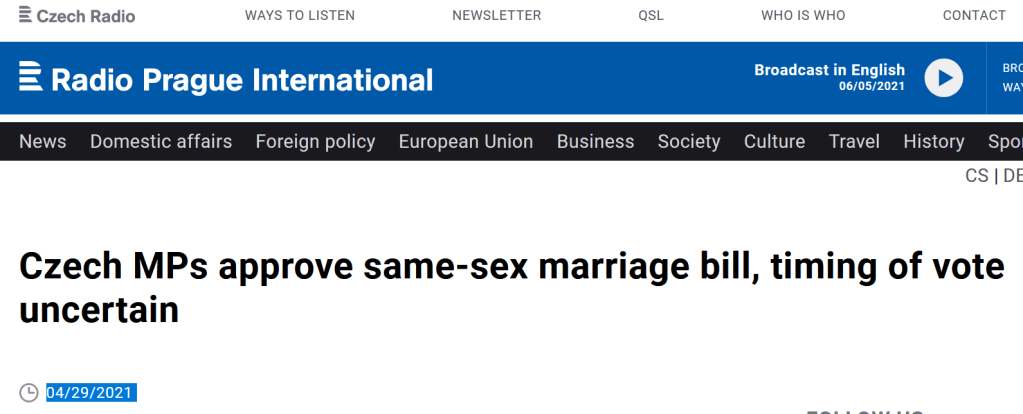
Czech MPs approve same-sex marriage bill, timing of vote uncertain
04/29/2021
The lower house of Parliament on Thursday approved a draft law in a first reading that would legalise same-sex marriages. At the same time, a counter bill that wants the Constitution to say marriage between a man and a woman is protected by law.
Read: https://english.radio.cz/czech-mps-approve-same-sex-marriage-bill-timing-vote-uncertain-8716225
In Ukraine, homosexual relations has been removed from the list of prohibitive criteria for blood donation

Source: @AllianceGlobalKyiv: https://www.facebook.com/AllianceGlobalKyiv/posts/4204946126205265
In Ukraine, such a discriminatory norm as homosexual relations has been removed from the list of prohibitive criteria for blood donation, which was previously equated to “risky behavior” and it have allowed homosexual and bisexual people to finally be blood donors.The Order #207 of 08.02.2021 came into force in early April, but the text is still not on the official website of the Ministry of Health of Ukraine, but it`s available on the website “LEAGUE: LAW”, link here (in Ukrainian): http://search.ligazakon.ua/l_doc2.nsf/link1/RE36027.htmlThanks to the joint advocacy efforts of many stakeholders, including Alliance.Global and the National MSM Consortium #MSM_PRO and based on medical common sense, the Ministry of Health of Ukraine has completely revised the rules of donation, “clearing” them of all irrational and unfair restrictions.In addition to the issue of homosexual relations, some other positions have disappeared from the new Order of the Ministry of Health, such as that contraindications to donation are “paid sexual services” or “sexual relations with strangers without a condom”; the old position “Addiction” was revised to “Intravenous or intramuscular injections” was clarified (see Annex #3 “Exclusion criteria of whole blood donors and blood components” of the new Order and for comparison – the old and no longer valid order the Ministry of Health: http://zakon2.rada.gov.ua/laws/show/z0896-05 dated 01.08.2005).However, in the new Order in paragraph #12 “Sexual Behavior” still remains the wording “A person with risky sexual behavior that can lead to serious infectious diseases that can be transmitted through blood”.This is a significant victory for you and me – all those who fought against such an openly discriminatory norm, which has worked for more than 15 years.Back in 2015, the EU court ruled that if the recipient’s safety could be guaranteed through HIV detection and donor surveys, banning homosexual people from being donors was unacceptable.Human rights activists have repeatedly stated that banning LGBTQ people from donating blood is discriminatory. The removal of this ban was envisaged in the human rights Action plan for the period up to 2020.We also remind you that on September 30 last year the Verkhovna Rada of Ukraine passed the Law “On Safety and Quality of Donor Blood and Blood Components” №931-IX (see here: https://zakon.rada.gov.ua/laws/show/931-IX#Text). #MSM_PRO, in solidarity with Alliance.Global, LGBT Association LIGA, Гей-Форум України / Gay-Forum of Ukraine NGO, Spectrum Kharkiv, Alliance.Global Kharkiv, MenSpace, “100% life” – PLHIV NetworkWith: MPact, International Association of Providers of AIDS Care, ECOM, WHO Regional Office for Europe, Amnesty International Ukraine, Freedom House Ukraine, AIDS Action Europe, Альянс громадського здоров’я Alliance for Public Health, Gender Z
USA: Florida governor signs controversial ban on transgender athletes from women’s sports

Florida Republican Governor Ron DeSantis signed into law the CS/CS/SB 1028 Bill on Tuesday, which includes a controversial provision on transgender athletes. Section 1006.205, titled the “Fairness in Women’s Sports Act” bans transgender women athletes from women’s sports.
The insertion of Section 1006.205 shall now require the designation of all public secondary school or post-secondary institution sponsored interscholastic, intercollegiate, intramural or club athletic teams and sports based on one’s biological sex at birth into one of the following three categories: males, men, or boys; females, women, or girls; or coed or mixed. The provision also states that athletic teams and sports “designated for females, women, or girls, may not be open to students of the male sex,” with determination of a student’s biological sex being made based on the student’s official birth certificate.
In its legislative intent to maintain equal opportunities for female athletes,’ the insertion shall allow for civil remedies to be passed in favor of any student who gets deprived of an athletic opportunity or suffers any direct or indirect harm as a result of a violation of the provisions of the “Fairness in Women’s Sports Act.” It shall entitle such student to initiate a private cause of action for injunctive relief, damages, and any other relief available under law against the school or public postsecondary institution, including monetary damages for any psychological, emotional, or physical harm suffered, reasonable attorney fees and costs, and any other appropriate relief.
A similar bill banning transgender athletes, HB 1475 Bill, had passed earlier this year in the Florida House of Representatives as a stand-alone bill, but it had failed in the Senate last month. The present law incorporates the failed standalone bill into the bill on education. Despite the existing controversial content of the enacted law, it differs from the previous version, since HB 1475 also allowed for physical examination of a student’s reproductive anatomy, genetic makeup or testosterone levels, in cases of dispute regarding a student’s sex, which the education law replaces by allowing for reference only to a student’s birth certificate in case of any dispute over the sex of a student.
Ironically, the law was signed on the first day of Pride Month, and goes into effect on July 1.
The post Florida governor signs controversial ban on transgender athletes from women’s sports appeared first on JURIST – News – Legal News & Commentary.
Failure to adequately deal with homophobic verbal abuse and threats in Romania is a violation of ECHR (CEDH, droits humains)
Posted: 01 Jun 2021 03:34 PM PDT (c) ECHR Sexual Orientation Blog

The Fourth Section of the European Court of Human Rights has today given its judgment in the case of Association ACCEPT and Others v Romania.
The case concerns Romania’s failure to protect the applicants – an LGBT non-profit association (Association ACCEPT) and five Romanian nationals (Alexandra Cândea, Alexandra Mihaela Carastoian, Ioana Ramona Filat, Diana Elena Mateescu, and Claudia Stănescu) – from homophobic verbal abuse and threats, to conduct a subsequent effective investigation into the applicants’ complaint, and the consequences of these incidents on the applicants’ right to freedom of peaceful assembly.
The applicants relied on Articles 3, 8, 11, 13 and 14 of the Convention, as well as on Article 1 of Protocol No. 12 to the Convention.
The Court found a violation of Article 14 of the Convention taken in conjunction with Article 8, and a violation of Article 14 of the Convention taken in conjunction with Article 11.
The facts
The incident
In February 2013, ACCEPT organised a series of cultural events to celebrate LGBT History Month. The programme included the screening of a movie portraying a same-sex family in a cinema situated in the National Museum for the Romanian Peasant in Bucharest.
ACCEPT became aware that an “online mobilisation” was taking place on social media platforms calling for a counter-demonstration during the screening at the Museum. They contacted the police and ten police officers from Bucharest police station no. 2, together with the head of that station, arrived on the premises to provide protection, and were later joined by a team of seven gendarmes.
About twenty people attended the public screening, including the individual applicants. Fifty more people entered the screen room, some of them carrying flagpoles, and disturbed the screening by shouting remarks such as “death to homosexuals”, “faggots” or “you filth”, and insulting and threatening attendees of the screening, including the individual applicants.
Some of the intruders displayed fascist and xenophobic signs and brandished the flag of Everything for the Country (Totul pentru ţară), a Romanian far-right party (since dissolved by court order). The intruders seemed to be associated with a far‑right movement, the New Right (Noua Dreaptǎ), which is active in political life and is openly opposed, among other things, to same-sex marriage and same-sex adoptions.
The organisers alerted the police officers who had been stationed outside the screening room. The police officers entered the room, confiscated some flags from the intruders and then left the room, despite the organisers’ request to remain.
The intruders opposed the screening as they considered that the movie damaged national dignity because of its homosexual theme, a feeling that had been aggravated by the choice of venue – a place of history and tradition. They blocked the projector, so the screening could not continue. The organisers halted the screening and switched the lights on.
As people started leaving the room, the police officers stationed in the corridor checked the identity papers of twenty-nine individuals, the majority of them from the group opposing the screening.
The screening was rescheduled and took place in the same location in March 2013 without incident.
Criminal complaint
On 5 March 2013, ACCEPT lodged a criminal complaint about the incident with Bucharest police section no. 2, alleging incitement to discrimination, abuse of office by the restriction of rights, and the displaying of fascist, racist or xenophobic symbols in public.
The complaint was lodged on behalf of ten individuals (including the individual applicants in this case) who had participated in the screening of February 2013. Those individuals complained that unidentified individuals had interrupted the screening, uttered threats, displayed fascist symbols, and filmed, photographed and videotaped the participants without their permission.
They furthermore complained that the authorities had failed to take adequate measures to prevent and stop the behaviour of the violent group and to allow the victims’ peaceful assembly to continue.
ACCEPT argued that those acts had been motivated by hatred towards homosexuals. ACCEPT appended information about the alleged perpetrators – details which, it believed, would contribute to the identification of the perpetrators and the roles that they had played in the incident and also attached to the complaint a video of the incident, which had been posted on the Internet.
In a decision of 24 June 2014, the military prosecutor’s office found that the gendarmes had been unable to create an action plan for dealing with the incident of February 2013 because ACCEPT had failed to seek the necessary pre-authorisation for that event. The prosecutor found that the gendarmes had complied with their obligations; the prosecutor then concluded the investigation in that respect.
In a decision of 14 October 2014, the prosecutor’s office attached to the Bucharest Court of Appeal ended its investigation on the grounds that the acts complained of did not constitute criminal offences. The description of the incident, which was depicted as “an exchange of views” between the participants, was similar to that contained in a report by the police.
For the next three years, the applicants sought to challenge the prosecutor’s decision, without success.
Complaints to the Court Article 3 taken alone or in conjunction with Article 14
The Article 3 complaint related to the psychological effect that the incident of February 2013 allegedly had on the applicants, as members of the LGBT community.
The Government argued that the treatment allegedly suffered by the individual applicants had not reached the threshold of Article 3 of the Convention. They pointed out that no physical harm had been caused to the individual applicants and that no forensic certificates attested to any consequences suffered by them in the aftermath of the incident in question. As for the alleged mental effects on the applicants, they argued that there were no special circumstances regarding the sex, age or state of health of the applicants that could have justified deeming that the treatment allegedly suffered fell within the scope of Article 3.
The individual applicants contended that the infliction of physical harm was not a pre-condition for treatment being ruled “degrading”. Moreover, the aggression that they had suffered had not turned into physical violence only because the first applicant had decided to suspend the event – a decision that had been taken in order to protect the participants. They submitted that, in their view, the degree of severity of that treatment should be assessed in the light of the fact that the acts of aggression had been directed against the LGBT community and had been part of a series of homophobic acts of violence coordinated by the extremist group the “New Right”, which was notorious in Romania for its acts of violence – especially against the LGBT community.
The individual applicants also stated that the intruders had outnumbered the participants in the event by a factor of two to one, and the applicants had felt trapped inside the closed dark space of the cinema, had been afraid for their own safety and lives, and had been verbally abused, while the police had refused to intervene and had seemed to even condone the intruders’ actions. The ensuing feelings of fear, anguish and humiliation had continued even after the incident, as the aggressors had videotaped the applicants against their will and had posted those videos online, thus exposing them to additional stigma and hate speech.
The Court stated that the applicants had not pointed to any facts that could enable the Court to find that the level of mental suffering that they experienced as a result of the incident – or as a result of the manner in which the investigation into that incident took place – came close to the level that the Court has found in other similar cases to engage the State’s responsibility under Article 3 of the Convention with respect to situations of abuse on discriminatory grounds.
The Court stated that the applicant’s situation stood in contrast to Identoba and Others v Georgia and to M.C. and A.C. v. Romania, where verbal abuse and serious threats directed against the applicants – marchers promoting LGBT rights – were followed by actual physical assault on some of the applicants in circumstances in which they were surrounded and outnumbered by their assailants.
The Court stated that although the counter-demonstrators outnumbered and surrounded the applicants, they were continuously monitored by the police, albeit from the corridor outside the screening room where the incident took place. Moreover, no acts of physical aggression took place between the applicants and the counter‑demonstrators. And the verbal abuse, although openly discriminatory and performed within the context of actions that showed evidence of a pattern of violence and intolerance against a sexual minority, were not so severe as to cause the kind of fear, anguish or feelings of inferiority that are necessary for Article 3 to come into play.
On this basis, the Court found that the minimum level of severity required in order for the issue to fall within the scope of Article 3 of the Convention had not been attained and rejected the complaint as being manifestly ill-founded.
Article 8 taken alone or in conjunction with Article 14
The Court gave careful consideration to several issues concerning the admissibility of this aspect of the application, but declared it admissible in respect of the individual applicants (and in respect of Article 1 of Protocol No. 12 to the Convention).
The individual applicants argued that the authorities had been motivated by their own bias and prejudice against the LGBT community both when they had failed to intervene to stop the homophobic attacks of February 2013 and when they had failed to investigate the incident.
The Government pointed out that the protection afforded against hate crimes had been previously enhanced. The police had not intervened to stop the “discussions between the two parties” because there had been no need for such an intervention. Moreover, the fact that the case had been discontinued for lack of evidence did not render the investigation ineffective.
At the outset, the Court observed that the applicants’ complaint was twofold: on the one hand, they argued that the authorities (the police and gendarmes) had failed to protect them during the incident of February 2013, and, on the other hand, that the authorities (the prosecutor’s office and the courts) had failed to conduct an effective investigation which would have taken into account the homophobic connotations of the incident. The Court examined these aspects separately.
In respect of the obligation to protect, the Government argued that the police had been unable to intervene because the organisers had failed to properly secure prior authorisation for the event, but the Court stated that it could not see the relevance of this, and that the authorities (police officers and gendarmes) were present in sufficient numbers on the premises from the beginning of the incident. The Court stated that the police officers and gendarmes did not intervene effectively, despite them being aware of the views and opinions being manifested by the intruders and having heard the contents of the slurs uttered by them and, consequently, did not prevent the individual applicants from being bullied and insulted by the intruders. Subsequent reports drafted by the police and gendarmes contained no reference to the homophobic insults suffered by the individual applicants and described the incident in terms that completely disregarded any such manifestations of homophobia. As a result, the Court concluded that the authorities failed to correctly assess the risk incurred by the individual applicants at the hands of the intruders and to respond adequately in order to protect the individual applicants’ dignity against homophobic attacks by a third party.
In respect of the obligation to investigate, the Court examined a number of aspects of how the national authorities responded, including that the authorities consistently referred to the verbal abuse that was targeted against the individual applicants as constituting mere “discussions” or an “exchange of views”, and that no weight was attached to the fact that the organisation that seemed to have been behind the attacks was notoriously opposed to same-sex relations or that the homophobic slurs in question had been uttered against the individual applicants. The Court stated, therefore, that the authorities did not take reasonable steps to investigate whether the verbal abuse had been motivated by homophobia. As such, the Court concluded that the authorities failed to discharge their positive obligation to investigate in an effective manner whether the verbal abuse directed towards the individual applicants constituted a criminal offence motivated by homophobia and, because of this, the authorities showed their own bias towards members of the LGBT community.
In the light of these findings, the Court considered it established that the authorities had failed to offer adequate protection in respect of the individual applicants’ dignity (and more broadly, their private life), and to effectively investigate the real nature of the homophobic abuse directed against them. The Court therefore considered it established that the individual applicants suffered discrimination on the grounds of their sexual orientation and, consequently, that there had been a violation of Article 14 taken in conjunction with Article 8 of the Convention.
The Court also concluded that it did not need to examine the complaint under Article 8 of the Convention alone, and that it was not necessary to examine separately whether there had also been a violation of Article 1 of Protocol No. 12 to the Convention.
Article 11 alone or in conjunction with Article 14
The applicants complained under Article 11 of the Convention, taken alone and in conjunction with Article 14, of the authorities’ failure to protect their right to freedom of peaceful assembly and to investigate the actions that had led to the interruption of the event organised by ACCEPT, and the Court declared this complaint admissible.
The applicants contended that the aim of the counter-demonstration had been to stop the event, and not to participate in a democratic debate. It had, inter alia, been aimed at inciting discrimination and violence, it had been held to oppose the rights of others, and it had hindered the normal course of a peaceful assembly. Despite those infractions to the law, the authorities had failed to intervene, and it had been no longer possible for the event to take place.
The Government argued that those who chose to exercise the freedom to manifest their views or expose their membership of a minority group could not reasonably expect to be exempt from all criticism. Specifically, the Government pointed out that the police had arrived in great numbers within a short space of time at the place where the incident was developing, in order to ensure the participants’ protection. Moreover, the authorities had conducted a thorough investigation into possible discriminatory reasons for the counter‑demonstration, and that the decision to halt the screening had been taken by the applicant association and had not been imposed by the police or the administration of the Museum.
The Court stated at the outset that the disruption of the screening of February 2013 undoubtedly amounted to an interference with the applicants’ right to freedom of peaceful assembly guaranteed by Article 11. The Court stated that, all in all, the domestic authorities failed to ensure that the event of February 2013 could take place peacefully by sufficiently containing the homophobic counter‑demonstrators. Because of their failures in this regard, the authorities fell short of their positive obligations under Article 14 taken in conjunction with Article 11 of the Convention.
Again, the Court did not feel that it was necessary to examine separately the admissibility and merits of the complaint under Article 1 of Protocol No. 12 to the Convention.
Article 13The Court did not feel it was necessary to examine separately the admissibility and merits of the complaints raised under Article 13 of the Convention.
Commentary
The Court’s judgment is welcome in relation to the violations it found for the individual applicants in respect of Article 14 of the Convention taken in conjunction with Article 8, and for all of the applicants in respect of Article 14 of the Convention taken in conjunction with Article 11.
The judgment sends another clear message to European States that they are under a positive obligation to protect LGBT people from abuse, to protect the freedom of peaceful assembly of LGBT people, and to rigorously investigate those who engage in hate-motivated acts against LGBT people. On this latter point, the Court repeated its now established view that “without […] a rigorous approach on the part of the law‑enforcement authorities, prejudice-motivated crimes will inevitably be treated on an equal footing with cases involving no such overtones, and the resultant indifference can be tantamount to official acquiescence in, or even connivance with, hate crimes” (§ 124).
A question can be raised about whether the Court’s decision to declare the Article 3 complaint inadmissible is appropriate, and whether it is consistent with the Court’s previous Article 3 jurisprudence in this area.
The Court appears to suggest that the lack of physical aggression towards the individual applicants was decisive to its decision not to declare the Article 3 complaint admissible. Yet, in Identoba and Others, when dealing with homophobic language and actions (including death threats, and terms such as “crushing” and “burning to death”) which were then followed by actual physical assaults, the Court stated that “the question of whether or not some of the applicants sustained physical injuries of certain gravity becomes less relevant” because:
All of the […] applicants became the target of hate speech and aggressive behaviour […] Given that they were surrounded by an angry mob that outnumbered them and was uttering death threats and randomly resorting to physical assaults, demonstrating the reality of the threats, and that a clearly distinguishable homophobic bias played the role of an aggravating factor […], the situation was already one of intense fear and anxiety. The aim of that verbal – and sporadically physical – abuse was evidently to frighten the applicants so that they would desist from their public expression of support for the LGBT community […] In the light of the foregoing, the Court concludes that the treatment of the applicants must necessarily have aroused in them feelings of fear, anguish and insecurity […], which were not compatible with respect for their human dignity and reached the threshold of severity within the meaning of Article 3 taken in conjunction with Article 14 of the Convention (§ 70-1).
Arguably, the situation described in Identoba and Others is very similar to the present case. In Identoba and Others, the Court placed emphasis on the “intense fear and anxiety” created by “hate speech and aggressive behaviour”, albeit in the context of sporadic physical assaults. One reading of Identoba and Others is that the “fear, anguish and insecurity” that was deemed to fall within the scope of Article 3 was primarily created by the verbal abuse and threatening behaviour, and did not depend on the existence of the sporadic assaults. On this basis, given the extreme nature of the verbal abuse and threatening behaviour in this case, which led the applicants to fear for their safety and their lives, it is disappointing that the Court did not consider it to reach the threshold of Article 3.
Relatedly, the Court appears to have made a qualitative assessment of the “verbal abuse” in this case which, “although openly discriminatory and performed within the context of actions that showed evidence of a pattern of violence and intolerance against a sexual minority”, it deemed not so severe as to cause the kind of “fear, anguish or feelings of inferiority” that are necessary for Article 3 to come into play (§ 56). Arguably, this is a strange conclusion given the nature of the verbal abuse to which the applicants where subjected. Why (as in this case) does the abusive language of “death to homosexuals”, “faggots” and “you filth” not reach the threshold of Article 3, when (as in Identoba and Others) the abusive language of “fagots”, “perverts” and “burning to death” does reach the threshold of Article 3?
It is vitally important that LGBT people are fully protected under Article 3 of the Convention, in order to address inhuman and degrading treatment. Silvia Falcetta and I discuss this in an article in European Law Review. It is disappointing that the Court concluded that the actions of a group of people entering a cinema and proclaiming “death to homosexuals”, and using the words “faggots” and “you filth”, in circumstances where the police failed to adequately provide protection, did not fall within the scope of Article 3 and, more importantly, amount to a violation of it.
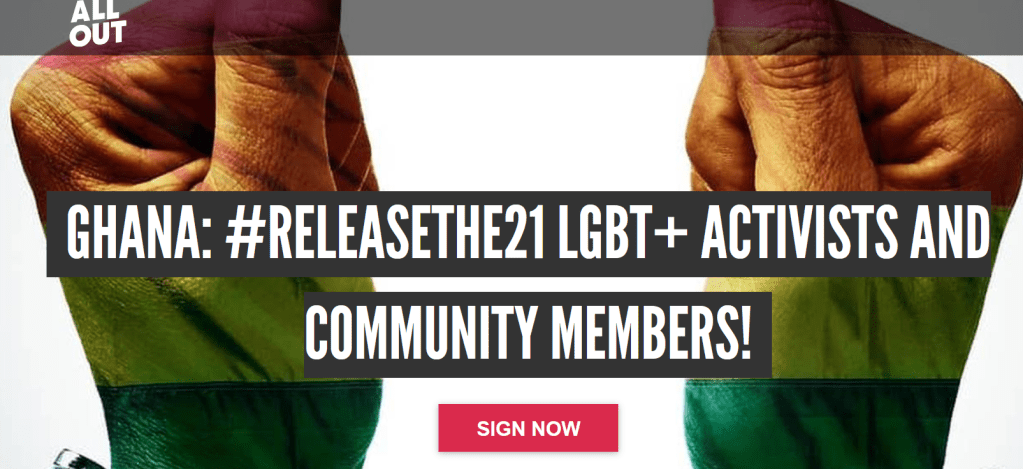
Urgent Petition: Ghana: #ReleaseThe21 LGBT+ activists and community members!
It’s Mathias from All Out. I’d like to let you know about an urgent campaign an All Out member from Ghana started on our petition platform.
Here’s what you need to know:
Why is this petition important?
At least 21 people were arrested by local police in the city of Ho, Ghana, on May 20 after police stormed a workshop for LGBT+ people. The police later declared the detained were arrested for “advocating LGBT+ activities.” But the arrests were illegal – there is no law in Ghana preventing LGBT+ people or activists from gathering.
What is the petition asking for?
The petition starter is asking the authorities to release the 21 immediately and unconditionally, meaning all charges made against them must be dropped.
Why should you sign the petition TODAY?
The 21 have been in police custody for almost two weeks. Some of them suffer from medical illnesses and need treatment for trauma. And time is running out: this Friday, June 4, the court will determine what happens next. We must dial up the pressure on the authorities before then to make sure they are released immediately!
I’m in touch with the petition starter and I’ve assured them that All Out members will have their backs.
And don’t forget: you can also launch a petition like this on All Out’s platform. Just click here to get started. Maybe next time it will be your petition getting support from the global All Out movement!
Germany parliament passes law compensating gay and lesbian soldiers for past discrimination
The German parliament Thursday voted in favor of the rehabilitation and compensation of soldiers who have faced discrimination on the basis of their sexual orientation.
Until the year 2000, German military policy held that gay soldiers posed a threat to discipline and were not eligible to be superior officers. For many years gay soldiers were denied promotions, discharged from service, and could even face criminal conviction because of their sexual orientation or gender identity. The new law entitles soldiers who were discriminated against to have their convictions expunged from the record, as well as some token financial compensation, setting aside a fund of 6 million euros.
Defense minister Annegret Kramp-Karrenbauer addressed parliament before the vote, saying that they had a duty to support individuals who had been discriminated against. She later tweeted that this move shows the German army is more open and tolerant today.
The Lesbian and Gay Association in Germany released a statement saying the new law was an important step toward justice but decried the fact that the law does not go far enough. They contend the compensation is only symbolic and does not go far enough. The law also does not address all the discrimination that has taken place, noting that it only covers discrimination that happened before July 3, 2000.
The post Germany parliament passes law compensating gay and lesbian soldiers for past discrimination appeared first on JURIST – News – Legal News & Commentary.
La Cour européenne des droits de l’homme a communiqué1 au gouvernement suisse l’affaire Semenya c. Suisse (requête no 10934/21) et lui a demandé de soumettre ses observations après la phase non contentieuse.
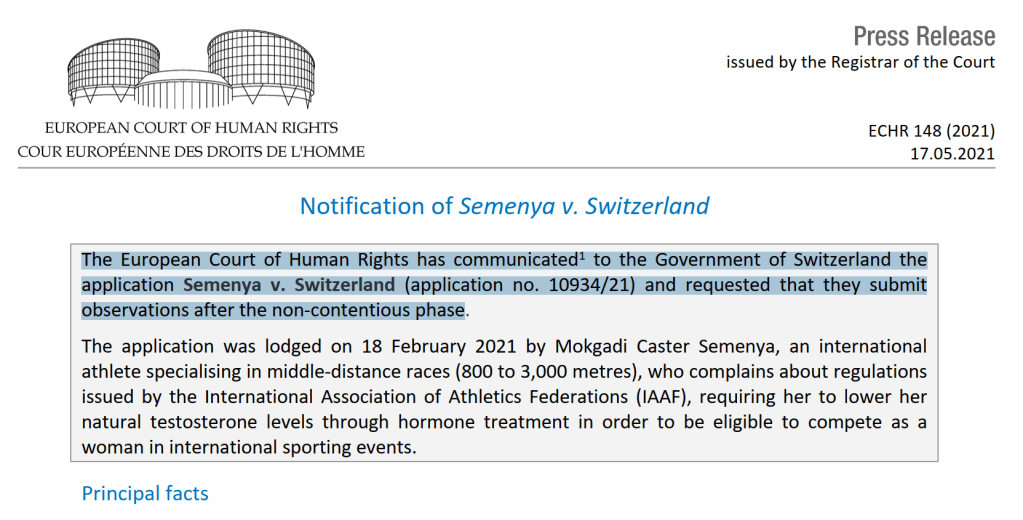
La requête a été introduite le 18 février 2021 par Mokgadi Caster Semenya, une athlète de niveau international spécialisée dans des courses de demi-fond (800 à 3 000 mètres), qui se plaint d’un règlement de l’International Association of Athletics Federations (IAAF) l’obligeant à réduire son taux naturel de testostérone par des traitements hormonaux pour pouvoir participer aux compétitions internationales dans la catégorie féminine.

Le Conseil fédéral a annoncé aujourd’hui que la votation sur le mariage pour tous aura lieu le 26 septembre 2021. Der Bundesrat hat heute bekannt gegeben, dass die Volksabstimmung über die Ehe für alle am 26. September 2021 stattfindet. See: https://www.admin.ch/gov/fr/accueil/documentation/communiques.msg-id-83585.html
The Swiss Federal Council announced today that the referendum on same-sex marriage for all will take place on 26 September 2021. — LGBTI Recht in der Schweiz – Droit LGBTI en Suisse – by Professor Andreas R Ziegler
 International and Comparative SOGIESC Law - Professor Andreas R Ziegler