This is a blog is related to my academic work in the International Academic Forum on SOGIESC Law but meant to serve anyone who wants to contribute to improve the protection of human rights worldwide. It is intended to keep interested readers informed about legal developments relating to sexual orientation, gender expression and identity and sex characteristics (SOGIESC). Hopefully, it will make it easier to find correct legal information about the developments in all regions of the world and, in particular, with regard to international law.
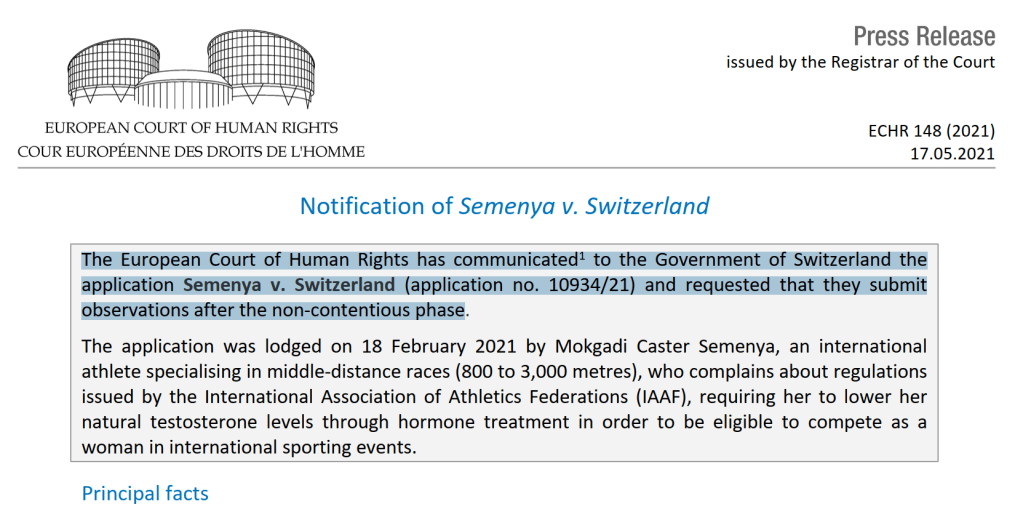
La Cour européenne des droits de l’homme a communiqué1 au gouvernement suisse l’affaire Semenya c. Suisse (requête no 10934/21) et lui a demandé de soumettre ses observations après la phase non contentieuse.
La requête a été introduite le 18 février 2021 par Mokgadi Caster Semenya, une athlète de niveau international spécialisée dans des courses de demi-fond (800 à 3 000 mètres), qui se plaint d’un règlement de l’International Association of Athletics Federations (IAAF) l’obligeant à réduire son taux naturel de testostérone par des traitements hormonaux pour pouvoir participer aux compétitions internationales dans la catégorie féminine.
Le Conseil fédéral a annoncé aujourd’hui que la votation sur le mariage pour tous aura lieu le 26 septembre 2021. Der Bundesrat hat heute bekannt gegeben, dass die Volksabstimmung über die Ehe für alle am 26. September 2021 stattfindet. See: https://www.admin.ch/gov/fr/accueil/documentation/communiques.msg-id-83585.html
Published on Monday, May 17 2021, ILGA-Europe’s annual Rainbow Europe Map and Index, ranking the legal and policy situation of LGBTI people in 49 European countries, finds that over the past 12 months advances in LGBTI rights have come to almost a complete standstill
CtEDH: Le refus de reconnaître un couple (de même sexe ou de sexe opposé) comme les parents d’un enfant né d’une gestation pour autrui ne constitue pas une violation de la CEDH
In today’s Chamber judgment in the case of Valdís Fjölnisdóttir and Others v. Iceland (application no. 71552/17) the European Court of Human Rights held, unanimously, that there had been: no violation Article 8 (right to respect for private and family life) of the European Convention on Human Rights.
The case concerned the refusal to recognise a parental link between Ms Fjölnisdóttir and Ms Agnarsdóttir and X. The latter had been born to them via a surrogate mother in the United States, but neither of the first two applicants is biologically related to him. They had not been recognised as the child’s parents in Iceland, where surrogacy is illegal.
The Court found that despite the lack of a biological link between the applicants, there had been “family life” in the applicants’ relationship. However, the Court found that the decision not to recognise the first two applicants as X’s parents had had a sufficient basis in domestic law and, taking note of the efforts on the parts of the authorities to maintain that “family life”, ultimately adjudged that Iceland had acted within its discretion in this case.
Switzerland: Level of LGBTQ abuse stays constant but violence decreases Photo by Vijay Putra on Pexels.com An organisation representing the LGBTQ community in Switzerland says complaints of abusive behaviour have not declined, despite the law against hate crimes currently being tightened. This content was published on May 17, 2021 – 14:01 May 17, 2021 – […]
USA: Department of Health and Human Services affirms nondiscrimination protections in health care for more than 13 million LGBT people
HS affirms nondiscrimination protections in health care for more than 13 million LGBT people
On Monday 10 May 2021, the U.S. Department of Health and Human Services reinstated federal protections from discrimination based on sexual orientation and gender identity in health care. The regulation will provide protection from discrimination for an estimated 13 million LGBT people ages 13 and older, including more than 1.5 million transgender people.
LGBT people experience health disparities compared to non-LGBT people and often lack access to health care. Recent research from the Williams Institute found that many LGB and transgender people have underlying health conditions that could increase their risk for COVID-19-related illness, including asthma, diabetes, heart disease, and HIV. In addition, discrimination against LGBT people in health care settings is well documented and takes many forms, including outright denials and substandard care.
USA: LGBQ people six times more likely than general public to be stopped by police
New research from the Williams Institute finds more LGBQ adults than people in the general United States population have had interactions with the police, including being stopped by police and seeking help from police.
Six times as many LGBQ people as people in the general population were stopped by the police in public spaces, and more than twice as many were stopped by the police while driving. Nearly seven times as many LGBQ people were stopped by the police for reasons that did not involve a vehicle. In addition, twice as many LGBQ people as the general public had sought help from the police.
Hungary: Amendment of the provisions on legal recognition of gender
The Constitutional Court annulled the provision of the Registry Act that the new rules (from came i2020) shall be applied to ongoing legal gender recognition proceedings as well.