This is a blog is related to my academic work in the International Academic Forum on SOGIESC Law but meant to serve anyone who wants to contribute to improve the protection of human rights worldwide. It is intended to keep interested readers informed about legal developments relating to sexual orientation, gender expression and identity and sex characteristics (SOGIESC). Hopefully, it will make it easier to find correct legal information about the developments in all regions of the world and, in particular, with regard to international law.
USA: Justices Thomas, Alito criticize same-sex marriage ruling in turning away Kentucky clerk’s case
The US Supreme Court denied the petition for a writ of certiorari on Monday filed by a former Rowan County, Kentucky, clerk who was sued for refusing to issue marriage licenses to same-sex couples following the landmark Obergefell v. Hodges decision that legalized same-sex marriage nationwide.
In the petition, Davis’s lawyers argued that her refusal to issue marriage licenses did not impose a substantial burden on the plaintiffs’ right to marry. Furthermore, they argued that Davis was entitled to qualified immunity, a doctrine that immunizes government officials from lawsuits alleging infringement of constitutional rights unless the conduct violates clearly established federal law.
The Sixth Circuit already rejected Davis’s arguments, and the Supreme Court declined to revisit the issue. Justice Clarence Thomas, in a statement joined by Justice Samuel Alito, agreed not to hear the case. However, Thomas also used his concurrence to criticize the court’s previous decision in Obergefell:
Moreover, Obergefell enables courts and governments to brand religious adherents who believe that marriage is between one man and one woman as bigots, making their religious liberty concerns that much easier to dismiss. … Obergefell was read to suggest that being a public official with traditional Christian values was legally tantamount to invidious discrimination toward homosexuals. This assessment flows directly from Obergefell‘s language, which characterized such views as “disparag[ing]” homosexuals and “diminish[ing] their personhood” through “[d]ignitary wounds.”
Thomas also criticized Sixth Circuit Judge John Bush’s concurrence in the Sixth Circuit decision, because Bush stated Davis was motivated by “anti-homosexual animus.”
Thomas’s statement caused alarm among some LGBT activists, although it is unclear whether a new court with Amy Coney Barrett would overturn Obergefell.
NeverGiveUp: Proposed anti-LGBTI amendments to the Russian Family Code explained (ILGA-Europe)
In July 2020, seven Russian senators introduced three bills to the State Duma, seeking to amend the Russian Family Code. With the purpose of “strengthening the family institute,” if approved, this legislative package would further limit the rights of LGBTI people. Here we bring you a breakdown of the proposed amendments and their potential impact.
The 180 pages of proposed amendments to the Russian Family Code could affect anyone living in the country. Furthermore, three pages refer specifically to sexual orientation, gender identity and expression, and sex characteristics (SOGIESC). How will these amendments impact the lives of LGBTI people in Russia, if the legislative package is adopted?
1. A box to indicate “sex at birth” will be included in birth certificates and changes to this category will not be possible.
People who made changes on their birth certificates will have to replace them with the old information by January 2022.
People who access the legal gender recognition procedures will be left with an incorrect birth certificate, leading to a mismatch between the birth certificate and other identity documents, such as passports.
While there is no ban on legal gender recognition (LGR) per se, or on gender-affirming treatment, the proposed changes would render the existing legal gender recognition procedure incomplete. This will have far-reaching consequences for trans and intersex individuals accessing LGR.
2. To register marriages legally, birth certificates might be requested if an official demands so.
Any marriage will be banned de facto for many trans people. With different gender markers on a birth certificate and passport, any marriage of a trans person, regardless of their sexual orientation, might be qualified by officials as a ‘same-sex marriage’, which is not allowed in Russia. This will have lasting impacts on a wide range of rights emerging from marital status.
3. The draft laws further cement barriers to equal family rights for LGBTI people.
A ban on same-sex marriage will be added to the Family Code, complementing the existing constitutional ban.
Adoption and guardianship will be banned for same-sex couples who registered their marriage abroad, and for unmarried individuals with citizenship in countries where same-sex marriages are possible. This ban already exists in Russian legislation.
What else?
These bills will not only affect LGBTI people. If adopted, children at the risk of abuse will not be removed from the family before the enforcement of a court decision. In the best scenario, this will take at least one month.
What can you do?
The State Duma can pass these bills any time. Here it is what you can do to prevent this from happening:
Write to your contacts at the UN, Council of Europe and OSCE, to flag and condemn the draft law, which would infringe on several internationally enshrined human rights, and remind Russia of its obligations to respect, protect and fulfill human rights for all people without discrimination.
Issue a statement/joint statement condemning the adoption of discriminatory laws limiting fundamental rights of LGBTI people in Russia: putting legal gender recognition of trans people in limbo, banning de facto marriage for trans people, cementing a ban on same-sex marriages and adoption by same-sex couples, and disallowing any recognition of same-sex marriages registered abroad .
Where possible, acknowledge the broader negative impact of the proposed laws, such as: weakening protection of child from domestic abuse, excessive regulation of family matters, limiting right of the child to adoption, redefining parenthood for adoptive parents.
Join us in showing your solidarity with Russian LGBTI activists in support of their tireless work! Post your selfie to your social media holding a sign saying ‘Never Give Up’ using the hashtag #NeverGiveUp!
Suggested messages:
1. The proposed ‘Traditional Values’ law in #Russia will eliminate #gender recognition for #trans and #intersex people. I stand in solidarity with Russia’s strong #LGBTI activists, who will #NeverGiveUp their fight for freedom and equality
2. The proposed ‘Traditional Values’ bill in Russia will further discrimination against LGBTI people in Russia, including partnership and guardianship rights. I stand in solidarity with Russia’s strong #LGBTI activists, who will #NeverGiveUp their fight for freedom and equality
3. Russia’s proposed ‘Traditional Values’ law reverses current gender recognition & violates the European Convention on Human Rights, to which Russia is a party. I stand in solidarity with Russia’s strong #LGBTI activists, who will #NeverGiveUp their fight for freedom and equality Tags: Russiafamily#NeverGiveUp
Posted: 13 Sep 2020 02:44 PM PDT The Telegraph has reported that “Britain is preparing to opt out of major parts of European human rights laws”. “Boris Johnson’s aides and ministers” are reportedly “drawing up proposals to severely curb the use of human rights laws in areas in which judges have ‘overreached’”. It is not made clear exactly which judges have “overreached”, or the areas of law in which this overreach has occurred, but the article explicitly mentions “asylum cases”. Details of the potential “opt out” are vague, but include “opt-outs from the Human Rights Act” which, reportedly, are being considered by “several Whitehall departments, including Number 10, the Ministry of Justice, the Home Office and the Ministry of Defence”. “One option”, it is said, “is to amend the Human Rights Act or disapply its provisions”, and other options include so-called “less radical changes” that are “designed to affect how judges interpret the law rather than changing the substance of the Act”.
It is also reported that “Senior Government figures want to roll back the influence of the European Court of Human Rights in Strasbourg, which several Cabinet ministers have accused of distorting the 67-year-old European Convention on Human Rights” (ECHR). “Senior Tories insist”, it is said, that “the ECHR was never intended to be used in the way it is now relied on…”
Nothing new
In some ways, the Telegraph article reports nothing new.
Back in 2014, the Conservative Party set out its proposal to repeal the Human Rights Act 1998 (HRA 1998), replace it with a new “British Bill of Rights and Responsibilities”, and raised the prospect that the UK might withdraw from the ECHR. The Conservative Party plan was based on a number of claims, not least that the HRA 1998 was said to undermine the role of UK courts when deciding human rights cases and “undermines the sovereignty of Parliament, and democratic accountability to the public”.
The Conservative Party suggested that the UK should remain committed to the ECHR, but only if “the Council [of Europe] will recognise these changes to our Human Rights laws”. The threat was clear: the Conservative Party said that in “the event that we are unable to reach that agreement [with the Council of Europe], the UK would be left with no alternative but to withdraw from the European Convention on Human Rights”. My colleagues and I considered the implications of this in a policy paper in 2015.
The Conservative Party’s 2015 election manifesto repeated the intention to “scrap” the HRA 1998 and replace it with a “British Bill of Rights”. It also promised to “curtail the role of the European Court of Human Rights”. The Conservative Party’s 2019 election manifesto had less detail, but did contain the proposal that “[w]e will update the Human Rights Act and administrative law to ensure that there is a proper balance between the rights of individuals, our vital national security and effective government”. Alongside this there has been a continuous stream of anti-ECHR rhetoric from senior Conservative Party officials, such as the then Home Secretary, Theresa May, who, in 2016, argued forcefully that the UK should leave the ECHR.
In short, senior figures in the Conservative Party have repeatedly made it clear over the last six years that they want to fundamentally change the scope and influence of European human rights law in the UK. Today’s Telegraph article tells us the Conservative Party may have this back on its agenda.
Why LGBT people should be worried
The ECHR has been fundamental to developing LGBT rights and freedoms in the UK; it is the bedrock of many rights and freedoms that LGBT people in the UK enjoy today.
The European Court of Human Rights, which is the highest judicial authority in respect of interpreting the rights and freedoms contained in the ECHR, has been central in safeguarding the rights of LGBT people in the UK.
The HRA 1998, in simple terms, brings the ECHR closer to home. It means that any court in the UK – from magistrates’ courts in England and Wales, to the UK Supreme Court – must take into account the jurisprudence of the European Court of Human Rights when considering any matter in connection with an ECHR right. Moreover, the HRA 1998 also requires that any UK legislation must operate in a way that is compatible with our ECHR rights.
The ECHR, in combination with the HRA 1998, provides LGBT people with one of the most powerful resources available to us to address the widespread forms of discrimination that we encounter in our lives. The ECHR provides LGBT people with one of the strongest shields to hold up against some of the most odious forms of discrimination.
The ECHR is a shield LGBT people have been using for a long time. Just three months after it was possible to make an application under the ECHR in Strasbourg in 1955, an individual in Germany submitted the first application concerning discrimination related to sexual orientation. Lesbian and gay people in the UK have been taking cases under the ECHR to Strasbourg since 1975, and trans people in the UK have been doing the same since 1981.
Decades of LGBT people in the UK taking cases under the ECHR to Strasbourg has resulted in, for example, the progressive decriminalization of male same-sex sexual acts, reform of the “age of consent”, the removal of the ban on gay people serving in the armed forces, and the right of trans people to full legal recognition of their sex/gender identity. The ECHR protects LGBT people from regressive action by this or future UK governments that may seek to “roll back” these important developments in human rights protection.
The ECHR continues to give LGBT people protection from discrimination in our everyday lives. For example, the ECHR in combination with the HRA 1998, provided the UK Supreme Court with a strong foundation for deciding, in 2013, that it was not lawful for Christian hotel keepers, who sincerely believed that sexual relations outside marriage are sinful, to refuse a double-bedded room to a same-sex couple. Similarly, the ECHR in combination with the HRA 1998, provided the foundation for an Employment Tribunal, in 2019, to conclude that certain “gender critical” beliefs about trans people are “not worthy of respect in a democratic society” and, consequently, not protectable under equality law.
The protective shield that the ECHR provides to LGBT people, and the capacity that the HRA 1998 creates to use that shield in the UK courts, could be severely diminished by the plans of the Conservative Party.
The lies they will tell us
Any plans that the Conservative Party come up with, to either reduce the scope of or disapply the HRA 1998, or curtail the UK’s commitment to the ECHR, will be cheered on by Eurosceptics and others. They will tell us a lot of half-truths, and downright lies, about the HRA 1998, the ECHR, and the European Court of Human Rights.
We will certainly hear, again and again, that human rights law is being abused, both by activist lawyers and activist judges, and has “gone beyond” what it was designed to do. We will be told that the European Court of Human Rights has usurped the power of democratically elected governments by way of an ever-expanding interpretation and application of the ECHR, continually adding rights in areas that should be left to governments to legislate in.
But when we hear claims like this we should remember the history – described in detail here – of the development of LGBT human rights under the ECHR. We should remember that there has never been any “judicial activism” or “overreach” when it comes to LGBT human rights. In fact, the opposite is true. As I argued here, whilst the European Court of Human Rights has certainly played an important part in bringing about changes to UK laws that once discriminated against people on the grounds of sexual orientation and/or gender identity – and I mentioned some of them above – it has also frequently adopted a conservative interpretation of the ECHR and, much to the disappointment of LGBT people, rejected complaints about discrimination.
When it comes to LGBT issues, it is “restraint” rather than “activism” that has usually been a hallmark of the European Court of Human Rights’ approach to interpreting the ECHR. So, whilst some would have us believe that the European Court of Human Rights has invented mechanisms to enable it to give rights away to everyone, the reality is that it is usually very cautious in evolving its interpretation of the ECHR. As a result, to put it simply, when LGBT people have knocked at the door of the European Court of Human Rights and asked for help, they have very often had the door slammed in their faces.
One of the reasons for this, as I set out in the Third Annual Belfast Pride Law Lecture, is that the European Court of Human Rights has itself often pandered to popularism when it comes to “gay issues” and, in doing so, decided not to side with gay people in ways that would be unpopular with European governments or the majority of people. It continues to do so, for example, on the subject of same-sex marriage, sticking rigidly to a heteronormative view of marriage and continually telling same-sex couples that, unlike different-sex couples, they have no human rights to marry.
For LGBT people, therefore, European human rights law has never been “activist” and has never “overreached”. It has evolved, painfully slowly, in response to LGBT people patiently bringing claims of discrimination, often failing, and trying over and over again to persuade those charged with interpreting the ECHR that gay rights are indeed human rights.
In short, there has never been and there is no “rights department store” where LGBT people can buy all the human rights we want, served to us by an over-reaching and activist judicial assistant. All of our human rights have been hard-won and have developed from long years of legal struggle in response to intense discrimination (listen to the voices of some of the brave people who engaged in that struggle).
The development of LGBT human rights under the ECHR is an exemplar of how the ECHR system can rarely accurately be described as activist.
So why should LGBT people guard the ECHR and the HRA 1998?
LGBT people should recognise the important role that the ECHR has played in the development of LGBT rights, and the ways the European Court of Human Rights has evolved its interpretation of the ECHR to protect LGBT people. We should also recognise the limitations of the ECHR system and, not least, that the European Court of Human Rights frequently doesn’t recognise that differences in treatment based solely on sexual orientation or gender identity amount to a violation of the ECHR. There is no contradiction in recognising the importance and also the limitations of the ECHR system for LGBT people. In my view, it’s important to recognise where the limitations lie and try to address them, so as to improve human rights protection for LGBT people in the future. One of the reasons that the ECHR system sometimes fails LGBT people is because those charged with interpreting the ECHR sometimes adopt a socially conservative or cautious approach to LGBT rights. Such an approach is encouraged in a context in which unpopular decisions or judgments by courts are so often used to threaten the legitimacy of human rights law and those who adjudicate it. That’s why the Conservative Party’s agenda of attacking the legitimacy of the HRA 1998 and the ECHR is so worrying for LGBT people. At the very least, it encourages a climate that is antithetical to the proper functioning of human rights law. It encourages the conservative and cautious approach to human rights law that is unhelpful to LGBT people seeking to address the discrimination we face. As the history of the development of LGBT human rights shows, we need to foster and promote a climate in which those charged with interpreting human rights law feel empowered to take decisions that best protect human rights regardless of when these decisions are unpopular, or claimed to be unpopular. The ECHR system works best, at the domestic and international levels, when it has firm political support. But the Conservative Party may have a different vision: a vision of a future in which UK courts are limited in how they can apply the ECHR and, if this creates problems down the line in the European Court of Human Rights, a battle over the ECHR itself. Attacking the legitimacy of human rights law is a means of achieving that vision. So LGBT people should beware on at least two fronts: first, we should beware claims of “judicial activism” and human rights “overreach”, because these bogus claims threaten the legitimacy of the ECHR and those that interpret it; and, second, we should beware a diminishing of the capacity to practically utilise ECHR rights to combat discrimination. We should get ready to fight to protect the HRA 1998 and the ECHR because, for all its faults, the ECHR system is the best framework we have for safeguarding our hard-won rights and freedoms, and evolving them in the future.
Paul Johnson: 70th anniversary of the ECHR – your reflections on LGBT rights welcome!
The 4th November 2020 will mark the 70th anniversary of the European Convention on Human Rights being opened for signatures.
To mark this occasion I would like to collect together some reflections on the enduring importance of the ECHR for the protection of LGBT human rights.
If you would like to provide a reflection – which I will publish here on the ECHR Sexual Orientation Blog on 4th November 2020 – then I invite you to do the following…
A short reflection (up to 250 words) on why the ECHR is important for LGBT human rights.
You can write whatever you like, obviously, but you might want to point out what you feel the ECHR has achieved for LGBT people, and what the ECHR might achieve for LGBT people in the future. You might also want to reflect on aspects or issues relating to the European Court of Human Rights, or the wider Council of Europe. It’s up to you!
Your name, as you would like it to appear, and any affiliation you want to be shown next to your name.
It’s that simple!
Please participate, send me your reflections, and let’s remind Europe (and the rest of the world) just how important the ECHR is for lesbian, gay, bisexual and transgender people!
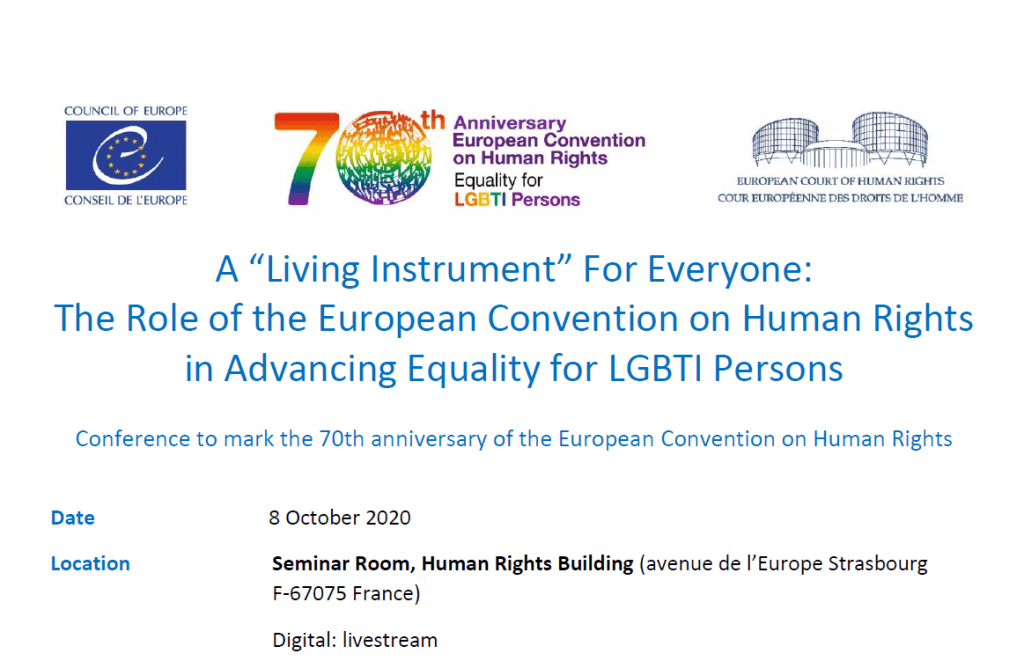
A “Living Instrument” For Everyone: The Role of the European Convention on Human Rights in Advancing Equality for LGBTI Persons – Conference to mark the 70th anniversary of the European Convention on Human Rights – Date 8 October 2020, livestream
Location Seminar Room, Human Rights Building (avenue de l’Europe Strasbourg F-67075 France)
*For smartphones and tablets: application Kudo Live and ID 111111789326
CONCEPT NOTE
The Convention for the Protection of Human Rights and Fundamental Freedoms, better known as the European Convention on Human Rights (“the Convention”), opened for signature in Rome on 4 November 1950, is perhaps the most successful and illustrious international legal instrument in the history of humanity. It enshrines the view that common understanding and observance of human rights, together with an effective political democracy, are prerequisites for ensuring justice and peace on the European continent. The Convention catalogues the fundamental rights and freedoms that represent the core values of a liberal democracy and establishes a mechanism to hold the High Contracting Parties accountable at a supranational level for the violations of these rights imputable either directly or indirectly to a State.
This supervisory mechanism (“the Convention mechanism”) is a shared responsibility between the State Parties and the European Court of Human Rights (“the Court”), established on 21 January 1959 “to ensure the observance of the engagements undertaken by the High Contracting Parties in the Convention and Protocols thereto”. The Court’s approach to the exercise of its powers to interpret the Convention is based on the premise that the latter is “a living instrument which must be interpreted in the light of present-day conditions and of the ideas prevailing in democratic States today” in a manner “consistent with the general spirit of the Convention, an instrument designed to maintain and promote the ideals and values of a democratic state”. Over the course of the past seven decades, the Convention has evolved to reflect the rapid evolution of societal norms and attitudes in every area of human life, including sexual orientation and gender identity.
Sexual orientation and gender identity are aspects of who we are. To be denied the effective enjoyment of the right to freedom of private and/or family life, of expression, or of assembly, to be ostracised or assaulted on account of one’s perceived failure to fit in the strictly construed societal mould of gender roles is to be denied the opportunity to exercise autonomy over one’s life.
Equality, pluralism and tolerance are notions inherent in a democratic society. Seeing democracy as one of the most progressive achievements of humanity, the Court has consistently put a strong emphasis on the need to protect an individual from the oppression by the majority. In the Court’s own words, “although individual interests must on occasion be subordinated to those of a group, democracy does not simply mean that the views of a majority must always prevail: a balance must be achieved which ensures the fair and proper treatment of people from minorities and avoids any abuse of a dominant position”.
The Convention mechanism is undeniably far from perfect. However, notwithstanding multiple limitations inherent in the functioning of a supranational arbiter, an application to the Court remains a powerful – and, in some instances, the only – tool to assert a claim to equality that has its practical uses. LGBTI persons within the jurisdiction of a Member State of the Council of Europe seeking redress against alleged violations of the rights and freedoms guaranteed by the Convention have a vested interest in accessing information on examples of a successful litigation of a case involving a SOGIESC element.
The primary purpose of the Conference is to celebrate the achievements in advancing equality for LGBTI persons with a view to bringing a SOGIESC issue before national jurisdictions and before the Court. It is addressed both to legal professionals and members of the general public interested in the topic. Another important aim of this Conference is to bring together a wide range of actors, including Judges of the Court, representatives of various bodies of the Council of Europe, and representatives of civil society with a view to approach the themes under discussion in a transversal manner.
The Conference will focus on three major topics: (i) the situation of transgender persons; (ii) same sex civil unions and equal marriage; (iii) hate speech directed at LGBTI persons.
PROGRAMME
October 2020
Venue
Time
Seminar Room (Human Rights Building, rez-de-jardin)
9.20 a.m. – 3.10 p.m. Central European Time
9 a.m.
Registration of the participants present on-site
9.20 a.m.
Screening of a short film
Testimonials by applicants
9.30 a.m.
Opening remarks
Gabriella Battaini-Dragoni, Deputy Secretary General of the Council of Europe Marialena Tsirli, Deputy Registrar and Registrar-elect of the ECHR
9.45 a.m.
Keynote speech
Robert Spano, President of the European Court of Human Rights
Panel I
The long road to ensuring respect for human dignity of transgender persons: Christine Goodwin v. the United Kingdom and the Court’s subsequent case-law
Moderator
Jeroen Schokkenbroek, Director of Anti-Discrimination, Council of Europe
The Christine Goodwin judgment was a remarkable success when it was adopted in 2002. It gave momentum to an important reform at the national level that resulted in the adoption of the UK Gender Recognition Act 2004. Moreover, this judgment played a pivotal role in the success of the litigation brought by Ms Lydia Foy before the Irish courts, which, in its turn, led to the adoption of the Irish Gender Recognition Act 2015. However, the Christine Goodwin judgment was a milestone on the long road, not the end of it. Has Europe made further advances as regards equality for transgender persons?
10.30 a.m.
Michael Farrell, First Vice-Chair, European Commission against Racism and Intolerance; Counsel to Ms Lydia Foy
10.40 a.m.
Clare Brown, Head of Section, Department for the Execution of Judgments of the ECHR
10.50 a.m.
Masen Davis, Interim Executive Director, TGEU
11 a.m.
Panel discussion
11.15 a.m.
Questions and Answers
11.30 a.m.
Break: disinfection of the room
Panel II
Oliari and Others v. Italy – a success story in the field of recognition and protection of same-sex civil unions
Moderator
Breifne O’Reilly, Ambassador, Permanent Representative of Ireland to the Council of Europe
The Oliari and Others judgment and the Legge Cirinnà adopted in response to it give a brilliant example of the capacity of the Convention human-rights protection mechanism to bring about an important societal change in a relatively short span of time through close cooperation between various actors responsible for the mechanism (in particular, the Court itself, the Department for the Execution of Judgments of the ECHR, and the national authorities). Could this successful example be reproduced in the Member States of the Council of Europe that have not granted legal recognition to same-sex couples?
11.45 a.m.
Yonko Grozev, Judge and Section President, European Court of Human Rights
11.55 a.m.
Robert Wintemute, Professor of Human Rights Law, School of Law, King’s College London
12 noon
Matteo Fiori, Lawyer, Department for the Execution of Judgments of the ECHR
12.05 p.m.
Giuseppe Maria Mezzapesa, Counsellor, Italian Court of Audit, and expert of UNAR – Italian Equality Body
12.15 p.m.
Géraldine Mattioli-Zeltner, Adviser, Office of the Commissioner for Human Rights
12.25 p.m.
Panel discussion
12.35 p.m.
Questions and Answers
12.45 p.m.
Lunch break
Panel II
Hate speech directed at LGBTI persons: a new frontier. Cases of Beizaras and Levickas v. Lithuania and Lilliendahl v. Iceland
Moderator
Nina Nordström, Ambassador, Permanent Representative of Finland to the Council of Europe
Freedom of expression is undoubtedly one of the essential foundations of a democratic society and one of the basic conditions for its progress and for each individual’s self-fulfilment, but does it include the right to verbally attack another person solely because of their sexual orientation or gender identity? In 2020, the Court’s answer is an emphatic ‘no’. In two recently adopted ground-breaking legal acts, the Beizaras and Levickas v. Lithuania judgment and the Lilliendahl v. Iceland decision, the Court took a stand against hurtful and hateful online comments directed at LGBTI persons.
2 p.m.
Egidijus Kūris, Judge, European Court of Human Rights
UK: Michael Cashman asked the government to explain where in the world cis men have abused self-ID to hurt women. They couldn’t
Michael Cashman posed a simple question to a Tory government minister: When has a cisgender man ever self-identified as a woman to commit crimes?
The response? Silence.
Conservative peer Elizabeth Berridge, a junior minister for women, fielded questions from the House of Lords Friday morning (September 25), regarding her boss Liz Truss’ decision to abandon reforms to the Gender Recognition Act.
Among them was Stonewall co-founder Cashman, a non-affiliated peer. He grilled Berridge on the government’s “woefully inadequate” response to a public consultation which revealed strong public support for trans people’s right to self-identification.
Appearing via video uplink, Cashman said Truss’ response “fails to take into account the Government’s own consultation”.
“This is at a time when gross defamation and gross misrepresentation on trans people, particularly trans women, has been whipped up by the media and by some members of your lordship’s house,” he continued, an LGBT+ Pride flag hanging behind him and a trans Pride pin adorning his tie.
Cashman asked Berridge to explain “how the government will address the real needs of trans people, as indicated overwhelmingly in the consultation”.
He further asked her to clarify Truss’ statement, “when the secretary of state said: ‘Self-declaration would be abused by men.’”
The barbed whataboutery of a cisgender man self-identifying as a woman to commit acts of violence is frequently wielded like a club by anti-trans campaigners without evidence.
Cashman continued: “What evidence of widespread abuse does the secretary of state have from other jurisdictions that have moved to self-ID, or does the secretary of state believe British men are uniquely abusive?”
A stuttering Berridge returned to the despatch box, saying the government believes self-identification needs “formality”. Cashman burrowed his brow as she added: “We do not believe we need to move away from the current system.”
Despite Cashman ending his comments with a clear and concise question, Berridge failed to respond with what “evidence”, if any, there is of “abuse” of self-ID.
She instead peeled off commitments by the government, such as the lord commissioners being alerted to the spikes in transphobic hate crimes, as well as the appointment of Dr Michael Brady to advise “NHS England and others about healthcare for LGBT people.”
Interesting Article: Member-on-Member Sexual and Gender- Based Crimes as War Crimes: Towards the Autonomy of Individual Criminal Responsibility from Underlying Violations of International Humanitarian Law?
Full quote: Giuseppe Nesi & Luca Poltronieri Rossetti, Member-on-Member Sexual and Gender- Based Crimes as War Crimes: Towards the Autonomy of Individual Criminal Responsibility from Underlying Violations of International Humanitarian Law?, in: La Comunità Internazionale (Vol. 75, no. 3, 2020)
USA: Minnesota appeals court rules students must be allowed to use locker rooms corresponding with gender identity
A Minnesota Court of Appeals ruled Monday that students must be allowed to use locker rooms that align with their gender identity.
The appeal stems from a case in which a transgender high school student, referred to as N.H., was threatened discipline should he continue to use the boys’ locker room. N.H. was born female but has socially transitioned to male. During his freshman year, N.H. joined the boys swim team and was initially allowed to use the boys’ locker room. Later, N.H.’s mother was informed that N.H. would be disciplined should he continue to use the main boys’ locker room.
In 2019, N.H.’s mother filed suit in Anoka County “alleging one count of violating the Minnesota Human Rights Act (MHRA) … and one count of violating the equal-protection provisions of article I, sections 1 and 7 of the Minnesota Constitution, and withdrew the charge filed at the MDHR.” The district court denied the school district’s motion to dismiss the suit but applied a strict scrutiny standard to N.H.’s claims.
The appeals court ultimately concluded that N.H. presented a claim upon which relief could be granted. “We affirm the district court’s denial of the school district’s motion to dismiss, reverse on the application of strict scrutiny, conclude that intermediate scrutiny applies to N.H.’s equal-protection claim, and remand for proceedings consistent with this opinion.”
Open letter of the Ambassadors of Albania, Argentina, Australia, Austria, Belgium, Canada, Croatia, Cyprus, the Czech Republic, Denmark, the Dominican Republic, Finland, France, Germany, Greece, Iceland, India, Ireland, Israel, Italy, Japan, Latvia, Lithuania, Luxembourg, Malta, Mexico, Montenegro, the Netherlands, New Zealand, North Macedonia, Norway, Portugal, San Marino, Serbia, Slovenia, South Africa, Spain, Sweden, Switzerland, Ukraine, the United Kingdom, the United States and Venezuela, as well as the General Representative of the Flemish Community and the Flemish Region, the General Delegate of the French Community and the Walloon Region, the Representatives in Poland of the European Commission and of the UNHCR, the First Deputy Director/Director’s alternate of the OSCE Office for Democratic Institutions and Human Rights, the Head of Office of the International Organization for Migration and the Secretary General of the Community of Democracies.
This letter has been coordinated by the Embassy of the Kingdom of Belgium in Poland.
Although due to epidemiological circumstances the 2020 Warsaw Equality Parade could not take place at the foreseen date we express our support for the efforts to raise public awareness of issues affecting the lesbian, gay, bisexual, transgender and intersex (LGBTI) community and other communities in Poland facing similar challenges.
We also acknowledge similar efforts in Białystok, Bielsko–Biała, Częstochowa, Gniezno, Kalisz, Katowice, Kielce, Koszalin, Kraków, Lublin, Łódź, Nowy Sącz, Olsztyn, Opole, Płock, Poznań, Rzeszów, Szczecin, Tarnów, Toruń, Trójmiasto, Włocławek, Wrocław and Zielona Góra.
We affirm the inherent dignity of each individual as expressed in the Universal Declaration of Human Rights.
Respect for these fundamental rights, which are also enshrined in OSCE commitments and the obligations and standards of the Council of Europe and the European Union as communities of rights and values, obliges governments to protect all citizens from violence and discrimination and to ensure they enjoy equal opportunities.
To this end, and in particular to shield communities in need of protection from verbal and physical abuse and hate speech, we need to jointly work on an environment of non-discrimination, tolerance and mutual acceptance.
This includes in particular sectors such as education, health, social affairs, citizenship, public service and public documents.
We pay tribute to the hard work of LGBTI and other communities in Poland and around the world, as well as the work of all those who seek to ensure human rights for LGBTI and other persons belonging to communities facing similar challenges, and to end discrimination in particular on the basis of sexual orientation or gender identity.
Human rights are universal and everyone, including LGBTI persons, are entitled to their full enjoyment.
This is something that everyone should support.
Signed,
H.E. Shpresa Kureta, Ambassador of the Republic of Albania
H.E. Ana María Ramírez, Ambassador of the Argentine Republic
H.E. Lloyd David Hargreave Brodrick, Ambassador of Australia
H.E. Werner Almhofer, Ambassador of Austria
H.E. Luc Jacobs, Ambassador of the Kingdom of Belgium
H.E. Leslie Scanlon, Ambassador of Canada
H.E. Tomislav Vidošević, Ambassador of the Republic of Croatia
H.E. Petros Kestoras, Ambassador of Republic of Cyprus
H.E. Ivan Jestřáb, Ambassador of the Czech Republic
H.E. Ole Toft, Royal Ambassador of Denmark
H.E. Aníbal de Castro, Ambassador of the Dominican Republic
H.E. Juha Ottman, Ambassador of Finland
H.E. Frédéric Billet, Ambassador of France
H.E. Arndt Freytag von Loringhoven, Ambassador of Germany
H.E. Michael-Efstratios C. Daratzikis, Ambassador of the Hellenic Republic
H.E. María Erla Marelsdóttir, Ambassador of Iceland
H.E. Tsewang Namgyal, Ambassador of India
H.E. Emer O’Connell, Ambassador of Ireland
H.E. Alexander Ben-Zvi, Ambassador of Israel
H.E. Aldo Amati, Ambassador of Italy
H.E. Tsukasa Kawada, Ambassador of Japan
H.E. Edgars Bondars, Ambassador of Latvia
H.E. Eduardas Borisovas, Ambassador of the Republic of Lithuania
H.E. Paul Schmit, Ambassador of the Grand Duchy of Luxembourg
H.E. John Paul Grech, Ambassador of Malta
H.E. Alejandro Negrín, Ambassador of Mexico
H.E. Budimir Šegrt, Ambassador of Montenegro
H.E. Daphne Bergsma, Ambassador of the Kingdom of the Netherlands
H.E. Mary Thurston, Ambassador of New Zealand
H.E. Vasil Panovski, Ambassador of the Republic of North Macedonia
H.E. Anders Eide, Ambassador of the Kingdom of Norway
H.E. Luís Manuel Ribeiro Cabaço, Ambassador of Portugal
H.E. Dario Galassi, Ambassador of San Marino
H.E. Nikola Zurovac, Ambassador of the Republic of Serbia
H.E. Božena Forštnarič Boroje, Ambassador of Slovenia
Daniel StemmerChargė D’ Affaires a.i., Embassy of South Africa
H.E. Francisco Javier Sanabria Valderrama, Ambassador of Spain
H.E. Stefan Gullgren, Ambassador of Sweden
H.E. Jürg Burri, Ambassador of Switzerland
H.E. Andrii Deshchytsia, Ambassador of Ukraine
H.E. Anna Clunes, Ambassador of the United Kingdom of Great Britain and Northern Ireland
H.E. Georgette Mosbacher, Ambassador of the United States of America
H.E. Luis Gómez Urdaneta, Ambassador of the Bolivarian Republic of Venezuela
Dries Willems, General Representative of the Flemish Community and the Flemish Region
Anne Defourny, General Delegate of the French Community and the Walloon Region
Katarzyna Gardapkhadze, First Deputy Director/Director’s alternate of the OSCE Office for Democratic Institutions and Human Rights ODIHR
Marek Prawda, Head of Representation, European Commission in Poland
Christine Goyer, Representative, UNHCR Representation in Poland
Thomas E. Garrett, Secretary General of the Community of Democracies
Hanna Dobrzyńska, Director, International Organization for Migration (IOM)




 International and Comparative SOGIESC Law - Professor Andreas R Ziegler