FIFA FIFA Celebrates Pride Month: Thank you Justin! – The Justin Fashanu Foundation & Football v Homophobia use his legacy to fight discrimination


FIFA FIFA Celebrates Pride Month: Thank you Justin! – The Justin Fashanu Foundation & Football v Homophobia use his legacy to fight discrimination
Paul Johnson: European Court of Human Rights communicates case against Lithuania concerning anti-gay hate speech

| European Court of Human Rights communicates case against Lithuania concerning anti-gay hate speech Posted: 03 Jul 2020 02:47 PM PDT The Second Section of the European Court of Human Rights has communicated the case of Jonas Valaitis v Lithuania. The case concerns a journalist, Mr Valaitis, who published an article about “homosexual people” on the Internet portal of a major daily newspaper. The facts Mr Valaitis’ publication received numerous comments by different persons. Twenty two comments, written by twenty persons, were particularly negative towards persons of homosexual orientation. A couple of those comments were directly targeted against Mr Valaitis, as the author of the article. He was called “a degenerate”, “a faggot” and “a shitty asshole”, it was suggested that he should be “peed on”, he was urged “not to advertise faggots”, it was also suggested that he “should be prosecuted for propaganda that defended perverts”, and that he “kept his shitty opinion to himself” and “did not offend normal persons”. The comments towards homosexual persons were even harsher, including a suggestion that they should be “let through the chimney in Auschwitz”. Mr Valaitis asked the authorities to start a criminal investigation for incitement of hatred and discrimination, under Article 170 § 2 of the Criminal Code, which provides: A person who publicly ridicules, expresses contempt for, urges hatred of or incites discrimination against a group of persons or a person belonging thereto on grounds of sex, sexual orientation, race, nationality, language, descent, social status, religion, convictions or views shall be punished by a fine or by restriction of liberty or by arrest or by imprisonment for a term of up to two years.Initially, the authorities refused the request. Afterwards, the criminal investigation was opened and Mr Valaitis was granted the status of a victim. Eventually, the criminal investigation was discontinued by courts on the ground that the statements in the comments constituted their authors’ opinion and had been improper, but had not reached the level of severity to justify prosecution. It had also been impossible to prove the guilt of the author of one of those comments. Complaint to the Court Under Article 13 of the European Convention on Human Rights, Mr Valaitis complains that the Lithuanian authorities did not take positive measures to protect persons of homosexual orientation, as well as himself, from hate speech. Article 13, which guarantees the right to an effective remedy, states: Everyone whose rights and freedoms as set forth in this Convention are violated shall have an effective remedy before a national authority notwithstanding that the violation has been committed by persons acting in an official capacity. Questions to the Parties The Court has asked the Parties the following questions:Is Article 13 of the Convention applicable to the applicant’s case (see, mutatis mutandis, Radomilja and Others v. Croatia [GC], nos. 37685/10 and 22768/12, § 126, 20 March 2018, and Beizaras and Levickas v. Lithuania, no. 41288/15, § 150, 14 January 2020)?Has there been a violation of the applicant’s right to effective remedy, as required by Article 13 of the Convention?The Court refers to the applicant’s grievance that the State authorities had not taken measures to protect him against hate speech linked to his writing about persons of homosexual orientation (see Beizaras and Levickas, cited above, §§ 131-56; on the issue of discrimination by association, see also, mutatis mutandis, Guberina v. Croatia, no. 23682/13, § 64 in limine, 22 March 2016, and Molla Sali v. Greece [GC], no. 20452/14, § 81, 19 December 2018).Comment Following the recent decision in Carl Jóhann Lilliendahl v Iceland, it would seem almost certain that the Court will consider the impugned comments in Mr Valaitis’ case to constitute “hate speech”. In approaching the issue under Article 13 of the Convention, the Court will probably reiterate its recent finding in Beizaras and Levickas v Lithuania that the Criminal Code itself provides an effective remedy but question whether it can be “considered not to have operated effectively … due to discriminatory attitudes negatively affecting the application of national law” (§ 151). The key issue to be argued, therefore, is whether Mr Valaitis was denied his right to an effective remedy by virtue of the Lithuanian authorities having decided that the anti-gay comments had “been improper, but had not reached the level of severity to justify prosecution” – in other words, that the comments did not reach the threshold of “hate speech” under the Criminal Code. If the Court follows its judgment in Beizaras and Levickas it could find that Article 13 has been violated because the attitudes of the authorities had negatively affected the application of domestic law. The key question, therefore, is whether the domestic authorities did enough in their application of the Criminal Code to satisfy the Court that they had provided Mr Valaitis with an effective remedy or, by contrast, whether the Court considers, as it has before, that the domestic authorities did not adopt “a strict approach” to prejudice-motivated crimes and the “resultant indifference” is “tantamount to official acquiescence or even connivance in hate crimes” (Identoba and Others v Georgia § 77). My own view is that, in light of the Court’s recent jurisprudence, Mr Valaitis has a very strong case against Lithuania. |
| You are subscribed to email updates from ECHR Sexual Orientation Blog. To stop receiving these emails, you may unsubscribe now. | Email delivery powered by Google |
| Google, 1600 Amphitheatre Parkway, Mountain View, CA 94043, United States |
Yulia Ioffe: Homophobia Disguised as Children’s Rights in Russia’s Constitutional Referendum
https://verfassungsblog.de/homophobia-disguised-as-childrens-rights-in-russias-constitutional-referendum/From the 25th of June to the 1st of July, Russia is holding a referendum, in which citizens are asked to vote on a package of amendments to the country’s constitution. The referendum is largely symbolic: the proposed constitutional amendments had been passed by the Russian parliament ahead of time. Before the referendum even started, copies of the amended constitution had already been available in local bookstores. Yet, the Kremlin went to great lengths to secure a sufficient turnout in order to clothe these amendments with a semblance of legitimacy.
The amended constitution could enable President Putin to remain in power until 2036. In an interview on Russian state television, Putin confirmed that he was indeed considering extending his presidency: “We need to work, not look for successors.” However, state officials reportedly played down the resetting of presidential term limits. Instead, they focused on other amendments, especially those concerning faith in god, the preeminence of the Russian language, and the definition of marriage exclusively as a union between a man and a woman. Public advertisements calling voters to “say yes to the future” likewise included images of happy heterosexual parents.
Putin has criticized what he describes as a Western willingness to embrace homosexuality and gender fluidity, which he claims is out of step with traditional Russian values. This phrase – “traditional values” – also expressly appears in the amended constitution (Article 114). Far from being unique to Russia, this term and others like it have often been exploited by other political regimes. In the Russian context, it reflects a dual attempt: to contrast the country with Western values, on the one hand, and to align with the Orthodox Church, on the other. Ironically, it is the exposure to the West that historically informed Russia’s approach to homosexuality. The first ban on “sodomy” in the Imperial Russian military was introduced by Peter the Great after his studies in Western Europe and was borrowed from Swedish law. Similarly, it is questionable to associate “traditional values” with Orthodox Christianity in a multidenominational country with a 70-year tradition of Marxist-Leninist atheism.
Interestingly, this amendment does not directly change the definition of family, which is found in Article 38 of the constitution. Instead, another article is amended: Article 72, which lists the areas under the joint jurisdiction of the federal government and Russia’s constituent entities. In its amended version, Article 72 extends these areas of jurisdiction to include “defense of the institution of marriage as a union of a man and a woman.” By amending Article 72 rather than Article 38, Putin would be able to bypass the constitutional requirement to convene a constitutional assembly, a procedure only required for amendments to Articles 1–64 and 134–137.
Just like the referendum, the amendment relating to the definition of marriage as a union between a man and a woman is purely symbolic. The Russian Family Code (Articles 1 and 12) already defines marriage in this manner, thereby denying same-sex marriage legal recognition. In addition, Russia has introduced several anti-gay statutes in recent years, including a notorious “gay propaganda law” and an extension of the prohibition on adoption by same-sex couples to foreign nationals. Therefore, the scenario depicted in the propaganda video was not only homophobic, but also completely fictional.
At the same time, now that the exclusionary definition of marriage as a union between a man and a woman is enshrined in the constitution, it may be virtually impossible to challenge the constitutionality of the Family Code or other anti-gay legislation. Further, this constitutional amendment significantly decreases chances of Russia implementing the European Court of Human Rights decisions regarding LGBT rights. This is because, under the amended version of Article 125 of the constitution, the country’s Constitutional Court is authorized to pronounce decisions of international human rights bodies “unenforceable” when it deems them to be incompatible with the constitution.
It may be possible to argue, if the matter is brought before the European Court of Human Rights, that the amendment to Article 72 conflicts with other provisions in the Russian constitution. Key among them are Article 2, which protects “human and civil rights and freedoms,” and Article 19, which guarantees such “rights and freedoms regardless of sex … [or] other circumstances” and prohibits any “limitations of human rights on social … or religious grounds.” However, there is no guarantee that such an argument would be accepted by the court, as has been acknowledged by scholars exploring similar arguments regarding other anti-gay provisions.
The constitutional amendment regarding marriage as a union between a man and a woman exemplifies how the Russian government and its allies foster homophobia in reliance on “traditional values.” But the campaign for this amendment also illustrates something else: the invocation of children’s wellbeing to justify and promote such homophobia.
Three weeks before the referendum, a pro-Kremlin media group answerable to Yevgeny Prigozhin, a wealthy Russian businessman with ties to Putin, published a homophobic video urging the public to vote for the amendments. Taking place in the year 2035, the video features an orphan being adopted by two men. When the boy realizes this, he is distraught about the lack of a new mother. One of his adoptive fathers, wearing makeup, then presents him with a dress to wear. “Is this the Russia you choose?,” the narrator asks the viewers, adding: “Decide for the future of the country, vote for the amendments to the constitution.”
Russia, however, is hardly the only country in which such rhetoric has been in use. For instance, in the United Kingdom, until 2003, it was legally prohibited to “intentionally promote homosexuality” or “promote the teaching in any maintained school of the acceptability of homosexuality as a pretended family relationship.” And in the United States and elsewhere, child-centered arguments figured centrally in debates on legalizing same-sex marriage. Indeed, those seeking to reinforce the heteronormative social order often articulate their claims in reference to children’s “best interests” and innocence.
More troublingly still, there is an ongoing global history of children’s wellbeing being invoked to justify the oppression of disempowered groups. For centuries, children from minority groups around the world have been forcibly removed from their parents and communities. Such acts have usually been presented as “rescuing” children from harmful environments and thus serving their interests. A broad range of groups have been subjected to such large-scale child removal, including: Muslims (Uyghurs and others) in present-day China, the Yenish in 1970s Switzerland, the Inuit in Danish-ruled Greenland in the 1950s, Indigenous children in North America and Australia in the 19th and 20th centuries, Andamanese tribes in British colonial India, impoverished immigrants in the 19th–20th-century United States, non-European Jewish immigrants in 1950s Israel, “mixed-race” families in both French colonial Morocco and the Dutch East Indies (today’s Indonesia), and Christians in the Ottoman-ruled Balkans.
In these and various other contexts, as in Russia’s current debate over the constitutional referendum, a rhetoric of child protection has legitimized harm to both children and adults. For example, the separation of children and adults in prison portrays the incarcerated adults as less vulnerable and less corrigible, thereby sanctioning harshness and apathy toward them. Similarly, in international humanitarian legal discourse, the frequent use of “women and children” as a shorthand for civilians disregards men’s unique vulnerabilities in armed conflict and has sometimes paved the way for their indiscriminate targeting by the belligerent parties. The privileging of children in humanitarian aid campaigns likewise disenfranchises adults by deeming them less deserving of empathy and assistance. The list of examples could go on.
At its core, the constitutional reform appears to have been designed to enable Putin to maintain his hold on power. Although this reform consists of 206 amendments, one amendment, enshrining the heteronormative family model, is at the forefront of the campaign by the government and its allies to raise turnout for the referendum. As Russian law already excludes same-sex marriage, the amendment’s main effect is to stymie potential legal challenges to discrimination based on sexual orientation and gender identity. According to its proponents, this amendment protects children. This problematic claim, while embedded in a particular Russian context, also resonates with a global history of children’s interests being invoked to legitimize oppression and homophobia. In view of this triad of homophobia, oppression, and a child rights rhetoric, further critical attention is urgently needed both to the events in Russia and to their parallels elsewhere.

Switzerland: Survey shows surprisingly high number of surrogate babies An increasing number of families in Switzerland are turning to foreign surrogate mothers in order to have a baby. According to a report in the newspaper NZZ am Sonntag, the Swiss ban on surrogate motherhood is circumvented via foreign countries more often than previously thought. The […]
Switzerland: Survey shows surprisingly high number of surrogate babies – ignoring the problem is no solution! — LGBTI Recht in der Schweiz – Droit LGBTI en Suisse
Despite major changes in laws and norms surrounding the issue of same-sex marriage and the rights of LGBT people around the world, public opinion on the acceptance of homosexuality in society remains sharply divided by country, region and economic development.
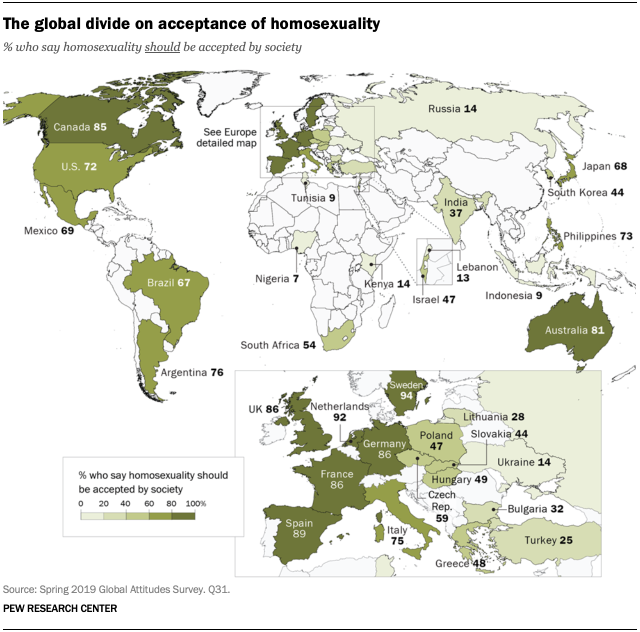
Read more: https://www.pewresearch.org/global/2020/06/25/global-divide-on-homosexuality-persists/
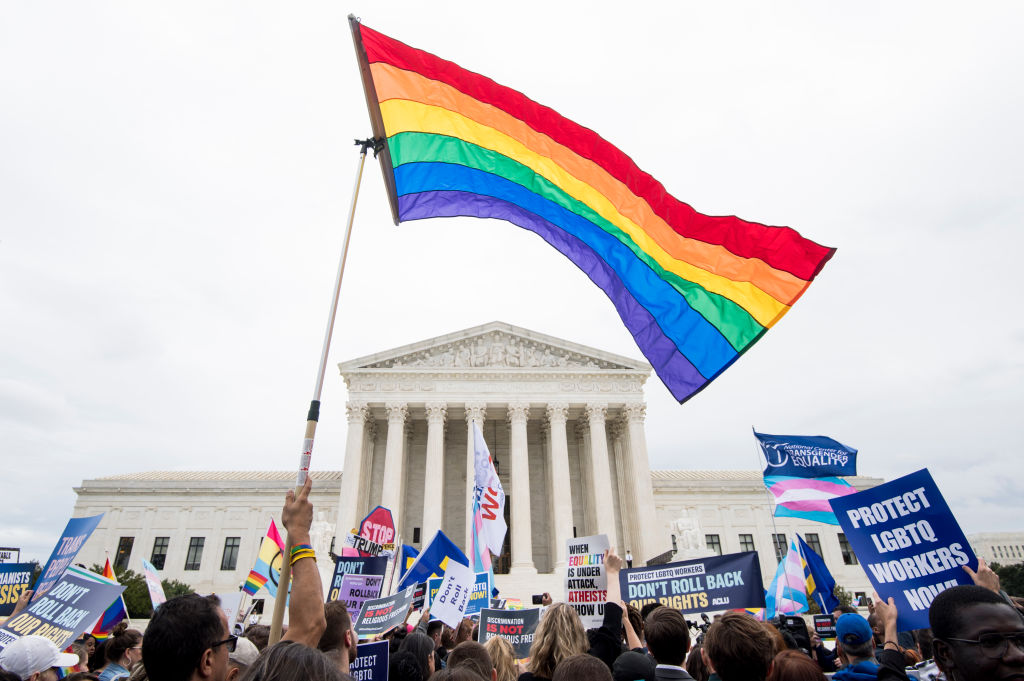
LGBT+ activists rally in front of the Supreme Court in October 2019 (Photo By Bill Clark/CQ-Roll Call, Inc via Getty Images)
The latest ruling from the US Supreme Court is being hailed as a landmark victory for LGBT+ people, but it has one glaring loophole: it doesn’t apply to small businesses.

Gay men wearing the pink triangle in a Nazi concentration camp. (Stock image)
Jewish leaders in Poland have spoken out about attempts to “dehumanise” and degrade the LGBT+ community in the country.
Poland has seen a surge in public homophobia and nationalist rhetoric over the past few years, with nearly 100 Polish municipal or local governments proclaiming themselves zones “free from LGBT+ ideology” amid the moral panic.
President of Poland Andrzej Duda has sought to capitalise on the issue amid a tough re-election battle this month, pledging to “prohibit the propagation of this ideology” in public institutions.
He has also vowed to outlaw adoption by same-sex couples, decrying “attempts to push an ideology on us and our children” and vowing: “We won’t allow [Poland] to be taken away from us.”
ILGA-Europe’s Third Party Interventions Before the European Court of Human Rights: Celebrating 20 Years of Our First Submission

The submission in Frette was initiated by our long-term supporter, Professor Robert Wintemute from King’s College London, and was inspired by his previous experience of amicus curiae submissions before US courts. The case concerned refusal of authorisation to adopt, based on applicant’s sexual orientation. Disappointingly, the Court delivered a negative judgment, referring to, among others, lack of consensus among the Council of Europe member states on adoption by gay and lesbian prospective parents, and limited number of scientific studies approving gay and lesbian parenting. Yet importantly, this case was a steppingstone for other cases before the Court, since the judgment was decided by four votes to three, and three the judges issued a supportive dissenting opinion. Many aspects of the latter were reflected in another adoption case, E.B. v France, decided positively only 6 years later in 2008.
It would be fair to suggest that this first third party intervention was an enlightening experience both for the Court and ILGA-Europe. As a first case on adoption by a gay person, it signalled the importance of family and the need to protect family rights of gay and lesbian parents. ILGA-Europe later built on the experience of providing the Court with the necessary information in order to enable positive and stronger judgments.
Thus, as the E.B. case came before the Court, ILGA-Europe once again submitted a third party intervention, also initiated by Professor Wintemute, this time jointly with other human rights organisations: Fédération Internationale des ligues des Droits de l’Homme (FIDH), British Agencies for Adoption and Fostering (BAAF), and Association des Parents et futurs parents Gays et Lesbiens (APGL). This submission provided the Court with information on “gradual trend towards full equality for same-sex couples with regard to second-parent adoption and joint adoption” among the Council of Europe member states, naming the countries which started permitting various forms of adoption to gay and lesbian couples.
In addition, the submission highlighted extensive scientific research in the field of adoption and parenting, evidencing that children raised by gay or lesbian parents do not suffer any harm in their psychological development, or exhibit any emotional, cognitive, social, and sexual functioning different to those in heterosexual families, and that parenting effectiveness is not related to parental sexual orientation.
These cases were just the beginning.
In subsequent years, more and more LGBTI organisations across Europe started to actively engage in strategic litigation work on LGBTI rights. Our work in supporting member organisations, building strategic partnership for litigation work, capacity building and peer learning, bringing in free resources to our members, sensitising the legal community, supporting implementation of judgments, as well as regarding third party interventions grew continuously. Many people contributed: LGBTI activists, legal advisors, and partners on national level; we are lucky to partner with other human rights organisations in strengthening strategic litigation on European level; and of course Nigel Warner, who until 2019 supported ILGA-Europe in developing this important area of our work.
Now 20 years on, we are working with member organisations and partners on strategic litigation cases addressing diverse areas of LGBTI rights, including hate crimes and hate speech, arbitrary arrests, detention and torture of LGBTI people, broader aspects of family rights (including but not limited to recognition of same-sex couples, custody rights, trans parenting, access to ART), legal gender recognition, asylum rights, freedom of association and assembly, anti-propaganda laws, access to goods and services and others.
Following E.B. the Court has delivered a number of positive judgments establishing strong protection framework for LGBTI rights, in many of which ILGA-Europe had intervened jointly with members and partners.
To name a few:
We would like to thank all our member organisations and engaged activists, partners, independent lawyers, researchers and academics for being partners in this important work.
ILA Assia: Newsletter May 2020
| View this email in your browser |
 |
| 01/06/2020 We share LGBTI+ related news from Asia. *You can click the underlined text and it is linked to the related article. Let’s Speak Up Together🗣️  Hello, Subscriber. It was IDAHOBIT day on the 17th of May. The slogan for this year’s IDAHOBIT day was ‘Breaking the Silence’. There are a lot of things going on around the world. #BlackLivesMatter movement is getting bigger and more serious. There were various IDAHOBIT events happened in Asia. It has been a year since Taiwanese same-sex marriage legalised first in Asia. There still are lots of individuals and community suffering from the COVID-19 pandemic situation. One of ILGA Asia’s strategic objectives is to build “Database for strategic information and knowledge sharing and building on SOGIESC issues in Asia”. This newsletter is one of the media that we are putting our efforts to achieve the objectives. This month, we’ve made a new video interview series. The first video is about the fight against 377A in Singapore Singapore High Court rejected the challenge to Section 377A last March. Hope this video helps you understand the situation and inspires your work. Lastly, we are collecting the stories of your IDAHOBIT this year so that we can share what we’ve been doing in these difficult times. Let’s not remain silent and let’s not stop raising our voices. ILGA Asia will trie our best to represent the voices of LGBTI communities in Asia. If you have any feedback, inquiry or news you want to share, please feel free to contact us. – Dowha, Communications and Membership Officer If there is any news, report or an article you want to share, please let us know. Share Your Story Here are some stories that you may have missed🛎️ 🌈Health/COVID-19 Virus pushes Pakistan’s transgender dancers out of their homes. Covid-19 update: Dedicated quarantine centres for transgenders in Manipur. South Korea’s coronavirus contact tracing puts LGBTQ community under surveillance, critics say. Linking of COVID-19 to gay clubs raises concerns among sexual minorities. 🌈Movements/Advocacy Malaysian wins landmark right to challenge Muslim gay sex ban. Malaysian launches test case against Islamic gay sex law. Press statement: Enabling access to justice for LGBTIQ persons. Taiwan LGBT group raising money to fight homophobia. Gay people in Myanmar have adopted a secret language. 🌈Discrimination/Attack Iraq condemns foreign embassies for violating country’s ‘values’ by displaying rainbow flag. Iraqi politicians call for expulsions after embassies fly LGBT flag. Japan hotels admonished for denying room to gay couple. 🌈Legislation/Law FOCUS: Freelance, LGBT wary of Japan’s new anti-harassment law. 🌈Marriage Equality/Family ‘Happily ever after’ eludes Taiwan, a year after Asia’s first gay marriages. Rights group urges Taiwan to allow cross-national same-sex marriage. Same-sex marriage, one year later. China’s same-sex couples heartened by property protection rights in new civil code. China’s LGBT activists step up push for gay marriage after official rejects change. Lawyers for gay homeowner call for his husband to be given equal treatment under Hong Kong’s inheritance laws. Lawyers for Hong Kong rights activist Jimmy Sham urge court to recognise his same-sex marriage. China’s LGBT parents find family and joy through surrogacy. China’s lesbian parenting case is a children’s rights issue. 🌈Culture/Sports New Documentary celebrates 1 year anniversary of same-sex marriage In Taiwan. Taiwan’s LGBTQ streaming platform GagaOOLala launches worldwide. How Thai LGBT show, 2gether: The Series, became an instant hit. Suk Suk film review: award-winning Hong Kong gay romance follows the twilight affair of two closeted family men. Queer Malaysian singer Alextbh on embracing his sexuality, living in a conservative society and going global. Dropped for coming out as gay, Singaporean singer Wils releases new album and wants his music to help others struggling with their identity. Korean LGBT drama Where Your Eyes Linger is a game-changer for yaoi, or ‘boys love’, gay storytelling in Asia. 🌈Education Teacher reveals high price of coming out as gay in China. 🌈Corporation StanChart extends staff mediclaim to LGBT partners. Please share your opinion on this newsletter with us! Hello, Subscriber. It was IDAHOBIT day on the 17th of May. The slogan for this year’s IDAHOBIT day was ‘Breaking the Silence’. There are a lot of things going on around the world. #BlackLivesMatter movement is getting bigger and more serious. There were various IDAHOBIT events happened in Asia. It has been a year since Taiwanese same-sex marriage legalised first in Asia. There still are lots of individuals and community suffering from the COVID-19 pandemic situation. One of ILGA Asia’s strategic objectives is to build “Database for strategic information and knowledge sharing and building on SOGIESC issues in Asia”. This newsletter is one of the media that we are putting our efforts to achieve the objectives. This month, we’ve made a new video interview series. The first video is about the fight against 377A in Singapore Singapore High Court rejected the challenge to Section 377A last March. Hope this video helps you understand the situation and inspires your work. Lastly, we are collecting the stories of your IDAHOBIT this year so that we can share what we’ve been doing in these difficult times. Let’s not remain silent and let’s not stop raising our voices. ILGA Asia will trie our best to represent the voices of LGBTI communities in Asia. If you have any feedback, inquiry or news you want to share, please feel free to contact us. – Dowha, Communications and Membership Officer If there is any news, report or an article you want to share, please let us know. Share Your Story Here are some stories that you may have missed🛎️ 🌈Health/COVID-19 Virus pushes Pakistan’s transgender dancers out of their homes. Covid-19 update: Dedicated quarantine centres for transgenders in Manipur. South Korea’s coronavirus contact tracing puts LGBTQ community under surveillance, critics say. Linking of COVID-19 to gay clubs raises concerns among sexual minorities. 🌈Movements/Advocacy Malaysian wins landmark right to challenge Muslim gay sex ban. Malaysian launches test case against Islamic gay sex law. Press statement: Enabling access to justice for LGBTIQ persons. Taiwan LGBT group raising money to fight homophobia. Gay people in Myanmar have adopted a secret language. 🌈Discrimination/Attack Iraq condemns foreign embassies for violating country’s ‘values’ by displaying rainbow flag. Iraqi politicians call for expulsions after embassies fly LGBT flag. Japan hotels admonished for denying room to gay couple. 🌈Legislation/Law FOCUS: Freelance, LGBT wary of Japan’s new anti-harassment law. 🌈Marriage Equality/Family ‘Happily ever after’ eludes Taiwan, a year after Asia’s first gay marriages. Rights group urges Taiwan to allow cross-national same-sex marriage. Same-sex marriage, one year later. China’s same-sex couples heartened by property protection rights in new civil code. China’s LGBT activists step up push for gay marriage after official rejects change. Lawyers for gay homeowner call for his husband to be given equal treatment under Hong Kong’s inheritance laws. Lawyers for Hong Kong rights activist Jimmy Sham urge court to recognise his same-sex marriage. China’s LGBT parents find family and joy through surrogacy. China’s lesbian parenting case is a children’s rights issue. 🌈Culture/Sports New Documentary celebrates 1 year anniversary of same-sex marriage In Taiwan. Taiwan’s LGBTQ streaming platform GagaOOLala launches worldwide. How Thai LGBT show, 2gether: The Series, became an instant hit. Suk Suk film review: award-winning Hong Kong gay romance follows the twilight affair of two closeted family men. Queer Malaysian singer Alextbh on embracing his sexuality, living in a conservative society and going global. Dropped for coming out as gay, Singaporean singer Wils releases new album and wants his music to help others struggling with their identity. Korean LGBT drama Where Your Eyes Linger is a game-changer for yaoi, or ‘boys love’, gay storytelling in Asia. 🌈Education Teacher reveals high price of coming out as gay in China. 🌈Corporation StanChart extends staff mediclaim to LGBT partners. Please share your opinion on this newsletter with us!I Really Liked It👍 | I Did Not Enjoy It👎  Here are some updates from ILGA Asia🌏 ILGA World Conference has been postponed to 2022. Video Interview Series: What Happened in [SINGAPORE] Social Image: IDAHOBIT 2020 👉 FB TW INS ILGA Asia is collecting stories on how we’ve celebrated IDAHOBIT in Asia. Share your stories to media@ilgaasia.org. Here are some updates from ILGA Asia🌏 ILGA World Conference has been postponed to 2022. Video Interview Series: What Happened in [SINGAPORE] Social Image: IDAHOBIT 2020 👉 FB TW INS ILGA Asia is collecting stories on how we’ve celebrated IDAHOBIT in Asia. Share your stories to media@ilgaasia.org. |
ILGA Europe Rainbow Digest May 2020
 Help transform realities for LGBTI communities across Europe and Central Asia. With your support we can do more. Make change happen here. No. 296. May 2020. ILGA-Europe Rainbow Europe 2020 has been launched Published on 14 May, the Rainbow Europe – ILGA-Europe’s annual benchmarking tool – examines the laws and policies in 49 countries using a set of 69 criteria – divided between six thematic categories: equality and non-discrimination; family; hate crime and hate speech; legal gender recognition and bodily integrity; civil society space; and asylum. You can see the original information sources that we base our Map and Index ranking on through our updated Rainbow Europe web module, www.rainbow-europe.org Rainbow Map points to make-or-break moment for LGBTI rights in Europe The ILGA-Europe Rainbow Map and Index revealed that once-leading countries in Europe are falling behind in their commitments to equality for LGBTI people. Combined with the COVID-19 pandemic, which disproportionately affects the most vulnerable and is being used by some governments as an excuse to advance their agendas to curtail human rights, the Map’s findings identify a make-or-break moment for LGBTI equality in Europe. Read here our press release with an executive summary of results. Watch back our online launch event that brought together policy makers and civil society. Watch here short video messages from European policy makers with their commitments. Join our Instagram Live chat about EU enlargement countries on 4 June During June, ILGA-Europe will have a series of Instagram live chat about the Rainbow Map results and the stories behind the scores. We will talk to activists to understand how the COVID-19 is affecting their activism, what the Rainbow Map score says about the particular issues and how we can move forward as a movement despite growing crisis. The series kick off on 4 June from 18.00 CEST with ILGA-Europe’s Belinda Dear connecting with ERA LGBTI Association’s Vuk Raičević to discuss the state of play of LGBTI people in the EU enlargement countries (Albania, Bosnia and Herzegovina, Kosovo, North Macedonia, Montenegro, Serbia, and Turkey). Join our live chat on Thursday, 4 June from 18.00 CEST. Follow @ilga-europe on Instagram. Meet online with activists about how to reach out to LGBTI communities In the second episode of our webinar series on community organising, we will share stories of activists maintaining their outreach work during lockdown and social distancing requirements across Europe and Central Asia. You can join other LGBTI activists from the region on June 5 from 11 AM CEST to reflect on peculiarities of outreach to LGBTI communities during pandemic. Our panelists will include Xheni Karaj from Aleanca LGBT, Albania, Farkhad Musazov from Kyrgyz Indigo, Kyrgyzstan, and Jan-Willem de Bruin from COC Netherlands. Register here in advance to attend the webinar. Did you miss our first webinar on community organising? Read here our blog post reporting what we have discussed. Save the date for the Equality Gala Online: 25 June 2020 Brussels’ biggest fundraising party for LGBTI equality is coming to your home this year! Join our European Equality Gala Online on 25 June 2020. Get updates about our Gala on the Facebook event page. Tips for organising online fundraising events As we gear up to bring our annual fundraising event online, Anna Shepherd, ILGA-Europe’s Partnerships Manager, shares some tips to help your organisation, whether you’re moving a physical fundraising event online or trying out a new online fundraising concept. Click here to read more about online fundraising events. Watch back the webinar on fundraising events Anna joined on 7 May. Gathering a list of funding opportunities for LGBTI activists On the week of IDAHOBIT, our Programmes Team launched their brand-new webpage with information on ILGA-Europe’s current funding opportunities along with other external calls for LGBTI organisations and activists in Europe and Central Asia. At ILGA-Europe we strive to support the work of the LGBTI movement in many ways, including by re-granting resources and sharing those external opportunities that meet the needs of LGBTI movements and communities. Check out our webpage that we keep up to date. Find more resources from the ILGA-Europe ‘Protect, Adapt, Rally: 3-Part Plan for the COVID-19 Crisis’. Help us identify real impact of COVID-19 on LGBTI people ILGA-Europe are inviting LGBTI groups and organisations in Europe and Central Asia to fill in our survey on monitoring the impact of COVID-19 crisis. Understanding current issues faced by LGBTI people will help ILGA-Europe to develop effective, evidence-based legal and policy and action demands for EU institutions and local governments. Based on the information collected, we will very soon organise thematic webinars to talk about what is happening in the region, to identify the needs and discuss together what policy responses need to look like. Fill in our survey by Monday, 15 June at 23.59 CEST. Looking for consultants for organising web-based conference ILGA-Europe team is looking for a consultant or small team of consultants expected to work with us on a variety of tasks to help ensure that an online event this October will come to a successful fruition. Send your application if you have a proven track-record in organizing large scale online meetings, experience working with online platforms that host larger events, and a track-record in working on human rights and/or with marginalised and underrepresented communities. Read more and apply by 7 June. To the top Decriminalisation A celebrity in Turkmenistan has been charged over same-sex relation On 23 May, a news outlet in Turkmenistan reported about a Turkmen celebrity who had been arrested and convicted of homosexuality in the capital Ashgabat. Earlier in April, there was news from the same outlet that the police had detained a celebrity, his boyfriend and dozen others allegedly for engaging in same-sex relations which is illegal in Turkmenistan. Turkmen.news this time reported that the celebrity had been convicted and sentenced to two years in prison. Following the report, Human Rights Watch issued a statement condemning the conviction and calling upon the Turkmen Government to repeal the article 135 from its Criminal Code. (Photo credit: Turkmen.news) Read more. To the top Equality and non-discrimination FRA’s 2nd LGBTI Survey points to clear need for decisive and immediate action by the EU There has been little progress in the lived experience of LGBTI people in Europe over the past seven years. This is a clear message coming out of the report on the EU’s Fundamental Rights Agency (FRA) 2nd LGBTI survey published on 14 May. Combined with ILGA-Europe’s Rainbow Europe Map, we have a uniquely comprehensive picture of the state of affairs for LGBTI people in Europe, with data on the legal and policy landscape complemented by data about the lived reality of LGBTI people in Europe. The unmistakable conclusion is there are no more excuses for complacently believing that the work on LGBTI equality is done, anywhere in Europe. Read more about the research and our statement. UPDATE: On 27 May, the European Commission revealed their re-prioritised workplan 2020 with the inclusion of the LGBTI strategy. The long-fought anti-discrimination legislation in North Macedonia has been repealed On 14 May, the Constitutional Court of North Macedonia repealed the Law on Prevention of and Protection against Discrimination due to the fact that it was adopted without the required constitutional majority in 2019. The adoption of the Law was a victory for all citizens and for equality. It had for the first time explicitly prohibited against discrimination based on sexual orientation and gender identity – the result of many years of work, tireless commitment and perseverance of LGBTI activists in North Macedonia. Read our joint statement with ERA. More on the legal situation of LGBTI people in North Macedonia. To the top Family Letter to Finnish Prime Minister Sanna Marin in regards to the new parental law The Finnish government has decided to put forward a new Parental Law, which has the potential of allowing for full recognition of rainbow families. On 5 May, together with NELFA we sent a letter to Finnish Prime Minister Sanna Marin to encourage to use this occasion to be the first country in Europe to put in place a Parental Law that truly treats all families equally. Read more on our letter to Sanna Marin. More on the legal situation of LGBTI people in Finland. Latvia moves on drafting of a life spouse partnerships bill On 27 May, for the first time, the Social and Employment Matters Committee of the Parliament of Latvia has decided to start an official consultation into the drafting of a life spouse partnerships bill, which will take place over the summer. Kaspars Zalitis, Coordinator of the Movement “Dzivesbiedri” (Life Spouses) said: “For the first time in Latvia, the Latvian Parliament has begun the discussion on the importance and necessity to support unions outside the concept of marriage. This is an important moment for all families in Latvia, including for the rainbow families, as every family deserves respect and protection.” Read more (in Latvian). Follow the movement of Dzivesbiedri on Twitter for updates. More on the legal situation of LGBTI people in Latvia. To the top Freedom of assembly Pride organisations come together to organise ‘Global Pride’ on 27 June InterPride and the European Pride Organisers Association – the world’s biggest international Pride networks – are working with national organisations in Canada, Germany, Sweden, the United Kingdom, and the United States of America, and regional networks in southern Africa, Asia, Oceania, and Latin America, to bring communities and Pride organisations together for a ‘Global Pride’ event on Saturday, 27 June 2020. Global Pride will use online platforms to deliver a Pride in which everyone can participate, wherever they are in the world. It will include musical performances, speeches, and key messages from human rights activists. The first wave of speakers and artists appearing at the online event have been just revealed. If you’re from a Pride organisation, check out this information to find out how to get involved. To the top Hate speech International call to end hate speech and targeted attacks against LGBTI people in Turkey On 8 May, ILGA-Europe and 9 other international human rights organisations revealed a joint statement calling on the Turkish government to ensure that all of its representatives refrain from making statements that stigmatise LGBTI people and people living with HIV, and which put them at risk of harassment and attack. LGBTI activists are concerned about rising hateful rhetoric against the LGBTI community by representatives of high-level religious and political institutions in Turkey which we have seen in the last month. The attacks on the LGBTI community unfortunately have become exemplary of efforts by the Turkish government to undermine human rights and the rule of law in the country. Read more on the joint statement. More on the legal and policy situation of LGBTI people in Turkey. LGBTI activists in Kazakhstan call for the disqualification of a homophobic MMA fighter Following an IDAHOBIT message from the US Embassy in Kazakhstan, a renowned MMA fighter Kuat Khamitov wrote on his Instagram with nearly 250 thousands followers that “These people [LGBTI] are worse than dogs!’ and added that ‘Dogs could get offended [by this comparison].” LGBTI activist Nurbibi Nurkadilova reacted to his post by addressing an open letter to Khamitov condemning his LGBTI-phobic posts and demanding he stops spreading hatred against LGBTI. As a result Nurkadilova has been targeted by anti-LGBTI groups and has received numerous threats to her and her girlfriend’s lives. (Photo credit: Kok Team) Read more and support LGBTI activists. LGBTI movement in Azerbaijan condemns homophobia by opposition On 14 May, during an online discussion organised by Azerbaijan’s Coordination Centre of the National Council of Democratic Forces (an alliance of opposition parties), the high-level politicians involved in a homophobic discussion by first ridiculing the journalist İsmayıl Cəlilov’s same-sex marriage, his husband, and the stress they are experiencing, and the LGBTI community has been called “üzdəniraq” (someone who should not be seen/encountered). Continuing the discussion, Rafiq Manaflı (Chairman of the Supreme Assembly of the Civil Solidarity Party) justified the Holocaust committed by Nazi Germany, adding: “I am very sorry that Hitler did not kill (destructed) those gays in 41-45.” Read here the join statement from Nafas LGBT, Minority, and AZAD LGBT Collective. More on the legal and policy situation of LGBTI people in Azerbaijan. To the top Health Germany is one step closer to ban “conversion therapy” for minors On 7 May, the German Bundesregierung decided to adopt a law banning so-called “conversion therapy” performed against persons under 18. ILGA-Europe hope this adoption will mark the start of efforts to end the practices, and look forward to its positive reception in the Bundesrat as well, and encourage clear responses from the German Medical Association to develop clear guidelines following their 2014 resolution condemning so-called “conversion therapy”, as well as ongoing legal discussions about how to effectively protect adults from these coercive practices as well as false advertisements as to their purported “outcomes”. Read here ILGA-Europe member organisation LSVD’s reaction to the bill. Read here the timeline of ongoing discussions on so-called “conversion therapy” in Germany. Albania’s licensing body for psychologists banned “conversion therapy” The Order of Psychologists in Albania, announced on 17 May a total ban on so-called “conversion therapy” by psychologists. “The decision is significantly important for LGBTI adolescents, whose parents often force them to undergo conversion therapy, in the hope of changing their sexual orientation or gender identity” says PINK Embassy NGO. The Order of Psychologists said members would face disciplinary proceedings if they carried out the treatment. All registered psychologists in Albania must be members of the Order of Psychologists which has given licences to about 600 psychologists since it was set up by parliament in 2017. Read more. To the top Legal gender recognition LGBT movement in the UK is worried about Minister’s statement on trans rights On 22 April, the United Kingdom Minister for Women and Equalities Liz Truss announced that the government’s response to a consultation to reform the Gender Recognition Act will be delivered by the summer. She also made some worrying points by commenting on trans people’s access to single-sex services and the ‘checks and balances’ that will be in the new system. The Minister said she wants to make sure ‘that the under 18s are protected from decisions that they could make, that are irreversible in the future’. Read more on the Stonewall’s reaction. If you live in UK, write to your MP. Sign this petition to help trans activists. Hungary rolls back legal protections, puts trans and intersex people at risk On 19 May, following weeks of international outcry, the Hungarian Parliament voted 133 in favour, 57 opposed, to approve an omnibus bill, one article of which replaces the category of “sex” on the civil registry with one of “sex assigned at birth”. The article within the omnibus bill, Article 33, amends the civil registry document, which is used as the basis for all legal identity documents for Hungarian citizens. In practice Hungary has made legal gender recognition, the process by which trans and intersex people can bring their documents into alignment with their gender identity, impossible. On 28 May, the President of the Hungarian Republic has signed the law despite human rights concerns raised by domestic and international bodies. Read more on our joint statement with TGEU, OII Europe, and IGLYO. Show your dismay, raise your voice and help protect human rights for all Hungarians by signing this online support letter. To the top Notice board ILGA World Conference postponed to 2022 Organised by ILGA World and to be hosted by the It Gets Better Project, the conference was originally planned for November 2021 in Los Angeles, CA, United States. After careful consideration of the board, the event has been postponed to Spring 2022 in California. The theme of the conference will be announced in the second half of this year, and a call for scholarship applications and session proposals will be opened in its last quarter. The official dates will be also communicated soon. Read more. Copenhagen 2021 welcomes proposals for the Human Rights Conference The team of Copenhagen 2021 is hosting WorldPride and EuroGames in 2021. From 17 until 19 August 2021, they are organising a high-level three-day Human Rights Conference and have just opened its Call for Sessions to its extended network. They welcome proposals for the 10 thematic topics of the LGBTI+ Human Rights Conference in two rounds. This round is targeted towards the extended network and open until Monday 3 August 2020. Read more. Webinar on ‘Protecting LGBT+ persons from torture and ill-treatment’ In March, the Inter-American Court of Human Rights delivered a ground-breaking ruling in the case of Azul Rojas Marin v. Peru, addressing for the first time the issue of discriminatory torture. On 11 June, Redress NGO will organise a webinar and Q&A session with strategic litigation professionals from around the globe, including ILGA-Europe Senior Strategic Litigation Officer Arpi Avetisyan to discuss the March-dated case and how strategic litigation is contributing to advance justice and protection for LGBT+ persons around the world. Register for the webinar that will take place on 11 June from 18.00 CEST. Find out more about the case of Azul Rojas Marin v. Peru. |
| ILGA-Europe Rainbow Digest is published by ILGA-Europe – the European Region of the International Lesbian, Gay, Bisexual, Trans & Intersex Association Follow us on social media TikTok Medium Vimeo YouTube Previous editions Rainbow Digest ISSN 1998-8117 Editor: Mehmet Akin Contact us This publication has been produced with the financial support of the Rights Equality and Citizenship (REC) programme 2014-2020 of the European Union. The contents of this publication are the sole responsibility of ILGA-Europe and can in no way be taken to reflect the views of the European Commission.  |
 International and Comparative SOGIESC Law - Professor Andreas R Ziegler