USA: Tennessee becomes first US state to ban drag performances in chilling attack on LGBTQ+ rights
USA: Tennessee becomes first US state to ban drag performances in chilling attack on LGBTQ+ rights
Leave a reply

USA: Tennessee becomes first US state to ban drag performances in chilling attack on LGBTQ+ rights
Badgett Summer Fellowship on Internatiyonal LGBTQI+ Law and Policy

| This fellowship provides advanced graduate students, including recent master’s or Ph.D. graduates, an opportunity to engage in research related to global LGBTQI+ law and policy with Williams Institute scholars. Fellows will receive a stipend of $6,000 and will work for up to 10 weeks at the Institute. Deadline to apply: March 10, 2023 |
USA: Iowa legislature introduces bill to ban same-sex marriage
Eight Republicans in the Iowa House of Representatives Tuesday introduced a bill that would ban amend the state constitution and ban same-sex marriage in the state. The amendment would stipulate that “In accordance with the laws of nature and nature’s God, the state of Iowa recognizes the definition of marriage to be the solemnized union between one human biological male and one human biological female.”
Representative Brad Sherman, the bill’s primary sponsor, stated that he “is not seeking to deny civil rights or public benefits to anyone” but that “[t]he definition of marriage was defined as being between male and female for 5000 years of world history.” Other representatives expressed their outrage over the bill. Representative Sami Scheetz stated, “we will not be going back to the days when committed, loving same-sex couples don’t have the same right to marriage equality as everyone else. This kind of disgusting hatred and backwards thinking has no place in Iowa.”
The Iowa legislature simultaneously introduced a similar bill that would not require Iowa residents to recognize same-sex marriages. H.F. 508 is a proposed statute rather than constitutional amendment. The operative language states:
The state of Iowa also recognizes the deep historical and religious roots that uniformly defined and understood marriage to be the union between one male and female. Therefore, no resident of Iowa shall be compelled, coerced, or forced to recognize any same-sex unions or ceremonies as marriage.
The bill also states that the Respect for Marriages Act, a federal law protecting same-sex marriage, has no effect in the state of Iowa. H.F. 508 claims that: (1) Congress does not have the power to define marriage, (2) the act violates the Establishment Clause of the First Amendment and (3) the act violates the Tenth Amendment and encroaches on states’ rights.
A local newspaper reported that over 200 Iowa students walked out of school on Wednesday and marched to the Capitol building in response to the recent slew of anti-LGBTQ bills introduced by the legislature.
The post Iowa legislature introduces bill to ban same-sex marriage appeared first on JURIST – News.
Kenya dispatch: LGBTQ persons win right to organise, but government rejects same-sex marriage amidst worsening economic crisis
Aynsley Genga is a JURIST Staff Correspondent in Kenya.
The Supreme Court of Kenya ruled last Friday that denying LGBTQ individuals the right to associate in a registered NGO to advance their collective interest was discriminatory. This came after a 10-year battle that began back in 2013 when the lower court originally denied potential members the right to freedom of association. The Supreme Court declared the lower court’s ruling unconstitutional and further stated that all Kenyans, including those of belonging to sexual minorities, are protected from discrimination under article 27 of the Constitution of Kenya(CoK). The judgment has since sparked heated debates all over the country.
Many have voiced their disdain for the ruling and have demanded an appeal of the decision. A good number of the public has expressed their fears that allowing members of the LGBTQ community to form groups and associate will lead to a further increase of such people, which is considered taboo in the eyes of the vast majority of the public. People fear that the ruling will lead to more radical changes, such as the legalization of same-sex marriages. On the other hand, those who are for the ruling argue that the judiciary’s ruling is a step in the right direction after all, as members of the LGBTQ community are human just like everyone else. The government has also been very vocal in their opposition for the ruling. Many government officials argue that it is a ploy by the judiciary as well as those in power to get in the good graces of the Western superpowers. “Our culture is not going to be ruined by the West,” Member of Parliament(MP) Joshua Kimilu said. “If they cannot give donations to Kenyans without these conditions, let them keep it.”
MP Kimilu was further supported by MP Farah Maalim who strongly advocates that the LGBTQ community should not only be criminalised, but that any one practising homosexuality should be given the death penalty. “They should have their own capital punishment,” he said. “This thing is worse than murder for us Africans.” Meanwhile President Ruto says he won’t allow LGBTQ marriages in Kenya.
President Ruto says he won’t allow LGBTQ marriages in Kenya pic.twitter.com/glH0wCRvGS
— Kenyans.co.ke (@Kenyans) March 2, 2023
Another issue that has been plaguing Kenyans for quite some time now is the current high cost of living crisis and how the government plans to handle it. The prices of nearly all commodities have risen recently and Kenyans have been left at a loss on what to do. People are complaining that the government is not doing anything to help ease the situation. The government seems to be more focused on dealing with the opposition party and its allies. A good number of Kenyans have lost faith in the government. The number of beggars on the streets has increased and the number of people losing their jobs has also risen since most employers lack the funding to pay their employees.
On March 1st, 2023, the president’s cabinet made a request for parliament to raise the public debt ceiling from 10 trillion Kenyan shillings (kshs) to 17 trillion kshs. This has caused further panic amongst Kenyans since many fear that the cost of living will become even more expensive. Others argue that the government keeps borrowing more money and yet the rate of development is not proportional to the amount borrowed. This stems from the fact that it was recently discovered that government borrows 25 billion every week and yet the public is not sure how exactly the money borrowed is being used. The rate at which Kenya’s debt is increasing has forced the Kenya Revenue Authority to lift all tax exemptions until further notice. This is inclusive of: owner-occupier reliefs for private sector employees with mortgages, motor vehicle import taxes for people with disabilities and those returning to Kenya after working abroad. The situation is quite dire. As it stands, the promises of the president such as the reduction of prices of cooking gas are the only things giving Kenyan a bit of hope. “Among the 70% of Kenyans who use firewood and charcoal, 99% of them are women and in order to reduce the gas prices we will, the gas cylinders you buy will move from Ksh.2800 to Ksh.300 or Ksh.500 from the month of July,” said President Ruto.
Something that has become prevalent especially since last year’s general elections is the use of religion in politics. Both the government as well as those in opposition have relied on religion to garner support from Kenyans. This was recently seen on Valentine’s Day when the president organized a prayer’s day so that Kenyans can come together to pray for the economy as well as rains since we are currently experiencing a drought. There were those who supported it and were quite pleased with having a president as prayerful as Hon. William Ruto. Those in support of his actions declared that his action would lead this country to even greater heights. However, those who were against it stated that instead of the president coming up with solutions to solve the current crisis facing the country, the president is busy occupying himself with other matters. There were even rumors on March 1st, 2023, that all members of staff in the State House would be forced to partake in fasting every Wednesday regardless of one’s religion or beliefs. Many on social media expressed their disbelief since article 32 of the Constitution advocates for one’s freedom of religion and beliefs. As it stands, nothing has yet been made official but it is very clear to see that religion is slowly becoming a major area of interest in the political arena.
Currently, the government is in the process of choosing who will be Kenya’s second Deputy Governor of the Central Bank of Kenya (CBK). Controversy has began to arise since people have noticed that one of the candidates, Dr. Susan Jemtai Koech is the most likely person to win. Many are worried since Jemtai was charged in the 63 billion shillings Arror and Kimwarer dams case but was dropped from the trial by the Director of Public Prosecutions (DPP). The scandal has left a permanent scar on Jemtai’s record thus many have their doubts about electing such a candidate. Rumors have already began to spread that she is only being elected due to tribalism. Thus, if Dr. Susan does win she will have a lot to prove in order to clean her image.
Due to the high cost of living, many in opposition as well as members of the general public have come out to voice their grievances. Moreover, threats of mass actions loom on the horizon. Among members of the public who have condemned the government’s lack of action against the high cost of living are entertainers such as Eric Omondi who has been arrested a second time due to providing maize flour to anyone who is willing to accompany him in his march to the State House to demand change. We also have political figures such as Babu Owino (Embakasi East MP) who has declared that next week there should be a nationwide strike to protest against the increase of school fees. Raila Odinga has also declared that there will be a nationwide strike to protest the high cost of living. Raila said that if his demands for policy changes are not heeded within fourteen days, “we shall lead Kenyans to massive mass action across the country to take their power back and restore sanity.”
His fourteen day ultimatum shall come to an end next week on Tuesday, 7th March, 2023. All one can hope for is that no one will get injured in case the strikes do actually happen.
The post Kenya dispatch: LGBTQ persons win right to organise, but government rejects same-sex marriage amidst worsening economic crisis appeared first on JURIST – Ne
Bulgaria denies citizenship to Spanish-born child with two mothers

The Bulgarian Supreme Administrative Court (SAC) has finally decided that Sara, born in Spain and raised by two mothers, does not have the right to receive a Bulgarian birth certificate and citizenship.
The case involves three European countries – Bulgaria, Spain and the UK, and soon it may be brought before EU institutions.
The child was born in 2019 in Spain to a family of two mothers – Kalina and Jane. Same-sex marriages are allowed in Spain but not in Bulgaria.
Sara has a document that she was born in Barcelona, in which it is written that the child has two mothers. The two women claimed to the Bulgarian authorities that Spain cannot issue the child citizenship because the women were not Spanish.
Jane is a British citizen, but the passport office in Belfast has already refused to issue documents to Sarah because her British mother acquired her citizenship via descent. Under UK law, if a child is not born in the UK to two British parents, citizenship can only be passed down by one generation. In Sara’s case, that right stopped with her mother.
The Bulgarian court also refuses to issue documents for Bulgarian citizenship because the biological mother is British, not Bulgarian. Bulgaria does not recognise the Bulgarian woman as a “mother” because she is not the child’s biological mother.
The result is that the child has been living in Bulgaria for three years now but is stateless, and his civil rights are severely limited. Sara cannot travel abroad because she has no documents, and she may not be able to attend school, access healthcare, or vote in the future.
According to Bulgarian legislation, the child’s origin from the mother is determined from birth. The registration of two female parents is inadmissible, as same-sex marriages are not recognised.
At the same time, the Bulgarian supreme judges decided that refusing to issue a Bulgarian birth certificate does not result in depriving the child of any citizenship. The judges disputed claims by both of Sarah’s mothers that the child was not entitled to Spanish citizenship.
The Supreme Court says that the Spanish Civil Code allows the granting of Spanish citizenship to children who are born in Spain and cannot acquire the citizenship of either of their parents.
“Given the facts established in the case that the national legislation of none of the parents named in the child’s birth certificate drawn up in Spain, where he was born, does not grant citizenship, he should, by virtue of the Spanish Civil Code, be a citizen of Spain, a member of the EU,” the supreme court said in its ruling.
The Bulgarian court claims that Spain has no right to refuse to grant citizenship to Sarah, and it depends only on the will of her relatives to request it. Before the decision of the Supreme Court, the Bulgarian non-governmental organisation “Deistvie” (Action), which defends the rights of LGBTI people, announced that it would appeal to the European Commission.
(Krassen Nikolov | EURACTIV.bg): https://www.euractiv.com/section/politics/news/bulgaria-denies-citizenship-to-spanish-born-child-with-two-mothers/
Panama’s Supreme Court rules against same-sex marriages
In its ruling, the court said that ‘no matter how many changes happen in reality,’ gay marriages lack ‘conventional and constitutional recognition.’

Panama’s Supreme Court has ruled that same-sex marriage is not a human right and the country therefore does not have to recognize such unions, according to a judgment published Wednesday, March 1.
The court had been considering the issue since 2016, following several appeals from same-sex couples claiming the Central American country’s family code was unconstitutional as it only recognizes marriages between a man and a woman.
Barring Legal Gender Reassignment in Bulgaria
Reprint from: https://verfassungsblog.de/barring-legal-gender-reassignment-in-bulgaria/
Author: Teodora Petrova
The Bulgarian Supreme Court of Cassation (SCC)1) has recently rejected the possibility for legal gender reassignment of transgender people. In an Interpretative Decision No. 2/2000 from the 20.02.2023, the General Assembly of the Civil Chamber decided that the “objective substantive law […] does not provide for the possibility for the court to admit […] a change of the data concerning the sex, name and unique civil number in the civil status records of an applicant who claims to be transgender.” The interpretative case targeted the contradictory practice of the SCC on the issue and provides binding instructions to the courts concerning all applications, pending or future, for legal gender reassignment. The decision’s reasoning is heavily based on the binding interpretative decision of the Constitutional Court stating that the concept of “sex” is determined at birth and can only have a binary biological meaning.
The SCC followed the approach of the Constitutional Court in framing its reasoning alongside the lines of the traditional social values. In doing so, the interpretative decision arguably undermined its own goal of unifying the future case-law by avoiding the discussion on the right to equal treatment of transgender persons and their protection from discrimination on the ground of their sexuality. Moreover, the legal reasoning fell short of addressing the main violations stemming from related ECtHR case-law against Bulgaria pertaining to the right to private life of transgender people and the balance between public and individual interests.
In the decision, 28 magistrates considered that the Constitution and all Bulgarian legislation are built on the understanding of the binary existence of the human species. Accordingly, gender is determined by birth and is lost with death, and “the concept of ’sex‘ has a meaningful application and determines the constitutional status of natural persons in relation to social relations and specifically to the institutions of marriage, family and maternity.” The legal recognition of gender reassignment can thus potentially lead to the civil registration of same-sex marriages or same-sex parentage which is not permitted under Bulgarian law.
By citing related ECHR case law (including Y.T. v. Bulgaria and P.H. v. Bulgaria), the reasoning of SCC points out that the ECtHR has repeatedly held in its judgments that in determining the existence of a state’s positive or negative obligation under Article 8 of the Convention in terms of legal gender reassignment, the correct balance between the common good and the interests of the individual must be taken into account. However, the SCC pointed out that while the ECHR has precedence over national laws that may violate it, it still occupies a lower rank than the Constitution in the national hierarchy of norms. Hence, the constitutional understanding of the term “sex” has supremacy when it came to the national law. While the meaning of “sex”, including in its relation to family relations, can evolve, such development requires a need of predictability and clarity of is application for the sake of legal certainty. Correspondingly, the SCC reasoned that the “society’s value understandings, shaped by religion and morality, are characterized by stability and resilience as a regulator of behavior, whereby the state’s imposition of legal permissions in conflict with established moral and/or religious norms and principles would be characterized by questionable legitimacy and would compromise their regulatory potential.”
Against this background and the outlined above potential legal consequences pertaining to same-sex marriage and parentage, the SCC considered that the overriding public interest outweighed the interest of transgender applicants in terms of amending civil registers. In addition, given “the manner in which this would be perceived in society, in the absence of public consensus and legislation”, the SCC concluded that legal gender reassignment would be contrary to the public interest. Such a change should be considered admissible only in the case of detailed legislative regulation, which is currently lacking.
Based on the adopted interpretative decision, it can be inferred that the SCC instructs the courts to refuse to consider the merits of applications of transgender persons for legal gender reassignment without taking into account the specific features of each individual case. Furthermore, courts can do so without considering whether the balance between the common good and the individual interest has been respected. Such an approach omits to consider whether the right to human dignity and respect for privacy would be disproportionately affected and thereby undermines related ECHR case-law as well as the principles of equality and non-discrimination.
21 magistrates provided a dissenting opinion, noting that the cited constitutional decision did not make binding prescriptions to the judiciary on the regulation of the legal status of transgender persons.2) Transgender persons, intersex persons and other persons for whom gender reassignment is medically necessary are “living human beings and their sex is biological according to the Constitution”. The opinion further states that the legal reassignment of sex is also “not in conflict with the binary existence of the human species” because one does not end up with a “third sex” but instead passes from one sex to the other due to a biological set of characteristics. The biological understanding of the concept of ’sex‘ does not in any way exclude the legal change of the sex of living human beings but only prohibits the possibility of such change for said persons after their death at the request of their heirs. Neither the Constitution nor the ordinary laws prohibit the changing the recorded sex of transgender, intersex and other persons on civil status certificates for medical reasons. Additionally, the cited constitutional decision specifically noted that in the case of intersex persons gender identification may be a ground for changing the sex recorded in civil status records.
The dissenting magistrates further reasoned that in order for the interpretive decision of the SCC to unify the future case-law it had to guarantee the right to equal treatment of transgender persons and their protection from discrimination on the ground of their sexuality. By failing to address this issue, the SCC leaves room for undermining the principle of prohibition of discrimination. Specifically, the decision’s reasoning does not touch upon the legal status of transgender persons who have already changed their sex with or without surgical intervention or hormonal treatment and the compliance of their status with the current law in the country. A related conundrum pertains to such persons’ equal treatment with other transgender people who in the future will not be able to legally reassign their sex and the equal treatment with intersex persons and other persons who need to change their sex for medical reasons.
Concerning the reasoning of the interpretative decision on the role of the ECHR, it needs to be pointed out that based on Article 149(1)1 of the Bulgarian Constitution, the Constitutional Court can rule on the constitutional compatibility of international treaties prior to their ratification. Accordingly, once the ECHR has been ratified, promulgated and entered into force, thereby becoming part of the domestic law of the country, the Constitutional Court, pursuant to Article (1)4 of the Constitution, can only rule on the laws’ conformity with it. As the Constitutional Court itself has pointed in Order No 2/29.04.21 in Const. Case No 6/2021, the Court could interpret the provisions of the Constitution in the light of international law, in particular the ECHR, but it could not rule on the compatibility of an international treaty in force with the Constitution. Likewise, the dissenting opinion in the SCC interpretative decision clearly states that there can be no question of a conflict between Article 8 of the ECHR and the Constitution, and consequently “neither of the two legal instruments ‚overrides‘ the other, including with respect to the biological explanation of the term ’sex‘ given by the Constitution”. The SCC decision is unable to limit the scope of Article 8 of the ECHR by excluding its application to transgender persons in Bulgaria due to the biological explanation of the term “sex” given by the Constitution. Moreover, as pointed above, transgender persons, intersex persons and other persons for whom sex reassignment is medically necessary are living persons and their sex is thus biological according to the Constitution.
The dissenting opinion recalls that in the two cases of Y.T. v. Bulgaria and P.H. v. Bulgaria, Bulgaria was convicted not for the lack of substantive prerequisites in the national law for the right of a transgender person to request the national court to change the sex in the civil status records. Instead, the violation was grounded in the fact that, under the available legal framework, the Bulgarian court had not taken into account the balance between the general public interest and the interests of the individual. The ECtHR further concluded that the national court refused to apply the existing Bulgarian legislation in the light of Article 8 of the ECHR. The Strasbourg Court has also found that the refusal in principle, based on traditional values and Christian traditions, as well as the lack of detailed national legislation, without examining whether the balance between the interests of society and the interests of the individual has been respected, violates Article 8 of the Convention.
Finally, in order to reach its conclusion, the interpretative decision also uses as an argument the lack of developed procedural pathways for legal gender reassignment in the national system. A relevant question in this regard is whether courts can deny the exercise of rights’ due to the lack of procedures for their realization. In a blog post, Dr. Vassil Petrov, a Judge in the Sofia District Court, reflects on this question in light of the SCC decision. Jurisdiction in administrative law, understood as the power to issue acts binding on citizens and organizations of citizens, is derived from the law. However, competence does not always stem from an explicit statutory provision. As Judge Petrov points out, sometimes jurisdiction arises from an implied (sub-legislative) statutory empowerment. Civil status regulation embodies principles of both private and public legal nature that not should only provide for the possibility of comprehensive protection of the rights and legitimate interests of natural persons through ensuring personal identification but should also ensure the exercise of all rights dependent on such identification. Indeed, Article 46(3) of the Law on Statutory Acts prohibits to interpretatively justify the competence of a public authority to impose criminal, administrative or disciplinary liability in hypotheses where there is no explicit statutory provision. Nevertheless, outside these cases, Judge Petrov concludes, the courts may interpretatively infer the competence of an administrative authority, provided that there is a statutory basis for doing so and no statutory prohibition or legal principle is violated.
Accordingly, courts cannot simply refuse to protect rights because the procedural law does not provide a way for this. The ultimate question then again boils down to the rights and freedoms of transgender people and how these rights are balanced against the public interest. Last but not least, according to the case-law of the Constitutional Court, Article 8 of the ECHR is a directly applicable provision in the domestic law hence implying that citizens can invoke the provision before national courts even without the presence of elaborate national legislation. Following a similar logic, in a number of its older decisions (for instance Decision 205/05.01.2017and Decision 142/28.06.2019) the SCC has remanded cases back to lower courts on the grounds that the national law recognizes the possibility of making a change in the civil status record based on a court decision allowing a change of the original sex. Such reasoning was deemed to be in accordance with the nature of the personal rights recognized and protected by Article 8 ECHR.
According to Article 4 of the Constitution, Bulgaria is a state governed by the rule of law and guarantees human dignity. The rule of law and the irrevocability of human dignity constitute a foundation of and guarantee for fundamental rights and principles, including the right to respect for private life and equal treatment. This constitutional basis entails the universal equality of dignity for all human beings, including transgender people. The recent interpretative decision of the SCC on the legal gender reassignment infers that related cases will continue to be examined, but simultaneously courts are instructed to refuse to consider the merits of transgender applications regardless of the various specifics of each case. Such approach not only undermines fundamental rights and principles but is also ultimately incapable of living up to the earlier reasonings of the SCC stipulating that every national court of all States Parties to the ECHR is also a national human rights court within the meaning of Article 13 of the Convention.
References
| ↑1 | Supreme Court of Cassation (“Върховен касационен съд”) is the court exercising supreme judicial supervision in Bulgaria over civil and criminal law cases. See Article 108, Law on the Judicial Power, SG 64/07.08.2007 (with later amendments). |
|---|---|
| ↑2 | The dissenting opinion could be found at the end of the interpretative decision in the case. |
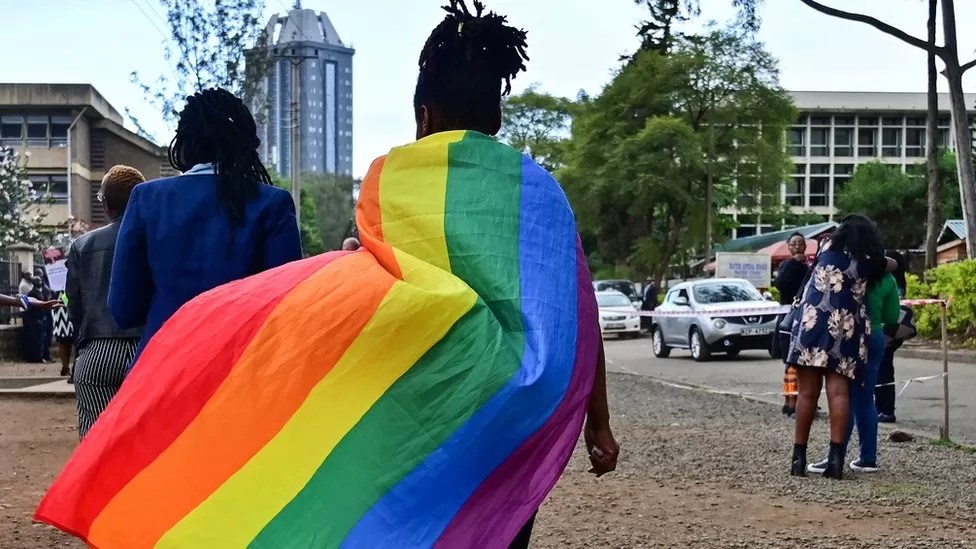
Kenya wrong to ban LGBT rights groups from registering – Supreme Court
Japan’s prime minister say same-sex marriage ban is not discrimination
Uganda dispatch: new anti-homosexuality bill to be presented to Parliament years after previous legislation was overturned in court
Lawrence Alado is a JURIST Staff Correspondent in Uganda. He reports from Kampala.
Speaking at a dedication service convened under the theme, “Let your light shine; rebuilding our Godly image”, the Speaker of Uganda’s Parliament announced Tuesday that an anti-gay bill will be presented before the Parliament of the country tomorrow, the 1st of March.
We gathered earlier today to dedicate @Parliament_Ug to the Lord, and I pledged to the Country that a Bill will be introduced as soon as possible to deal with Homosexuality and lesbianism. We shall Jealously protect our cherished values and culture. pic.twitter.com/yAABBIs3dK
— Anita Annet Among (@AnitahAmong) February 28, 2023
In her remarks, Anita Annet Among stressed that Uganda has moral values that the legislature and the public seek to protect. She said: “We don’t appreciate the values of Ugandans that they are destroying. We do not appreciate their money that they are using to destroy our culture. We do not need their money, we need our culture. And on that note therefore, as an institution of Parliament that passes the laws, tomorrow we are going to bring a Bill on anti-homosexuality.”
The Right Honorable speaker vehemently stated that Uganda will show the world that it does not condone darkness. She declared, “We are going out to the World as the light. I want to promise you that as the legislature, we are going to be the light of the world.”
The previous Anti-Homosexuality Act which infringed on the rights of sexual minorities was declared null and void by Uganda’s Constitutional Court in Professor Oloka-Onyango and Others v Attorney General (Constitutional Petition 8 of 2014). The Act sought to impose life imprisonment for homosexual relations.
It remains to be seen what the contents of the proposed Bill are, but the speech of the Speaker follows several statements by religious leaders around the country stressing that schools should not receive “gay funds” and that the public should desist and condemn all acts of homosexuality.
The post Uganda dispatch: new anti-homosexuality bill to be presented to Parliament years after previous legislation was overturned in court appeared first on JURIST – News.
 International and Comparative SOGIESC Law - Professor Andreas R Ziegler
