Category Archives: Allgemein

Now also available in print and as e-book: The Oxford Handbook of LGBTI Law (Andreas R. Ziegler, Michael Lysander Fremuth, and Berta Esperanza Hernandez-Truyol eds.)

Now also available in print and as e-book: The Oxford Handbook of LGBTI Law (Andreas R. Ziegler, Michael Lysander Fremuth, and Berta Esperanza Hernandez-Truyol eds.)

Please make sure your library orders a copy – now more important than ever before …

All information available here: https://global.oup.com/academic/product/the-oxford-handbook-of-lgbti-law-9780198847793

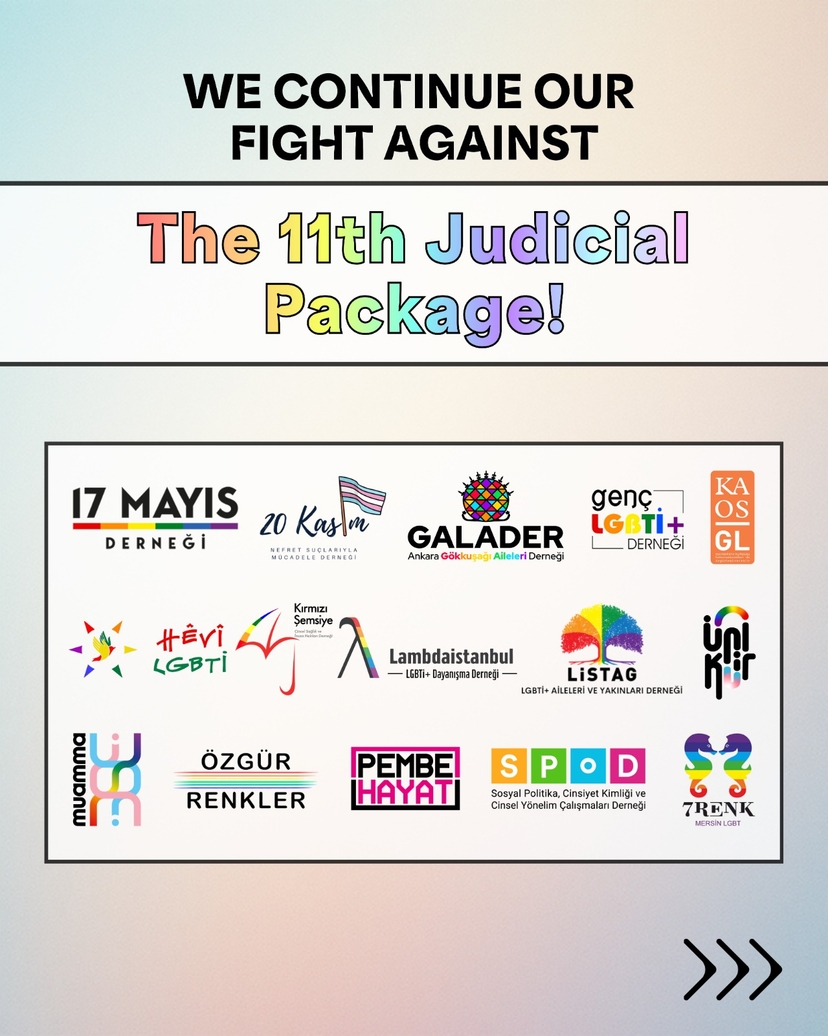
LGBTI+ associations from Tรผrkiye, vow to fight “unacceptable” judicial package, citing “serious threats” beyond rumored removal of hate clauses

LGBTI+ associations from Tรผrkiye, vow to fight “unacceptable” judicial package, citing “serious threats” beyond rumored removal of hate clauses

Image
LGBTI+ associations from Tรผrkiye, vow to fight “unacceptable” judicial package, citing “serious threats” beyond rumored removal of hate clauses.  A powerful coalition of 15 LGBTI+ organizations from Tรผrkiye has declared it will intensify its fight against the government’s controversial “11th Judicial Package,” warning the public against “complacency” even as unverified reports claim specific anti-LGBTI+ “hate provisions” have been removed from the draft. In a joint statement, the rights groups expressed deep skepticism about the claims, suggesting they could be a “deliberate” government tactic “to neutralize public outrage and pacify social opposition.” The statement, signed by all registered organizations, thanked feminist movements, women’s organizations, trade unions, and other civil society allies for their “strong and collective response” that reportedly forced the government to reconsider the discriminatory clauses. However, the activists remain vigilant. “This strong and collective response has once again proven the power of social opposition,” the statement read, but it cautioned that “this does not change the anti-democratic intent of the government.” The coalition highlighted that nearly identical hate provisions were previously included in a “10th Judicial Package” and were “postponed only thanks to our struggle and public pressure.” They warn that even if the clauses are removed now, the government will likely reintroduce them “under the guise of the ‘family year'” or as part of a future constitutional amendment. Package “Unacceptable” Even Without Hate ClausesCrucially, the organizations argued that the 11th Judicial Package remains “unacceptable even in its current form,” posing “serious threats to society at large.”The statement identifies two other key areas of concern: Children’s Rights: The package includes regulations concerning “children pushed into crime (CDC)” that the groups argue “do not aim to protect children, but to further criminalize them” and “disregard the principle of the child’s best interests.”
Right to Protest: An amendment introduced as a “traffic regulation” is condemned as a disguised attempt to “effectively obstruct the constitutional right to protest and demonstration and suppress street opposition.”
The coalition described this as “a step toward silencing not only the voices of LGBTI+ people, but all segments of society seeking their rights and justice.” The 15 signatory organizations have vowed to continue their struggle against the entire package, calling on the public “to remain vigilant against these attacks… to stand shoulder to shoulder, and to strengthen solidarity.” Full Text of the Joint Statement

US Supreme Court declines to revisit same-sex marriage decision

US Supreme Court declines to revisit same-sex marriage decision

The US Supreme Court declined to hear an appeal on Monday that sought to overturn the decade-old landmark decision legalizing same-sex marriage.

The appeal was filed by Kim Davis, a former Kentucky county clerk who refused to issue marriage licenses to same-sex couples in 2015, defying a court order.

Davis asked the Supreme Court to reconsider Obergefell v. Hodges, which legalized same-sex marriage nationwide. She argued that the ruling unconstitutionally violated her right to practice religion freely under the Free Exercise Clause. Hearing the first appeal of the case, the US Court of Appeals for the Sixth Circuit held that, in this instance, her First Amendment rights could not be violated in her capacity as a public official.

โ€œWhen Davis denied Plaintiffs a marriage license, she was wielding the โ€˜authority of the Stateโ€™โ€”not โ€˜function[ing] as a private citizen,โ€ Judge Helene N. White, nominated by former President George W. Bush in 2008, wrote.

Davis also sought to reverse a verdict that required her to pay more than $100,000 in damages, $246,000 in legal fees and $14,000 in expenses to the couple whom she denied a marriage license. The Sixth Circuit affirmed the trial courtโ€™s judgment against Davis in March.

Obergefell held that denying same-sex couples the right to marry โ€œdemeansโ€ and โ€œstigmatizesโ€ them, โ€œdiminish[es] their personhood,โ€ and โ€œsubordinate[s] them.โ€

โ€œTheir hope is not to be condemned to live in loneliness, excluded from one of civilizationโ€™s oldest institutions. They ask for equal dignity in the eyes of the law. The Constitution grants them that right,โ€ Justice Anthony Kennedy wrote in the landmark opinion.

Several organizations celebrated the Supreme Courtโ€™s decision not to hear Davisโ€™s appeal. In a statement Monday, the ACLU wrote: โ€œOur freedom to marry remains the law of the land.โ€ The Human Rights Campaign wrote: โ€œLove is (still) loveโ€ฆ We wonโ€™t let up. We will keep fighting until all of us are free.โ€

The post US Supreme Court declines to revisit same-sex marriage decision appeared first on JURIST – News.

US Supreme Court grants stay that restricts gender expression on passports

US Supreme Court grants stay that restricts gender expression on passports

The US Supreme Court on Thursday allowed a policy to move forward that prevents nonbinary and transgender people from having gender markers on their passports that align with their chosen identity.

In the 6-3 decision, the court held that:

Displaying passport holdersโ€™ sex at birth no more offends equal protection principles than displaying their country of birthโ€”in both cases, the Government is merely attesting to a historical fact without subjecting anyone to differential treatment.

The respondentsโ€™ failed to establish that the government acted โ€œarbitrarily and capriciouslyโ€ when issuing passports. 22 U. S. C. ยง211a permits the government to:

โ€ฆgrant and issue passports, and cause passports to be granted, issued, and verified in foreign countries by diplomatic and consular officers of the United States, and by such other employees of the Department of State who are citizens of the United States as the Secretary of State may designate, and by the chief or other executive officer of the insular possessions of the United States.

The court said that the government was likely to succeed on the merits because it would suffer an โ€œirreparable injuryโ€ without the stay. The government argued that it would be injured by โ€œhaving to speak to foreign governmentsโ€ in instances of identifying people, which is contrary to its foreign policy and โ€˜scientific reality.’โ€

In February, the ACLU sued the Trump administration when the president signed an executive order reversing a Biden-era policy that allowed transgender and nonbinary people to mark an โ€œXโ€ on their passport. The lawsuit claimed that the policy violated the Equal Protection and Due Process clauses of the Fifth Amendment by infringing on individualsโ€™ privacy rights.

The case will be remanded to the US Court of Appeals for the First Circuit for further litigation.

The post US Supreme Court grants stay that restricts gender expression on passports appeared first on JURIST – News.

The Supreme Court of India held that transgender and gender-diverse persons are not required to seek permission from their employers to undergo gender affirmation or surgical intervention

The Supreme Court of India held that transgender and gender-diverse persons are not required to seek permission from their employers to undergo gender affirmation or surgical intervention

The Supreme Court of India held that transgender and gender-diverse persons are not required to seek permission from their employers to undergo gender affirmation or surgical intervention, asserting that the right to self-determination of gender is a matter of personal autonomy and dignity.

More: https://www.livelaw.in/top-stories/transgender-persons-need-not-take-employers-permission-for-sex-reassignment-surgery-supreme-court-307374

Roundtable โ€žSOGIESC and the State of LGBTI Lawโ€œ, Tuesday, 25 November 2025, from 5:00 p.m. to 6:30 p.m., at the University of Lausanne (Room 2, IDHEAP Building) and online

Roundtable โ€žSOGIESC and the State of LGBTI Lawโ€œ, Tuesday, 25 November 2025, from 5:00 p.m. to 6:30 p.m., at the University of Lausanne (Room 2, IDHEAP Building) and online Roundtable organised by the Law and Society Initiative of the University of Lausanne(IDES) on the theme: โ€žSOGIESC and the State of LGBTI Lawโ€œ The event will take place on [โ€ฆ]

Roundtable โ€žSOGIESC and the State of LGBTI Lawโ€œ, Tuesday, 25 November 2025, from 5:00 p.m. to 6:30 p.m., at the University of Lausanne (Room 2, IDHEAP Building) and online

USA: SCOTUS dispatch: justices see speech concerns in conversion therapy ban, but path forward unclear

USA: SCOTUS dispatch: justices see speech concerns in conversion therapy ban, but path forward unclear

Chloe Miracle-Rutledge is a JURIST Supreme Court Correspondent and a 2L at Georgetown University Law Center in Washington, DC. 

On Tuesday morning, the second day of the Supreme Courtโ€™s new term, I went to the United States Supreme Court to attend oral argument for Chiles v. Salazarโ€”a case about a Christian counselorโ€™s First Amendment challenge to Coloradoโ€™s ban on conversion therapy for minors. Given the caseโ€™s focus on LGBTQ rights and conservative Christian views, I expected crowds outside the Court. Instead, it was strikingly quiet.

The pressroom was sparse, too, allowing me a clear view of all nine justices from the front of the press box. The light turnout was surprising. This case could reshape First Amendment law, yet it seems to have slipped under the public radarโ€”perhaps a result of news fatigue or attention on the Courtโ€™s emergency docket cases involving President Trump. Still, the ruling will offer key insight into how this Court views freedom of speech and the ideological preferences of the justices.

The law at issue in this case is Coloradoโ€™s Minor Conversion Therapy Law, which prohibits licensed counselors and therapists from trying to change a young personโ€™s sexual orientation or gender identity. The petitioner, Kaley Chiles, is a Christian counselor who argues that the law violates her freedom of speech by preventing her from having certain conversations with clients.

Representing Chiles was Jim Campbell, a lawyer from the Alliance Defending Freedom, a conservative impact litigation group focusing on freedom of speech and religion issues. Campbell urged the Court to strike down the law as unconstitutional. He framed the law as one that silences certain viewpoints, claiming it prevents Chiles from โ€œhelping minors pursue state-disfavored goals on issues of gender and sexuality.โ€ Campbell emphasized that the treatment consists โ€œonly of speech,โ€ not conduct, which would place the case firmly in โ€œFirst Amendment land.โ€ Because of that, he argued, the Court must apply strict scrutinyโ€”a level of review Colorado cannot meet, according to Campbell.

The Trump administration also intervened as amicus curiae in support of Chiles. Principal Deputy Solicitor General Hashim Mooppan said the law โ€œrestricts speech based on content and viewpointโ€ and โ€œfalls outside any historically grounded exception.โ€

Shannon Stevenson, the Solicitor General of Colorado, emphasized that the law is a healthcare regulation that only applies โ€œwhen a licensed professional is delivering clinical care to an individual patient.โ€ Because the law only prohibits treatment, Stevenson suggested, โ€œit does not interfere with any First Amendment interestโ€ and does not โ€œstop a professional from expressing any viewpoint.โ€

In a relatively short and quick ninety-minute argument, in which Justice Brett Kavanaugh asked no questions, the justices grappled with a variety of different questions and issues.

A few justices were concerned about whether Chiles actually had standing to bring her case.  Justice Sonia Sotomayor pressed Campbell to explain how Chiles was personally harmed by the law, noting that she may not face a โ€œcredible threat of prosecution.โ€ Colorado has made clear that it will not apply the statute to her unless she explicitly tries to change a minorโ€™s orientation or gender identity.

The justices also wrestled with a larger question of whether the law regulates speech or conduct. The answer is critical, as it determines the level of constitutional protection that applies. Justice Ketanji Brown Jackson remarked that it seemed โ€œvery oddโ€ to view licensed professionals providing medication as conduct but licensed professionals providing talk therapy as speech. She also pointed out the long history of regulating medical treatment and brought up the recent Skrmetti decision which allowed Tennessee to regulate gender-affirming care for minors. Justice Clarence Thomas also asked about the history and tradition of medical regulations, particularly in the context of talk therapy.

Justice Samuel Alito, however, pushed back sharply against Coloradoโ€™s framing of the law as a neutral and narrow medical regulation, calling it โ€œblatant viewpoint discrimination.โ€ Even Justices Sotomayor and Elena Kaganโ€”typically part of the Courtโ€™s liberal blocโ€”appeared uneasy with the stateโ€™s interpretation. Sotomayor wondered why the special relationship between a licensed therapist and client made the speech any less protected, and Kagan questioned whether the law was viewpoint discrimination.

The justices then turned to the scientific evidence behind the law. Campbell and Mooppan criticized the studies Colorado cited, arguing that they were flawed and failed to distinguish between voluntary and coercive treatments. Stevenson defended the research and emphasized that โ€œthere is no studyโ€ showing that conversion therapy works.

Still, several conservative justices seemed troubled by how states justify these kinds of laws. Justice Neil Gorsuch asked Stevenson whether a state could regulate a medical treatment even where medical uncertainty was present. Justice Amy Coney Barrett followed up by asking whether states can โ€œpick a sideโ€ if there is a lack of medical consensus. Alito then raised examples of politicized medical practices from the past, like forced sterilization and institutionalization. This line of questioning hints at concerns that laws like Coloradoโ€™s could be driven by ideology rather than evidence.

The justices also debated what to do next. If the Court agrees with Chiles that the law discriminates based on viewpoint, it must decide whether to strike it down or send the case back to the lower court on remand. Colorado urged remand, saying it would allow more evidence and studies to be added to the record. Campbell and Mooppan opposed that, arguing that a remand would only โ€œprolong the ongoing harmโ€ to Chiles and others like her.

Sotomayor and Jackson seemed clearly inclined toward remanding. Barrett, often considered a wild card on the Court, also pressed questions about remandโ€”suggesting she might favor that outcome as well.

As the argument ended, the quiet that had greeted me outside lingered. But beneath that calm was a brewing tension: a case that could redefine the boundary between speech and conduct, faith and professional duty, in one of the most ideologically charged contexts of our day.

Overall, I found the Court skeptical of Coloradoโ€™s assertion that this is conduct and not speech. But larger questions remain about whether the Court will send the case back to the lower courts and how they will treat medical regulations in the future. A decision is expected by the end of the summer.

The post SCOTUS dispatch: justices see speech concerns in conversion therapy ban, but path forward unclear appeared first on JURIST – News.

Tรฉmoigner contre la conversion. Quand la prise en charge de l’homosexualitรฉ par des รฉvangรฉliques devient le problรจme

Tรฉmoigner contre la conversion. Quand la prise en charge de l’homosexualitรฉ par des รฉvangรฉliques devient le problรจme

Philippe Gonzalez a publiรฉ un chapitre dans l’ouvrage “L’interdiction des “thรฉrapies de conversion sexuelle” sous la direction de Jimmy Charruau, Daniel Borrillo, Thomas Perroud.

Publiรฉ le 01 oct. 2025

Partager l’actualitรฉ

Rรฉsumรฉ du livre

Chocs รฉlectriques, traitements mรฉdicamenteux ou psychiatriques, exorcismesโ€ฆ
Derriรจre lโ€™expression trompeuse de ยซ thรฉrapies de conversion sexuelle ยป, se cachent des pratiques variรฉes visant ร  modifier lโ€™orientation sexuelle ou lโ€™identitรฉ de genre dโ€™une personne pour la rendre hรฉtรฉrosexuelle ou conformer son genre ร  son sexe biologique. Autrefois rรฉalisรฉes principalement dans le milieu mรฉdical, elles trouvent aujourdโ€™hui un nouveau terrain dโ€™expression, sous dโ€™autres formes, notamment dans certains courants religieux.
Face ร  cette rรฉalitรฉ aux consรฉquences humaines dramatiques, de nombreux ร‰tats ont lรฉgifรฉrรฉ pour interdire expressรฉment ces pratiques. Ce phรฉnomรจne normative interroge : comment, en fonction des cultures et systรจmes juridiques nationaux, lโ€™interdiction varie-t-elle dans son principe et sa formulation ? Jusquโ€™oรน le droit peutil intervenir sans rompre lโ€™รฉquilibre nรฉcessaire rรฉsultant de la conciliation entre lโ€™autodรฉtermination, les libertรฉs dโ€™expression et de religion, le principe de non-discrimination ou encore le respect de lโ€™autoritรฉ parentale ? Aprรจs avoir dressรฉ un panorama de la variรฉtรฉ et de lโ€™รฉvolution des pratiques, cet ouvrage sโ€™inscrit dans une dรฉmarche juridique : il procรจde dโ€™abord ร  lโ€™analyse des textes produits aux niveaux international et rรฉgional, puis รฉtudie les nombreuses lรฉgislations nationales, avant de mettre en perspective ces interdictions en les confrontant aux droits et libertรฉs en jeu. Suivant une approche comparatiste et interdisciplinaire, cet ouvrage inรฉdit sโ€™avรจre essentiel pour comprendre les enjeux politiques et sociaux que soulรจvent ces pratiques et interroger les limites du droit face ร  leur persistance.

Par

Pauline Blaser


Liens et documents utiles