Qatar seizes rainbow-coloured toys it deems ‘un-Islamic’

Read: https://guardian.ng/news/qatar-seizes-rainbow-coloured-toys-it-deems-un-islamic/

Qatar seizes rainbow-coloured toys it deems ‘un-Islamic’
Read: https://guardian.ng/news/qatar-seizes-rainbow-coloured-toys-it-deems-un-islamic/
UK’s highest court rejects appeal for gender-neutral passports after activist’s ‘long, hard’ fight

Read: https://www.pinknews.co.uk/2021/12/15/x-passports-supreme-court-christie-elan-cane/
ECJ: All EU nations must recognise children of same-sex parents

The European Union’s (EU) top court has ruled that Bulgaria must issue identity papers to a child of same-sex parents, and that all EU nations must respect such families.
Read: https://www.pinknews.co.uk/2021/12/14/eu-same-sex-parents-bulgaria/
ECJ, Judgment in Case C-490/20 Stolichna obshtina, rayon ‘Pancharevo’: http://curia.europa.eu/juris/documents.jsf?num=C-490/20
European Court of Human Rights finds Georgia complicit in violence against LGBT demonstrators
The European Court of Human Rights Thursday held against Georgia in a case concerning an attack on LGBT protestors in the capital city Tbilisi.
Amidst threats of a counter-demonstration by ultra-conservative NGOs and clergymen, senior officials of the Ministry of the Interior had guaranteed the safety of the applicants, a group of 35 Georgian nationals and two LGBT rights advocacy groups, during a 20-minute silent flash mob on the International Day Against Homophobia.
On the day of the demonstration, May 17, 2013, the applicants were attacked at Pushkin Square by 35,000 to 40,000 counter-demonstrators wielding sticks, stones, and batons, and hurling homophobic slurs and death threats. Following an inquiry by the Ministry of the Interior, criminal proceedings resulted in the acquittal of four demonstrators, and imposition of a fine on four others. One proceeding is still pending.
The Court held unanimously that Article 3 (prohibition of inhuman or degrading treatment) and Article 11 (freedom of association) in conjunction with Article 14 (prohibition of discrimination) of the European Convention on Human Rights had been violated. They also found that the mental anguish suffered by the applicants in the face of homophobic threats of violence was sufficient to sustain charges under the Convention.
The Court found that the authorities had failed to take proper safety measures to protect the applicants’ right to freedom of association despite knowing the risks associated with the tension-fraught event. A prior announcement by the counter-demonstrators of their intentions and the State’s failure to manage the previous year’s LGBT rally discredited the State’s contention that it was not anticipating the escalation. The State’s response to the threat was “to deploy unarmed and unprotected police patrol officers who were supposed to contain the tens of thousands of aggressive people by forming thin human cordons.” These safety precautions were deemed to be wholly inadequate for the event especially considering the notice given by both groups. The Court also explained that whenever large-scale violence is foreseeable:
It is important for the domestic authorities to evaluate the resources necessary for neutralizing the threat of violent clashes by, amongst other things, equipping law-enforcement officers deployed to the scene with appropriate riot gear in order to be able to discharge their police functions.
The impartiality of the criminal proceedings was also questioned given that they were led by the same unit of the Ministry of the Interior which had guaranteed the safety of the protestors. The Court held that “no tangible results” had been achieved in these cases and that:
the protraction of the investigation exposed the domestic authorities’ long-standing inability – which can also be read as unwillingness – to examine the homophobic and/or transphobic motives behind the violence and degrading treatment committed against the relevant twenty-seven individual applicants.
The Court under Article 41 (just satisfaction) of the Convention found Georgia liable to pay the applicants a total of 193,500 euros in damages.
The post European Court of Human Rights finds Georgia complicit in violence against LGBT demonstrators appeared first on JURIST – News.
Six international legal norms on the protection of same-sex partnership have emerged
by Kees Waaldijk *
19 December 2021
When in 2006 I wrote the first version of my article ‘Same-Sex Partnership, International Protection’ for the online Max Planck Encyclopedia of Public International Law, only some fifteen cases on the topic had been decided by international bodies. At the time, it felt as a daunting task to write a for this prestigious, authoritative and massive Encyclopedia (the roots of which go back to the 1920s, while the printed edition of 2012 has more than 11,000 pages covering more than 1,600 topics). Even more so, because what was expected was a comprehensive and – as far as possible – impartial account, complemented by a personal assessment. At the same time, inclusion of this topic in the Encyclopedia felt as a welcome recognition for – and ‘coming out’ of – a new topic of international law.
Fifteen years later, international protection of same-sex partnership has become a well-established topic of international law – albeit a highly dynamic and controversial issue. By 2021 the number of decided international cases about same-sex partners has reached 50, while more and more international written law and soft law documents touch upon the topic. So after my minor 2013 update of the article, a much fuller revision and update was needed for 2021.
The beginning of my article (paragraphs 1-3) could remain unchanged:
“Many people want to live their life in intimate partnership with another person. And many do. These two facts have been recognized and protected in law for many centuries. Hence the existence—in domestic law—of family law, and of numerous related provisions in other areas of public and private law. International law, too, and especially international law on the protection of human rights, recognizes and protects the desire for, and existence of intimate partnership. It does so mainly through guaranteeing rights to marriage, to family, and to private life, and through prohibitions of discrimination. (…)
Although international human rights instruments do not contain wordings that refer explicitly to heterosexual partnership, their provisions on the rights to marriage, to family, and to privacy have traditionally often been interpreted as only covering different-sex partners. Thus same-sex partnership has often been excluded from the protection of these rights. (…)”
Meanwhile, my research has discovered that my bold claim about the non-existence, in international human rights documents, of any explicit reference to heterosexual partners, was even more true than I realized in 2006. If you look closely at the drafting history of article 16 of the Universal Declaration of Human Rights, there is nothing heterosexual about the words “men and women” as used in human rights provisions on the right to marry. In 1948 these words had been introduced as an amendment to the originally proposed “Everyone has the right to contract marriage”. And the aim of this amendment had been to make clear that women must have the “same freedom” to marry as men. No doubt the drafters were thinking about different-sex marriages, but they did not include this exclusivity in the text of the fundamental right to marry. Instead the drafters underlined the equal rights of “men and women”. The drafters were not thinking of same-sex partners. (For a detailed analysis of all this, see my 2021 book chapter ‘The Right to Marry as a Right to Equality’ or my 2018 podcast; details below.)
A lot, however, had to change in the rest of my article, because in international law (as in more and more countries) there now is substantial recognition of same-sex partners.
After discussing all 50 rulings on the topic given by international judicial and quasi-judicial bodies, plus various decisions of other bodies of UN, EU and other international organizations (covering human rights law and international staff law, and touching on rules of free movement and private international law), I now conclude the 2021 version of my Encyclopedia article as follows:
“International protection for same-sex partnership is a topic that has seen important developments recently (…). At least two ‘global’ norms have emerged:
(1) a prohibition of discrimination between unmarried different-sex cohabitants and unmarried same-sex cohabitants; and
(2) an obligation to recognize existing same-sex marriages from other jurisdictions (at least for some purposes).
Two related ‘global’ norms seem to be emerging (…):
(3) an obligation to respect existing marriages that are becoming ‘same-sex’ because one of the spouses is having a change of sex/gender; and
(4) an obligation to recognize existing registered partnerships from other jurisdictions (at least for some purposes). (…)
Authority for these four ‘global’ norms can be found in decisions of bodies of the UN, in decisions of European and Inter-American bodies, and also in the domestic law of countries in different parts of the world. (…) In two regions of the world (Europe and the Americas) two further norms are emerging. One of these regionally emerging norms is:
(5) an obligation to give same-sex couples access to a legal framework for their relationship.
In the Americas this emerging obligation ultimately requires the opening up of marriage, while in Europe it still leaves it to the countries themselves to decide whether this legal framework will be marriage or only a form of registered partnership (…). The other regionally emerging norm is:
(6) an obligation to give same-sex couples access to rights and benefits derived from marriage.
In the Americas this obligation seems to concern all rights that flow from marriage, while in Europe it so far seems limited to core or essential rights, such as the right to live in the same country as your partner (…). For these emerging regional norms there is not yet much authority in decisions of bodies of the UN, and even less from regional bodies outside Europe and the Americas. However, these norms do reflect developments in domestic law that have at least started on all continents. It seems likely that in both regions the international case law will crystalize further, and there seems scope for some convergence between the approaches of ECtHR and IACtHR. (…) (Also because) both courts have acknowledged both the controversial character and the dynamic nature of developments in the national and international protection of same-sex partnership. (…)”
For the full text of this quote, and for references to case law and previous paragraphs, see paragraphs 38-40 of my Encyclopedia article. And for an analysis (based on how the law has been developing in 21 European countries) of what rights for same-sex partners could be considered as “core or essential rights” in the sense of emerging norm 6, see my 2020 book chapter ‘What First, What Later?’, where I conclude (in paragraph 2.7):
“a core minimum of rights would consist at the very least of (…)
– legal protections at times of death (…);
– legal protections for times of other great sadness (…);
– the right to be able to live in the same country (…); and
– the right to take at least some responsibility for each other’s children (…).”
Perhaps this will emerge as a seventh international legal norm on the protection of same-sex partnership.
REFERENCES:
Kees Waaldijk, ‘Same-Sex Partnership, International Protection’ (update 2021), in: Anne Peters & Rüdiger Wolfrum (eds.), The Max Planck Encyclopedia of Public International Law, Oxford: Oxford University Press (from 2008, online), http://www.mpepil.com (free access to this article until mid-March 2022 at https://opil.ouplaw.com/view/10.1093/law:epil/9780199231690/law-9780199231690-e1739).
Kees Waaldijk, ‘The Right to Marry as a Right to Equality – About Same-Sex Couples, the Phrase “men and women”, and the Travaux Préparatoires of the Universal Declaration’, in: Niels Blokker et al. (eds.), Furthering the Frontiers of International Law: Sovereignty, Human Rights, Sustainable Development (Liber Amicorum Nico Schrijver), Leiden: Brill Nijhoff 2021, p. 457-472 (pre-print version of this chapter will be online soon at http://www.law.leidenuniv.nl/waaldijk).
Kees Waaldijk, Same-sex couples and the international human right to marry, podcast, SDG Talk on Soundcloud, The Hague: Centre for Innovation, Leiden University 2018 (https://soundcloud.com/user-542495654-897696505/prof-kees-waaldijk-llm-legal-recognition-of-same-sex-relationships-emerging-nat-minimum-standards).
Kees Waaldijk, ‘What First, What Later? Patterns in the Legal Recognition of Same-Sex Partners in European Countries’, in: Marie Digoix (ed.), Same-Sex Families and Legal Recognition in Europe (European Studies of Population Series, volume 24), Cham (CH): Springer 2020, p. 11-44 (open access to this chapter at https://link.springer.com/chapter/10.1007/978-3-030-37054-1_2).
* Kees Waaldijk is professor of comparative sexual orientation law, Leiden Law School, http://www.law.leidenuniv.nl/waaldijk. He is grateful to Oxford University Press for providing free access (until mid-March 2022) to his Encyclopedia article, and for making it available to participants in the Summer School on Sexual Orientation and Gender Identity in International Law, which he runs at Leiden University. For the fifth edition of this Summer School (27 July – 5 August 2022, The Hague & Amsterdam), see: https://www.universiteitleiden.nl/en/education/study-programmes/summer-schools/sexual-orientation-and-gender-identity-in-international-law-human-rights-and-beyond
Valérie V. Suhr has published Rainbow Jurisdiction at the International Criminal Court: Protection of Sexual and Gender Minorities Under the Rome Statute (Asser Press 2022).
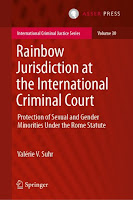
Here’s the abstract:
This timely book comprehensively examines whether the worst human rights violations directed specifically at sexual and gender minorities are punishable under international criminal law, as codified in the Rome Statute of the International Criminal Court. Drawing on general rules of interpretation, the development of human rights for sexual and gender minorities, and the social construction of gender, this monograph reveals that the worst crimes committed against persons because of their sexual orientation or gender identity can amount to crimes against humanity, particularly the crime of persecution under Article 7(1)(h). It also shows how legislators can be held individually criminally responsible for passing laws that criminalize consensual same-sex sexuality.
New Zealand passes law allowing citizens to self-identify sex on birth certificates
The New Zealand Parliament passed legislation Thursday that will allow people to amend the gender identity on their birth certificates. The country first allowed self-identification on birth certificates in 2018 but required applicants to prove they underwent medical treatment to align their sex and gender identities. The Births, Deaths, Marriages, and Relationships Registration Act 2017, which was unanimously passed, eliminates that requirement.
The bill was first introduced in 2017 and originally focused on access to digital information and reviews of burial and cremation. However, following the first reading in December 2017, members of the select committee were urged to include the birth certificate change in the bill through a petition.
Before the provisions take effect, the parliament must work out who will be allowed to support gender-change applications for young people, how non-binary and cultural identities will be marked on birth certificates and what the requirements will be for people seeking to change their sex more than once.
Internal affairs minister Jan Tinetti remarked, “The passing of the Births, Deaths, Marriages, and Relationship Registration Bill brings with it a more accessible and inclusive process for people to change the sex recorded on their birth certificate. This law change will make a real difference for transgender, non-binary, takatāpui [LGBT] and intersex New Zealanders.” Since the changes only apply to New Zealand birth certificates, New Zealanders born overseas will not yet be able to self-identify. The minister stated that work will be done to address this issue.
New Zealand joins around a handful of other countries around the world that have made it easier to change one’s gender identity on state documents.
The post New Zealand passes law allowing citizens to self-identify sex on birth certificates appeared first on JURIST – News – Legal News & Commentary.
Chile legalizes same-sex marriage by an overwhelming majority
Chile legalized same-sex marriage on Tuesday as societal norms in the predominantly Catholic country shift. The bill was first introduced in Congress in 2017. Chile’s Congress passed the bill with majorities in both chambers, making it the eighth Latin American country and the thirty-first worldwide to allow same-sex marriage. After a decade-long legal battle, the legalization of same-sex marriage is a watershed moment for the conservative South American nation. The law will take effect 90 days after its publication in the Official Gazette.
Chile’s Senate and lower house of parliament both voted heavily in favor of the bill on Tuesday, which had previously been partially approved in November before the Senate sent it back to a committee to clarify ambiguities. President Pinera’s predecessor, Michelle Bachelet, was the first to introduce the measure, in 2017. This year, Pinera’s government-backed marriage equality firmly.
For married same-sex couples, the law recognizes parental ties, full spousal benefits, and adoption rights. It will also replace gendered terminology in the country’s civil code and other legislation with the words “spouse” and “parent,” among other modifications. Since 2015, civil unions have been legal in Chile, providing same-sex partners with many of the privileges that married couples have, such as the right to adopt.
Jaime Bellolio, the Government Spokesperson, said that the approval of this proposal during this presidential term is an honor for the Government of Chile. Concerning the legalization of same-sex marriage, he stated, “[a]s a Government we believe in the protection of children and adolescents, we believe in the family and in the institution of marriage and this is a way in which it is protected.” Bellolio further added:
What we are advancing today is not only for those thousands and thousands of people who were waiting for equal marriage to be approved, but we are advancing for all Chilean women and men, because we are advancing in recognition, respect, and embracing the difference, in embracing the diversity of different opinions, different orientations, and different identities. That is what it is all about, moving towards a fairer, more respectful, more tolerant, and dignified country.
The post Chile legalizes same-sex marriage by an overwhelming majority appeared first on JURIST – News – Legal News & Commentary.
Spain: Good Intentions May Not Be Enough
On 29 June 2021, the Spanish Cabinet approved to sponsor the Draft Bill for the Real and Effective Equality of Trans People and the Guarantee of the Rights of LGTBI People in Parliament. This Bill aims to “guarantee and promote the right to real and effective equality” of LGTBIQ+ people and their families, and to reform in depth the legal recognition procedure for gender amendment.
Stepping forward with such a proposal on trans and LGTBIQ+ rights could be interpreted as a sign that Spain is currently experiencing a contrary trend to the backlash against LGTBIQ+ rights that some fellow European countries are going through. In Italy, for example, the Senate voted against a Bill to make violence against LGBT people and disabled people, as well as misogyny, a hate crime last October. In addition, that same week, the Polish Parliament had been debating a bill to ban Pride marches and other public gatherings that “promote” non-heterosexual orientations and non-biological gender identities. Thus, the Spanish Cabinet move signaled something different, in line with the intended government coalition recently announced in Germany. However, the Spanish proposal –which has certainly generated some social debate– is not approved yet, and its development has been a source of conflict within the Spanish Government for the last two years.
Even though the Bill’s main goal is to introduce game-changing and long-demanded reforms, such as the incorporation of the self-determination principle in legal gender amendment procedures or a state-level set of norms against LGTBIphobia, political struggles within the government have resulted in a weak text. And, most importantly, they are causing a major delay to its parliamentary discussion and approval.
While Spain has an Act to eradicate discrimination between men and women at State level, it has none about LGTBIphobia, and being part of the LGTBIQ+ community is not recognized as a protected ground in State-level non-discrimination regulations. Although most of the Spanish regions have already passed specific acts to tackle the issue of LGTBIphobia, some have not. Also, there is great disparity among the different regulations, so legal responses to LGTBIphobia vary depending on the territory where it takes place. Therefore, if a Bill of this kind is finally approved, it will be a novelty in the Spanish State legislation and will offer more legal certainty in terms of protection to LGTBIQ+ people throughout the country. Moreover, and despite the regional norms on the matter, a State level norm is the only way to establish the self-determination principle on legal gender amendment, since the regulation of public registries is an exclusive competence of the Spanish state (art. 149.1.8ª Spanish Constitution).
The Draft agglomerates issues that, according to the government’s parties’ own agreement, should be dealt with in two different bills: an act against discrimination of LGTBIQ+ people and a more specific act for the trans community. Political reasons are probably behind this decision, but their unification results in a rather dense and complex set of norms, from a technical point of view. In any case, its highlights undoubtedly are (a) the incorporation of the principle of gender self-determination; (b) civil reforms on family law matters; and (c) protection measures against LGTBIphobia.
The introduction of the principle of gender self-determination has been the main reason why this Draft has been severely criticized by some feminist groups (most of them aligned with the Socialist Party (PSOE), the main party in the Spanish Government), but is also its main feature. Probably due to the conflict that surrounds it, the term “self-determination” is not used in the text, but its regulation can be found in articles 37 to 45. The new legal gender amendment procedure would only require the solicitants’ own declaration and would replace the current one, foreseen in Act 3/2007, which requires solicitants to prove that they have been diagnosed with “gender dysphoria” and that they have undergone medical treatment for at least 2 years “to adjust their physical features to the desired sex”.
Despite the clear progress that overcoming Act 3/2007 will bring, there are several limitations that the text of the preliminary Draft presents and that should be taken seriously into consideration during its parliamentary debate. Of particular concern is the submission of foreign people to a different standard than nationals: their own declaration will not be enough, they will have to prove the inability to amend their legal gender in their home countries. Also, self-determination will not be available for minors between 12 and 14 years of age who, additionally, will need to go through a judicial procedure instead of the simpler administrative one that is foreseen in the rest of cases. This is an especially delicate issue since, in 2019, the Spanish Constitutional Court ruled that excluding mature enough minors from the current administrative procedure was unconstitutional, without establishing any minimum age for a presumed maturity. Self-determination is also abandoned in the so called “reversion” regime, provided in article 41, that is, whenever someone needs to change their legal gender a second time during their life. This way, gender self-determination will only be possible once in a lifetime. Further amendments will necessarily go through a judicial procedure in which it is not clear what will need to be proven. Finally, the fact that the gender category options will remain binary between man and woman, and the resulting lack of recognition of non-binary people is worrying, especially, given that previous proposals had shown at least some concern regarding their inability to self-determine their gender.
Civil reforms on family law matters mostly consist of terminological corrections that make the letter of the law more inclusive towards rainbow families. The goal is to avoid dichotomous formulas based on binaries such as “man and woman” or “father and mother” and replace them with more neutral ones such as “spouses”, “every person”, “parents”, “pregnant parent” or “non-pregnant parent”. Surprisingly, it is not even an exhaustive review of the body of regulation in whole: the great technical weight of the reform on the inclusion of family diversity falls into the creation of a tenth Additional Disposition of the Civil Register Act, which extends the effects of the parenthood norms to everybody regardless of their gender.
This means that, regarding families formed by two women, some discriminatory obstacles are overcome. For example, the current requisite to be married for the birth mother’s partner to also be registered as the mother of the child. Nevertheless, this “terminological patch” does not equate them to different-gender couples, which continue to have more options available.
Moreover, the Draft does not refer to the nomenclature, predictably gendered, that trans people will receive as parents upon registering their children. That is: will they be able to choose to be registered as mother, father or parent according to their gender identity? This has not been the case for Alfred McConnell in UK ([2020] EWCA Civ 559), nor in the cases solved in the Bundesgerichtshof Beschluss of 06.09.2017 (XII ZB 660/14) in Germany and in the Première chambre civile de la Cour de cassation of 16.09.2020 (n. 18-50.080, n. 19-11.251) in France. This issue is not mentioned either when the effects of legal gender amendment are described in art. 40 of the Draft. The regulation as a whole, thus, seems insufficient to ensure that the gender identity of all parents is recognized and respected in the registry entries and in the issuance of official documents.
Therefore, it cannot be said that the reform on parenthood is sufficiently clear or complete. More than 15 years after the approval of same-gender marriage, it seems that we only get momentary patch up solutions which show that we are far from having a system that truly recognizes and includes LGTBIQ+ family diversity.
Finally, the Draft Bill aims to promote the effective equality of LGTBIQ+ people and to tackle LGTBIphobia through a wide variety of measures. A series of general and abstract mandates for public powers are introduced, but also some provisions regarding relations between private persons are foreseen. The prohibition of conversion therapies (art. 16), the prohibition of surgical interventions on intersex children (art. 18.2) or the nullity of contractual clauses that are discriminatory on the basis of sexual orientation or gender identity (art. 58) are some examples of significant relevance. It is also worth remarking on the mention of intersectionality in different sections of the Draft, a phenomenon that occurs when someone suffers multiple discriminations because of different layers of their identity. A Chapter within Title III is, for example, dedicated exclusively to vulnerable identities that are simultaneously LGTBIQ+, such as minors, elderly people or people with disabilities, among others.
Probably one of the most relevant measures is the creation of a specific administrative sanctioning regime of LGTBIphobic conducts. However, it is important that the Draft Bill and future acts do not put too much weight on punitive strategies, given that restorative measures can be considered more preventing and repairing than those based on pure punishment. Notwithstanding, this regulation could mean an equalization of responses to LGTBIphobia in all Spanish territories, but the Draft articulates this sanctioning regime as supplementary to the regional ones in force. This way, the law does not only not achieve the desired uniformity among territories, but allows for less protective regional regimes to still be in place.
Since the Government agreed on sponsoring the Bill in June, there have not been any parliamentary developments regarding the Draft. The congress‘ diary during these months has only stated that some parliamentary groups demand that the government „streamline, as far as possible, the processing of the Draft Bill„. Despite the tragic events that have been taking place in Spain with regard to LGTBIphobia and specific transphobia within part of the feminist movement, it seems that there is no political urgency in relation to the Bill’s development.
In the light of this year’s events and the historical debt societies have towards their oppressed groups, the passing of this Bill should be a matter of high priority. Technical accuracy should be ensured for it to be an effective counter-impulse to the hate speech and hate crimes the LGBTIQ+, and specifically the trans community, are suffering worldwide.
Source: Laura Esteve Alguacil – https://verfassungsblog.de/spanish-lgbtq-bill/
 International and Comparative SOGIESC Law - Professor Andreas R Ziegler