USA: Joe Biden ends Trump’s monstrous trans military ban in momentous victory for LGBT+ rights


USA: Joe Biden ends Trump’s monstrous trans military ban in momentous victory for LGBT+ rights
Why the heinous crimes committed by the Nazis against thousands of queer people must never, ever be forgotten
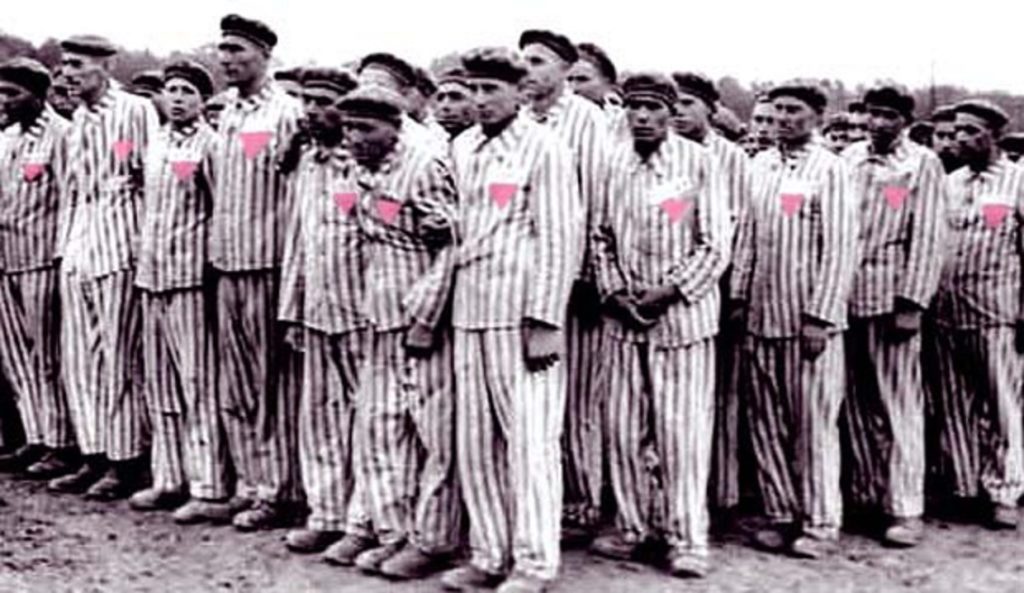
On Holocaust Memorial Day 2021, we remember the victims, LGBT+ and otherwise, murdered by Nazis, and explore the significance of the pink triangle.
On Wednesday (27 January), 76 years after the Auschwitz concentration camp was liberated, buildings around Britain will be lit in purple, with those who are able to encouraged to light a candle in their window at 8pm GMT to remember those murdered simply because of who they were.
Every year on Holocaust Memorial Day, the world honours the millions of people who lost their lives during the Holocaust (as well as those who died under Nazi persecution and in subsequent genocides, such as those in Cambodia, Rwanda, Bosnia and Darfur).
Up to 17 million people were exterminated under the Nazi regime, with six million Jews included in that number.
The Holocaust was, at its core, a wide-scale and violent persecution of minority groups – and LGBT+ people were not exempt. Between 1933 and 1945, an estimated 100,000 men were arrested for homosexuality in Nazi Germany. Some 50,000 were sentenced for their “crimes” and an estimated 5,000-15,000 gay men were sent to concentration camps.
Sociologist Rüdiger Lautmann has estimated that up to 60 per cent of gay men incarcerated in concentration camps died during their imprisonment. But these figures only account for those who were persecuted directly for their sexuality. Among the millions of people killed in the Holocaust, there were undoubtedly many more LGBT+ people who kept their sexual and gender identities a secret as they went to their deaths.
The world today is a very different place, but the threat of violence is never too far away for minority groups. Hate crimes have surged across the world, including in the UK and the United States. Homophobic hate crimes have more than doubled in the UK in the most recent five-year period, with transphobic hate crimes quadrupling between 2014-15 and 2019-20. There were more than 6,800 hate crimes defined by religion in 2019-20 (a slight fall from the year prior), with antisemitism remaining pervasive.
In the United States, LGBT+ people, Jewish people and Black people are the most targeted groups. Jewish people in the US suffered more antisemitic attacks in 2019 than in any other year since the Anti-Defamation League began collecting records sine 40 years ago. The 2,107 incidents recorded marked a 12 per cent rise from 2018, which had been the worst on record previously.
These figures serve as a reminder that – while the Holocaust is part of our history – the lingering hatred of anybody seen as “different” is always ready to rear its head.
When Adolf Hitler and his Nazi Party seized power in Germany in July 1933, the dictatorship moved to persecute and murder minority groups, including Jews, LGBT+ people, the Romani people, and political prisoners.
Beginning in 1933, the Nazis built a network of concentration camps throughout Germany, where “undesirable” groups were detained, including Jewish people and gay men.
Those “undesirables” often had their uniforms branded in concentration camps so officers knew what kind of person they were dealing with. Many gay people had their uniforms branded with an upside-down pink triangle. The symbol set them apart as sexually deviant, with paedophiles and rapists given the same mark.
Like other prisoners, those who wore the pink triangle were brutalised in ways that most people today cannot even begin to comprehend. Gay men were subjected to torture, including forced sodomy using wood, and many were experimented on. The Nazis also implemented a form of conversion therapy, whereby gay men were forced to sleep with female sex slaves.

Charting the history of other members of the LGBT+ community in the Holocaust is more challenging as they were not given their own distinct categories. Lesbians were sometimes made to wear a black triangle to denote that they were “asocial”, according to Benno Gammerl, a lecturer in Queer History at Goldsmiths, University of London.
There was no solidarity for the homosexual prisoners; they belonged to the lowest caste.
Meanwhile, trans people were generally lumped in under the same category as homosexuals under the Nazi regime, meaning many also wore the pink triangle. There is evidence that trans people, like gay people, were specifically targeted. On November 11, 1933, the Hamburg City Administration asked the head of police to “pay special attention to transvestites” and to “deliver them to the concentration camps”.
The end of the Second World War did not spell the end of the persecution of gay and bisexual men.
Unfortunately, when the allies liberated the concentration camps, many of the gay people who were imprisoned were not set free. Instead they were transferred to prisons, then under the control of the Allied forces. Same-sex sexual activity between men remained illegal in East and West Germany until 1968 and 1969 respectively.
Because homosexuality was still seen as a taboo topic for several decades after the end of the Holocaust, there are limited first-person accounts from queer survivors. One account, from Pierre Seel, who survived the Schirmeck-Vorbrück concentration camp near Strasbourg, recalled the trauma of watching his 18-year-old lover stripped by SS guards and mauled to death by German Shepherd dogs. Seel died in 2005.
“There was no solidarity for the homosexual prisoners; they belonged to the lowest caste,” Seel wrote in his 1995 book I, Pierre Seel, Deported Homosexual: A Memoir of Nazi Terror.
Stars you didn’t know are LGBT+ Celebs you didn’t know have an LGBT sibling The stars who went gay for pay
While the pink triangle originated as a symbol of sexual deviancy, it has since been reclaimed as a powerful symbol by LGBT+ people across the world. In the 1970s, with the dawn of the modern gay liberation movement, activists took the upside-down pink triangle and turned it the right way around to use it as a sign of their own difference – and the need for that difference to be accepted, embraced and understood.
In 1972, the first autobiography of a gay concentration camp survivor was published. The Men with the Pink Triangle told the story of Josef Kohout and shone a light on the largely untold treatment of queer people in the Holocaust. The following year, Germany’s first gay rights organisation, Homosexuelle Aktion Westberlin (HAW) reclaimed the pink triangle as a symbol of liberation.
One of the organisation’s founding members, Peter Hedenström, said in 2014 that the symbol “represented a piece of our German history that still needed to be dealt with.”
The pink triangle was used again in a 1986 poster, as the AIDS epidemic took hold, that read: “Silence = Death.” The poster was later adopted by AIDS organisation ACT UP.
Today, the pink triangle is a timely reminder that we must never forget the horrors that were inflicted on minority groups during the Holocaust. As hate crimes surge across the world, that reminder has never been as important.
More: Auschwitz, concentration camps, Holocaust Memorial Day, Nazi Germany, Nazis, pink triangle
Read: https://www.pinknews.co.uk/2021/01/27/holocaust-memorial-day-lgbt-gay-pink-triangle/
USA – Puerto Rico declares state of emergency to combat gender-based violence
The governor of Puerto Rico declared a state of emergency on Sunday in response to the high rate of violence against women and transgender individuals.
Governor Pedro Pierluisi, who took office earlier this month, issued an executive order to combat the high rates of gender-based violence in the territory. In addition to declaring the state of emergency, the order establishes several other mechanisms to respond to the issue, including the appointment of a Compliance Officer to monitor the implementation of the order, the Committee on the Prevention, Support, Rescue and Education of Gender Violence (PARE Committee), and a mobile phone application. According to a press release from the governor’s office, the phone app will allow victims of gender-based violence to request emergency help and hide the messages so that the victim’s aggressor will not see them.
In the order Pierluisi stated:
Gender violence is a social evil, based on ignorance and attitudes that cannot have space or tolerance in the Puerto Rico we aspire to. For too long vulnerable victims have suffered the consequences of systematic machismo, inequality, discrimination, lack of education, lack of guidance and above all lack of action. It is my duty and my commitment as governor to establish a STOP to gender violence and for these purposes it is that I have declared a state of emergency.
The governor also mentioned the need for “an educational approach” to combat the problem, which he said has “permeated our society for a long time.” The claim that gender violence is a systemic and long-time issue is backed by numerous reports by local groups. One such report, released by Kilometer 0 in 2019, states that in Puerto Rico one femicide takes place every week. This equates to three femicides for every 100,000 women, which is considered a high rate. The report also notes that undereducated women “have femicide rates almost 5 times higher than other women in their age group, and women between the ages of 25-34 are at greater risk. Femicides occur mainly in the women’s homes or in the homes of their family members, and 58% of the women killed are murdered with firearms.”
Other reports have been released by the Observatory of Gender Equality, another local rights organization, the American Civil Liberties Union and Puerto Rico’s police department.
The PARE Committee will publish a progress report within 45 days of its first meeting, followed by monthly reports for the duration of the state of emergency, which will last until at least June 2022.
The post Puerto Rico declares state of emergency to combat gender-based violence appeared first on JURIST – News – Legal News & Commentary.
Panel Suisse LGBTIQ+: Participez !
Nous, Dr Léïla Eisner (Université de Lausanne) et Dr Tabea Hässler (Université de Zurich), sommes les chercheuses principales du Panel Suisse LGBTIQ+ (lesbienne, gay, bisexuelle, trans, intersexe, queer/questioning). L’objectif de notre Panel est de comprendre comment les personnes LGBTIQ+ et les personnes hétérosexuelles (cisgenres) perçoivent la situation des individus LGBTIQ+ en Suisse. Nous souhaitons aussi évaluer comment cette situation évolue au fil du temps.
Pour atteindre cet objectif, nous conduisons des enquêtes annuelles auprès de personnes LGBTIQ+ et hétérosexuelles cisgenres. Au cours des deux dernières années, près de 1700 personnes ont participé à chacune des enquêtes annuelles du Panel Suisse LGBTIQ+. Comme nous nous efforçons de rendre les résultats accessibles à la communauté et aux participant-e-s, nous avons récemment partagé avec vous les principales conclusions de notre étude (rapports annuels 2020 et 2019). L’étude en est maintenant à sa troisième année et nous avons besoin d’un maximum de participant-e-s pour poursuivre le projet. Dans ce questionnaire, nous posons des questions sur divers sujets tels que les différentes formes de soutien, la discrimination, les changements politiques actuels et les expériences vécues pendant la pandémie de Covid-19. En partageant l’enquête avec votre réseau, vous nous aiderez à en savoir plus sur la situation des personnes LGBTIQ+ en Suisse. Les personnes LGBTIQ+ et cis-hétérosexuelles peuvent participer à cette enquête.
Vous pouvez trouver le questionnaire ici:https://tinyurl.com/PanelWave3
L’enquête prendra environ 20 à 30 minutes. En signe de remerciement, trois heureux/hereuses gagnant-e-s seront sélectionné-e-s parmi tous les participants pour un bon d’une valeur de 300 CHF et deux bons de 100 CHF chacun. Votre soutien sera grandement apprécié! Consultez notre page web (www.swiss-lgbtiq-panel.ch) si vous voulez en savoir plus sur notre projet. Vous y trouverez une section avec les questions fréquemment posées, nos travaux scientifiques et nos rapports annuels (rapports 2019 et 2020). Vous pouvez également nous suivre sur Instagram, Facebook, et Twitter. N’hésitez pas à nous contacter en cas de questions (leila.eisner@unil.ch) !
Japan: Pass Equality Act before Olympics
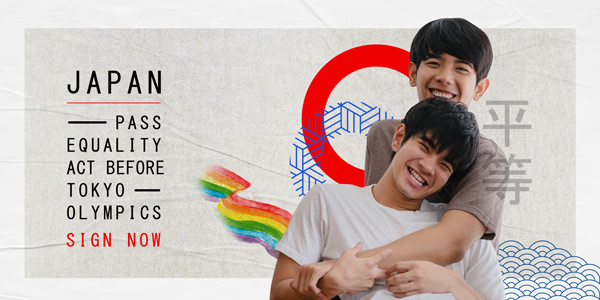
In July 2021, the Summer Olympic and Paralympic Games are set to begin in Japan.
But Japan is not ready to host the Olympics.
The Tokyo Olympics are advertised as celebrating “unity in diversity” and “passing on a legacy for the future.” But LGBT+ people in my country continue to face social stigma and enjoy fewer legal protections than other Japanese citizens.
There’s still time to change this. Before athletes and visitors from all around the world come to celebrate the Olympic Games, the Japanese government must enact the Equality Act and protect LGBT+ athletes, visitors, and their own citizens from discrimination.
Join us today and sign to show your support for the Equality Act.
The Olympic Games stand for diversity and tolerance. The Olympic Charter specifically protects against discrimination, including on the grounds of sexual orientations.
That’s why the Olympics are the perfect time to stand in solidarity with the LGBT+ community in Japan and to remind the government of its duty to protect its visitors and citizens.
And it’s urgent: Tokyo has passed an ordinance that protects LGBT+ people from discrimination. But several Olympic competitions will take place outside of Tokyo, leaving LGBT+ fans, athletes, and citizens in these areas unprotected.
Yuri
Japan Alliance for LGBT Legislation (J-ALL)
Sources:
●︎ Japan: Introduce LGBT Non-Discrimination Law – Human Rights Watch, 15. May 2020
●︎ Letter to Prime Minister Shinzo Abe Regarding National LGBT Non-Discrimination Law – Human Rights Watch, 17. April 2020
●︎ Olympic Charter – IOC, 17. July 2020
New Judgment by the ECtHR: SABALIĆ v. CROATIA: Lesbian woman assaulted for refusing man’s advance: Man fined derisory fine of 40 EUR

http://hudoc.echr.coe.int/fre?i=001-207360 (14 January 2021)
5. On 13 January 2010 the applicant was physically attacked in a nightclub in Zagreb where she was with several of her friends. The attack ceased only after one of the applicant’s friends, I.K., used her gas pistol to frighten off the attacker.
6. At about 6.00 a.m. a local police station of the Zagreb Police Department (Policijska uprava zagrebačka, hereinafter: the “police”) was informed of the incident and two police officers immediately responded at the scene.
7. The relevant part of the police report on the findings at the scene of the incident reads:
“When we came at the scene … we found Petra Sabalić …, I.K. …, I.D. …, K.F. …, E.N. … and A.B. … [personal details omitted].
By interviewing them and observing the scene of the incident we established that the above-mentioned persons had come to [the nightclub] at around 4.00 a.m., where they stayed for about one and a half hours. While they were in the nightclub [the applicant] was approached by an unidentified man who started flirting with her but she was constantly refusing him. After the nightclub closed they were all standing in front of it and the man continued pressing [the applicant] to be with him. When she said that she was a ‘lesbian’ he grabbed her with both of his arms and pushed her against a wall. He then started hitting her all over her body and when she fell to the ground he continued kicking her. …”
68. As a result of the attack the applicant sustained multiple physical injuries, including contusion on the head, a haematoma on the forehead, abrasions of the face, forehead and area around the lips, neck strain, contusion on the chest and abrasions of both palms and knees (see paragraph 10 above). These particular circumstances of the attack were later confirmed in the minor offences proceedings (see paragraphs 12 and 14 above) and they formed the essence of the applicant’s criminal complaint and the ensuing criminal investigation (see paragraphs 16 and 20 above).
69. Furthermore, the Court notes that there is sufficient evidence before it to conclude that the attack against the applicant was influenced by her sexual orientation. This follows from the above-noted findings of the police, the applicant’s detailed account of the events in her criminal complaint lodged with the State Attorney’s Office (see paragraph 16 above), the applicant’s and her friends’ police interviews (see paragraphs 18-19 above), and the findings of the criminal investigation conducted by an investigating judge of the County Court (see paragraph 23 above).
70. In light of the foregoing, the Court concludes that the treatment, convincingly described by the applicant, to which she was subjected and which was directed at her identity and undermined her integrity and dignity, must necessarily have aroused in her feelings of fear, anguish and insecurity reaching the requisite threshold of severity to fall under Article 3 of the Convention (compare Identoba and Others, cited above, § 71; M.C. and A.C., cited above, § 119; …
71. The Court therefore rejects the Government’s objection and finds Article 3 of the Convention applicable to the applicant’s complaints.
105. In these circumstances, the Court finds that already at the initial stages of the proceedings, immediately after the physical attack against the applicant had taken place, the domestic authorities were confronted with prima facie indications of violence motivated or at least influenced by the applicant’s sexual orientation (compare Šečić, cited above, § 69; Milanović, cited above, § 99; Abdu, cited above, § 35; and Begheluri, cited above, § 176). According to the Court’s case-law, this mandated for an effective application of domestic criminal-law mechanisms capable of elucidating the possible hate motive with homophobic overtones behind the violent incident and of identifying and, if appropriate, adequately punishing those responsible (see paragraphs 94-95 above; see also S.M. v. Croatia, cited above, § 324).
107. Instead of lodging a criminal complaint before the State Attorney’s Office concerning the hate motivated violent attack against the applicant or conducting any further actions to elucidate the possible hate crime element of the events, as required by the relevant instructions (see paragraph 46 above), the police instituted minor offences proceedings in the Minor Offences Court indicting M.M. on charges of breach of public peace and order. These proceedings ended with M.M.’s conviction for the minor offence and his punishment by a fine of approximately EUR 40 without addressing or taking into account the hate motive at all. As there was no appeal by M.M. or the police, and since the applicant was not informed of the proceedings, M.M.’s minor offences conviction became final (see paragraphs 13-15 above).
108. Although it goes without saying that it is not for the Court to address such issues of domestic law concerning individual responsibility, that being a matter for assessment by the national courts, or to deliver guilty or not guilty verdicts in that regard, the Court observes that the minor offences proceedings did not in any manner address the hate crime element to the physical attack against the applicant nor was M.M. indicted or convicted of any charges related to violence motivated by discrimination …
110. The Court cannot therefore overlook the fact that M.M.’s sentence in the minor offences proceedings was manifestly disproportionate to the gravity of the ill-treatment suffered by the applicant (compare Identoba and Others, cited above, § 75). Indeed, this conclusion is confirmed by comparing the prescribed sanctions for the offences as subsequently classified by the State Attorney’s Office – which were publishable by imprisonment (see paragraphs 16, 20 and 32 above) – and the nature of the sanction actually imposed on M.M. in the minor offences proceedings. …
111. In overall, the Court finds that such a response of the domestic authorities through the minor offences proceedings was not capable of demonstrating the State’s Convention commitment to ensuring that homophobic ill-treatment does not remain ignored by the relevant authorities and to providing effective protection against acts of ill-treatment motivated by the applicant’s sexual orientation. The sole recourse to the minor offences proceedings against M.M. could be considered rather as a response that fosters a sense of impunity for the acts of violent hate crime, than as a procedural mechanism showing that such acts could in no way be tolerated …
114. In the Court’s view, both failure to investigate hate motives behind a violent attack and failure to take into consideration such motives in determining the punishment for violent hate crimes, amounted to “fundamental defects” in the proceedings under Article 4 § 2 of Protocol No. 7. In the present case the domestic authorities failed to remedy the impugned situation,although it could not be said that there were de jure obstacles to do so (see paragraph 99 above). In particular, they failed to offer the defendant the appropriate redress, for instance, by terminating or annulling the unwarranted set of proceedings and effacing its effects, and to re-examine the case. The domestic authorities therefore failed to fulfil their duty to combat impunity of hate crimes in compliance with the Convention standards …
115. In sum, in view of the above considerations, the Court finds that by instituting the ineffective minor offences proceedings and as a result erroneously discontinuing the criminal proceedings on formal grounds the domestic authorities failed to discharge adequately and effectively their procedural obligation under the Convention concerning the violent attack against the applicant motivated by her sexual orientation. Such conduct of the authorities is contrary to their duty to combat impunity for hate crimes which are particularly destructive of fundamental human rights (see paragraph 95 above).
116. There has therefore been a violation of Article 3 under its procedural aspect in conjunction with Article 14 of the Convention.
Czech Constitutional Court rules against adoption of children abroad by same-sex registered couples
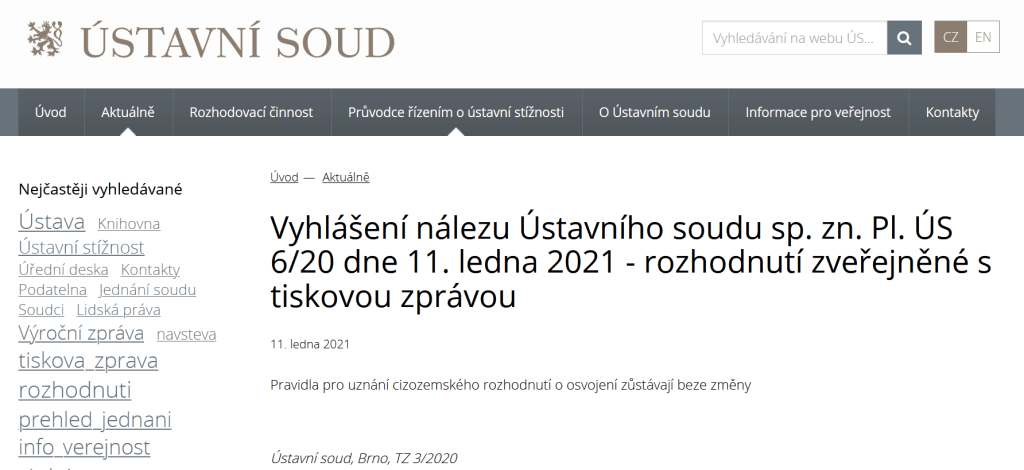
The judgment can be found here: https://www.usoud.cz/aktualne/vyhlaseni-nalezu-ustavniho-soudu-sp-zn-pl-us-6-20-dne-11-ledna-2021-rozhodnuti-zverejnene-s-tiskovou-zpravou?fbclid=IwAR1BoJOHMiGPnuAGSYFtMfPUt5r3EkV1cc8Ob2iAAf_1BlFb0UvHgRBydl8
Honduras lawmakers vote to harden bans on abortion and same-sex marriage

The National Congress of Honduras Thursday voted in favor of constitutional reforms that make it difficult to reverse provisions preventing the legalization of abortion and same-sex marriage.
Of the 128 members of Congress, 88 voted in favor of the amendments, 28 opposed and seven abstained. They will have to be ratified in a second session. If ratified, amendments to the provisions granting legal personhood to fetuses and restricting same-sex marriages will require three-quarters majority.
At present, in addition to Honduran women who undergo abortions, persons involved also face up to six years in prison. In addition to criminalizing abortion, existing laws also prohibit the “use, sale, distribution, and purchase of emergency contraception, carrying the same imprisonment penalties as abortion.”
“This reform is the product of a state-imposed religion on Honduras,” said gay rights advocate Kevihn Ramos.
Feminist collective Somos Muchas member Neesa Medina cited concerns over lawmakers’ decision to “ignore women’s suffering” in a country where sexual violence rates are high and 40 percent of pregnancies are unplanned or unwanted. “There are thousands of people affected by the pandemic, there is insufficient healthcare and thousands are leaving in caravans, many who are women and girls,” Medina said of the thousands of migrants fleeing Honduras.
The Office of the UN High Commissioner for Human Rights estimates the number of Honduran women and girls undergoing unsafe abortions each year to be between 51,000 and 82,000, and said that “lack of accessibility of contraception, particularly in rural areas, which, together with the prohibition of emergency contraception, contributes to a high rate of unwanted pregnancy, including adolescent pregnancy.”
The post Honduras lawmakers vote to harden bans on abortion and same-sex marriage appeared first on JURIST – News – Legal News & Commentary.
USA – Alabama: These Trans Women Just Won the Right to a Driver’s License Without Needing Surgery
Last week, a federal court struck down a 2012 Alabama policy requiring trans people to undergo gender confirmation surgery before correcting their IDs.

Read: https://www.them.us/story/alabama-id-lawsuit-transgender-discrimination
Hungary government orders disclaimers for books with gay themes
The Hungarian government has ordered a publisher to print disclaimers identifying books containing “behaviour inconsistent with traditional gender roles.”
The order is in response to the publication of Meseorszag mindenkie (A Fairy Tale for Everyone) a fairytale anthology published by Labrisz, an association for lesbian, bisexual and transgender women. The group says the storybook includes “elderly and Roma people, people living in poverty, adopted or abused children and heroic girls, as well as lesbian, gay, and trans characters.”
The Hungarian Consumer Protection Authority said that the book constitutes unlawful commercial practice since “the book is sold as a fairytale, called so on its cover and designed accordingly, but it hides the fact that it depicts behaviour inconsistent with traditional gender roles.” Labrisz noted that the storybook first caused controversy when Hungarian politician Dóra Dúró shredded a copy of the book in September, stating that the book constitutes “homosexual propaganda.”
Labrisz, supported by LGBTQI organization Háttér Society, plans to seek judicial review of the decision.
 International and Comparative SOGIESC Law - Professor Andreas R Ziegler