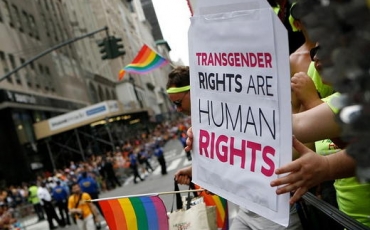
From the Margins: Global Perspectives on LGBTQ+ Experiences, Virtual Symposium and Workshop, April 8 and 9 2021

From the Margins: Global Perspectives on LGBTQ+ Experiences, Virtual Symposium and Workshop, April 8 and 9 2021

Maynooth University Department of Law, in association with the MU Sexualities and Genders Network, is organising a virtual Symposium and Workshop entitled “From the Margins: Global Perspectives on LGBTQ+ Experiences”. This takes place on April 8 and 9 2021. 


The Thursday symposium features presentations from international speakers, both academic and activist, on experiences of being LGBTQ+ in different parts of the globe. The Friday workshop focusses on the politics of voice and listening, with a particular emphasis on non-binary gender identities. Both events take place on Zoom.
Attendance at the events is free, but those wishing to attend are asked to register. Further details on registration are available here: 

These events are very kindly sponsored and supported by the Maynooth University Equality, Diversity, Inclusion, and Interculturalism (EDI) Project Fund.

African Court on Human and People’s Rights defends socio-economic rights of gender-nonconforming and sex workers

African Court on Human and People’s Rights defends socio-economic rights of gender-nonconforming and sex workers

Advisory Opinion No. 001/2018 issued by the African Court on Human and People’s Rights on 4 December 2020 with a section entitled “Vagrancy laws and the right to non-discrimination and equality” includes paragraph 70, where the court explicitly refers to gender non-conforming people and sex workers in the following terms:

Against the above background, the Court notes that vagrancy laws, effectively, punish the poor and underprivileged, including but not limited to the homeless, the disabled, the gender-nonconforming, sex workers, hawkers, street vendors, and individuals who otherwise use public spaces to earn a living. Notably, however, individuals under such difficult circumstances are already challenged in enjoying their other rights including more specifically their socio-economic rights. Vagrancy laws, therefore, serve to exacerbate their situation by further depriving them of their right to be treated equally before the law.

The conclusion of the Court reads:

The court (…) finds that vagrancy laws, including but not limited to those that contain offences which criminalise the status of a person as being without a fixed home, employment or means of subsistence, as having no fixed abode nor means of subsistence, and trade or profession; as being a suspected person or reputed thief who has no visible means of subsistence and cannot give a good account of him or herself; and as being idle and who does not have visible means of subsistence and cannot give good account of him or herself violate; and also those laws that order the forcible removal of any person declared to be a vagrant and laws that permit the arrest without a warrant of a person suspected of being a vagrant are incompatible with Articles 2, 3, 5, 6, 7, 12 and 18 of the Charter;


https://www.african-court.org/en/images/Cases/Advisory%20Opinion/Advisory%20Opinions/001-2018_-_PALU-Advisory_Opinion.pdf

Japan court finds government’s failure to recognize same-sex marriage unconstitutional

Japan court finds government’s failure to recognize same-sex marriage unconstitutional

The Sapporo District Court found Wednesday that the government’s failure to recognize same-sex marriage is unconstitutional because it violates the right to equality.

As a member of the Group of Seven, an intergovernmental organization including Canada, France, Germany, Italy, the UK and the US, Japan was the only country that did not recognize same-sex marriage. Same-sex couples were not afforded the same rights as heterosexual couples. Some municipalities, such as Tokyo’s Shibuya ward, only began recognizing same-sex partnerships in 2015. In 2017, Osaka become the first city in the country to recognize same-sex couples as foster parents. However, Japan did not recognize same-sex marriage.

In February 2019, 13 same-sex couples filed lawsuits across four districts in Japan, alleging that the country’s denial of same-sex marriage violates the constitution. The couples sought 1 million yen in damages each for psychological damage allegedly caused by the government’s negligence in not amending the law. This was the first major challenge to same-sex marriage’s constitutionality. In July 2019, major opposition groups, including the Constitutional Democratic Party and the Japanese Communist Party, submitted a bill to recognize same-sex marriages.

On Wednesday, the court found that the government was violating Article 14 of the Constitution by discriminatorily failing to implement legal measures to offer any marital benefits to same-sex couples. The denial of same-sex marriage violated the right to equality. However, the court declined to award psychological damages.

This was a historic verdict in Japan, as it is considered to be a major symbolic victory for the LGBTQ community.

The post Japan court finds government’s failure to recognize same-sex marriage unconstitutional appeared first on JURIST – News – Legal News & Commentary.

Parution d’un ouvrage de Thierry Delessert sur l’histoire des homosexualités en Suisse — LGBTI Recht in der Schweiz – Droit LGBTI en Suisse – by Professor Andreas R Ziegler

Parution d’un ouvrage de Thierry Delessert sur l’histoire des homosexualités en Suisse Link: https://www.seismoverlag.ch/en/daten/sortons-du-ghetto/

Parution d’un ouvrage de Thierry Delessert sur l’histoire des homosexualités en Suisse — LGBTI Recht in der Schweiz – Droit LGBTI en Suisse – by Professor Andreas R Ziegler

USA: South Dakota Senate passes bill to block transgender women from girls’ sports

USA: South Dakota Senate passes bill to block transgender women from girls’ sports

The South Dakota state Senate on Monday approved a bill that prevents transgender women from competing in women’s sports at the high school and college level.

Titled “an act to promote continued fairness in women’s sports,” the legislation applies to public schools and any “institution of higher education under the control of the Board of Regents or the South Dakota Board of Technical Education.” Under the new bill, any qualifying school must designate athletic activities as male, female, or coeducational. Any team or sport in the female category will be available only to students who “are female, based on their biological sex.”

The bill mandates that each student who wishes to participate in a school sport submits a statement including their age and “biological sex, as ascertained at or before birth in accordance with the student’s genetics and reproductive biology.” If a school has “reasonable cause” to think that a student’s statement of their biological sex is false, it may “remove the student from, and prohibit further participation in, any sport or on any athletic team for the duration of the school year.”

The legislation also includes provisions to prohibit the investigation of school employees who enforce the bill and gives students a claim for relief if they are harmed by violation of the bill or face retaliation for reporting a possible violation of the bill.

Having passed the South Dakota state House in February, the bill will now go to Governor Kristi Noem for approval. Noem stated that she is “excited to sign this bill very soon” in the pursuit of “defending women’s sports.” Utah, Mississippi and Tennessee state legislatures have advanced similar bills this year.

The American Civil Liberties Union of South Dakota called the legislation “an attack on transgender women and girls that will cause them serious emotional and physical harm” and said it undermines policies that are already in place to include transgender athletes.

The post South Dakota Senate passes bill to block transgender women from girls’ sports appeared first on JURIST – News – Legal News & Commentary.

“Gender critical” beliefs and the ECHR

“Gender critical” beliefs and the ECHR

Posted: 08 Jun 2020 01:14 PM PDT (c) Paul Johnson – http://echrso.blogspot.com/

European Human Rights Law Review has published my article “Gender Critical Beliefs and the European Convention on Human Rights”.

The article critically explores the extent to which “gender critical” beliefs – which, principally, are that sex is biologically immutable and that it is impossible for a human being to change sex – should qualify for protection under the Convention.

In the article, I argue that a recent judgment of an Employment Tribunal in the UK, which held that gender critical beliefs do not qualify for protection under British equality law, was appropriate because it reflects the settled jurisprudence of the European Court of Human Rights in respect of the rights and freedoms of transgender people.

I also argue that this approach is consistent with the right to express gender critical beliefs, as the High Court of England and Wales has held, under Article 10 of the Convention.

The article is published in EHRLR (2020) issue 2, and will soon be available on Westlaw. If anyone wants to read it and cannot access it online, please email me and I will happily send you a copy.

USA: Idaho House approves bill imposing opt-in requirement for sex education

USA: Idaho House approves bill imposing opt-in requirement for sex education

The Idaho House of Representatives approved House Bill 249 on Friday, requiring parents to opt in for sex education of their children, as opposed to the blanket opt-out requirement that was in place earlier. The bill, which was introduced by Representative Barbara Ehardt, passed with a vote of 56-12 and amends certain provisions of Chapter 16, Title 33 of the Idaho Code relating to the instruction of sex education.

Section 1 of the bill amends Section 33-1609 of the code, which defined “sex education” only as “the study of the anatomy and the physiology of human reproduction.” The bill, however, inserts another category of sex education, which it refers to as “instruction regarding human sexuality,” and defines as “any presentation, story time, discussion, or reading assignment, other than sex education as specifically and narrowly defined [otherwise], that is focused primarily or substantially on human sexuality, encompassing the topics of sex, gender identity, sexual orientation, eroticism, sexual pleasure, or sexual intimacy,” while expressly limiting the scope of sex education as it originally existed.

For this newly-inserted definition, the bill places an opt-in requirement, where parents who want their children to be given human sexuality instruction shall provide written permission to the school district board of trustees, while the opt-out requirement for the instruction on the anatomy and physiology of human reproduction remains in place. Therefore, the bill effectively divides sex education into two areas and indicates that schools would be disallowed from offering instruction in areas relating to human sexuality, gender identity, sexual orientation, and sexual pleasure unless parents or legal guardians specifically and explicitly file written forms allowing for such instructions to take place for their child.

The post Idaho House approves bill imposing opt-in requirement for sex education appeared first on JURIST – News – Legal News & Commentary.