Canada finally introduces legislation to ban traumatising conversion therapy
Canada finally introduces legislation to ban traumatising conversion therapy
Leave a reply

Canada finally introduces legislation to ban traumatising conversion therapy
Northern Ireland’s ban on same-sex marriage was ‘unjustified discrimination’, top court finally rules
Pre-doctoral research vacancies: Intersex – New Interdisciplinary Approaches (INIA) (including: The legal aspects of intersex and variation of sex characteristics)
The research vacancies (pre-doctoral) are now open and we invite applications.
Intersex people’s healthcare, social and human rights issues are often overlooked. They continue to face exposure to multiple forms of human rights violations and discrimination, requiring cross-sectoral policy responses in fields including healthcare, education, and the law.
The INIA Consortium aims to develop knowledge that will support the wellbeing and rights of intersex people and those who do not identify as intersex but have some variations of sex characteristics (hereafter: intersex people/people with variations of sex characteristics).
INIA will train a cohort of 10 early stage researchers working collaboratively to develop knowledge that will inform policy making and practice across a range of key sectors. It is being established by the University of Huddersfield, the Université Libre de Bruxelles, Dublin City University, the University of Zurich, the Escuela Andaluza de Salud Pública / Andalusian School of Public Health and the Universitat Autònoma de Barcelona in collaboration with intersex activists and advocates, clinicians, and other specialists. It will enable 21 organisations from more than 10 countries to work together on issues relating to intersex people / people with variations of sex characteristics, in a unique multidisciplinary and transectoral network. The Consortium includes international experts from a wide range of countries across the globe. The INIA work-package themes are shared across the main partners and the INIA projects, and they include:
The INIA project started on 1 March 2020 and will run for 48 months.
We will be hiring 10 Early Stage Researchers (who will become PhD students) across the whole consortium. We will provide a pioneering multi-disciplinary, multiagency international training environment which will prepare the Early Stage Researchers for future careers in academia, NGOs, policy making, or service provision. Brief details about the PhD projects are available on the PhD project tab. Each Early Stage Researcher will benefit from 2-3 secondments to other countries which will be hosted by NGOs, healthcare providers, and/or Universities. More information, and access to the application process, will become available in March 2020. The Early Stage Researchers will start their posts in September 2020.
For any questions about the INIA programme please email s.monro (at) hud.ac.uk.
Information related to the application process during Covid-19 pandemic:
The European Commission is showing support and flexibility about the delivery of this programme, due to the COVID-19 crisis.You might want to know that successful candidates will receive a sum of euro 600 per month (before tax) addition to the generous salary (see individual projects), and if they have dependent/s (child/ren or legally recognised partner) then there is more money available to them. Also, there is the possibility to apply for extra funds if the successful applicants have disabilities that are recognised by medical authorities.
All interviews for the positions will take place via skype or zoom.
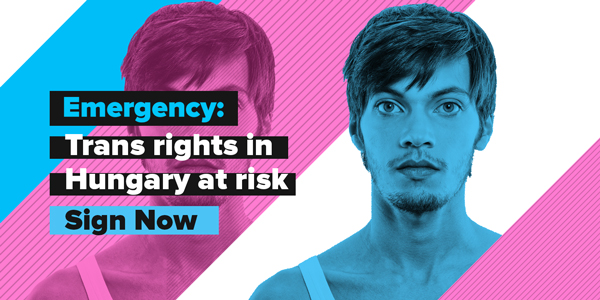
Most governments around the world are mobilizing all their resources in the fight against the COVID-19 pandemic. They reach across the aisle in an effort to tackle one of the greatest challenges humanity has faced in recent history.
But here in Hungary, our Prime Minister Viktor Orbán has unashamedly used the situation as a pretext to grab unlimited power, enabling him to rule by decree. And while everyone is distracted by the coronavirus, the government also submitted a bill that, among other things, would make it impossible for transgender people to legally change their gender.
If passed, the law would force trans people to live with documents that do not match their true identity. It would expose them to discrimination in employment, housing, and access to services and official procedures. It would also clear the way for medical practice, including surgery, harmful to intersex children.
That’s why I’ve launched a petition to the Hungarian government. Several thousand people have signed it since I launched it earlier this week, but we’ll need many more signatures to break through the noise and get the government’s attention.
OAS Publishes Guide on Safeguarding Rights of Vulnerable Groups (such as women, indigenous peoples, and the LGBTI community) in Context of COVID-19 Response
By: Justine N. Stefanelli | April 7, 2020 – 1:18pm
On April 7, 2020, the Organization of American States published a “Practical Guide to Inclusive Rights-Focused Responses to COVID-19 in the Americas.” As explained in a press release from the OAS, the guide addresses the concern that situation for vulnerable people, such as women, indigenous peoples, and the LGBTI community, worsens in the context of emergency situations, such as the current pandemic. Therefore, the guide stresses the need for states to emphasize the protection of the right to health of vulnerable groups. It consists of ten chapters, each of which addresses specific groups of vulnerable people and issues such as the right to education for children, responding inclusively to internally displaced persons, migrants, and refugees, and how to ensure that prevention, containment, and mitigation efforts include people living in poverty and extreme poverty.
The guide is currently available only in Spanish, but an English version is forthcoming.
IACHR finds Peru responsible for arbitrary detention and rape of transgender woman
The Inter-American Court of Human Rights (IACHR) found in a decision released Monday that Peru owed damages to Azul Rojas Martin, a transgender woman who was imprisoned and tortured by Peruvian authorities.
Rojas Martin was detained by authorities in February 2008 striped of her clothes and beat as authorities screamed and insulted her for being transgender.
In its decision, the court noted the long history of discrimination and abuse against LGBT people. They also reiterated that LGBT people are part of a protected class and that discrimination based on sexual orientation or gender identity will not be tolerated by the court.
The court ordered Peru to investigate and try the officers who attacked Rojas Martin. In addition, they are required to create an efficient way to investigate and punish people who commit anti-LGBT crimes. They also are asked to create educational programs for offenders to create awareness about the LGBT community. Finally, they are required to pay for Rojas Martin’s therapy and an undisclosed amount of money in reparations.
The post IACHR finds Peru responsible for arbitrary detention and rape of transgender woman appeared first on JURIST – News – Legal News & Commentary.
ECtHR: Beizaras and Levickas v. Lithuania: ILGA-Europe’s Work On a Landmark European Hate Speech Judgement
by ILGA-Europe
On 14 January 2020, the European Court of Human Rights (ECRI) delivered its judgements in the case of Beizaras and Levickas against Lithuania. An analysis of the content of the decision highlights how the ECRI 2016 Report on Lithuania and its 2019 Conclusions on the implementation of the recommendations in respect of Lithuania positively influenced the outcome of the case.
LGBTI people should be and feel safe online. As every other citizen, we should be able to use social media and share online without fearing a backlash. That’s not always the case, which is why many activists continue to fight and to push for legal frameworks that protect all citizens from discrimination. In ILGA-Europe we work towards advancing human rights, one litigation case at a time.
Violation of rights
The landmark case of Beizaras and Levickas v. Lithuania originated after one of the applicants posted a photograph of him kissing his male partner (the second applicant) on his Facebook page, which led to hundreds of online hate comments. The European Court of Human Rights found Lithuania’s failure to investigate online hateful comments against the gay couple to violate their rights to private and family life (Article 8) and to effective remedy (Article 13) as well as being discriminatory on the ground of sexual orientation (Article 14).
The European Commission against Racism and Intolerance (ECRI) is a Council of Europe human rights monitoring body. As part of its mandate it issues recommendations to address the issues of racism and intolerance it identifies in member states. ECRI’s General Policy Recommendation No. 15 (2015) on Combating Hate Speech is of particular importance to the work of ILGA-Europe and its member organisations.
Structure of a court’s judgement
To understand the importance of the ECRI report in the case of Beizaras and Levickas v. Lithuania, it is necessary to understand the structure of a Court’s judgement, which is composed of an assessment of firstly “The Facts” and secondly “The Law”. In the case at stake, the Facts section is sub-divided into:
The Law section comprises:
It is to be noted that ILGA-Europe and partner organisations also referenced the ECRI report in their written submission to the Court. In its judgement, the Court relied on the intervention, especially on the arguments based on the ECRI report.
The Court indicates, before starting the legal assessment of the case, that the Report will be part of the authoritative documents it will rely on to decide on the various conventional violations.
Concretely, the ECRI Report is part of the “III. Relevant international materials” (paras 56-62 of the judgement). In this section of the judgement, the Court extensively quotes relevant parts of the ECRI 2016 Report (paras. 22, 25-29, 31-33, 35-38, 53-59, 90-92 of the Report) and also refers to the 2019 “Conclusions on the implementation of the recommendations in respect of Lithuania” (para 62 of the judgement). The difference in length with the other “relevant international materials” referred to is striking.
The Court further refers to the ECRI Report in several parts of the judgement when assessing “The Law,” to decide both on the admissibility and on the merits of the case.
Admissiblity
As regard admissibility, the question arose whether the Court was competent to hear the case even though the national complaint was brought by an Association rather than physical persons (the same-sex couple). The Court relied on the ECRI report to establish that the contextual situation explained why the victims, the same-sex couple, were not in a position to submit a complaint at the national level since there were risks of retaliation. The Court hence decided that the complaint was admissible.
The Report is also part of the reasoning of the Court on the merits of the case, and it influences its findings. The Court referred to the ECRI Report both in its analysis of I) the violation of Article 14 of the convention taken in conjunction with article 8 and II) the violation of article 13 of the Convention.
Concerning Articles 14 and 8, the ECRI report highlights that hate speech is a serious issue in Lithuania and that most of it takes place on the Internet. This enables the Court to reject the Government’s argument according to which hate comments on Facebook don’t reach the required threshold of harmfulness and seriousness such as to require its intervention.
The Court considered that the comments constituted a threat to the applicants’ physical and mental integrity, and the lack of requisite protection, due to the discriminatory attitude of the authorities, constituted a breach of Article 14 taken in conjunction with Article 8 of the Convention.
Right to an effective remedy
As regard the Right to an effective remedy (Article 13), the Court first referred to the third-party intervention, specifically to its developments on the ECRI report. The latter concern the condemnation by ECRI of the Lithuanian Supreme Court’s practice of referring to “protection of public morals” to justify or condone incitement of hatred against LGBT people. The Court then relied heavily on the findings of the Report in its own assessment of a breach of Article 13.
The Court noted in particular the ECRI’s observation of a “growing level of intolerance against sexual minorities”; the law-enforcement authorities’ failure to acknowledge bias-motivation of hate crime; the “prejudicial attitude of the domestic court” and the “lack of comprehensive strategic approach to tackle the issue of …homophobic hate speech by the authorities”. This contextual information, together with the authorities’ attitude in the case at stake, led to the conclusion that the applicants were denied an effective domestic remedy in respect of their complaint, which constituted a violation of Article 13.
Breaches of the LGBTI community’s fundamental rights generally take place in a wider context of permanent multidimensional discrimination. This case highlights that up-to-date background information on the situation of the LGBTI community in the Member States of the Council of Europe is crucial to enable a rigorous assessment of applicants’ complaints and to hold States accountable.
Read ILGA-Europe’s joint intervention with partners here
Read the court’s judgement here


Right On: Fighting Online Hate Speech and Fake News in a Global Crisis Event Geneva Internet Platform Content challenges such as fake news, disinformation campaigns, and online hate speech are increasingly common these days. These challenges are far from recent developments; the outbreak of the coronavirus has only accelerated this ‘infodemic’, while the growth in […]
Online: Right On: Fighting Online Hate Speech and Fake News in a Global Crisis, 8 April 2020, 14:00-16:00 — International Law Association – Swiss Branch (since 1929)
USA: New York budget legalizes commercial surrogacy and outlaws “pink tax”
New York passed its 2020-2021 budget Thursday despite COVID-19 uncertainties. The New York State Assembly enacted legislative reforms alongside the budget. The most notable of these reforms include legalizing commercial surrogacy and outlawing the “pink tax.”
In legalizing commercial surrogacy, the state created a Surrogates’ Bill of Rights that ensures comprehensive health insurance and pregnancy termination rights for surrogates. Regarding the “pink tax,” the overpricing of products marketed towards women, New York has banned this overpricing and requires producers to disclose pricing information.
Governor Cuomo praised the New York State Assembly’s efforts on legislative reform alongside the budget during the COVID-19 outbreak:
This is a moment in history unlike any other, and government needs to function and deliver results for the people of this state now more than ever — and that’s exactly what we did with this budget. That the legislature and the Executive got this budget done with all of these policy initiatives is an extraordinary feat, and I praise Speaker Heastie, Leader Stewart-Cousins and every member of the legislature. It would have been very easy to say, ‘Oh, this is an extraordinary year; let’s just do the bare minimum and go home.’ We did the opposite. We said there is a lot of need and there are a lot of issues that need to be addressed, and we stepped up to the plate and we got it done. That it was done this year is really extraordinary.
Complimenting these two large reforms, the New York State Assembly additionally banned hydrofracking, outlawed e-cigarettes, and tightened gun control to exclude those who committed serious crimes in others states from New York gun licensing.
The post New York budget legalizes commercial surrogacy and outlaws “pink tax” appeared first on JURIST – News – Legal News & Commentary.
8th European Transgender Council – 17-20 September 2020, Berlin, Germany
| Together towards tomorrow 15 years of resilience and movement building |
| It is a pleasure to invite you to join the upcoming 8th European Transgender Council. The European Transgender Council is the first and largest gathering of trans activists in Europe and Central Asia, being both a forum setting the agenda for trans politics and a celebration of trans communities. With 200 to 300 participants every other year, it’s one of the most important meetings of trans communities in Europe and Central Asia. Please note this year’s TGEU Council will not take place in Lisbon as previously announced; instead, the event will be held in Berlin, Germany, from 17 to 20 of September 2020. TGEU is committed to making the 2020 Council as accessible as possible. Based on previous years’ feedback, a disability expert has been contracted to help with planning and on-site support. In addition, we will create space for those recognising Rosh Hashanah, which will take place during the Council weekend. In the meantime, there are many ways to get involved with the Council. Check out volunteer and contract opportunities below, as well as a timeline of important dates. We hope to see you in Berlin! Further information about the Council will be soon be available on our website. |
| Get involved There is a lot that goes into creating the Council. We encourage trans and queer people to get involved before, during, and after the conference. Application forms to be part of the teams below will be available soon on our website. Volunteers Team: Volunteers can attend the Council for free (in limited numbers). We cannot cover traveling and accommodation costs. Volunteering includes, for instance, helping with info point and registration, social events, videography and photography, setting up and cleaning up. Awareness Team: Be a contact point for participants and help make the Council a safer space. Kids area Team: If you are a trusted adult with childcare experience, you can help looking after them while their parents and caregivers attend the Council’s sessions. Transcription Team: Support the real-time transcription and captioning of spoken speech. Interpretation Team: We have secured funding to contract English/Russian interpreters for the Council. Donation and Sponsorship: Support the 8th European Transgender Council to fund more scholarships for trans activists from Europe and Central Asia. Large donations can get visibility within the Council. If you are interested, please contact us at council@tgeu.org |
| Timeline March 2020 Council page available online Opening of registrations Call for scholarships Call for session proposals Call for volunteers April 2020 Deadline for scholarship applications May 2020 Deadline for session proposals Outcome of scholarships Start of visa applications process June 2020 Outcome of session proposals July 2020 Call for Board candidates Call for Auditors Call to host the 9th European Transgender Council in 2022 August 2020 Programme available online |
 International and Comparative SOGIESC Law - Professor Andreas R Ziegler