USA: FDA eases blood donation restrictions for gay men and other groups

USA: FDA eases blood donation restrictions for gay men and other groups

The US Food and Drug Administration issued updated guidance on Thursday, amending restrictions so that certain blood donor groups are now subject to a three month waiting period instead of a 12 month deferral.

This guidance was issued in an attempt to address the blood supply shortage that has emerged due to the coronavirus pandemic.

Blood donations from certain groups have been restricted for decades. In 1985, the FDA recommended that “blood establishments indefinitely defer male donors who have had sex with another male, even one time, since 1977, due to the strong clustering of AIDS illness and the subsequent discovery of high rates of HIV infection in that population.” This ban on donations from gay male donors was heavily criticized for adding to social stigma and homophobic attitudes. In 2015, after reviewing data about partner fidelity and the prevalence of HIV infections, this policy was amended to change the indefinite deferral to a 12-month deferral. This change did not result in an increased risk of HIV in the blood supply, and many in the LGBTQ+ community have questioned the need for any deferral.

In an attempt to encourage blood donations during the COVID-19 pandemic, and based on “recently completed studies and epidemiologic data,” the FDA is now recommending that male donors wait a period of three months between sex with another male and blood donation. This change puts the US in step with current blood donation policies in Canada and the UK.

This three month deferral recommendation also applies to other restricted blood donor groups, including female donors who have had sex with men who are engaging in sex with other men; individuals who have had recent tattoos and piercings; and individuals who have traveled to regions with malaria. The FDA is additionally recommending no deferral for individuals “who were previously considered to have been exposed to a potential risk of transmission of Creutzfeldt-Jakob Disease.”

Although “[t]hese recommendations are expected to remain in place after the COVID-19 pandemic ends,” establishments that receive blood donations are “not required to implement the changes in the FDA recommendations.”

The post FDA eases blood donation restrictions for gay men and other groups appeared first on JURIST – News – Legal News & Commentary.
Switzerland: Discrimination based on sexual orientation punishable as of 1 July 2020

CF – L’interdiction de la discrimination en raison de l’orientation sexuelle entrera en vigueur le 1er juillet


Berne, 03.04.2020 – À partir du 1er juillet 2020, il sera punissable de discriminer une personne en raison de son orientation sexuelle. Lors de sa séance du 3 avril 2020, le Conseil fédéral a arrêté cette date pour l’entrée en vigueur des normes pénales correspondantes. Lors de la votation du 9 février 2020, le peuple a clairement confirmé la décision du Parlement d’étendre la norme antiracisme du code pénal et du code pénal militaire.

UK woman wins claim for NHS to pay US surrogacy costs after wrong treatment

UK woman wins claim for NHS to pay US surrogacy costs after wrong treatment:

The UK Supreme Court on Wednesday awarded damages to a woman for surrogacy costs after she was left infertile when the Whittington Hospital National Health Service (NHS) trust failed to detect signs of cervical cancer.

The woman had tests and underwent biopsies in 2008 and 2012, all of which were wrongly reported as showing negative for cancer. The error was discovered in 2013, when the woman was told that she had cancer and was referred to another hospital. The hospital admitted negligence, noting a 95 percent chance that the woman would have not developed cancer at all had the appropriate action been taken in 2008.

In June 2013, the woman underwent ovarian stimulation and egg collection. Due to surgery and chemotherapy as a result of cervical cancer, her womb was damaged and she could not bear children. Looking to use a surrogate from California, she sought to claim damages to pay for the cost.

The Supreme Court noted that government policy in the UK had moved “in the direction of supporting surrogacy arrangements in appropriate cases.” Lady Hale stated that it was possible to claim damages for the cost of surrogacy arrangements, and it “is no longer contrary to public policy to award damages for the costs of a foreign commercial surrogacy.”

However, in awarding damages to this woman, the court noted that damages will not always be awarded. There are “some important limiting factors” that must be considered: the proposed treatments must be reasonable; it must be reasonable for the claimant to seek foreign commercial arrangements rather than arrangements within the UK; and the costs involved must be reasonable.

The post UK woman wins claim for NHS to pay US surrogacy costs appeared first on JURIST – News – Legal News & Commentary.

Hungarian government seeks to disallow legally changing one’s gender

Hungarian government seeks to disallow legally changing one’s gender

https://index.hu/english/2020/04/01/hungary_gender_at_birth_transgender_rights/

An omnibus bill submitted to Parliament by Deputy Prime Minister Zsolt Semjén on Tuesday night would make it impossible to officially change one’s gender in Hungary.

The bill submitted to Parliament on none other than the international Transgender Day of Visibility seeks to introduce the term “gender at birth” defined as “the biological sex determined by primary sexual characteristics and chromosomes” to the Civil Registry Act.

“Gender at birth” would replace “Gender” in the civil registry, and if the bill passes, altering this entry will be expressly forbidden,

making it impossible to legally change one’s gender in Hungary.

Since data in official documents such as ID cards, driving licenses, and passports are taken from the civil registry, the change would affect these as well,

newly printed official documents would display gender at birth,

an expert of administrative law speaking to Index clarified. It is unclear how this would affect changes of gender already entered into the civil registry, and since the civil registry can only contain first names that correspond to one’s gender,

if the law passes, transgender people will no longer be able to register their chosen names, which means that it will also be disallowed to change the names on official documents to reflect one’s gender identity.

The explanatory memorandum of the bill states that current legislation does not define the “gender” as it is determined biologically, adding:

“The gender entered into the civil registry is based on facts determined by doctors, declared by the registry. The registry certifies the facts and rights it includes until proven otherwise, therefore it does not create rights. However, the gender declared by the registry could create rights or obligations, and therefore it is necessary to define the term of gender at birth. Given that completely changing one’s biological gender is impossible, it is necessary to lay it down in law that it cannot be changed in the civil registry either.”

Earlier, Hungary refused to ratify the Istanbul Convention for its definition of gender as a social construct.

ECHR communicated new case – same-sex foster and then adoptive parents

ECHR communicated new case – same-sex foster and then adoptive parents Communicated on 6 March 2020 (Published on 23 March 2020 – SECOND SECTION)

Application no. 277/20 – J.B. and E.M. against Norway lodged on 20 December 2019

SUBJECT MATTER OF THE CASE

Applicant A is a Nigerian national, and applicant B is a Norwegian national of Liberian origin. Both are currently residing in Sweden. The applicants are former partners and the parents of X, born in January 2013, and Y, born in August 2014.

On 20 June 2013, as X was four months old, a decision on emergency care order and placement in foster home was taken by the Child Protection Service. An ordinary decision on a care order and placement in foster home for X was given on 18 November 2013 by County Social Welfare Board (Fylkesnemnda for barnevern og sosiale saker). Contact rights were set at two hours twice per year.

On 5 June 2014, by judgment of the City Court (tingrett), the decision of the board upheld. The foster parents in the designated foster home were a same sex couple.

On 2 December 2015 the two applicants applied for termination of the care order and placement in foster home, and, if the placement in foster home was not discontinued, that X should be placed in a foster home where the foster parents were not a same sex couple. On 29 March 2016, by decision by the Board, the application was declined. The applicants appealed against the decision.

On 3 January 2017, by judgment of the City Court, the decision not to terminate the care order was upheld. Contact rights were set at two hours twice a year for B, and two hours once a year for A. On 31 March 2017 the High Court (lagmannsrett) refused the applicant leave to appeal.

On 27 June 2018 the Board granted the request of the Child Protection Service that the applicants’ parental responsibilities for X should be withdrawn and adoption should be approved. The applicants appealed against the decision.

On 2 January 2019 the City Court quashed the decision of the Board. The Child Protection Service appealed against the judgment.

On 24 April 2019 the High Court in a judgment withdrew the applicants’ parental responsibilities for X and allowed for his foster parents to adopt him.

On 21 June 2019 the Supreme Court (Høyesterett) refused leave to appeal.

Relying on Article 8 of the Convention, the applicants submit that their right to respect for their family life was violated by the decision to withdraw the applicants’ parental responsibilities for their son and allow for his foster parents to adopt him.

Furthermore, relying on Article 9 (1) in conjunction with Article 2 of Protocol No. 1, and Article 9 (2) of the Convention, the applicants submit that the placement of X in foster home of a same sex couple constitutes a breach of the parents’ right to respect for their freedom of religion, and that adoption of their child by foster parents being a same sex couple does not meet the criteria of “necessary in a democratic society” in Article 9 (2) of the Convention as there are other foster families readily available.

QUESTIONS TO THE PARTIES

1.  Has there been a violation of the applicant’s rights under Article 8 of the Convention as a result of the decision to withdraw the applicants’ parental responsibilities in respect of their son and allow for his foster parents to adopt him, see Strand Lobben and Others v. Norway [GC], no. 37283/13, 10 September 2019?

2.  Having regard to the fact that X was adopted by foster parents being a same sex couple, does a separate issue arise under Article 9 of the Convention as regards to the applicants’ freedom of religion? If so, are the admissibility criteria for such a complaint fulfilled, in particular the criterion on exhaustion of domestic remedies? If so, has there been a violation of the applicants’ rights under Article 9 of the Convention?

Paul Johnson: “Gay cake” case communicated by European Court of Human Rights

Paul Johnson: “Gay cake” case communicated by European Court of Human Rights
Posted: 30 Mar 2020 03:38 AM PDT


The First Section of the European Court of Human Rights has communicated the case of Lee v the United Kingdom.

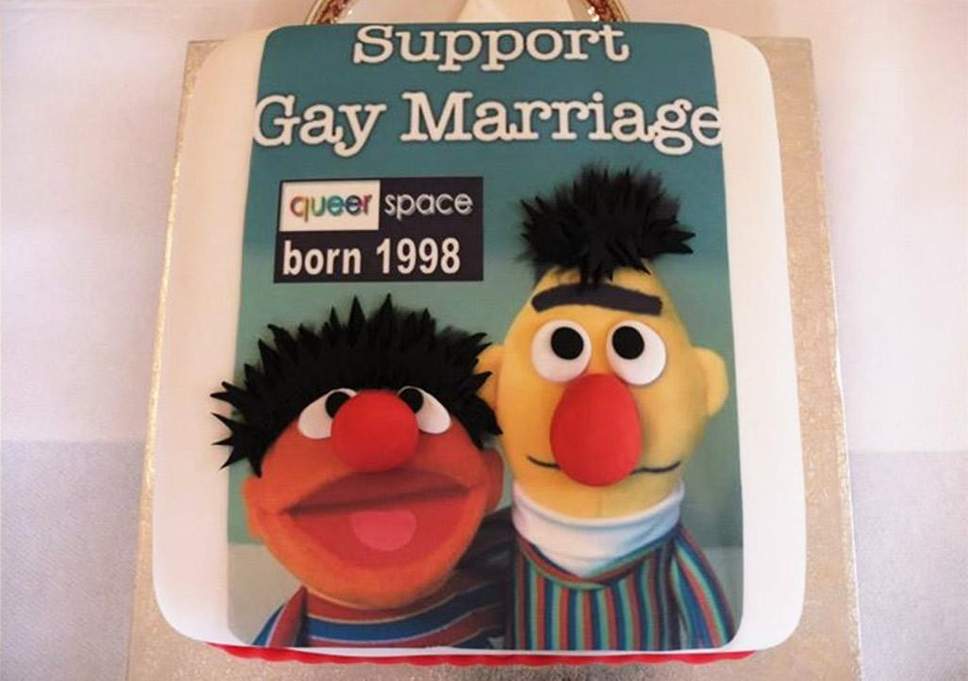
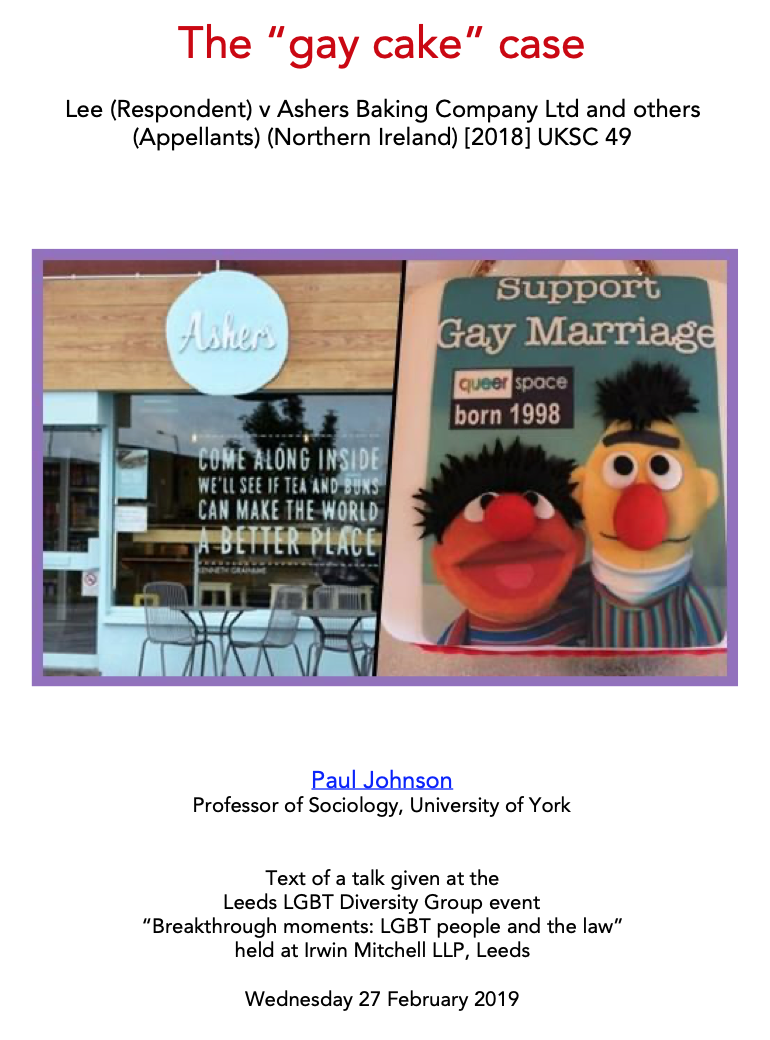
The case is brought by Mr Gareth Lee who, in 2014, placed an order for a cake from Ashers Baking Company Limited with the words “Support Gay Marriage” on it and later received a telephone call from Ashers indicating that the order could not be fulfilled. The reason given was that Ashers is a Christian business and, on that basis, should not have taken Mr Lee’s order.

Mr Lee’s claim that he had, inter alia, suffered discrimination on the grounds of sexual orientation – as prohibited by domestic legislation in force in Northern Ireland – was upheld by the County Court, and affirmed by the Court of Appeal. However, the Supreme Court subsequently found in favour of Ashers because “the objection was to the message and not to any particular person or persons”.

Complaint to the Court
Mr Lee complains under Articles 8, 9, 10, and under Article 14 in conjunction with those Articles, of the European Convention on Human Rights, that his rights were interfered with by a public authority (namely, the Supreme Court) by its decision to dismiss his claim for breach of statutory duty due to discrimination contrary to the provisions of the Equality Act (Sexual Orientation) Regulations (Northern Ireland) 2006 and the Fair Employment and Treatment (Northern Ireland) Order 1998.

Mr Lee argues that the interference was not proportionate and that the Supreme Court disregarded the democratically chosen resolution to the conflict of rights between religious organisations and persons of same sex orientation, and those supporting the aspirations of such persons.

Questions to the Parties
The Court has asked the parties the following questions:

1. Has the applicant exhausted domestic remedies in respect of his complaints under Articles 8, 9, 10 and 14 of the Convention by presenting his complaints in so far as they are different to his complaints under domestic legislation, either explicitly or in substance, in a manner to allow his allegations of violations of Convention rights to be addressed and, where appropriate, to afford redress before those allegation were submitted to the Court (see Peacock v. the United Kingdom (dec.), no. 52335/12, § 33, 5 January 2016 and Nak Naftogaz Ukrainy v. the United Kingdom (dec.) no. 62976/12, § 50, 23 May 2017)?

2. If so, has there been an interference with the applicant’s rights under Articles 8, 9 and 10 of the Convention, both alone and in conjunction with Article 14 of the Convention? Was that interference in accordance with the law and necessary in a democratic society?

3. In this context, what is the appropriate test to be applied by the Court in a case concerning a dispute of a “purely private nature” (see mutatis mutandis Plaand Puncernau v. Andorra, no. 69498/01, § 59, ECHR 2004 VIII, i.e.)?

My previous comments on this case
I entirely agree with Mr Lee’s argument that the Supreme Court, through its judgment in Lee (Respondent) v Ashers Baking Company Ltd and others (Appellants) (Northern Ireland), “disregarded the democratically chosen resolution to the conflict of rights between religious organisations and persons of same sex orientation”.
I expressed the same view on the day the Supreme Court handed down it judgment here – where I said that I thought the judgment was wrong – and expanded my reasons for that view later here.
In February 2019, I gave a talk at the Leeds LGBT Diversity Group event “Breakthrough moments: LGBT people and the law” (held at Irwin Mitchell LLP, Leeds) on the case, the full text of which is available here

Fully-funded PhD opportunity at Birmingham City University: LGBTQ teaching row

Fully-funded PhD opportunity at Birmingham City University: LGBTQ teaching row

I wanted to let you know that we’ve got an excellent opportunity for a fully-funded PhD study on the LGBTQ teaching row in Birmingham and beyond. I was hoping you might be able to help me disseminate this information? Details below.

Some exciting news for anyone thinking of doing a PhD in the area of LGBTQ inclusion:

BCU School of Social Sciences has secured funding for an excellent candidate to work on an interdisciplinary research project entitled ‘What can we learn from the LGBTQ teaching row in Birmingham?’

Birmingham has hit the headlines because of protests against the inclusion of same sex relationships in sex and relationship education in schools. This PhD aims to understand the debates, the anti-LGBTQ rhetoric, their effects on LGBTQ people (including hate crime), as well as teachers’ confidence in incorporating LGBTQ content into their teaching.

We strongly encourage to apply candidates with the ability to analyse the teaching row in Birmingham in an international perspective, taking into account the ongoing fundamentalist, anti-gender and anti-LGBTQ campaigns in other countries. 

Essential qualifications are:

  • A minimum of 2.1 UK UG degree in a relevant subject (eg psychology, sociology, politics) or the overseas equivalent
  • Undergraduate level qualifications in qualitative methods and quantitative statistical analysis
  • Effective oral and written communication skills
  • Ability to work as a member of a team with shared goals
  • Interpersonal skills: ability to relate to others with tact and diplomacy

Supervisory Team: Dr Lesley Storey, Dr Piotr Godzisz, Dr Keeley Abbott

The funding consists of a tax-free stipend paid monthly and has a current value of £15,285 per annum. The bursary is renewable annually for up to 36 months in total, subject to you making satisfactory progression within your PhD research.

Successful applicants for our funded PhD studentships will receive a tax-free research stipend that tracks UK Research Council rates (currently £15,285) and a fee waiver to the value of Home / EU student PhD fees (currently £4,407). 

The closing date for applications is 23.59 on Sunday 31 May 2020.

More info: https://www.bcu.ac.uk/social-sciences/research/phd_opportunities