New study be the University of Geneva shows that gender and beliefs shape homophobic attitudes
Leave a reply

According to new analysis by the Center for American Progress, more than 350 LGBTQI+ pages, policies, and guides have been removed from the websites of the White House and federal agencies, including the U.S. Agency for International Development (USAID) and Department of Veterans Affairs.
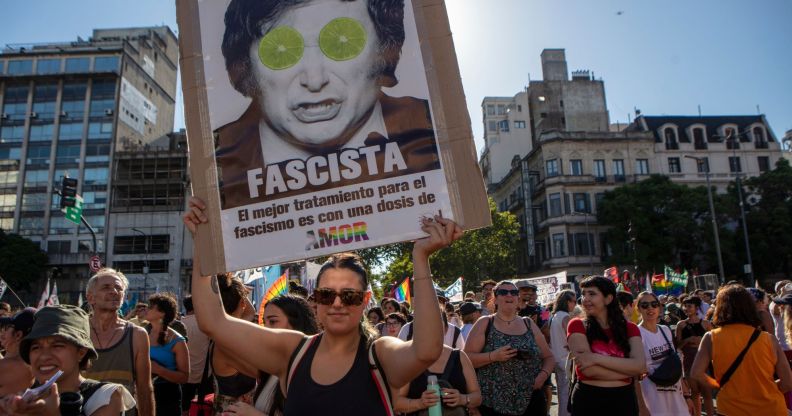
Protestors during a pro-LGBTQ+ rally in Buenos Aires. (Getty)
Argentina president Javier Milei has announced a ban on trans healthcare for anyone under the age of 18.
The right-wing populist president reportedly implemented a decree on Thursday (6 February), following similar moves in the UK, Sweden and Finland.
“Gender ideology taken to extremes and applied to children by force or psychological coercion clearly constitutes child abuse,” a spokesperson for the president’s office said.
There is no evidence that children are being forced to begin gender-affirming care in Argentina.
The decree also forces transgender prison inmates to be held in jails according to their gender at birth.
More: https://www.thepinknews.com/2025/02/11/javier-milei-trans-healthcare-under-18s/
In his first month in office, US President Donald Trump has issued a series of sweeping executive orders targeting transgender rights. Thus far, these aim to rigidly define “sex” in federal law, exclude transgender people from military service, ban gender-affirming healthcare for people under the age of 19, restrict support for transgender students in schools, and prohibit transgender women and girls from participating in sports consistent with their gender identity. The orders not only seek to roll back important rights, but functionally aim to erase any recognition of transgender people at the federal level.
More: Thoreson, Ryan: Transgender Rights at a Crossroads in the United States, VerfBlog, 2025/2/13, https://verfassungsblog.de/transgender-rights-at-a-crossroads-in-the-united-states/, DOI: 10.59704/cc4e6489ea14698b.
In January ILGA Europe submitted their annual contribution to the European Commission’s consultation ahead of this year’s Rule of Law report
The submission includes expert input of their member organisations in 9 EU countries: Belgium, Bulgaria, Cyprus, Hungary, Italy, Poland, Romania, Slovakia and Spain.
After a year of elections across the EU, threats to democracy and the rule of law are growing both in Europe and globally. Our submission highlights more clearly than ever the connection between these threats and the instrumentalisation of LGBTI people.
Disinformation, hate speech, and discriminatory political discourse have surged in many countries, directly impacting the lives of LGBTI people. At the same time, violence and restrictive legislation against LGBTI individuals are increasing, undermining the rule of law.
Transgender teens challenge Trump ban on participating in women’s sports
Two transgender girls in New Hampshire brought the first legal action against President Donald Trump’s executive order banning transgender athletes in women’s sports on Wednesday. The amended complaint is an expansion of a lawsuit filed last August, after a state bill prohibiting transgender girls from participating in female sports was signed into law.
Last September, a federal judge granted the girls’ preliminary injunction against the law—permitting them to compete while the lawsuit continued. Now, however, the highschoolers claim Trump’s executive orders threaten their ability to participate despite the judge’s preliminary relief.
The executive order cites Title IX of the Education Amendments Act and case law as justification for prohibiting the participation of transgender women in women’s sports. It directs the Department of Education to prioritize Title IX enforcement actions and rescinds federal funds from schools that do not comply with the ban. The amended lawsuit, however, claims the ban “wrongly interprets Title IX to exclude protections for transgender people, in direct contradiction to this Court’s order” on the girls’ preliminary injunction.
In addition to the existing charges against the state defendants, the amended suit claims the executive order violates equal protection rights, contradicts statutory law, and exceeds the authority of the president. The plaintiffs argue that the executive orders are discriminatory on their face “because they direct agencies to target investigations and rescind federal funding for entities whose sports programs include transgender girls on girls’ sports teams.” The complaint claims this not only contravenes the Fifth Amendment’s Equal Protection Clause but also contradicts Title IX’s prohibition on discrimination in sports participation “on the basis of sex.” Finally, it claims the president cannot unilaterally amend or cancel congressional appropriations, as that exceeds the powers granted to the executive branch.
Several other lawsuits challenging President Trump’s actions have also claimed he has exceeded executive authority. Among these are challenges to the president’s suspension of refugee admissions and termination of federal funding for gender-affirming care (which also argues that the president “cannot directly and unilaterally amend or cancel appropriations Congress has duly enacted”). The American Bar Association released a statement this week criticizing the president’s actions, particularly his efforts to undermine congressional authority by refusing to spend money appropriated by Congress.
The post Transgender teens challenge Trump ban on participating in women’s sports appeared first on JURIST – News.
Human rights groups raise concerns over UN framework on sex-based violence
Twenty-three human rights organizations and individuals, including Amnesty International, raised concerns about sex-based violence on Thursday. The report titled, “Forms of Sex-Based Violence Against Women and Girls: New Frontiers and Emerging Issues” comes after the UN Special Rapporteur called for input in the upcoming 59th session of the UN Human Rights Council.
The submission contended that the shift in terminology from “gender-based” to “sex-based” violence is a concerning step. The new framing undermines the decades of progress in addressing violence against women and other vulnerable groups. This approach reverts to an outdated binary understanding that fails to take into account modern scientific development and diverse gender identities.
Additionally, the statement cited research from Nature and the World Health Organization which have demonstrated that the characteristics of sex lie on a spectrum. On this basis, the proposed framework could potentially jeopardize individuals whose experiences fall outside the ambit of traditional binary categories.
Moreover, the organizations suggested that the interpretation of international law misrepresents the thirty years of progress in human rights jurisprudence. Numerous UN bodies and regional human rights mechanisms have increasingly come to recognize the importance of gender identity in shaping instances of discrimination and violence.
The statement concluded that maintaining a gender-based analytical framework as a central aspect of examining violence against women and girls is a more effective approach. Gender-based violence stems from social structures and power dynamics rather than biological determinism. International human rights bodies, including the Committee on the Elimination of Discrimination against Women (CEDAW), have long recognized the same as essential for addressing structural inequalities and discrimination.
Noting that human rights instruments are “living documents” that must evolve with contemporary challenges, the submission called for a recommitment to inclusive and evidence-based approaches to human rights protection based on the global acknowledgement of the diversity of individual experiences.
In early February when Sara Godfrey, a researcher at the Global Accountability Network, spoke with JURIST, she raised a similar concern on the limitation of focusing on sex-based violence instead of gender-based violence. She contended that focusing on gender is important to capture the true range of harms experienced by victims of gender-based crimes, including violence that goes beyond the scope of sexual violence.
The post Human rights groups raise concerns over UN framework on sex-based violence appeared first on JURIST – News.
US federal judge stays Trump order cutting transgender youth medical funding
US Federal District Judge Brendan A. Hurson issued a temporary restraining order Thursday blocking a Trump administration executive order aimed at eliminating federal funding to transgender medical care for minor youths.
The judge’s order restrains executive officials from “conditioning or withholding federal funding based on the fact that a healthcare entity or health professional provides gender-affirming care to a patient under the age of nineteen…”
Trump’s controversial executive order, titled “Protecting Children From Chemical and Surgical Mutilation,” cuts funding to medical institutions, schools, and hospitals unless they terminate gender-affirming care to minors. It also directed the Secretary of the Health and Human Services office to take regulatory action to discourage providers from giving gender-affirming care to minors through Medicare/Medicaid conditions, drug use reviews, and other regulatory rule-making and oversight mechanisms.
The administration touted its actions in a press release saying the order has already had its “intended effect in preventing children from being maimed and sterilized by adults perpetuating a radical, false claim that they can somehow change a child’s sex.” The release further cited actions taken in New York, Colorado, Virginia, Washington D.C., Illinois, and Pennsylvania where gender-affirming surgeries and prescriptions have been suspended as evidence of the order’s effectiveness.
The ACLU who is a party to the lawsuit that generated the restraining order celebrated the ruling and hit back against Trump administration’s contention that gender-affirming care is not backed by rigorous scientific research:
Forcing providers to withhold medically necessary, evidence based care not only threatens patient health and well-being, but also undermines the integrity of our healthcare system in its entirety. Today’s intervention by the court underscores the cruelty and recklessness that is embedded in this order and affirms our commitment to resist the administration’s extremist agenda that targets trans and non-binary young people and privileges political ideology over medical expertise.
Gender-affirming care for minors can include hormone therapy, puberty blockers, psychiatric therapy and in rare cases surgeries. Advocacy groups like the Human Rights Campaign argue that research has shown that gender-affirming care is vitally important for the mental well-being of transgender individuals who suffer from higher rates of anxiety, depression, and suicide.
The restraining order is the latest development in the Trump administration’s efforts to end the use of gender-affirming care and roll back transgender rights across all levels of US society. Efforts include orders banning transgender women from sports, restrictive passport policies, and even bans on government employees’ use of pronouns in email signatures.
The post US federal judge stays Trump order cutting transgender youth medical funding appeared first on JURIST – News.
USA: Trump signs executive order aimed at banning transgender athletes from women’s sports
President Trump signed an executive order Wednesday aimed at keeping transgender women out of women’s sports by rescinding all funds from educational programs that allow transgender women to compete in women’s categories or to use women’s changing rooms.
Trump stated that the goal of this executive order is to “protect opportunities for women and girls to compete in safe and fair sports,” citing Title IX of the Education Amendments Act of 1972 and several Federal court cases including, Kansas v. U.S. Dept. of Education and Tennessee v. Cardona. Title IX states that, “No person in the United States shall, on the basis of sex, be excluded from the participation in, be denied the benefits of, or be subjected to discrimination under any education program or activity receiving Federal financial assistance.” This provision has brought the definition of “sex” to the forefront, as debated in both federal court cases in Kansas and Tennessee. Trump used these cases to highlight his interpretation of “Congress’ goal of protecting biological women in education.”
Some athletes celebrated the executive order, including Riley Gaines, Kaitlynn Wheeler, and Danica Patrick. Kaitlynn Wheeler stated, “this is a victory for every girl who has fought for fairness, every woman who refused to be silenced and every future athlete who deserves a level playing field.”
Trans athletes claim that the order will have detrimental effect on the trans community, including Karleigh Webb, who said, “this is part of a whole program to essentially erase transgender Americans from American life.” There are concerns that the policy will have the effect of excluding transgender women from participating in sports, with opponents claiming the policy is discriminatory.
Charlie Baker, the National Collegiate Athletic Association (the “NCAA”) President, released a statement addressing the executive order:
The NCAA Board of Governors is reviewing the executive order and will take necessary steps to align NCAA policy in the coming days, subject to further guidance from the administration. The Association will continue to help foster welcoming environments on campuses for all student-athletes.
With the Olympics headed to Los Angeles in 2028, there is debate over whether trans athletes will be able to compete. The International Olympic Committee has allowed transgender athletes to participate at the Olympics since 2004, but the first trans athletes to compete were in 2021. Trump has made it clear he intends to challenge the Olympic Committee on this policy moving forward.
The post Trump signs executive order aimed at banning transgender athletes from women’s sports appeared first on JURIST – News.
Tunisia intensifies crackdown on LGBTI individuals: Amnesty International
Amnesty International denounced Tunisian authorities’ increased arrests of LGBTI individuals on Thursday. The organization reported that at least 84 individuals, mostly gay men and transgender women, have been arrested since September 2024.
The wave of arrests began after a homophobic and transphobic online campaign gained traction. Many individuals involved in the campaign were supporters of Tunisian President Kais Said. President Said has historically supported the criminalization of homosexuality.
The majority of arrests were based on Article 230 of Tunisia’s Penal Code, which criminalizes “sodomy and lesbianism.” Additionally, Article 226 of the Penal Code prohibits acts that are “against good morals or public morality.” Tunisian authorities have deemed displays of non-conforming gender identity to fall under these provisions.
Arrestees have been subjected to mistreatment while in custody. Men accused of participating in same-sex relations must undergo anal examinations to test for evidence of penetration. Amnesty International considers these forced examinations to be a form of torture. According to the UN Convention Against Torture, “torture” means any official act by which severe pain or suffering, whether physical or mental, is intentionally inflicted on a person to obtain information from him or for a reason based on discrimination.
Amnesty International reported that LGBTI activists have also been subject to arrest in Tunisia. Mira Ben Salah, who is a part of the LGBTI activist group Damj Association for Justice and Equality, stated that she has been repeatedly harassed by authorities due to her work. Ben Salah has filed complaints with the Public Prosecutor at the country’s Court of First Instance but told Amnesty International that the investigation has not progressed.
Amnesty International has consistently monitored the human rights situation in Tunisia. The organization’s Secretary General reported an alarming rollback of human rights protections after a visit to Tunisia in July 2024. Amnesty International now calls for Tunisian authorities to immediately release arrested LGBTI individuals.
Even though there are no international conventions with a view to eliminating discrimination on the basis of sexual orientation and gender, the UN considers Article 1 of the Universal Declaration of Human Rights as the source of state obligations to respect the human rights of LGBTI persons.
Relatedly in January 2024, Human Rights Watch called on Meta to protect LGBTQ+ people by preventing Middle Eastern countries’ security forces, including Tunisia, from using their data to prosecute sexual minorities.
The post Tunisia intensifies crackdown on LGBTI individuals: Amnesty International appeared first on JURIST – News.
 International and Comparative SOGIESC Law - Professor Andreas R Ziegler