USA: Missouri man pleads guilty to federal hate crime charges for 2019 anti-gay shooting

USA: Missouri man pleads guilty to federal hate crime charges for 2019 anti-gay shooting

A man from Kansas City, Missouri, Thursday pled guilty to committing a hate crime. According to his plea agreement, Malachi Robinson shot a teenager eight times because of the teen’s sexual orientation.

Robinson met the teen, identified as M.S., at the Kansas City public library where the two had a brief interaction. During the interaction, M.S. asked Robinson about his sexual orientation, to which Robinson replied “I am not gay.” The two left the library and Robinson suggested they go into a wooded area. As M.S. turned to leave the woods, Robinson fired eight shots and caused significant injuries to M.S. In the days following the shooting, Robinson told others the reason he shot the teen was because of M.S.’s sexual orientation.

Robinson was indicted on one charge of hate crime involving an attempt to kill and one charge of discharging a firearm during a crime of violence. Robinson admitted that he shot M.S. and violated the Matthew Shepard and James Byrd Jr. Hate Crimes Prevention Act in federal court.

US Attorney Teresa Moore of the Western District of Missouri commented:

Violence against others, motivated by hatred of their sexual orientation, is unacceptable. Such callous disregard for the life of a teenage victim, gravely wounded in a failed murder attempt, must be challenged by a commitment to protect the civil rights of all our citizens. When those rights are threatened, the Justice Department will act to hold the violators accountable.

Robinson faces possible life in prison without parole. Robinson’s sentencing hearing will be set after the US Probation Office finishes their pre-sentence investigation.

The post Missouri man pleads guilty to federal hate crime charges for 2019 anti-gay shooting appeared first on JURIST – News.

Slovenia Constitutional Court legalizes same-sex marriage and adoption

Slovenia Constitutional Court legalizes same-sex marriage and adoption

The Constitutional Court of Slovenia has legalized same-sex marriage and adoption by homosexual couples. The highest Slovenian authority as far as the constitution is concerned deemed on Friday that the distinction between heterosexual and homosexual couples resulted in discrimination, which is incompatible with the Slovenian Constitution.

The Slovenian Ministry of Labour, Family, Social Affairs and Equal Opportunities indicated that this was done in response to the recent US Supreme Court ruling in Dobbs v. Jackson Women’s Health Organizationwhich overturned Roe v. Wade and brought into question Obergefell v Hodgeswhich legalized same-sex marriage in the US in 2015. Slovenian Minister of Labour, Family, Social Affairs and Equal Opportunities Luka Mesec welcomed this decision, claiming that the ministry is already at work to codify the end of “this unconstitutionality” into law.

One point emphasized by the Constitutional Court, in a press release, was that it was not introducing the right to adoption or negatively affecting the importance and the position of the traditional and non-biological family. According to its president, the court merely overturned a regulation which “prevented [same-sex couples] from [applying for adoption]”. He moved on to highlight the detrimental nature of this regulation to the best interests of the child, which is crucial at all times during adoption procedures.

The post Slovenia Constitutional Court legalizes same-sex marriage and adoption appeared first on JURIST – News.

Germany unveils plan to deregulate legal name and gender change process

Germany unveils plan to deregulate legal name and gender change process

The German government Thursday presented plans to make it easier for transgender people to legally change their first name and gender, ending the current rules which require an expert assessment and court authorization.

Under Germany’s current “transsexual law,” which was put in place under the Transgender Act of 1980, individuals are required to go through a lengthy process of obtaining assessments from two experts and a court decision in their favor. The proposed “self-determination” law, titled the Self-Determination Act, would allow adults to change their first name and legal gender at their local registry office without any further formalities. With the permission of their parents or legal guardians, children aged 14 and over would also be allowed to utilize the new procedure.

Commenting on the proposed law, Federal Minister of Justice Dr. Marco Buschmann said the time for a self-determination law is long overdue for Germany. Federal Family Minister Lisa Paus, who announced the move, explained:

The transsexual law dates from 1980 and is degrading for those affected. We will finally abolish it and replace it with a modern self-determination law. Today is therefore a good day for freedom and for diversity in our country. The Self-Determination Act will improve life for transgender people and recognize gender diversity.

Legal gender change through self-declaration is currently in place in a number of European countries, including Denmark and Switzerland.

The post Germany unveils plan to deregulate legal name and gender change process appeared first on JURIST – News.

Spain cabinet approves bill expanding rights for trans youth

Spain cabinet approves bill expanding rights for trans youth

Spain’s Cabinet Monday approved a draft bill on LGBTQ+ rights which aims to increase the rights of trans and gender noncomforming minors. Unlike the bill’s 2021 version, the current text extends these rights to non-citizens living in Spain.

If the bill is approved by Spain’s parliament, 16-year-old Spaniards will have the right to legally change their gender identities and names without parental, governmental or medical infringement after stating their desired changes twice in four months. Those aged 14 to 15 would still need parental approval, but a judge could intervene in the event of familial disagreement.

Children 12 and up would have the ability to change their gender identities in cases authorized by judges. The bill would not allow children under the age of 12 to change their legal gender identity but would afford them the opportunity to seek a legal name change.

Spain’s Minister of Equality Irene Montero celebrated the Cabinet’s support and expressed hope for Parliament’s passage of the bill. Montero belongs to the left-leaning Podemos political party and gained her current ministerial role in 2020. Montero has spoken about the difficulties faced by the LGBTQ+ community in employment and education.

The draft comes just in time for the International Day of LGBT Pride, celebrated on June 28.

The post Spain cabinet approves bill expanding rights for trans youth appeared first on JURIST – News.

Japan district court upholds ban on same-sex marriage

Japan district court upholds ban on same-sex marriage

Japan’s Osaka District Court ruled Monday that the country’s ban on same-sex marriages is not unconstitutional. The court rejected claims brought by three same-sex couples who sought marriage licenses. Because the court found the ban to be constitutional, it also dismissed the plaintiffs’ demands for 1 million yen in damages per couple who argued that they had suffered unjust discrimination by not being allowed to marry.

Activists consider the ruling a setback for LGBTQ rights since the Sapporo District Court ruled that Japan’s same-sex marriage was unconstitutional in 2021.  Even though some cities and localities in Japan, such as Tokyo, have begun issuing partnership certificates to help same-sex couples rent properties and gain hospital visitation rights, same-sex couples still cannot inherit each other’s property or even enjoy parental rights. Moreover activists argue that due to the stigma surrounding the LGBTQ community, many fear coming out to their families or loved ones.

The plaintiffs plan on appealing.

The post Japan district court upholds ban on same-sex marriage appeared first on JURIST – News.

UN health expert calls for holistic approach to violence with focus on women and non-binary people

UN health expert calls for holistic approach to violence with focus on women and non-binary people

The UN Special Rapporteur on the right to health Sunday, called for a holistic approach to violence with a special focus on preventing violence against women, non-binary people, and children.

Tlaleng Mofokeng’s report highlights the intersection between violence and its impact on the right to health. The report highlights the dramatic changes to the health situation across the world, which has grown to encompass concerns as violence and armed conflict. Violence has many different forms: within families, between partners, intensified by coronavirus lockdowns, brutality by State agents in democracies and dictatorships alike, and discrimination against marginalized groups.

Mofokeng calls for a substantive equality approach to the right to health. She notes that “a substantive equality approach to the right to health when responding to violence requires addressing common root causes of violence entrenched in patriarchy, systems of oppression, systemic racism, inequalities, and binary approaches to gender.”

The Special Rapporteur further underlines the criticality of adopting a non-binary approach to gender and gender-based violence under the right to health. The expert notes that:

“the binary conceptualization of gender as strictly being heteronormative creates an assumption that shapes how LGBTIQ+ persons navigate social, political, economic and legal structures, including those directly relating to gender-based violence and is one of the root causes of the particularly brutal forms of gender-based violence, hate crimes and hate speech they face.”

States have been asked to expand the definition of gender-based violence to include violence based on sexuality, sexual orientation, gender identity and sex characteristics, including all cisgender, queer, intersex and transgender women and feminine-presenting people.

The post UN health expert calls for holistic approach to violence with focus on women and non-binary people appeared first on JURIST – News.

USA: Supreme Court Judge Clarence Thomas requests to abolish the right to same-sex intimacy and the right to same-sex marriage

USA: Supreme Court Judge Clarence Thomas requests to abolish the right to same-sex intimacy and the right to same-sex marriage

The US Supreme Court ruled Friday in Dobbs v. Jackson Women’s Health Organization that there is no constitutional right to abortion, overturning the landmark decisions in Roe v. Wade and Planned Parenthood v. Casey.

The decision comes in a case involving a Mississippi law banning all abortions after 15 weeks of pregnancy. Mississippi’s Gestational Age Act, passed in 2018, outlaws abortions after 15 weeks with only a few exceptions, such as when the mother’s life is endangered.

Jackson Women’s Health Organization—the only abortion provider in the state—challenged the law. The trial court granted summary judgment for the plaintiffs, blocking the law. Thomas Dobbs, the State Health Officer for the Mississippi Department of Health, then appealed to the US Court of Appeals for the Fifth Circuit. The appeals court concluded that the law was unconstitutional. Dobbs then appealed the case to the Supreme Court, which agreed to take up the case last May.

In an opinion by Justice Samuel Alito, the court upheld Mississippi’s law and found that the US Constitution does not protect a right to abortion:

We hold that Roe and Casey must be overruled. The Constitution makes no reference to abortion, and no such right is implicitly protected by any constitutional provision, including the one on which the defenders of Roe and Casey now chiefly rely—the Due Process Clause of the Fourteenth Amendment. That provision has been held to guarantee some rights that are not mentioned in the Constitution, but any such right must be “deeply rooted in this Nation’s history and tradition” and “implicit in the concept of ordered liberty.” The right to abortion does not fall within this category.

Alito also compared the decision in Roe to Plessy v. Ferguson, the 1896 case that upheld racial segregation.

Justice Clarence Thomas filed a concurring opinion to emphasize his view that substantive due process should be “elimate[d] … from our jurisprudence at the earliest opportunity.” He called on the court to reconsider decisions in Griswold v. Connecticut, which protects the right to contraception, Lawrence v. Texas, the right to same-sex intimacy, and Obergefell v. Hodges, the right to same-sex marriage.

Justice Brett Kavanaugh filed a concurring opinion “to explain [his] additional views about why Roe was wrongly decided, why Roe should be overruled at this time, and the future implications of today’s decision.”

Chief Justice John Roberts also filed a concurring opinion. He would have upheld Mississippi’s abortion restriction but would not have gone so far as to overturn Roe, as it was not necessary to decide this case.

Justices Stephen Breyer, Sonia Sotomayor and Elena Kagan filed a strongly worded dissent. They concluded, “With sorrow—for this Court, but more, for the many millions of American women who have today lost a fundamental constitutional protection—we dissent.”

With this decision, abortion regulation will now be left up to individual states. While some states have recently passed measures enshrining abortion protections into law, many others will now seek to ban abortion entirely.

The post US Supreme Court overturns landmark Roe v. Wade abortion rights decision appeared first on JURIST – News.

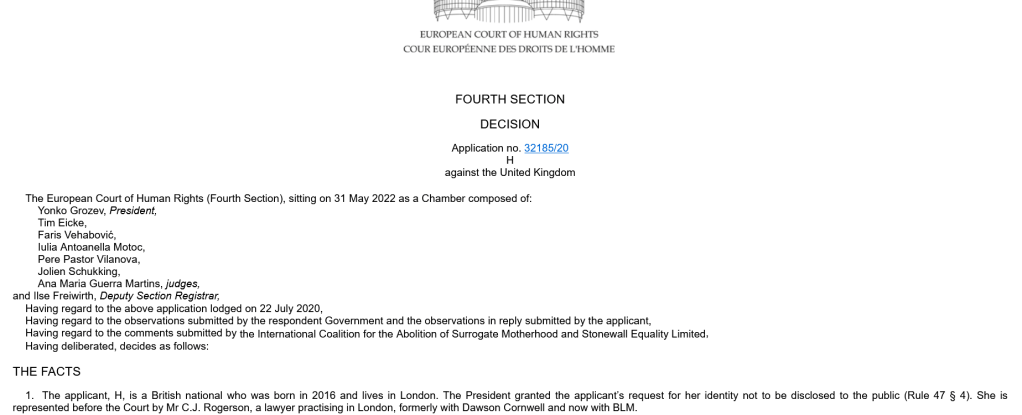
European Union: MEPs write to President von der Leyen on Coman & Hamilton’s 4 year non-implementation anniversary

European Union: MEPs write to President von der Leyen on Coman & Hamilton’s 4 year non-implementation anniversary

11 days ago 1032 0 1

ILGA-Europe, Coman Four Years On

Ursula von der Leyen, European Commission President

Cc: Věra Jourová, Commission Vice-President, Values and Transparency

Cc: Didier Reynders, Commissioner for Justice

Cc: Helena Dalli, Commissioner for Equality

Brussels, 7 June 2022

Subject: (Non-)Implementation of the Coman & Hamilton case 4 years after the CJEU decision

Dear Commission President, Ursula von der Leyen,

This past Sunday marked the 4-year anniversary of the CJEU’s Coman & Hamilton landmark decision.[1] On 5 June 2018, the CJEU ruled that the term spouse includes same-sex spouses under EU freedom of movement law. This decision provided a much-awaited clarification of EU free movement law and its application to rainbow families, which enshrined the need to respect their freedom of movement as much as for any other EU citizen. Coman & Hamilton remains a landmark decision – if anything, for the lack of its proper implementation to this day by the Romanian authorities.

Four years on, Clai Hamilton, spouse of Romanian citizen Adrian Coman, has not yet been granted residency in Romania. The couple has not only had no redress after ten years of strategic litigation efforts, but additionally had to resort to the European Court of Human Rights in pursuit of effective redress. In the meanwhile, the European Commission has remained blatantly silent on any possibility for infringement. 

The problem

The Romanian Constitutional Court ruling stipulated that the ban to recognise same-sex marriage conducted abroad is constitutional only insofar as it does not preclude married same sex couples from exercising their freedom of movement. As such, these couples should, even if not given the opportunity to transcribe their marriage certificates, be allowed to obtain residency permits.  This ruling, coupled with the CJEU judgment of 5 June 2018 is still in contradiction with the existing legislation on freedom of movement in Romania.  

Namely, the GEO (Government Emergency Ordinance) 102/2005 on freedom of movement on the territory of Romania of citizens of EU, EEA and Swiss Confederation Member States excludes the Romanian citizens in article 1. b. The GEO (Government Emergency Ordinance) 194/2002 imposes additional conditions than those provided in Directive 2004/38/EC (the free movement Directive). In particular, based on GEO 194/2002, same-sex spouses are still not treated as spouses four years after the Coman & Hamilton judgment – their marriage certificate is not taken into account (based on the Civil Code provisions as shown below); they are treated as other family members than spouses and they are required evidence of residence in another EU Member State for both of them together. The fact is that the Romanian Civil Code not only defines marriage as the union of a man and a woman, but also stipulates that “marriage between persons of the same sex shall be prohibited” and, even more specifically, “marriages between persons of the same sex entered into or contracted abroad by Romanian citizens or by foreigners shall not be recognised in Romania”.  As long as these stipulations remain in the Romanian Civil Code, the implementation of Coman & Hamilton is impossible. 

The Commission’s (in)action

In the LGBTIQ Equality Strategy,[2] the Commission committed to “continue to ensure the correct application of free movement law, including to address specific difficulties preventing LGBTIQ people and their families from enjoying their rights.” It goes on to mention the Coman & Hamilton case, mentioning that it will take legal action if necessary.

Several actions have since taken place since:

  • An official complaint (CHAP(2019)3147) was submitted by ACCEPT and ILGA-Europe to the Commission regarding a similar case to Coman & Hamilton’s. One partner in that case was threatened with deportation. To this day, the Commission provided no official reply to this complaint.
  • In a September 2021 resolution, the Parliament called on the Commission[3] to start infringement procedures against Romania over its ongoing failure to comply with the judgement. The Commission took no action to follow Parliament’s call.
  • On November 2021, a parliamentary Written Question co-signed by 21 MEPs enquired the EC about the status of play on opening infringement procedures.[4] The Commission’s answer is non-informative and shows no willingness to open infringement procedures.

We are aware of the Commission’s plan to issue guidelines on free movement – lest we are ill-informed, these will remain, as the name indicates, guidelines, i.e. not enforcement tools. In order to ensure that all EU citizens can effectively enjoy their right to freedom of movement,the Commission needs to use its powers as Guardian of the Treaties to level legal action if need be and to protect the credibility of the Court.

In light of the former:

  1. Are the Commission’s commitments to protect freedom of movement for rainbow families void of accountability or will the Commission initiate an infringement procedure over Romania’s failure to implement judgement C-673/16? 
  2. For future reference, what is the adequate duration of a Member State’s possibility to violate EU law before this violation becomes problematic?
  3. What strategy is the Commission pursuing to ensure that freedom of movement is effectively respected and protected in the EU, e.g. through appropriate legal action?

Yours sincerely,

Marc ANGEL, Co-Chair, LGBTI Intergroup (S&D, Luxembourg)

Terry REINTKE, Co-Chair, LGBTI Intergroup (Greens-EFA Vice-President, Germany)

Fabio Massimo CASTALDO, Vice-President, LGBTI Intergroup (Non-attached, Italy)

Pierre KARLESKIND, Vice-President, LGBTI Intergroup (Renew Europe, France)

Malin BJÖRK, Vice-President, LGBTI Intergroup (The Left, Sweden)

Maria WALSH, Vice-President, LGBTI Intergroup (EPP, Ireland)

Michal ŠIMEČKA (Slovakia), EP Vice-President 

Malik AZMANI (Netherlands), Renew Europe First Vice-President 

Frédérique RIES (Belgium), Renew Europe Vice-President

Alice KUHNKE (Sweden), Greens/European Free Alliance Vice-President

Ernest URTASUN (Spain) Greens/European Free Alliance Vice-President

Marisa MATIAS (Portugal), The Left Vice-President

Juan Fernando LÓPEZ AGUILAR, LIBE Committee Chair (S&D, Spain)

Andreas SCHIEDER (S&D, Austria)

Bart GROOTHUIS (Renew Europe, Netherlands)

Caroline NAGTEGAAL (Renew Europe, Netherlands)

Catharina RINZEMA (Renew Europe, Netherlands)

Cyrus ENGERER (S&D, Malta) 

Daniel FREUND (Greens-EFA, Germany)

Diana RIBA I GINER (Greens-EFA, Spain) 

Eleonora EVI (Greens-EFA, Italy)

Erik MARQUARDT (Greens-EFA, Germany)

Evin INCIR (S&D, Sweden)

Giuliano PISAPIA (S&D, Italy)

Gwendoline DELBOS-CORFIELD (Greens-EFA, France)

Irène TOLLERET (Renew Europe, France)

Jan HUITEMA (Netherlands, Renew Europe)

José GUSMÃO (The Left, Portugal)

Karen MELCHIOR (Renew Europe, Denmark)

Karin KARLSBRO (Renew Europe, Sweden)

Kim VAN SPARRENTAK (Greens-EFA, Netherlands)

Marianne VIND (S&D, Denmark)

Martin HOJSÍK (Renew Europe, Slovakia)

Monika VANA (Greens-EFA, Austria)

Morten PETERSEN (Renew Europe, Denmark)

Rasmus ANDRESEN (Greens-EFA, Germany)

Robert BIEDROŃ (S&D, Poland)

Rosa D’AMATO (Greens-EFA, Italy)

Sara MATTHIEU (Greens-EFA, Belgium)

Saskia BRICMONT (Greens-EFA, Belgium)

Sirpa PIETIKÄINEN (EPP, Finland)

Sophie IN’T VELD (Renew Europe, Netherlands)

Sylwia SPUREK (Greens-EFA, Poland)

Thijs REUTEN (S&D, Netherlands)

Tilly METZ (Greens-EFA, Luxembourg)


[1] CJEU, Case-673/16, Relu Adrian Coman and Others v Inspectoratul General pentru Imigrări and Ministerul Afacerilor Interne (Coman and Others), accessible at https://eur-lex.europa.eu/legal-content/EN/TXT/?uri=CELEX%3A62016CJ0673.

[2] European Commission (2020),Union of Equality: LGBTIQ Equality Strategy 2020-2025”, published on 12 November 2020, accessible at https://ec.europa.eu/info/sites/default/files/lgbtiq_strategy_2020-2025_en.pdf.

[3] European Parliament resolution of 14 September 2021 on LGBTIQ rights in the EU, ¶10, accessible at https://www.europarl.europa.eu/doceo/document/TA-9-2021-0366_EN.html.  

[4]Parliamentary Written Question, “Romania’s failure to implement the Coman and Hamilton judgment”, accessible at https://www.europarl.europa.eu/doceo/document/E-9-2021-005164_EN.html.