Author Archives: Andreas R. Ziegler

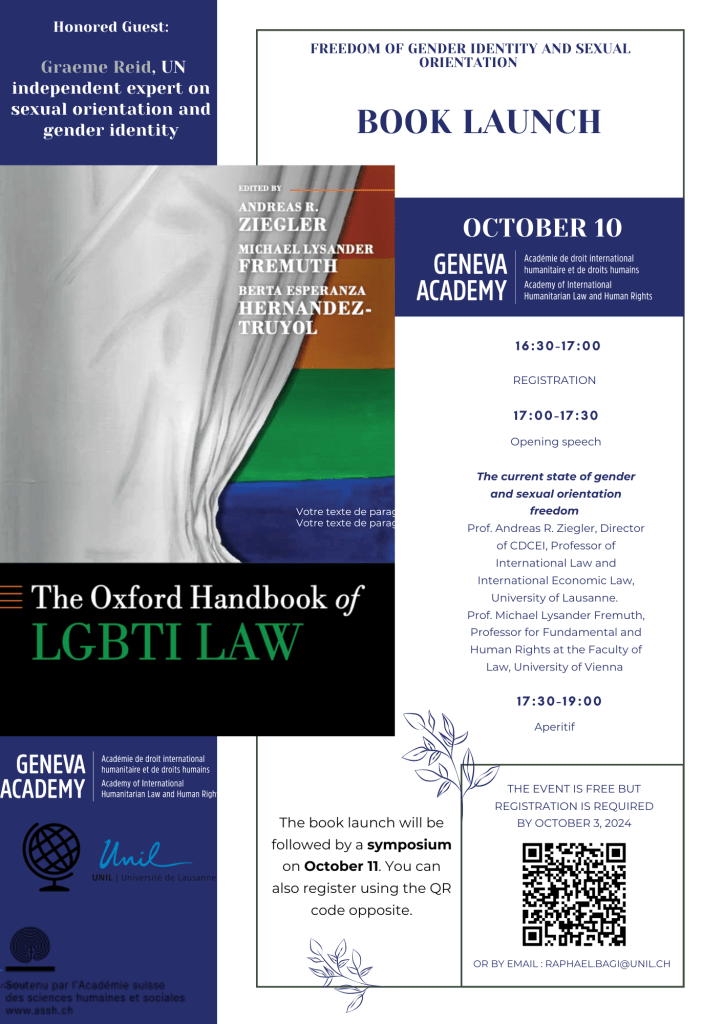
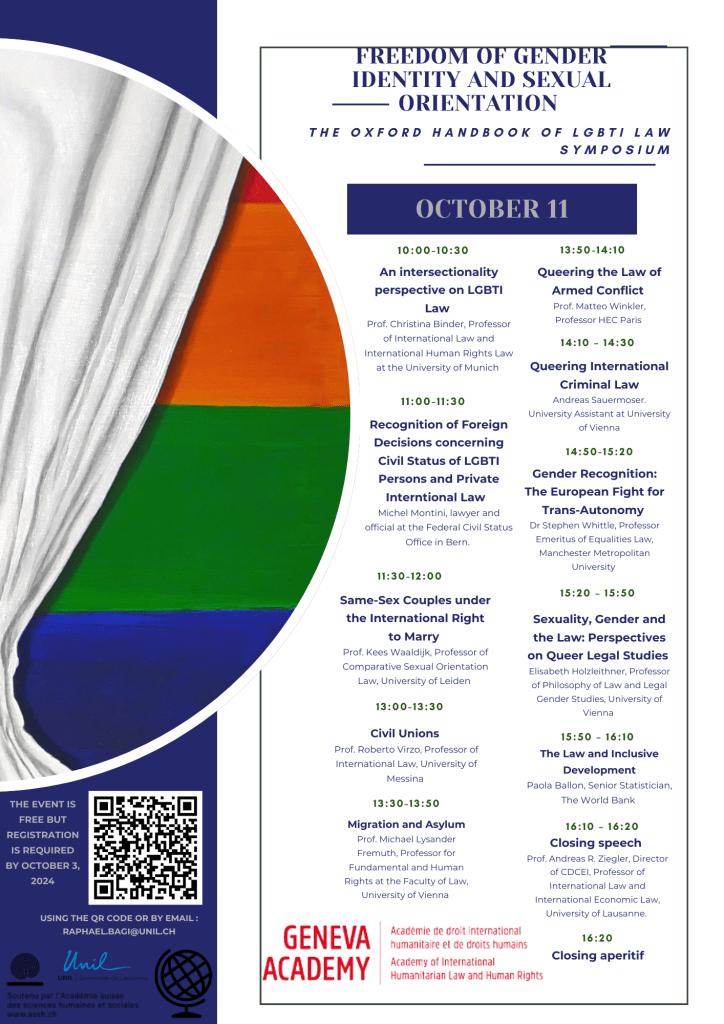
Join us in Geneva to celebrate the launch of the Oxford Handbook on LGBTI Law (10 and/or 11 October 2024) !

Join us in Geneva to celebrate the launch of the Oxford Handbook on LGBTI Law (10 and/or 11 October 2024)

We will celebrate the launch of the digital version of the book with a book launch followed by a reception on Thursday 10 October 2024 at the Villa Moynier, home of the Geneva Academy. For a preview of the book check out this link !

On 11 October 2024 some of our authors will discuss important legal questions during a symposium at the same venue. It is open to the public.

We hope that many members of academia, international organisations, governments and civil society will join us for these important events.

Participation in both events is free of charge but registration is required. Use the QR Code or the following link. In case of technical problems write to Email: raphael.bagi@unil.ch.

We look very much forward to sharing this important moment with you.

Andreas R. Ziegler (Université de Lausanne)

Michael Lysander Fremuth (Universität Wien)

Berta Esperanza Hernandez-Trujol (University of Florida)

US Court of Appeals confirms district court decision on transgender sport bans

US Court of Appeals confirms district court decision on transgender sport bans

The US Ninth Circuit Court of Appeals on Monday affirmed a lower court’s decision to restrict legislation that bans transgender girls from playing sports in an all-girls team.

The plaintiffs, Kate and Megan Doe, two transgender minors, challenged Senate Bill 1165 (Save Women’s Sports Act), which bans transgender girls and women from taking part in women’s sports and teams that match their gender identity. The bill applies to all educational levels, ranging from elementary school to university.

In April 2023, Kate and Megan Doe sued the defendants, the Arizona Superintendent of Public Instruction, and their schools, seeking injunctive relief. The complainants relied on Sec. 1681(a) of Title IX of the Education Amendments of 1972, which prohibits discrimination where a school receives federal financial assistance, and the Fourteenth Amendment, Equal Protection and Rights of Citizens, where “every individual is equal before and under the law and has the right to the equal protection and equal benefit of the law without discrimination.”

In July of 2023, the US District Court for the District of Arizona ruled that the Act should not prevent the plaintiffs from playing sports, finding that there was no significant athletic advantage before puberty and in girls who received puberty blockers. The court also granted a preliminary injunction, allowing the applicants to continue playing on their sports teams. The three-judge panel of the Ninth Circuit Court of Appeals held that the lower court’s decision was correct and that the Save Women’s Sports Act discriminates against transgender people, violating the Equal Protection Clause. However, the court did not conclude whether Title IX was violated or not. The case is still set to go to trial.

In 2022, Arizona’s Governor Doug Ducey signed Senate Bill 1165, which defined gender in interscholastic sports. The bill stated that “‘female’, ‘women’ or ‘girls’ may not be open to students of the male sex” and that the legislature finds biological sex to be “either male or female” and “biological differences between males and females are determined genetically during embryonic development.” Previously, before 2021, transgender students participated in sports on a case-by-case basis.

86 percent of transgender and non-binary youth find that anti-trans bills negatively impact their mental health. The American Civil Liberties Union is currently tracking 530 anti-LGBTQ bills in 2024, 13 of which aim to ban transgender students from playing on sports teams that match their gender identity.

The post US Court of Appeals confirms district court decision on transgender sport bans appeared first on JURIST – News.

US appeals court allows Florida ban on gender-affirming care for minors

US appeals court allows Florida ban on gender-affirming care for minors

The US Court of Appeals for the Eleventh Circuit on Monday stayed a lower court decision to block Florida laws that ban gender-affirming care for transgender minors and restrict such healthcare for transgender adults.

The decision allows for Florida to enforce SB 254 (Treatments for Sex Reassignment), which bans hormone replacement therapy for minors and limits transgender healthcare for adults, while pending an appeal of a June federal court ruling in June that found the ban unconstitutional. The three-panel judges ruled 2-1 in favor of the defendants-appellants, Florida Surgeon General Joseph Ladapo and the Florida Board of Medicine (BOM).

Judges Britt Grant and Robert Luck, both appointed by former president Donald Trump, were in the majority. Judge Charles Wilson dissented. He contended that the matter is “a medical issue, where patients are best left to make decisions alongside health professionals, with access to complete, unbiased information, as needed” and that the plaintiffs would “suffer if the stay were granted.” If the law is violated, children undergoing hormone replacement therapies or blockers may be taken into the state’s custody. Doctors can face imprisonment, fines and/or loss of license.

The federal appellate court’s order undoes Judge Robert Hinkle’s June 11 ruling that stopped Florida from enforcing the law. Last month, while the case went through appeals, Hinkle confirmed his June ruling. He stated that the 2023 ban on puberty blockers and hormone replacement therapy for minors and limitations for transgender adults directly attacked transgender people and violated the rights of transgender people and transgender children’s parents.

In March 2023, Florida families filed a lawsuit against the ban, arguing that it impacted needed medical care for transgender youth and that the law removed parents’ right to make informed decisions. Last month GLBTQ Legal Advocates & Defenders (GLAD) extended the lawsuit to include four transgender adults to deal with SB S54’s restriction on adult transgender healthcare. Various organizations representing the plaintiffs expressed their disappointment in appeals court’s decision, saying that “restrictions were based on disapproval of transgender people and serve no purpose other than to harm transgender Floridians”.

Currently, 39.4 percent of youth live in states that ban transgender healthcare. There are 642 bills in 2024 that block transgender healthcare, education and legal recognition. Seventy-nine are being considered at a federal level and 45 that have been passed.

The post US appeals court allows Florida ban on gender-affirming care for minors appeared first on JURIST – News.

Australia judge awards transgender woman $10k for gender discrimination claim against women-only app

Australia judge awards transgender woman $10k for gender discrimination claim against women-only app

An Australian judge on Friday awarded a transgender woman $10,000 for her claim of gender discrimination, finding she had been indirectly discriminated against by a women-only social media app.

Justice Bromwich rejected the woman’s claim of direct discrimination but found her claim of indirect discrimination on the basis of gender successful since the app imposed the condition that users have the appearance of a cisgender woman. The plaintiff also sought orders for a written apology, but Justice Bromwich declined to make those orders on the basis that any apology by the respondent would not be sincere.

Roxanne Tickle made a complaint to the Australian Human Rights Commission (AHRC) in December 2021 under Section 22 of the Sex Discrimination Act 1984 (Cth). She asserted that in being blocked from Giggle, an app marketed exclusively for women to share experiences and speak freely in a “safe space,” she was being discriminated against on account of her gender identity. 

Giggle founder Sall Grover said that Tickle was removed from the app “because they are male, no other reason.” Grover confirmed that Tickle’s removal was “manual,” saying that she looked at Tickle’s onboarding selfie and “saw a man.” She added, “The Al software had let them through, thereby making a mistake that I rectified.”

Tickle first downloaded Giggle in 2021. To access the app, users are required to upload a selfie to the platform, which is then assessed by third-party artificial intelligence (AI) software that determines whether the person is a man or a woman. If the software verifies that the user is a woman, she is granted full access to the app.

Tickle underwent this process and was provided with full access to the app between February 2021 and September 2021. After this period, the applicant found that she could no longer use any of the app’s features, such as posting content or commenting on other’s posts. She then received a ‘User Blocked’ message. Tickle attempted to contact the app’s owners about this issue, to which she received no response.

Australia’s Sex Discrimination Commissioner Dr. Anna Cody commended the case for recognizing that everyone deserves equal and fair treatment under the law, regardless of gender identity. Cody stated:

We must continue to recognise the worth and dignity of every person and reject the harmful stigmas and stereotypes that cause discrimination. No one in Australia should face exclusion or discrimination based on sex or gender identity, and we will continue to stand with trans communities and advocate for the rights of all women, including women who are trans.

This is the first case alleging gender identity discrimination to be heard by the Australian Federal Court.

The post Australia judge awards transgender woman $10k for gender discrimination claim against women-only app appeared first on JURIST – News.

Algeria Olympic boxer Imane Khelif files legal complaint amid gender debate

Algerian boxer and Olympic gold medalist Imane Khelif filed a complaint on Saturday over online abuse following a controversial gender debate that made headlines during Paris’s Olympic Games.

Khelif’s lawyer, Nabil Boudi, announced via a press release on the social media platform X that he filed a complaint with the anti-online hatred center of the Paris Public Prosecutor’s Office for acts of aggravated cyber harassment. Boudi stated that the criminal investigation aims to clarify who initiated and perpetuated the “misogynistic, racist and sexist campaign” against the boxer.

Imane Khelif and Taiwan’s Lin Yu-ting became the subjects of significant controversy and online harassment after being allowed to compete in the 2024 Paris Olympics despite being disqualified by the International Boxing Association (IBA) from the IBA Women’s World Boxing Championships New Dheli in 2023 for reportedly failing gender eligibility tests.

The IBA was previously stripped of its recognition by the International Olympic Committee (IOC) over concerns related to governance, finance and ethical matters. The IOC, however, cleared the two athletes for the Olympic Games, stating that all athletes in the boxing tournament complied with the relevant eligibility, entry and medical regulations, whilst also criticizing the IBA’s previous disqualifications.

Numerous human rights NGOs also heavily condemned the developments occurring online. The Sports & Rights Alliance urged for social media platforms to respect human rights whilst describing the online abuse directed towards the two Olympic boxers as “horrifying,” “unconscionable” and “unfounded.”

Human Rights Watch (HRW) expressed similar sentiments, supporting the IOC’s decision and condemning the so-called practice of “sex testing.” The NGO previously published a 127-page long report concerning human rights violations in “sex testing” of elite women athletes in 2020 by the sport governing body World Athletics, which primarily targeted women with elevated testosterone levels. The report provides a detailed account of how these practices violate the most fundamental rights, including the rights to privacy, dignity, health, non-discrimination, freedom from ill-treatment and employment. According to HRW, such regulations subject female athletes to unnecessary medical procedures carried out under coercive conditions, often making them the target of intense speculation and humiliation. In turn, HRW applauded the IOC’s new “Framework on Fairness, Inclusion, and Non-Discrimination on the Basis of Gender Identity and Sex Variations” for countering many of the harmful elements in previous sex-testing regulations.

The post Algeria Olympic boxer Imane Khelif files legal complaint amid gender debate and online abuse appeared first on JURIST – News.

Le Secrétariat d’Etat aux migrations SEM recherche un/e: Conseiller/ère spécialisé/e Libre circulation des personnes – 80%-100% / Berne

Le Secrétariat d’Etat aux migrations SEM recherche un/e: Conseiller/ère spécialisé/e Libre circulation des personnes – 80%-100% / Berne

La migration nous concerne
En tant que conseiller/ère spécialisé/e, vous aurez la chance de participer aux négociations avec l’UE sur l’accord sur la libre circulation des personnes, aux côtés d’une équipe dynamique.

Vos tâches

  • Soutenir l’équipe de négociation en fournissant des analyses approfondies et des argumentaires sur des questions juridiques sélectionnées, en tenant compte du contexte des négociations avec l’UE en matière de politique intérieure et extérieure.
  • Analyser la jurisprudence pertinente du Tribunal fédéral et de la Cour de justice des Communautés européennes.
  • Participer à l’élaboration des documents en vue de l’approbation et de la mise en œuvre du résultat des négociations (consultation, message, ordonnances, instructions).
  • Répondre aux questions juridiques liées à l’application de l’accord actuel sur la libre circulation des personnes.

Votre profil

  • Diplôme universitaire (master) en droit, de préférence avec une spécialisation en droit européen ou en droit des migrations.
  • Capacité de compréhension rapide et volonté de se familiariser rapidement avec de nouveaux domaines d’activité
  • Joueur/se d’équipe avec de fortes capacités de communication, de conception et de rédaction ; capacité à penser en réseau et de manière interdisciplinaire
  • Sens politique et intérêt pour la politique d’immigration de la Suisse
  • Deux langues officielles et anglais

Informations complémentaires

Le poste est limité au 31 décembre 2025.

Pour de plus amples informations, veuillez contacter Mme Sarah Dubach, cheffe de la section Libre circulation des personnes, tél. +41 58 483 60 47.

Veuillez postuler via notre système de gestion des candidatures. Pour ce faire, veuillez cliquer sur «Pour postuler».

Numéro de référence: 420-11873

Pour postuler

À propos de nous

La section Libre circulation des personnes est responsable de la mise en œuvre et du développement de l’accord sur la libre circulation des personnes entre la Suisse et l’UE.

+ plus d’informations

L’administration fédérale est attentive aux différents parcours de vie et besoins de ses collaboratrices et collaborateurs et en favorise la diversité. Elle accorde la plus haute priorité à l’égalité de traitement.

Les personnes germanophones étant sous-représentées dans notre unité administrative, nous nous réjouissons de recevoir leur candidature.

US appeals court reinstates Iowa law banning books and restricting education about gender identity

US appeals court reinstates Iowa law banning books and restricting education about gender identity

The US Court of Appeals for the Eighth Circuit reinstated an Iowa law on Friday that law requires public school libraries to remove books that are not “age appropriate,” such as when they describe or depict “sex acts.” The law, SF 496, also forbids education about gender identity. A federal district judge previously enjoined those provisions, blocking their enforcement.

The appeals court vacated the district judge’s decision because he did not apply the correct analysis for facial challenges, which seek to block a law in all its applications, rather than as applied to the plaintiff. However, the plaintiffs in this case, which include an LGBT advocacy group, students, and teachers, may again request an injunction in the district court.

Yet, the appeals court noted that states, in defining public schools’ “pedagogical mission,” may limit expression, including what books libraries offer. The court added that judges ruling on such limitations should “bear in mind that Iowa is not required to tolerate speech that undermines or is inconsistent with its central mission of educating Iowa Children.”

Iowa Governor Kim Reynolds (R) celebrated the decision. She stressed that “it should be parents who decide when and if sexually explicit books are appropriate for their children.” Iowa Attorney General Brenna Bird also called the decision a victory.

The American Civil Liberties Union (ACLU), counsel for the plaintiffs, lamented that the law will now “take effect just before students go back to school.” But the organization also expressed hope, noting that the court rejected Iowa’s “most dangerous arguments” and that the plaintiffs will try to block the law again “at the earliest opportunity.”

Hot-button Iowa legislation has faced litigation in recent months. In July, a federal judge upheld the state’s six-week abortion ban. In May, civil rights groups sued to stop a criminal immigration law from going into effect. And in previous years, litigation ensued over the state’s limits on damages for victims of police brutality and mask-mandate bans.

Book bans over sexual or gender identity-related content are not unique to Iowa. A federal appellate court granted plaintiffs a victory in their challenge to Texas’s book ban. A district judge did the same in Arkansas. And Alabama and Idaho are considering similar bills, potentially giving rise to more litigation in the future.

The post US appeals court reinstates Iowa law banning books and restricting education about gender identity appeared first on JURIST – News.

US Supreme Court denies Title IX protections for LGBTQ+ students from taking effect

US Supreme Court denies Title IX protections for LGBTQ+ students from taking effect

The US Supreme Court on Friday denied the US government’s application to enforce a new Title IX rule that expands protections to LGBTQ+ students under the definition of “sex discrimination.”

The court unanimously agreed that federal court injunctions blocking three provisions in the Title IX rule related to gender identity should remain in effect while cases are decided at the federal appeals courts. The justices were split on whether the federal injunctions should be upheld fully or partially.

The five-justice majority denied the US government’s request and fully upheld the injunctions for several reasons. They found that the US government did not provide a sufficient basis to overturn the lower federal courts’ finding that the definitional changes to “sex discrimination” to include gender identity are “intertwined with and affect[t] many other provisions of the new rule.” The majority also held that the government did not indicate which other provisions of the rule are independent of “sex discrimination” and could be enforced. Finally, the court noted that the issue regarding the definition of “sex discrimination” will be decided shortly, with the US Court of Appeals for the Sixth Circuit scheduled to hear oral arguments in October.

Justice Sonia Sotomayer, writing for the dissent, would have partially upheld the injunctions. She found the preliminary injunctions to be overbroad because they prevented unrelated rules that protected other groups from taking effect. The dissent characterized the Title IX changes as “covering a range of discrimination matters, most of which do not reference gender identity discrimination.” Justice Sotomayer noted that the majority’s decision would prevent unchallenged protections “such as those governing preemployment inquiries about an applicant’s marital status or sex and prohibiting pregnancy discrimination,” which “include no reference to gender identity discrimination or hostile environment harassment,” from taking effect.

The ruling is the latest setback to the US Department of Education’s contentious Title IX interpretation, which follows US President Joe Biden’s 2021 executive order on Title IX school protections. 26 states have now fully blocked the new Title IX protections from taking effect, and they will remain suspended until the merit of the injunctions is decided by the federal appeals courts. The next court hearings are the October oral hearings in the Sixth Circuit, a federal appeals court that hears appeals from the states of Kentucky, Michigan, Ohio and Tennessee. The court will hear the federal government’s appeal of the Title IX injunction that was granted in Tennessee v. Cardona.

Title IX of the Education Amendments of 1972 was landmark legislation that prohibited “sex-based discrimination” in schools or other education programs that received federal government funding. At the time of its enactment, gender identity and sexual orientation were not included in the definition, and the 2021 executive order and interpretation were actions to codify these protections for LGBTQ+ students.

The post US Supreme Court denies Title IX protections for LGBTQ+ students from taking effect appeared first on JURIST – News.