Author Archives: Andreas R. Ziegler

US appeals court orders return of books to Texas public library after book ban

US appeals court orders return of books to Texas public library after book ban

The United States Court of Appeals for the Fifth Circuit affirmed Thursday a District Court’s ruling to return books to a Texas public library after they were removed because of their viewpoint and content. This was a partial victory for the plaintiffs, as eight of the 17 banned books are to be returned to shelves.

The Llano County Library in Texas removed 17 books in 2021 after the library received  complaints about the books being too sexual to be in the children’s section. The plaintiffs, seven patrons of the Llano County library system, brought suit against Llano County, the members of the County’s Commissioners Court, the library system director, and the library board for pulling the books from the system, alleging that the defendant’s violated their First Amendment right to freedom of speech.

At the beginning of this litigation, the defendant’s attorney donated copies of the 17 books back to the library. However, to access these books, a patron had to explicitly ask for them. They are currently not on the shelves or displayed in the system. In March 2023, U.S. District Judge Robert Pitman ordered the 17 books to be returned to the shelves. On appeal, the Appeals Court affirmed the ruling. Judge Weiner wrote, “a book may not be removed for the sole—or a substantial— reason that the decisionmaker does not wish patrons to be able to access the book’s viewpoint or message.” However, out of the three judge panel, one affirmed, one agreed eight books should be returned, and one dissented. This meant there was majority support to return eight books to the shelves.

The library began to pull books when one resident, who now resides on the library board and checked out the books for months to prevent others from accessing them, made a complaint. After being told to pull the books by the Judge who oversees the library and the commissioner, the library director removed the books from the shelves. Months later, the library director was forced to pull more books after receiving additional complaints. The library director was given a list, deemed the Wallace list after the patron who wrote it, and pulled all the books on it. The books on this list focused on the LGBTQ+ community, puberty, and the history of racism in the United States.

The book ban was quite controversial, with UniteAgainstBookBans taking to X (formerly Twitter) in 2023 to say, “To Llano County commissioners who want to close their public library, banning books is more important than serving communities. We stand with library workers & library users in Llano.” The American Library Association reposted this tweet, urging people to speak up against the book ban. 

The post US appeals court orders return of books to Texas public library after book ban appeared first on JURIST – News.

Israel: Knesset allows transgender people to remove ‘dead name’ from IDs

Israel: Knesset allows transgender people to remove ‘dead name’ from IDs

Transgender people in Israel will no longer need to register their previous name on their ID, after the Interior Ministry amended ID regulations on Monday.

Someone who has undergone gender reassignment will not be obliged to register their ‘dead name’ – the term for the name a transgender person received at birth before transitioning – after a position was filed by the Justice Ministry to the High Court.

The petition was submitted by Nofar Ashbel, a transgender woman, who requested to replace the male birth name with Nofar, the chosen new name. 

More: https://www.jpost.com/israel-news/article-804856

Man arrested in Qatar Grindr ‘sting’ sentenced

Man arrested in Qatar Grindr ‘sting’ sentenced

5.6.2024

Josh Parry,Caroline Hawley

-Mexican man who was arrested in Qatar in what his family called a “honeytrap operation” on gay dating app Grindr has been given a six-month suspended sentence and will be deported.

Manuel Guerrero Aviña, 44, was found guilty of being in possession of an illegal substance at a hearing in Doha and fined £2,100.

His family say police planted drugs in his apartment and Mr Guerrero Aviña believes he was targeted by the sting because he is gay.

Human rights group FairSquare called his trial a “travesty of justice” but Qatari officials insist the airline worker’s arrest in February was solely due to drug offences.

More on this story

‘Qatar targeted my brother on Grindr – I want him home’

Mr Guerrero Aviña has called the verdict – which he is considering appealing – a human rights breach and says he was targeted because of his sexuality.

He said: “Although I welcome the fact that I can leave the country, I still condemn the unfair trial I have been subjected to and the torture and ill treatment I endured during my preliminary detention”.

Mr Guerrero Aviña, an airline worker, said he is “taking advice” on his options.

Qatari prosecutors have up to 30 days to appeal the sentence, meaning he can’t leave the country immediately, even if he were to accept the verdict.

James Lynch, co-director of human rights organisation FairSquare and former British diplomat in Qatar said the case was a “travesty of justice.”

Homosexuality is illegal in Qatar, but the family of Mr Guerrero Aviña say he had lived a normal life there for the past seven years and had never been in trouble with the authorities before.

The case hit the headlines internationally when his family claimed he was targeted on gay dating app Grindr, after arranging to meet a man called “Gio”.

But he was instead met by police and arrested on drug charges, in what his family called a “honeytrap operation”.

After 42 days in a detention centre, Mr Guerrero Aviña was released on the condition he handed over his passport.

He was forced to thumbprint a confession written in Arabic, without the help of a translator or access to a lawyer’s advice, his family say.

Qatari officials insist the 44-year-old’s arrest was “for possession of illegal substances on his person and in his apartment” and that “no other factors were taken into account”.

They added that tests for illegal substances in his system had come back positive for amphetamine and methamphetamine.

Amnesty International described the tests as “questionable” and not up to international standards. Mr Guerrero Aviña denies taking any drugs.

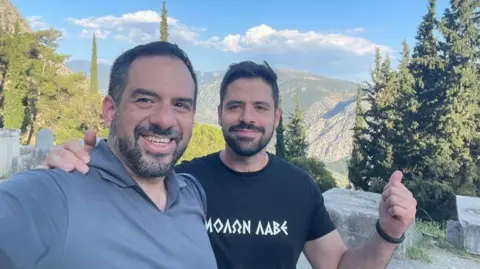
Family handout Two men take a selfie on top of a mountain
Enrique (right) previously told the BBC his brother Manuel’s case sounded like “one from another century.”

Aya Majzoub, Amnesty International’s Deputy Regional Director for the Middle East and Africa, said in a statement that authorities in the country must overturn Mr Guerrero Aviña’s “outrageous conviction and lift his travel ban”.

“There are serious fears that [he] was targeted for his sexual orientation and was coerced into providing the authorities with information that they could use to pursue a wider crackdown on LGBTI individuals in Qatar”.

HIV charities had also launched interventions in the case after claims Mr Guerrero Aviña, who is HIV positive, had not had regular access to his medication, which keeps the virus under control.

Mr Guerrero Aviña’s family have told the BBC that his usual treatment, prescribed by British doctors, ran out in mid-April.

The UK’s National Aids Trust told the BBC he urgently needs to return to the UK for the medication as it is not available in Qatar, and he may have built up resistance to it, which would make it less effective.

Deborah Gold, CEO of National Aids Trust, said: “We are hugely concerned that he will not be able to access the ongoing medical care and treatment that is his human right while in Qatar.”

Mr Guerrero Aviña’s brother Enrique told the BBC: “My brother is facing punishment in Qatar because he is gay.”

“We will keep fighting until justice is serviced and until Manuel is safely back home.”

A Qatari official said: “Contrary to certain media reports, no other factors were taken into account when making the arrest, and Mr Aviña has been treated with respect and dignity throughout his detention.”

Source: https://www.bbc.com/news/articles/cj55y7v23y0o

Switzerland: Federal Supreme Court confirms judgment against politician regarding discrimination and incitement to hatred based on race and sexual orientation

Switzerland: Federal Supreme Court confirms judgment against politician regarding discrimination and incitement to hatred based on race and sexual orientation

Court refers to ECtHR, Vejdeland et al. v. Sweden (9. Februar 2012, Nr. 1813/07, § 54-57)

Report finds Uganda’s LGBTQ community faces human rights violations following passage of Anti Homosexuality Act

Report finds Uganda’s LGBTQ community faces human rights violations following passage of Anti Homosexuality Act

Ugandan LGBTQ+ advocacy organisation Convening for Equality (CFE) released a report on Monday documenting human rights violations against LGBTQ+ people following the passage of the country’s Anti-Homosexuality Act (AHA) 2023, which introduced severe penalties for same-sex intercourse, including life imprisonment and the death penalty for “aggravated” offences. The organization reviewed over a thousand cases of human rights violations and says that arrests, torture and forced evictions against LGBTQ+ people have followed the act’s passage.

The report says that, after the AHA’s passage, the state has failed to protect the human rights of LGBTQ+ persons. According to CFE, cases of rights violations have increased from 306 in the January to August 2023 period to 1253 cases between September 2023 and April 2024. Abuse against LGBT has been manifested through “correctional” rapes, reproductive coercion, denial of housing rights and mob attacks. The largest share of affected persons is gay men followed by transgender women and lesbians. The report states that the Uganda Police, landlords, local councils (LCs) and family members have been reported as top violators of LGBT rights.

Though Article 21 of Uganda’s Constitution provides for equality of persons before the law in “all spheres of political, economic, social, and cultural life,” Uganda’s Constitutional Court decided not to strike down the AHA, only revoking parts of it. The Constitutional Court nullified section 9 of the AHA, which criminalizes the usage of a person’s premises for homosexual acts, and section 14, which made it mandatory for every person to report cases of homosexuality even if they were based on suspicion. However, the report documents that the nullification had little to no impact on the general public, which has taken the law into its own hands on many instances to search through premises, which violates the right to privacy Article 27 of the Uganda Constitution.

After the AHA’s predecessor, the Anti-Homosexuality Act 2014 was struck down that year, Uganda’s government took measures to outlaw homosexual relations, including the Sexual Offenses Bill of 2021, which criminalized anal sex between people of any gender and any “sexual act between persons of the same gender.” Following this, the AHA 2023 received assent from the president in May 2023. The law attracted criticism from international organizations, including the EU, over equality and human rights concerns.

The post Report finds Uganda’s LGBTQ community faces human rights violations following passage of Anti Homosexuality Act appeared first on JURIST – News.

US sanctions Uganda officials for corruption and human rights violations

US sanctions Uganda officials for corruption and human rights violations

The United States sanctioned five current and former Ugandan officials on Thursday for their involvement in corrupt practices and human rights violations, making the individuals ineligible for entry into the US.

Speaker of Parliament Anita Among, former Minister of Karamoja Affairs Mary Goretti Kututu, former Minister of State for Karamoja Affairs Agnes Nandutu and Minister of State for Finance Amos Lugolobi were sanctioned for “significant corruption,” with the US Department of State claiming the four individuals “abused their public positions for their personal benefit at the expense of Ugandans.” The department additionally sanctioned the spouses of Among, Kitutu and Lugolobi.

Former Deputy Chief of the Ugandan Peoples’ Defence Forces (UPDF) Peter Elwelu was the only military leader sanctioned. Elwelu was designated for his “gross violations of human rights” due to his involvement in a 2016 attack that killed over 100 people.

The department stated:

The United States stands with Ugandans advocating for democratic principles, a government that delivers for all its citizens, and accountability for actions committed by those who abuse their position … Today’s actions reaffirm the U.S. commitment to support transparency in Uganda’s democratic processes, counter corruption globally, and address the broader culture of impunity that prevents all Ugandans from enjoying their human rights and fundamental freedoms.

The designations were made under Section 7031(c) of the Department of State, Foreign Operations, and Related Programs Appropriations Act, 2024. The UK imposed similar sanctions on Among, Kitutu and Nandutu last month, implementing travel bans and asset freezes against the three individuals.

Among called the US sanctions “politically motivated,” claiming she was being targeted for her anti-homosexuality stance and her involvement in Uganda’s anti-LGBTQ+ legislation. In April, Uganda’s Constitutional Court upheld a law that imposes the death penalty for “aggravated homosexuality.” The legislation, known as the Anti-Homosexuality Act, was signed into law by President Yoweri Museveni last May. Among defended the law at the time, stating, “[W]e have heeded the concerns [of] our people and legislated to protect the sanctity of the family.” The law has been cited in multiple reports as a violation of human rights threatening the global rule of law.

Activists have pointed out other violations of Ugandans’ rights in recent years, including Human Rights Watch claiming in November that the country’s surveillance system threatens individuals’ constitutional rights to privacy, expression and association. Critics of the government also noted that activists and opposition leaders are consistently harassed and threatened for expressing anti-government views. In January, for example, opposition leader Bobi Wine was placed under house arrest ahead of anti-government protests.

Wine, who is the president of the National Unity Platform (NUP), celebrated Thursday’s sanctions. He stated:

We welcome these sanctions and appreciate the Government of the United States for listening to the cry of the oppressed people of Uganda. It has been our call to the civilised world not to keep a blind eye to the impunity perpetuated by the Museveni regime. We hope more individuals and organizations responsible for the suffering of our people will be sanctioned.

The post US sanctions Uganda officials for corruption and human rights violations appeared first on JURIST – News.

USA: South Carolina governor signs gender-affirming healthcare ban into law

USA: South Carolina governor signs gender-affirming healthcare ban into law

South Carolina Governor Henry McMaster on Tuesday signed into law a gender-affirming healthcare ban for transgender minors.

House Bill (HB) 4624, known as the Help Not Harm bill, prohibits physicians, mental health providers and other healthcare professionals from “knowingly” providing gender-transition procedures to individuals under eighteen years of age. HB 4624 defines “gender transition procedures” as puberty-blocking drugs, cross-sex hormones or gender reassignment surgery “provided or performed for the purpose of assisting an individual with a physical gender transition.”

Healthcare professionals can continue to temporarily provide hormone treatments and puberty blockers to minors who are prescribed such treatment before August 1, 2024. The professional must determine and document that immediate termination of the treatment “would cause harm” to that individual, and the period for continued treatment must end by January 31, 2025.

The law further requires schools to notify the parents or guardians of minor students if the child has told a school employee that their gender is “inconsistent with” their sex or asks a school employee to address them by “a pronoun or title that does not align with the minor’s sex.”

House Representative Sylleste Davis stated in January that HB 4624 protects children by “ensuring they are not exposed to irreversible medical procedures at an age when they are most vulnerable.” McMaster offered a similar sentiment in January, stating the bill was “a good idea to keep our young people healthy and safe.”

Critics of HB 4624, however, emphasize the harm that the law will impose on transgender youth. Director of Communications for the Women’s Rights and Empowerment Network Kelli Parker stated, “Rather than prioritizing the real issues facing South Carolinians, our lawmakers shamefully chose to promote hate, fear, and discrimination under the guise of ‘protecting kids.’” Parker added, “Laws that block essential healthcare violate human rights and are a major setback for equality.”

The ACLU of South Carolina announced its opposition to the bill earlier this year, stating that gender-affirming care “is a best practice backed by scientific evidence and endorsed by leading medical organizations.” The organization also noted that such care is “life-saving” and “is the only effective treatment for trans youth to prevent self-harm and suicidal ideation.”

Critics have further emphasized that doctors and patients testified before the legislative committees that gender-transition surgeries are currently unavailable to minors in South Carolina and that patients can only begin hormone treatments after “extensive consultation with health professionals” and the consent of parents or legal guardians.

South Carolina is now the 25th state to restrict or ban gender-affirming treatment for minors. Similar legislation has been introduced in states such as West Virginia, Ohio, and Louisiana in the past few years, representing a spike in legislation that targets the LGBTQ+ community. Last month, the US Supreme Court allowed a gender-affirming care ban for minors in Idaho to go into effect, while the governor of Kansas vetoed a state ban on such care.

The ACLU is currently tracking 515 anti-LGBTQ+ bills in the US. Other types of bills targeting LGBTQ+ youth include policies that restrict personal pronoun usage in schools, prohibit transgender athletes from participating on sports teams that do not correspond with their sex assigned at birth, and limit transgender students’ access to bathrooms that align with their gender identity.

The post South Carolina governor signs gender-affirming healthcare ban into law appeared first on JURIST – News.

US Supreme Court declines hearing parent challenge to school gender identity policies

US Supreme Court declines hearing parent challenge to school gender identity policies

The US Supreme Court declined Monday to hear a challenge to a Maryland school district’s gender identity policy, which parents are alleging violates their rights.

In John and Jane Parents v. Montgomery County Board of Education, three parents with children who attend Montgomery County Public Schools (MCPS) allege the school enacted policies that violated their Fourteenth Amendment rights. The policies adopted by the school in the 2020-2021 school year enabled students of any age to “transition socially to a different gender identity at school without parental notice or consent.” The policies address a multitude of topics: establishing a gender support plan, protecting student privacy, the use of appropriate names and pronouns, and participation in gender based activities. The goal of the policies was to create a safe environment for students.

The complaint alleged no specific allegations regarding the application of the policies. The primary issue at hand was the portion of the guidelines that allow students to transition without parental involvement. School personnel was advised to avoid disclosing the student’s gender without the consent of the student. The US District Court for the District of Maryland previously dismissed the case for failure to state a claim for which relief could be granted under Rule 12(b)(6) of the Federal Rules of Civil Procedure. The Supreme Court declined to hear the case upon appeal.

This case comes not long after Maryland parents were denied the right to request to have their children opt out of education on LGBTQ+ history and topics. Parents also alleged that the policy violated their due process rights under the Fourteenth Amendment and their children’s freedom of speech under the First Amendment. These claims were dismissed.

The post US Supreme Court declines hearing parent challenge to school gender identity policies appeared first on JURIST – News.