Panel Suisse LGBTIQ+: Participez !

Panel Suisse LGBTIQ+: Participez !

Nous, Dr Léïla Eisner (Université de Lausanne) et Dr Tabea Hässler (Université de Zurich), sommes les chercheuses principales du Panel Suisse LGBTIQ+ (lesbienne, gay, bisexuelle, trans, intersexe, queer/questioning). L’objectif de notre Panel est de comprendre comment les personnes LGBTIQ+  et les personnes hétérosexuelles (cisgenres) perçoivent la situation des individus LGBTIQ+ en Suisse. Nous souhaitons aussi évaluer comment cette situation évolue au fil du temps. 

Pour atteindre cet objectif, nous conduisons des enquêtes annuelles auprès de personnes LGBTIQ+ et hétérosexuelles cisgenres.   Au cours des deux dernières années, près de 1700 personnes ont participé à chacune des enquêtes annuelles du Panel Suisse LGBTIQ+. Comme nous nous efforçons de rendre les résultats accessibles à la communauté et aux participant-e-s, nous avons récemment partagé avec vous les principales conclusions de notre étude (rapports annuels 2020 et 2019).   L’étude en est maintenant à sa troisième année et nous avons besoin d’un maximum de participant-e-s pour poursuivre le projet. Dans ce questionnaire, nous posons des questions sur divers sujets tels que les différentes formes de soutien, la discrimination, les changements politiques actuels et les expériences vécues pendant la pandémie de Covid-19. En partageant l’enquête avec votre réseau, vous nous aiderez à en savoir plus sur la situation des personnes LGBTIQ+ en Suisse. Les personnes LGBTIQ+ et cis-hétérosexuelles peuvent participer à cette enquête.  

Vous pouvez trouver le questionnaire ici:https://tinyurl.com/PanelWave3  

L’enquête prendra environ 20 à 30 minutes. En signe de remerciement, trois heureux/hereuses gagnant-e-s seront sélectionné-e-s parmi tous les participants pour un bon d’une valeur de 300 CHF et deux bons de 100 CHF chacun. Votre soutien sera grandement apprécié!   Consultez notre page web (www.swiss-lgbtiq-panel.ch) si vous voulez en savoir plus sur notre projet. Vous y trouverez une section avec les questions fréquemment posées, nos travaux scientifiques et nos rapports annuels (rapports 2019 et 2020). Vous pouvez également nous suivre sur InstagramFacebook, et Twitter. N’hésitez pas à nous contacter en cas de questions (leila.eisner@unil.ch) !

Japan: Pass Equality Act before Olympics

Japan: Pass Equality Act before Olympics

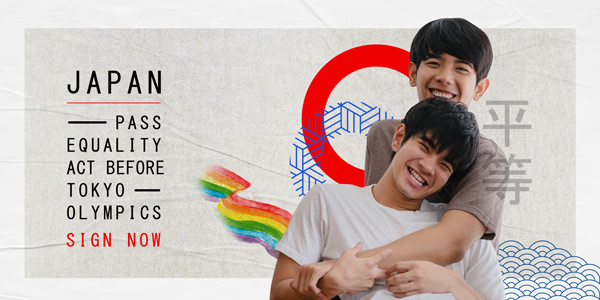
The picture is a young gay couple hugging. The Text reads: Japan: Pass Equality Act Before Tokyo Olympics / Sign Now

In July 2021, the Summer Olympic and Paralympic Games are set to begin in Japan.

But Japan is not ready to host the Olympics.

The Tokyo Olympics are advertised as celebrating “unity in diversity” and “passing on a legacy for the future.” But LGBT+ people in my country continue to face social stigma and enjoy fewer legal protections than other Japanese citizens.

There’s still time to change this. Before athletes and visitors from all around the world come to celebrate the Olympic Games, the Japanese government must enact the Equality Act and protect LGBT+ athletes, visitors, and their own citizens from discrimination.

Join us today and sign to show your support for the Equality Act.

The Olympic Games stand for diversity and tolerance. The Olympic Charter specifically protects against discrimination, including on the grounds of sexual orientations.

That’s why the Olympics are the perfect time to stand in solidarity with the LGBT+ community in Japan and to remind the government of its duty to protect its visitors and citizens.

And it’s urgent: Tokyo has passed an ordinance that protects LGBT+ people from discrimination. But several Olympic competitions will take place outside of Tokyo, leaving LGBT+ fans, athletes, and citizens in these areas unprotected.

Andreas, sign our petition and call on Japan’s government to introduce legislation to protect LGBT+ people from discrimination before the Olympics.

Yuri
Japan Alliance for LGBT Legislation (J-ALL)

Sources:

●︎ Japan: Introduce LGBT Non-Discrimination Law – Human Rights Watch, 15. May 2020
●︎ Letter to Prime Minister Shinzo Abe Regarding National LGBT Non-Discrimination Law – Human Rights Watch, 17. April 2020
●︎ Olympic Charter – IOC, 17. July 2020

New Judgment by the ECtHR: SABALIĆ v. CROATIA: Lesbian woman assaulted for refusing man’s advance: Man fined derisory fine of 40 EUR

New Judgment by the ECtHR: SABALIĆ v. CROATIA: Lesbian woman assaulted for refusing man’s advance: Man fined derisory fine of 40 EUR

Lad culture and sexual harassment in universities: it's about more than a  'few bad apples'

http://hudoc.echr.coe.int/fre?i=001-207360 (14 January 2021)

5.  On 13 January 2010 the applicant was physically attacked in a nightclub in Zagreb where she was with several of her friends. The attack ceased only after one of the applicant’s friends, I.K., used her gas pistol to frighten off the attacker.

6.  At about 6.00 a.m. a local police station of the Zagreb Police Department (Policijska uprava zagrebačka, hereinafter: the “police”) was informed of the incident and two police officers immediately responded at the scene.

7.  The relevant part of the police report on the findings at the scene of the incident reads:

“When we came at the scene … we found Petra Sabalić …, I.K. …, I.D. …, K.F. …, E.N. … and A.B. … [personal details omitted].

By interviewing them and observing the scene of the incident we established that the above-mentioned persons had come to [the nightclub] at around 4.00 a.m., where they stayed for about one and a half hours. While they were in the nightclub [the applicant] was approached by an unidentified man who started flirting with her but she was constantly refusing him. After the nightclub closed they were all standing in front of it and the man continued pressing [the applicant] to be with him. When she said that she was a ‘lesbian’ he grabbed her with both of his arms and pushed her against a wall. He then started hitting her all over her body and when she fell to the ground he continued kicking her. …”  

68.  As a result of the attack the applicant sustained multiple physical injuries, including contusion on the head, a haematoma on the forehead, abrasions of the face, forehead and area around the lips, neck strain, contusion on the chest and abrasions of both palms and knees (see paragraph 10 above). These particular circumstances of the attack were later confirmed in the minor offences proceedings (see paragraphs 12 and 14 above) and they formed the essence of the applicant’s criminal complaint and the ensuing criminal investigation (see paragraphs 16 and 20 above).

69.  Furthermore, the Court notes that there is sufficient evidence before it to conclude that the attack against the applicant was influenced by her sexual orientation. This follows from the above-noted findings of the police, the applicant’s detailed account of the events in her criminal complaint lodged with the State Attorney’s Office (see paragraph 16 above), the applicant’s and her friends’ police interviews (see paragraphs 18-19 above), and the findings of the criminal investigation conducted by an investigating judge of the County Court (see paragraph 23 above).

70.  In light of the foregoing, the Court concludes that the treatment, convincingly described by the applicant, to which she was subjected and which was directed at her identity and undermined her integrity and dignity, must necessarily have aroused in her feelings of fear, anguish and insecurity reaching the requisite threshold of severity to fall under Article 3 of the Convention (compare Identoba and Others, cited above, § 71; M.C. and A.C., cited above, § 119; …

71.  The Court therefore rejects the Government’s objection and finds Article 3 of the Convention applicable to the applicant’s complaints.

105.  In these circumstances, the Court finds that already at the initial stages of the proceedings, immediately after the physical attack against the applicant had taken place, the domestic authorities were confronted with prima facie indications of violence motivated or at least influenced by the applicant’s sexual orientation (compare Šečić, cited above, § 69; Milanović, cited above, § 99; Abdu, cited above, § 35; and Begheluri, cited above, § 176). According to the Court’s case-law, this mandated for an effective application of domestic criminal-law mechanisms capable of elucidating the possible hate motive with homophobic overtones behind the violent incident and of identifying and, if appropriate, adequately punishing those responsible (see paragraphs 94-95 above; see also S.M. v. Croatia, cited above, § 324).

107.  Instead of lodging a criminal complaint before the State Attorney’s Office concerning the hate motivated violent attack against the applicant or conducting any further actions to elucidate the possible hate crime element of the events, as required by the relevant instructions (see paragraph 46 above), the police instituted minor offences proceedings in the Minor Offences Court indicting M.M. on charges of breach of public peace and order. These proceedings ended with M.M.’s conviction for the minor offence and his punishment by a fine of approximately EUR 40 without addressing or taking into account the hate motive at all. As there was no appeal by M.M. or the police, and since the applicant was not informed of the proceedings, M.M.’s minor offences conviction became final (see paragraphs 13-15 above).

108.  Although it goes without saying that it is not for the Court to address such issues of domestic law concerning individual responsibility, that being a matter for assessment by the national courts, or to deliver guilty or not guilty verdicts in that regard, the Court observes that the minor offences proceedings did not in any manner address the hate crime element to the physical attack against the applicant nor was M.M. indicted or convicted of any charges related to violence motivated by discrimination 

109.  Moreover, the Court notes that in the minor offences proceedings M.M. was sentenced to a derisory fine of approximately EUR 40. While the Court acknowledges the role of the national courts to determine the appropriate sentence for an offender, its task is to ensure that a State’s obligation to protect the rights of those under its jurisdiction is adequately discharged, which means that it must retain its supervisory function and intervene in cases of manifest disproportion between the gravity of the act and the punishment imposed

110.  The Court cannot therefore overlook the fact that M.M.’s sentence in the minor offences proceedings was manifestly disproportionate to the gravity of the ill-treatment suffered by the applicant (compare Identoba and Others, cited above, § 75). Indeed, this conclusion is confirmed by comparing the prescribed sanctions for the offences as subsequently classified by the State Attorney’s Office – which were publishable by imprisonment (see paragraphs 16, 20 and 32 above) – and the nature of the sanction actually imposed on M.M. in the minor offences proceedings. …

111.  In overall, the Court finds that such a response of the domestic authorities through the minor offences proceedings was not capable of demonstrating the State’s Convention commitment to ensuring that homophobic ill-treatment does not remain ignored by the relevant authorities and to providing effective protection against acts of ill-treatment motivated by the applicant’s sexual orientation. The sole recourse to the minor offences proceedings against M.M. could be considered rather as a response that fosters a sense of impunity for the acts of violent hate crime, than as a procedural mechanism showing that such acts could in no way be tolerated …

114.  In the Court’s view, both failure to investigate hate motives behind a violent attack and failure to take into consideration such motives in determining the punishment for violent hate crimes, amounted to “fundamental defects” in the proceedings under Article 4 § 2 of Protocol No. 7. In the present case the domestic authorities failed to remedy the impugned situation,although it could not be said that there were de jure obstacles to do so (see paragraph 99 above). In particular, they failed to offer the defendant the appropriate redress, for instance, by terminating or annulling the unwarranted set of proceedings and effacing its effects, and to re-examine the case. The domestic authorities therefore failed to fulfil their duty to combat impunity of hate crimes in compliance with the Convention standards …

115.  In sum, in view of the above considerations, the Court finds that by instituting the ineffective minor offences proceedings and as a result erroneously discontinuing the criminal proceedings on formal grounds the domestic authorities failed to discharge adequately and effectively their procedural obligation under the Convention concerning the violent attack against the applicant motivated by her sexual orientation. Such conduct of the authorities is contrary to their duty to combat impunity for hate crimes which are particularly destructive of fundamental human rights (see paragraph 95 above).

116.  There has therefore been a violation of Article 3 under its procedural aspect in conjunction with Article 14 of the Convention.

Czech Constitutional Court rules against adoption of children abroad by same-sex registered couples

Czech Constitutional Court rules against adoption of children abroad by same-sex registered couples

The court ruling was in response to a proposal that would amend a current law preventing same-sex partners who registered abroad to adopt.

Read: https://www.expats.cz/czech-news/article/court-against-child-adoption-by-same-sex-couples-concluded-abroad

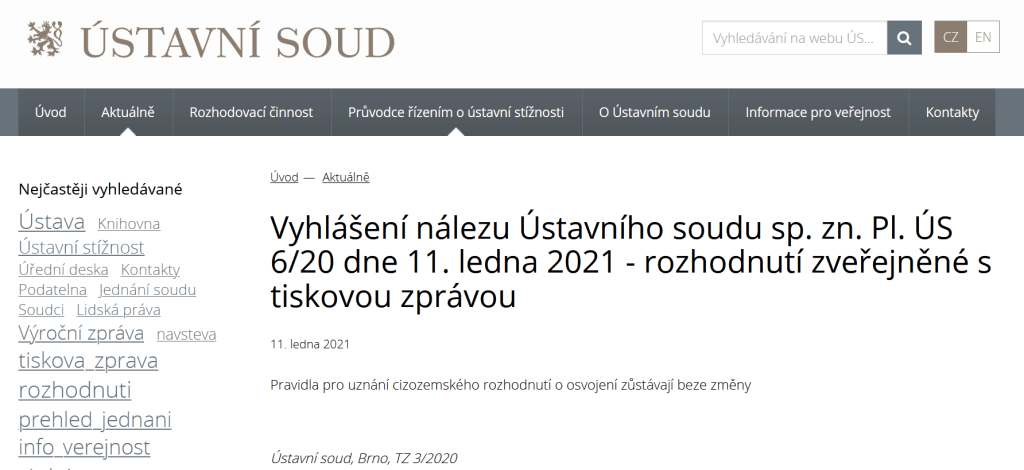
The judgment can be found here: https://www.usoud.cz/aktualne/vyhlaseni-nalezu-ustavniho-soudu-sp-zn-pl-us-6-20-dne-11-ledna-2021-rozhodnuti-zverejnene-s-tiskovou-zpravou?fbclid=IwAR1BoJOHMiGPnuAGSYFtMfPUt5r3EkV1cc8Ob2iAAf_1BlFb0UvHgRBydl8

Honduras lawmakers vote to harden bans on abortion and same-sex marriage

Honduras lawmakers vote to harden bans on abortion and same-sex marriage

Image: HONDURAS-CHINA-HEALTH-VIRUS-COVID-19

The National Congress of Honduras Thursday voted in favor of constitutional reforms that make it difficult to reverse provisions preventing the legalization of abortion and same-sex marriage.

Of the 128 members of Congress, 88 voted in favor of the amendments, 28 opposed and seven abstained. They will have to be ratified in a second session. If ratified, amendments to the provisions granting legal personhood to fetuses and restricting same-sex marriages will require three-quarters majority.

At present, in addition to Honduran women who undergo abortions, persons involved also face up to six years in prison. In addition to criminalizing abortion, existing laws also prohibit the “use, sale, distribution, and purchase of emergency contraception, carrying the same imprisonment penalties as abortion.”

“This reform is the product of a state-imposed religion on Honduras,” said gay rights advocate Kevihn Ramos.

Feminist collective Somos Muchas member Neesa Medina cited concerns over lawmakers’ decision to “ignore women’s suffering” in a country where sexual violence rates are high and 40 percent of pregnancies are unplanned or unwanted. “There are thousands of people affected by the pandemic, there is insufficient healthcare and thousands are leaving in caravans, many who are women and girls,” Medina said of the thousands of migrants fleeing Honduras.

The Office of the UN High Commissioner for Human Rights estimates the number of Honduran women and girls undergoing unsafe abortions each year to be between 51,000 and 82,000, and said that “lack of accessibility of contraception, particularly in rural areas, which, together with the prohibition of emergency contraception, contributes to a high rate of unwanted pregnancy, including adolescent pregnancy.”

The post Honduras lawmakers vote to harden bans on abortion and same-sex marriage appeared first on JURIST – News – Legal News & Commentary.

USA – Alabama: These Trans Women Just Won the Right to a Driver’s License Without Needing Surgery

USA – Alabama: These Trans Women Just Won the Right to a Driver’s License Without Needing Surgery

Last week, a federal court struck down a 2012 Alabama policy requiring trans people to undergo gender confirmation surgery before correcting their IDs.

Read: https://www.them.us/story/alabama-id-lawsuit-transgender-discrimination

Hungary government orders disclaimers for books with gay themes

Hungary government orders disclaimers for books with gay themes

The Hungarian government has ordered a publisher to print disclaimers identifying books containing “behaviour inconsistent with traditional gender roles.”

The order is in response to the publication of Meseorszag mindenkie (A Fairy Tale for Everyone) a fairytale anthology published by Labrisz, an association for lesbian, bisexual and transgender women. The group says the storybook includes “elderly and Roma people, people living in poverty, adopted or abused children and heroic girls, as well as lesbian, gay, and trans characters.”

The Hungarian Consumer Protection Authority said that the book constitutes unlawful commercial practice since “the book is sold as a fairytale, called so on its cover and designed accordingly, but it hides the fact that it depicts behaviour inconsistent with traditional gender roles.” Labrisz noted that the storybook first caused controversy when Hungarian politician Dóra Dúró shredded a copy of the book in September, stating that the book constitutes “homosexual propaganda.”

Labrisz, supported by LGBTQI organization Háttér Society, plans to seek judicial review of the decision.

Hungary orders publisher to slap disclaimer on LGBT+ children’s book in ‘unconstitutional’ assault on free speech

Hungary orders publisher to slap disclaimer on LGBT+ children’s book in ‘unconstitutional’ assault on free speech

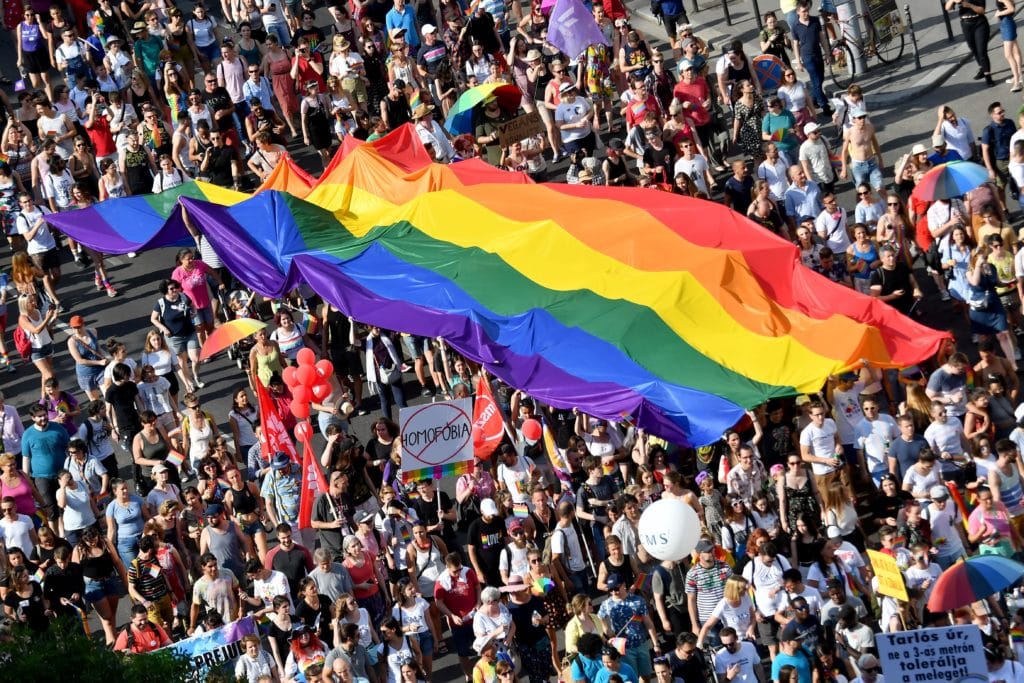
A Pride protest in Budapest, capital of Hungary, in 2019

Hungary has ordered a publisher of LGBT+ books to print a disclaimer on a queer fairytale anthology.

The Labrisz Lesbian Association was ordered to add the disclaimer to any book containing LGBT+ themes after it published the fairytale tome, titled Wonderland Is For Everyone, Reuters reported.×

Authors explained that the book is intended to represent everyone. It features the tale of a prince marrying a prince and a doe wishing to become a buck, as well as a reimagined Snow White, now renamed “Leaf Brown”.

But such stories are, according to the Government Office of the Capital City Budapest, a threat to society itself. Yes, really.

“The book is sold as a fairytale, called so on its cover and designed accordingly, but it hides the fact that it depicts behaviour inconsistent with traditional gender roles,” Reuters reported the office stating.

As a result, Labrisz was ordered to slap disclaimers on all books with LGBT+ content, including Wonderland Is For Everyone.

The group, alongside fellow LGBT+ advocacy and legal aid organisation Háttér Society, now plan to sue the government in response. It says the disclaimers are discriminatory and unconstitutional.

Read: https://www.pinknews.co.uk/2021/01/21/hungary-lgbt-publisher-disclaimer-gay-fairytale/

English Court Blocks Puberty Blockers in Anti-Trans Craze Judgment

English Court Blocks Puberty Blockers in Anti-Trans Craze Judgment

In the far-reaching and immediately impactful judicial review decision of Bell and A v The Tavistock and Portman NHS Foundation Trust, the English High Court conflates puberty blockers and medical transition and decides puberty blockers should not be available to trans youth under the age of 16. The court gives the reason that puberty blockers ‘lead down a pathway to medical transition’ which can have some irreversible effects. According to the court, young persons under the age of 16 cannot appreciate the significance of these potential, and potentially irreversible effects in the areas of sexual functioning and fertility. Better then, is the court’s logic, to let them experience the irreversible effects of puberty.

As was argued by the Tavistock, which runs the Gender Identity Development Service (GIDS), the only National Health Service (NHS) gender clinic for youth in England and Wales, puberty blockers alone are accepted to have no known negative side-effects and their intended effects are beneficial, temporary and reversible. Medical research has shown that puberty blockers significantly reduce suicidal ideation in trans youth (Turban et al, 2020). In England and Wales, medical transition through gender-affirming hormones (sometimes described as cross-sex hormones) is already only available to over 16s, and surgery only to adults – through the NHS’s Gender Dysphoria Clinics. The three treatment processes, which are described in the decision in some detail, are unique and subject to separate decision-making processes (para. 40 of the judgment). Banning an innocuous, reversible treatment for under-16s because a treatment which is, and will remain, available only to over-16s may have irreversible effects that an under-16 might not be able to appreciate, exposes the flawed logic of the court and leaves the decision wide open to appeal.

At the heart of the decision lay the question of who is ‘competent’ to decide a course of medical treatment. In all areas of healthcare, the NHS deploys a test called the ‘Gillick Competence test’ for deciding under 16’s capacity to make informed decisions regarding their own treatment. The Court found that trans youth are highly unlikely to be Gillick competent, and accordingly put itself in charge of making complex medical decisions, instead of trusting the agreement on a course of treatment reached between the young person, their parents and a team of physicians and counsellors. The decision may well have repercussions beyond the current area of trans healthcare.

The decision puts trans children’s lives at risk and only makes eventual transition much more invasive. The court showed itself to be persuaded by one of the interveners in the case, ‘Transgender Trend’, an anti-trans organisation, which believes young people are being pushed to transition as part of a media-fuelled craze, and distributes anti-trans info packs among schools. The court also cited a plethora of outlier ‘experts’ included in the claimants’ evidence, many of whom have made anti-trans statements in public and some of whom are linked to the US Christian-right.

Judicial review and the arguments

The case was brought by Bell (the claimant’s name is listed as Quincy although Bell uses Keira in the media), now 23, who regrets her medical transition, and ‘Mrs A’. The court decision tells the story of how as a young teenager Bell sought treatment from the GIDS. The GIDS discouraged Bell from taking steps to transition but this only solidified her objective which was to get testosterone. At Bell’s request and with parental support, at 16 she was prescribed puberty blockers, and started on Testosterone at 17. At 20 Bell had a double mastectomy. Now 23 Bell belongs to the less than 0.5 percent who regret their transition, and she has gone to court to challenge the prescription of puberty blockers to all trans teenagers.

The second claimant is Mrs A, parent of a 15-year-old trans teenager diagnosed with autism whom Mrs A wants to prevent from accessing puberty blockers. Since the teenager is not a GIDS client, and the GIDS would not refer someone for puberty blockers without parental consent, such access is out of the question. The court concedes that Mrs A’s interest in the legal action is ‘therefore largely theoretical’ (para. 89). Mrs. A’s participation plays into the common transphobic trope that the coincidence of autism spectrum conditions among youth with gender dysphoria explains why ‘transgenderism’ is merely a teenage craze – as the second interveners believe – and transition a mere placebo for complex mental health issues.

The claim is a judicial review of the practice of the Tavistock and Portman NHS Trust, through its GIDS and the first and second interveners (UCL and Leeds NHS Trusts, the two hospitals that the GIDS works with) of prescribing puberty suppressing drugs to persons under the age of 18 who experience gender dysphoria (para. 2). The legal action, brought by two individuals in the form of a judicial review of a general practice by a public body, is therefore intended to affect a whole class of people.

The court discusses the GIDS practice in detail, citing evidence submitted by the clinicians involved, including the information the GIDS provides to young people during the several appointments that precede any treatment plan. Like all clinicians, when assessing a young person’s capacity to make decisions on their own medical treatment, GIDS teams use what is known as the ‘Gillick competence test’. This test hails from the 1986 House of Lords case of Gillick v West Norfolk NHS Trust, the unsuccessful case by activist and campaigner Victoria Gillick, who challenged the right of under-16s to be offered the contraceptive pill. A ‘Gillick competent’ child is one who has “enough understanding to make up their own mind about the benefits and risks of treatment.” The court in Bell limited its decision to under-16s because 16- and 17-year olds are by law considered competent.

By raising a presumption against Gillick competence in the case of trans children seeking puberty blockers, the court effectively renders illegal the GIDS’ clinical teams’ use of the Gillick procedure to assess an under-16-year-old’s competence. It also decided that under-16s as a rule cannot give informed consent to puberty blockers. This is because, in the court’s view, they cannot understand the potential long-term effects of medical transition.

The question before the court in fact only concerns the provision of puberty blockers and not medical transition. Puberty blockers serve to give a young person some time to reflect on their gender identity and consider any next steps and their effects are temporary – normal puberty follows when blockers are stopped. Gender-affirming hormones (like testosterone and oestrogen) and surgery (together: medical transition) are subject to an entirely separate assessment carried out by the UCL and Leeds Hospitals’ teams and the adult Gender Dysphoria Clinics, and are never offered by the NHS to youth under 16. Despite the extensive evidence provided by the GIDS’, UCL’s and Leeds’ clinicians of their separate assessment processes, the court conflates the three, barring access to puberty blockers, seemingly so as to deter take-up of medical transition.

The notion (commonly cited in anti-trans publications and suggested by the claimants and their counsel) that ‘scores of children’ are seduced by the internet to believe they are trans and handed life-altering medication ‘like it is candy’ before being sent down a transition pathway is simply not supported by the facts. Even before Bell, there were considerable constraints on access to gender-affirming healthcare for young people. The average waiting time for the initial GIDS appointment is 22-26 months (pre-COVID) and in some cases young people wait up to four years. It takes between 3-6 appointments for assessment, involving social workers, family therapists, psychiatrists, psychologists, psychotherapists, paediatric and adolescent endocrinologists and clinical nurse practitioners, over at least 6 months, before a care plan is agreed with the young person and their family. Only if the young person is Gillick competent, has parental/guardian support, and fulfils other strict criteria will they be referred to the UCL or Leeds NHS Trusts for consultation and/or physical assessment with an endocrinologist to decide if puberty blockers may be appropriate.

The court sides with the claimants despite the GIDS’ numbers painting a different picture. In 2019/20, 95 young persons under the age of 16 were referred by GIDS to the UCL and Leeds NHS Trusts’ endocrinologists for puberty blockers (para.  29). If we compare this (something the court neglects to do) to the number of young people referred to GIDS, which was 2519 in 2018 (para.  31), we see that contrary to the claim of ‘scores’ this is an extremely low number, especially if we take into consideration that the GIDS serves the entirety of England & Wales.

The fact that most GIDS clients who take puberty blockers after some time (usually years) move to taking gender-affirming hormones is taken by the claimants – and the court – to mean that hormone blockers send young people down an inexorable path of medical transition. A more likely explanation is that the numbers rather speak to the thorough job the GIDS do to ensure that only those young people who are certain of their gender identity are prescribed blockers. Transition regret, as noted above, is extremely rare and although it is a serious and difficult issue for the individual involved, this should not be used to seek to deny that treatment to others.

The impact and appeal

Following the decision, the GIDS has effectively suspended treatment for all its patients under 16. This means that trans teenagers now face the immediate prospect of going into puberty. Apart from being extremely distressing for young trans people, puberty produces the need for further, more invasive medical treatment in the future (e.g. top surgery) or may produce changes to the body that are irreversible (e.g. deepening of the voice) which may worsen dysphoria throughout a person’s life. The alternative for trans youth and their families – if they have the means – to purchase medication privately or online without being certain of its source or quality and without appropriate guidance.

The court’s decision adds a considerable delay and cost to treatment, for both patients, for the Courts and for the NHS. It further deepens the inequality in access to trans healthcare. It demands that young people prove their identity to a court, a demand that in 2017 was already recognised as unnecessarily increasing mental health risks by an Australian decision which removed court authorisation for youth access to gender-affirming hormones. Mermaids, which supports trans children and young people, and many other organisations such as Gendered Intelligence and Think2Speak have pointed out the dangers of this decision and published guidance for trans young people and their parents/carers. Stonewall has pointed out that the court’s judgment does not reflect international best practice in the care of trans youth, The World Professional Association for Transgender Health (WPATH) Standards of Care, and the Endocrine Society’s Guidelines, and that experts around the world have called for the decision to be overturned.

The 2020 High Court decision comes in the midst of an increasingly hostile environment for trans people in the UK , where the government recently chose to ignore its consultation on reform of the Gender Recognition Act because it did not like the fact that respondents overwhelmingly favoured gender self-determination.

The courts might see this decision and others (like trans-dad Freddy McConnell’s case) as a way to push back against a perceived “wave of transgenderism”. But young people will continue to assert gender self-determination, trans youth will continue to take steps to transition, trans people are not going away. These efforts to “stem the tide” are punitive, they are cruel, and they will ultimately be ineffective. The question is how many young lives will be harmed in the process. The Tavistock was granted leave to appeal, and hearings will take place by 22 March. The Good Law Project intends to intervene alongside many trans organisations.