Once again, the ECtHR has strengthened the rights of trans people. The case was brought by two trans men from Romania (no compulsory surgery)
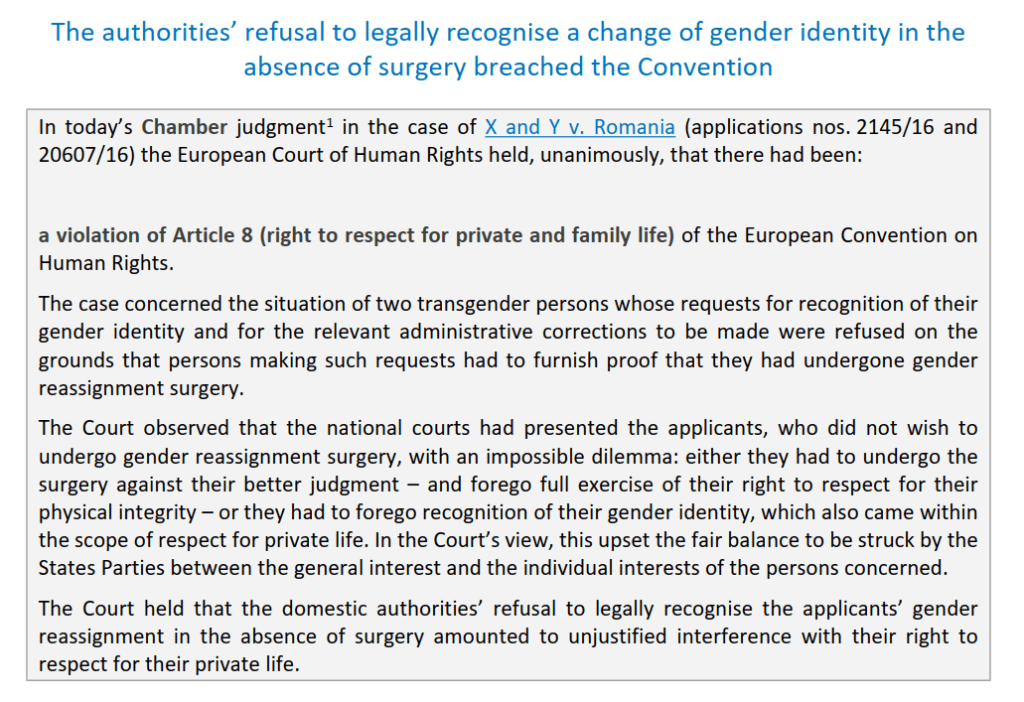

Once again, the ECtHR has strengthened the rights of trans people. The case was brought by two trans men from Romania (no compulsory surgery)
USA: California: Three Dads and a Baby – at-birth custody to three fathers

USA: Alabama law requiring surgery for transgender individuals to change sex on driver’s license unconstitutional
Alabama’s policy requiring that transgender people show proof of sex reassignment surgery in order to change the sex designation on their driver’s license was found to be unconstitutional, courts ruled Friday.
Under the Alabama Law Enforcement Agency’s (ALEA) Policy Order 63, transgender individuals could only get a license that accurately reflected their gender after they had sex reassignment surgery, “regardless of whether the surgery is necessary, desired, safe, or within the financial means of the individual,” said the complaint. The ALEA argued that this rule would ensure consistency in state records and provide a paper trail that could explain discrepancies between the sex listed on a person’s birth certificate and driver’s license. But the court held that “‘administrative ease and convenience’ is not a sufficiently important justification for a state policy based on sex.”
Forcing transgender individuals to present a license with a sex designation that does not match the way they present creates the potential for harassment. US District Court Judge Mayron Thompson cited statistics of violence related to inaccurate driver’s licenses:
One-quarter of all transgender people who carry identification documents that do not match their gender have been harassed after showing these documents. One in six has been denied services and more than half have faced harassment or assault from a law enforcement officer who learned they were transgender.
Thompson found the policy violated the Equal Protection Clause of the Fourteenth Amendment because it “treats people differently based on the nature of their genitalia, classifying them by sex.” Laws that separate people based on protected categories are subject to a higher standard of scrutiny, and the government must provide legitimate justifications as to why that law was necessary.
The post Alabama law requiring surgery for transgender individuals to change sex on driver’s license unconstitutional appeared first on JURIST – News – Legal News & Commentary.
Failure to adequately investigate and punish attack on a lesbian in Croatia is a violation of ECHR
| Posted: 14 Jan 2021 02:38 PM PST – (c) Paul Johnson – http://echrso.blogspot.com/ The First Section of the European Court of Human Rights has today given its judgment in Sabalić v Croatia. The case concerns Ms Pavla Sabalić’s complaint about a lack of an appropriate response of the Croatian authorities to a homophobic act of violence against her.The factsOn 13 January 2010, Ms Sabalić was physically attacked in a nightclub in Zagreb where she was with several of her friends. The attack ceased only after one of the Ms Sabalić’s friends used her gas pistol to frighten off the attacker. The police report records the incident as follows:“While they were in the nightclub [Ms Sabalić] was approached by an unidentified man who started flirting with her but she was constantly refusing him. After the nightclub closed they were all standing in front of it and the man continued pressing [Ms Sabalić ] to be with him. When she said that she was a ‘lesbian’ he grabbed her with both of his arms and pushed her against a wall. He then started hitting her all over her body and when she fell to the ground he continued kicking her.” The Zagreb Police Department was informed of the incident and two police officers immediately responded at the scene. The police soon identified the man as M.M. through the licence plates of a car he had used for fleeing from the scene. He was immediately apprehended and interviewed.Ms Sabalić was examined in the accident and emergency department. The examination indicated a contusion on the head, a haematoma on the forehead, abrasions of the face, forehead and area around the lips, neck strain, contusion on the chest and abrasions of both palms and knees. The injuries were qualified as minor bodily injuries.Proceedings after Ms Sabalić’s attackFollowing the incident the police interviewed Ms Sabalić and M.M., and the other participants in the event in connection with M.M.’s physical attack.The police instituted minor offences proceedings in the Minor Offences Court against M.M. for breach of public peace and order. Before the Minor Offences Court, M.M. confessed to the charges against him. No further evidence was taken and Ms Sabalić was not informed of the proceedings. The Minor Offences Court found M.M. guilty as charged of breach of public peace and order and fined him 300 Croatian kunas (approximately 40 Euros).After having realised that the police had failed to institute a criminal investigation, Ms Sabalić lodged a criminal complaint with the Zagreb Municipal State Attorney’s Office against M.M. for the offences of attempted grave bodily injury, motivated by hate crime, and the criminal offence of discrimination.On the basis of Ms Sabalić’s criminal complaint, the State Attorney’s Office ordered the police to investigate the allegations. This led to rulings by the domestic courts that M.M. had already been prosecuted and no further action would be taken.Complaint to the CourtMs Sabalić complained of a lack of an appropriate response of the domestic authorities to the act of violence against her, motivated by her sexual orientation. She relied on Articles 3, 8 and 14 of the Convention.Article 3 + 14 complaintThe Court stated that the treatment suffered by Ms Sabalić, which was “directed at her identity and undermined her integrity and dignity” (§ 70), must necessarily have aroused in her feelings of fear, anguish and insecurity reaching the requisite threshold of severity to fall under Article 3 of the Convention. On this basis, the Court found Article 3 of the Convention applicable to Ms Sabalić’s complaints. The Court recalled the established principles of its case-law on Articles 3 and 14 of the Convention concerning the State’s procedural obligation when confronted with cases of violent incidents triggered by suspected discriminatory attitudes, including those relating to the victim’s actual or perceived sexual orientation. In applying its established general principles, the Court noted that at the relevant time the domestic legal system provided protection to individuals from hate motivated violence, including crime motivated by the victim’s sexual orientation. However, the Court felt it did not need to examine the domestic legal framework since Ms Sabalić did not complain specifically in that respect. Rather, Ms Sabalić’s complaint was of a procedural nature relating to a lack of an appropriate response of the domestic authorities to the violent hate crime against her. Focusing on the procedural aspect of the State’s obligations, the Court observed that following the physical attack against Ms Sabalić in the nightclub the police immediately responded at the scene and that, at the initial stages of the proceedings, the domestic authorities were confronted with prima facie indications of violence motivated or at least influenced by Ms Sabalić’s sexual orientation. The Court observed that the minor offences proceedings did not in any manner address the hate crime element to the physical attack against Ms Sabalić nor was M.M. indicted or convicted of any charges related to violence motivated by discrimination. The Court stated that it could not “overlook the fact that M.M.’s sentence in the minor offences proceedings was manifestly disproportionate to the gravity of the ill-treatment suffered” by Ms Sabalić (§ 110). The Court stated that both the failure to investigate hate motives behind a violent attack and failure to take into consideration such motives in determining the punishment for violent hate crimes amounted to “fundamental defects”. The domestic authorities failed to remedy the impugned situation and, in particular, they failed to offer Ms Sabalić the appropriate redress. The Court therefore unanimously found “that by instituting the ineffective minor offences proceedings and as a result erroneously discontinuing the criminal proceedings on formal grounds the domestic authorities failed to discharge adequately and effectively their procedural obligation under the Convention concerning the violent attack against the applicant motivated by her sexual orientation” (§ 115). On this basis, there had been a violation of Article 3 under its procedural aspect taken in conjunction with Article 14 of the Convention. Partly concurring opinion of Judge Krzysztof Wojtyczek (First Section President)Judge Wojtyczek raised the concern that, in essence, the Court had implicitly established – whether or not it so intended – that M.M. committed an act which may be characterised as a criminal offence, that M.M. is guilty of this offence, and that a much more severe punishment should have been imposed upon him by the domestic courts. Judge Wojtyczek stated that this raised serious questions about M.M.’s fundamental rights.Brief commentThis is an important judgment which further evolves the Court’s jurisprudence on the interplay between Article 3 and Article 14 of the Convention in respect of hate crime committed on the basis of sexual orientation. It restates the principle that states are under a procedural obligation to investigate hate motives behind a violent attack and to take into consideration such motives in determining the punishment for violent hate crimes. It specifically establishes that states must use the most appropriate criminal law to deal with such serious offences of hatred on the grounds of sexual orientation, and not “downgrade” them to minor offences. The Court’s jurisprudence has evolved rapidly and it is important to remember that it was as recently as 2012 that the Court held, for the first time, that the ill-treatment of an individual on the grounds of sexual orientation amounted to a violation of Article 3, alone and in conjunction with Article 14, of the Convention. This is remarkable because individuals in Europe have been arguing since 1959 that forms of ill-treatment based on sexual orientation amount to a violation of Article 3. Dr Silvia Falcetta and I have written a history of Article 3 and sexual orientation discrimination here. Establishing that discrimination against individuals on the grounds of sexual orientation is a violation of Article 3 is important. Article 3 is an absolute right and, as such, provides no qualifications that can be utilised by a state to justify treating people differently on the grounds of sexual orientation. I have argued that Article 3 should be utilized more widely to address degrading treatment suffered by gay people, including failures by the state to provide adequate recognition of same-sex relationships (see here). Today’s judgment is an important reminder of the value of Article 3 of the Convention in holding national authorities to account in respect of their duty to combat hate crimes directed at people on the basis of their sexual orientation. |
Germany: Two mothers on Paula’s birth certificate?Rainbow family fights discrimination in court because of need for social mother to adopt proper child
A rainbow family in Lower Saxony no longer wants to accept discrimination – and is suing for equal treatment with heterosexual families.

Read: https://www.queer.de/detail.php?article_id=37906&pk_campaign=Nwsl
Israel declassifies being trans as a mental disorder in ‘important and significant step for the community’

Lesen: https://www.pinknews.co.uk/2021/01/14/israel-trans-ministry-health-guidelines-gender-pronouns
Germany: Law on Transgender Persons – Ten years ago, Federal Constitutional Court declared the sterilization requirement unconstitutional

Since 2011, “permanent inability to reproduce” is no longer a prerequisite for trans people to be allowed to change their gender registration. To date, however, the federal government has not removed the discriminatory passage from the text of the law.
Read: https://www.queer.de/detail.php?article_id=37893&pk_campaign=Nwsl
South Africa: Lesbian couple forced to take legal action after sperm donor tries to claim parental rights

A Johannesburg couple are litigating against their sperm donor, who is demanding he be recognised as father (Envato)
A lesbian couple in South Africa have been forced to take legal action against their sperm donor, who is demanding parental rights to their child.
USA: Colorado updates definition of common-law marriage to include LGBTQ+ couples
The Colorado Supreme Court updated the definition of common-law marriage to include LGBTQ+ individuals with three rulings handed down on Monday. The decisions also retroactively recognize same-sex common-law marriages entered into before the 2015 Obergefell v. Hodges decision.
Common law marriages are relationships that resemble marriage but lack official records to verify that union. Whether a common law marriage exists depends on a couple’s “mutual consent … to enter the legal and social institution of marriage, followed by conduct manifesting that mutual agreement.”
Colorado courts previously used a list of factors called the Lucero test to judge whether a couple’s conduct signified a common-law marriage. These factors included cohabitation, joint bank accounts and “use of the man’s surname by the woman or by children born to the parties.”
Justice Monica Márquez explained that “the gender-differentiated terms and heteronormative assumptions of the Lucero test render it ill-suited for same-sex couples.” She also recognized that customs traditionally associated with marriage “have become less reliable indicators of a marital relationship.” More unmarried couples are living together than before and fewer people are taking their partner’s last name, noted Márquez.
Monday’s rulings replaced the reliance on these factors. Under the new test, the most important determinant of a common-law marriage is the couple’s agreement upon the existence of a marriage. If the couple does not agree, their conduct is used to fill in the gaps. But bright-line factors will no longer make or break the existence of a marriage.
The post Colorado updates definition of common-law marriage to include LGBTQ+ couples appeared first on JURIST – News – Legal News & Commentary.
USA: Donald Trump’s HHS finalizes rule rolling back nondiscrimination protections for LGBTQ individuals
With less than two weeks left in office, Donald Trump’s administration announced on Friday a new rule that narrows nondiscrimination protections for LGBTQIA individuals seeking services of health and welfare programs that are funded by the United States Department of Health and Human Services (HHS).
This rule narrows LGBTQIA non-discrimination protections that were previously in 45 CFR 75.300(c) which barred discrimination without merit based on factors such as age, disability, sex, race, color, national origin, religion, gender identity, or sexual orientation in receiving benefits of HHS programs.
One example of the new rule changing treatment for the LGBTQIA community is that the original 45 CFR 75.300(d) required grant recipients to treat same-sex marriages as valid. The newly amended rule instead permits a change in treatment of same-sex marriages based on later Supreme Court rulings.
In its 86-page release adopting the rule HHS said that they are “committed to the principle that every person must be treated with dignity and respect and afforded all of the protections of the Constitution and statutes enacted by Congress – and to fully enforcing such civil rights protections and requirements.”
HHS presented explanations for creating a rule that contradicts this statement. Their release says that if they continue enforcing the rule as currently written in § 75.300(c) and (d) they will disrupt “the balance struck by Congress with respect to nondiscrimination requirements applicable to grant recipients.” HHS also cited evidence of accommodation requests and lawsuits as proof that the current rule violates the Religious Freedom Restoration Act, 42 U.S.C. 2000bb–2000bb-4 (RFRA). Lastly, the release by HHS also refers to the current rule leading to a decrease in “effectiveness of Department-funded programs by deterring participation in them.”
This rule will go into effect 30 days after publication in the Federal Register.
The post Donald Trump’s HHS finalizes rule rolling back nondiscrimination protections for LGBTQ individuals appeared first on JURIST – News – Legal News & Commentary.
 International and Comparative SOGIESC Law - Professor Andreas R Ziegler