Imane Khelif ‘has right to appeal’ [before the Court of Arbitration for Sports] over genetic sex tests but will miss world championships

Imane Khelif ‘has right to appeal’ [before the Court of Arbitration for Sports] over genetic sex tests but will miss world championships

  • Olympic boxing body stands firm over new testing rules
  • Gold medalist has appealed to Cas over eligibility bar

More:

https://www.theguardian.com/sport/2025/sep/03/imane-khelif-has-right-to-appeal-over-gender-tests-but-will-miss-world-championships#:~:text=On%20Tuesday%2C%20Khelif%20appealed%20to,of%20her%20appeal%20on%20Wednesday.

Burkina Faso passes law outlawing homosexual practices

Burkina Faso passes law outlawing homosexual practices

John Silk AP, AFP, Reuters, dpa, KNA09/02/2025September 2, 2025

Burkina Faso’s parliament has passed a law banning homosexuality with offenders facing two to five years in prison. The amended family code was approved in a unanimous vote in the West African country.

Source: https://www.dw.com/en/burkina-faso-passes-law-outlawing-homosexual-practices/a-73855503

X enabled online abuse against LGBTQ+ community in Poland, report finds

X enabled online abuse against LGBTQ+ community in Poland, report finds

Amnesty International on Monday released a report finding that X (formerly Twitter) allowed for the spread of technology-facilitated gender-based violence (TfGBV) against LGBTQ+ people in Poland.

The report highlights that Elon Musk relaxed the X’s Community Guidelines regarding the content allowed on the platform after taking ownership. Consequently, X has become “awash with content constituting TfGBV” requiring “urgent, wide-ranging reforms”. Alia Al Ghussain, Amnesty International Researcher and Advisor on technology and human rights, highlighted that “through inadequate content moderation practices and a lack of human rights due diligence, X has contributed to human abuses against members of Poland’s LGBTI community.”

Amnesty International’s research found that the examination of the tweets unveiled that “homophobic and transphobic content is highly prevalent on X, particularly for accounts that follow politicians who do not support the rights of LGBTI people.” Importantly, the algorithm responsible for the “For You” feed (also known as the recommender system) aims to increase user engagement. Therefore, content that is likely to garner interaction will be displayed to users. Amnesty International classified X’s business model as “surveillance-based” because it is dependent on intrusive data collection so that advertisements reach the target audience, similar to other social media platforms.

The group notes that X’s lack of funding in Polish language content moderation has led to the failure of handling TfGBV content. Only two Polish-speaking content moderators are “responsible for covering a population of 37.45 million people and 5.33 million X users.” The report states that “the combination of poor resourcing, policy, and practice has contributed to X becoming a platform awash with hateful content” against the LGBTQ+ community.

Furthermore, Amnesty International argues that X has not complied with the European Union’s Digital Services Act (DSA). Article 34(1) of the DSA states that providers of Very Large Online Platforms (VLOPs) must “diligently identify, analyse and assess any systemic risks in the [EU] stemming from the design or functioning of their service and its related systems, including algorithmic systems, or from the use made of their services.”

Article 34(1)(b) highlights that the risk assessment must regard whether there are systemic human rights risks by considering whether any fundamental rights, as enshrined by the Charter of Fundamental Rights of the European Union (CFREU), are at risk. This includes the right to human dignity (Article 1 CFREU), right to respect for private and family life (Article 7 CFREU), right to the freedom of expression and information, including the freedom and pluralism of the media (Article 11 CFREU), and non-discrimination (Article 21 CFREU). The organization emphasizes that X has harmed the ability of LGBTQ+ individuals “to freely express themselves, to live free from discrimination and to feel safe in Polish society”.

Previously, the European Commission launched an investigation under the DSA against X in December 2023 and required X to give information on its recommender system in January 2025. Amnesty International states that the European Commission’s investigations should include X’s ability to effectively tackle the risk of TfGBV.

The post X enabled online abuse against LGBTQ+ community in Poland, report finds appeared first on JURIST – News.

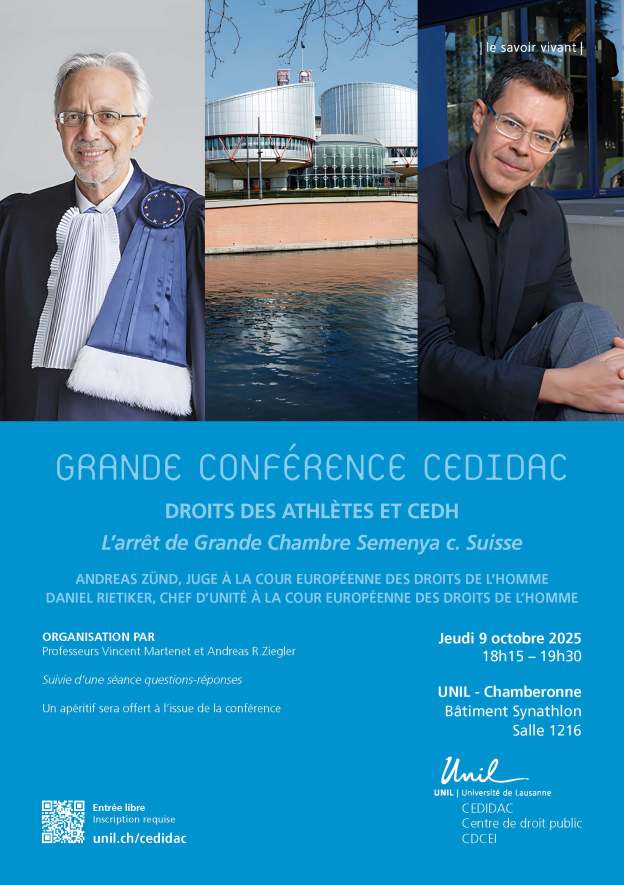
DROITS DES ATHLÈTES ET CEDH – L’arrêt de Grande Chambre Semenya c. Suisse, GRANDE CONFÉRENCE CEDIDAC, Lausanne 9 octobre 2025

GRANDE CONFÉRENCE CEDIDAC: DROITS DES ATHLÈTES ET CEDH – L’arrêt de Grande Chambre Semenya c. Suisse, Lausanne 9 octobre 2025


ANDREAS ZÜND, JUGE À LA COUR EUROPÉENNE DES DROITS DE L’HOMME
DANIEL RIETIKER, CHEF D’UNITÉ À LA COUR EUROPÉENNE DES DROITS DE L’HOMME

45 UN experts renew call for gender centered approach to reach human rights goals

45 UN experts renew call for gender centered approach to reach human rights goals

45 UN human rights experts reaffirmed on Thursday that gender must remain central to the fight for equality and human rights worldwide.

The statement was signed by UN special procedure mandate holders from various countries, jointly emphasizing that “binary conceptions of sex” result in an incomplete picture of the “social and cultural factors that shape identity and lived experience.” Thus, the experts urge that “[g]ender-based discrimination must be addressed alongside sex-based discrimination.”

According to the experts, employing a gender-based perspective advances human rights and equality goals due to a more comprehensive appreciation of how “roles, expectations, and hierarchies manifest in education, health, culture, at the workplace or with respect to social, economic, and political opportunities.” As such, the experts call on states and other stakeholders to reaffirm their commitment to gender equality and integration of a gender-based practice in international law. This call is consistent with the goals and objectives outlined in the UN’s Sustainable Development Goals, particularly Goal 5 on gender equality.

The value of recognizing intersectional forms of discrimination, including those based on sexual orientation and gender identity, was also supported by the work of the Independent Expert on protection against violence and discrimination based on sexual orientation and gender identity (SOGI). The current Independent Expert mandate is held by South African scholar Graeme Reid and was recently renewed by the UN Human Rights Council.

The UN experts’ statement comes amidst issues of gender-based discrimination across borders. In mid-July, the UN highlighted persistent gender gaps in sports, calling on member states to address gender inequalities. More specifically, in the US, several states, including Tennessee and Oklahoma, have made efforts to ban gender-affirming care for minors. Meanwhile, the UN also recently condemned the Taliban’s “gender apartheid” in Afghanistan, urging that dismantling these barriers is key to reaching gender equality.

The post 45 UN experts renew call for gender centered approach to reach human rights goals appeared first on JURIST – News.

USA announce that it will not participate in the United Nations’ Universal Periodic Review (UPR) scheduled for November 7

USA announce that it will not participate in the United Nations’ Universal Periodic Review (UPR) scheduled for November 7

This week, Laurel Sprague, Research Director and Blachford/Cooper Distinguished Scholar at the Williams Institute, was one of six U.S. participants in the pre-sessions for the United Nations’ Universal Periodic Review (UPR) of the United States. The UPR requires UN member states to report approximately every four and a half years on their human rights progress and receive recommendations from other states for continued improvement. In her testimony, Laurel addressed the U.S. government’s failures to meet its human rights obligations toward LGBTQ people since the last review in 2020 and offered recommendations for the reviewing states. On Wednesday, the U.S. announced that it would not participate in the UPR scheduled for November 7. “The State Department’s decision not to participate in this review marks a reversal of U.S. leadership on LGBTQ rights and sets a dangerous precedent,” Laurel said from Geneva. “This decision tells governments that they can disregard human rights recommendations, which threatens to further undermine human rights globally. It puts minority groups—including sexual and gender minorities—at greater risk and removes a key accountability process for anyone needing to defend themselves against government overreach.”
Read the UPR Submission

USA: Scholars file amicus brief with the Supreme Court in conversion therapy case

USA: Scholars file amicus brief with the Supreme Court in conversion therapy case

Scholars file amicus brief with the Supreme Court in conversion therapy case On August 27, Williams Institute scholars, represented by Cohen Milstein Sellers & Toll PLLC, filed a friend-of-the-court brief with the Supreme Court in Chiles v. Salazar.  The case was brought by Kaley Chiles, a mental health professional in Colorado, who is challenging the state’s ban on conversion therapy for youth. Chiles contends that the law restricts her ability to provide comprehensive counseling consistent with her and her clients’ religious beliefs, in violation of the First Amendment’s Free Speech Clause. The brief presents research showing that conversion therapy is ineffective and can cause serious harm to vulnerable LGBTQ youth, such as increased risks of suicidal ideation, depression, anxiety, physical health problems, financial hardships, and social isolation. The brief also supports Colorado’s authority to regulate the medical profession to prevent such harms.

Read the brief
IMPACT

Activists condemn public flogging of two men under Indonesia’s Islamic criminal law

Activists condemn public flogging of two men under Indonesia’s Islamic criminal law

Amnesty International on Tuesday condemned the public caning of two men in Indonesia’s Aceh province after they were convicted of same-sex relations under Islamic criminal law.

Aceh, located on the northern tip of Sumatra island, is Indonesia’s only province that criminalizes consensual same-sex acts. Under its special autonomy status, Aceh enforces qanun jinayat, Islamic criminal bylaws introduced in 2015 that criminalize adultery, gambling, alcohol consumption, and same-sex relations, with punishments including up to 200 lashes.

Aceh, located on the northern tip of Sumatra island, is Indonesia’s only province with special autonomy to enforce qanun jinayat, a set of bylaws introduced in 2015 that criminalize acts such as adultery, gambling, alcohol consumption, and same-sex relations, prescribing punishments including lashes.

The men, aged 20 and 21, were publicly flogged 76 times each after the local Sharia court found them guilty of engaging in consensual same-sex activity. Spectators reportedly watched on, with some recording the abuse as it was carried out in Banda Aceh. 

Montse Ferrer, Amnesty International Regional Research Director, criticized the flogging, stating:

This public flogging of two young men under Aceh’s Islamic Criminal Code for consensual sex is a disturbing act of state-sanctioned discrimination and cruelty. This punishment is a horrifying reminder of the institutionalized stigma and abuse faced by LGBTQ+ individuals in Aceh.

Amnesty has repeatedly urged Indonesia to repeal these laws, arguing they contravene the International Covenant on Civil and Political Rights and the UN Convention Against Torture, both of which Indonesia has ratified. The UN Human Rights Committee has previously called on the government to prohibit corporal punishment and protect LGBTQ+ persons from discrimination. 

Despite international criticism, Aceh authorities maintain that the qanun jinayat reflects local customs and Islamic values. The central government in Jakarta has historically deferred to Aceh’s autonomy arrangements, though rights groups argue this undermines Indonesia’s constitutional commitment to equality and non-discrimination. Tuesday’s flogging underscores ongoing tensions between Indonesia’s decentralized legal system and its international human rights commitments.

 Amnesty has called on the government to immediately halt the practice of public caning and decriminalize consensual same-sex relations nationwide. 

Such incidents are not novel in Aceh. The province has carried out public canings for same-sex relations and other morality offenses since implementing the Islamic criminal laws in 2015. Human rights organizations have repeatedly condemned the practice.

The post Activists condemn public flogging of two men under Indonesia’s Islamic criminal law appeared first on JURIST – News.

To be queer in parts of Colombia is ‘to sign your own death sentence’

To be queer in parts of Colombia is ‘to sign your own death sentence’

Colombia’s gang members tell CNN of a killing campaign aimed at LGBTQ people. Trans women, like Sara Millerey and Nawar Jimenez, are paying the price. This story is part of As Equals, CNN’s ongoing series on gender inequality. For information about how the series is funded and more, check out our FAQs.

More: https://edition.cnn.com/2025/08/05/us/video/colombia-gangs-queer-transgender-killings-as-equals-lon-digvid