Category Archives: Allgemein

English Court Blocks Puberty Blockers in Anti-Trans Craze Judgment

English Court Blocks Puberty Blockers in Anti-Trans Craze Judgment

In the far-reaching and immediately impactful judicial review decision of Bell and A v The Tavistock and Portman NHS Foundation Trust, the English High Court conflates puberty blockers and medical transition and decides puberty blockers should not be available to trans youth under the age of 16. The court gives the reason that puberty blockers ‘lead down a pathway to medical transition’ which can have some irreversible effects. According to the court, young persons under the age of 16 cannot appreciate the significance of these potential, and potentially irreversible effects in the areas of sexual functioning and fertility. Better then, is the court’s logic, to let them experience the irreversible effects of puberty.

As was argued by the Tavistock, which runs the Gender Identity Development Service (GIDS), the only National Health Service (NHS) gender clinic for youth in England and Wales, puberty blockers alone are accepted to have no known negative side-effects and their intended effects are beneficial, temporary and reversible. Medical research has shown that puberty blockers significantly reduce suicidal ideation in trans youth (Turban et al, 2020). In England and Wales, medical transition through gender-affirming hormones (sometimes described as cross-sex hormones) is already only available to over 16s, and surgery only to adults – through the NHS’s Gender Dysphoria Clinics. The three treatment processes, which are described in the decision in some detail, are unique and subject to separate decision-making processes (para. 40 of the judgment). Banning an innocuous, reversible treatment for under-16s because a treatment which is, and will remain, available only to over-16s may have irreversible effects that an under-16 might not be able to appreciate, exposes the flawed logic of the court and leaves the decision wide open to appeal.

At the heart of the decision lay the question of who is ‘competent’ to decide a course of medical treatment. In all areas of healthcare, the NHS deploys a test called the ‘Gillick Competence test’ for deciding under 16’s capacity to make informed decisions regarding their own treatment. The Court found that trans youth are highly unlikely to be Gillick competent, and accordingly put itself in charge of making complex medical decisions, instead of trusting the agreement on a course of treatment reached between the young person, their parents and a team of physicians and counsellors. The decision may well have repercussions beyond the current area of trans healthcare.

The decision puts trans children’s lives at risk and only makes eventual transition much more invasive. The court showed itself to be persuaded by one of the interveners in the case, ‘Transgender Trend’, an anti-trans organisation, which believes young people are being pushed to transition as part of a media-fuelled craze, and distributes anti-trans info packs among schools. The court also cited a plethora of outlier ‘experts’ included in the claimants’ evidence, many of whom have made anti-trans statements in public and some of whom are linked to the US Christian-right.

Judicial review and the arguments

The case was brought by Bell (the claimant’s name is listed as Quincy although Bell uses Keira in the media), now 23, who regrets her medical transition, and ‘Mrs A’. The court decision tells the story of how as a young teenager Bell sought treatment from the GIDS. The GIDS discouraged Bell from taking steps to transition but this only solidified her objective which was to get testosterone. At Bell’s request and with parental support, at 16 she was prescribed puberty blockers, and started on Testosterone at 17. At 20 Bell had a double mastectomy. Now 23 Bell belongs to the less than 0.5 percent who regret their transition, and she has gone to court to challenge the prescription of puberty blockers to all trans teenagers.

The second claimant is Mrs A, parent of a 15-year-old trans teenager diagnosed with autism whom Mrs A wants to prevent from accessing puberty blockers. Since the teenager is not a GIDS client, and the GIDS would not refer someone for puberty blockers without parental consent, such access is out of the question. The court concedes that Mrs A’s interest in the legal action is ‘therefore largely theoretical’ (para. 89). Mrs. A’s participation plays into the common transphobic trope that the coincidence of autism spectrum conditions among youth with gender dysphoria explains why ‘transgenderism’ is merely a teenage craze – as the second interveners believe – and transition a mere placebo for complex mental health issues.

The claim is a judicial review of the practice of the Tavistock and Portman NHS Trust, through its GIDS and the first and second interveners (UCL and Leeds NHS Trusts, the two hospitals that the GIDS works with) of prescribing puberty suppressing drugs to persons under the age of 18 who experience gender dysphoria (para. 2). The legal action, brought by two individuals in the form of a judicial review of a general practice by a public body, is therefore intended to affect a whole class of people.

The court discusses the GIDS practice in detail, citing evidence submitted by the clinicians involved, including the information the GIDS provides to young people during the several appointments that precede any treatment plan. Like all clinicians, when assessing a young person’s capacity to make decisions on their own medical treatment, GIDS teams use what is known as the ‘Gillick competence test’. This test hails from the 1986 House of Lords case of Gillick v West Norfolk NHS Trust, the unsuccessful case by activist and campaigner Victoria Gillick, who challenged the right of under-16s to be offered the contraceptive pill. A ‘Gillick competent’ child is one who has “enough understanding to make up their own mind about the benefits and risks of treatment.” The court in Bell limited its decision to under-16s because 16- and 17-year olds are by law considered competent.

By raising a presumption against Gillick competence in the case of trans children seeking puberty blockers, the court effectively renders illegal the GIDS’ clinical teams’ use of the Gillick procedure to assess an under-16-year-old’s competence. It also decided that under-16s as a rule cannot give informed consent to puberty blockers. This is because, in the court’s view, they cannot understand the potential long-term effects of medical transition.

The question before the court in fact only concerns the provision of puberty blockers and not medical transition. Puberty blockers serve to give a young person some time to reflect on their gender identity and consider any next steps and their effects are temporary – normal puberty follows when blockers are stopped. Gender-affirming hormones (like testosterone and oestrogen) and surgery (together: medical transition) are subject to an entirely separate assessment carried out by the UCL and Leeds Hospitals’ teams and the adult Gender Dysphoria Clinics, and are never offered by the NHS to youth under 16. Despite the extensive evidence provided by the GIDS’, UCL’s and Leeds’ clinicians of their separate assessment processes, the court conflates the three, barring access to puberty blockers, seemingly so as to deter take-up of medical transition.

The notion (commonly cited in anti-trans publications and suggested by the claimants and their counsel) that ‘scores of children’ are seduced by the internet to believe they are trans and handed life-altering medication ‘like it is candy’ before being sent down a transition pathway is simply not supported by the facts. Even before Bell, there were considerable constraints on access to gender-affirming healthcare for young people. The average waiting time for the initial GIDS appointment is 22-26 months (pre-COVID) and in some cases young people wait up to four years. It takes between 3-6 appointments for assessment, involving social workers, family therapists, psychiatrists, psychologists, psychotherapists, paediatric and adolescent endocrinologists and clinical nurse practitioners, over at least 6 months, before a care plan is agreed with the young person and their family. Only if the young person is Gillick competent, has parental/guardian support, and fulfils other strict criteria will they be referred to the UCL or Leeds NHS Trusts for consultation and/or physical assessment with an endocrinologist to decide if puberty blockers may be appropriate.

The court sides with the claimants despite the GIDS’ numbers painting a different picture. In 2019/20, 95 young persons under the age of 16 were referred by GIDS to the UCL and Leeds NHS Trusts’ endocrinologists for puberty blockers (para.  29). If we compare this (something the court neglects to do) to the number of young people referred to GIDS, which was 2519 in 2018 (para.  31), we see that contrary to the claim of ‘scores’ this is an extremely low number, especially if we take into consideration that the GIDS serves the entirety of England & Wales.

The fact that most GIDS clients who take puberty blockers after some time (usually years) move to taking gender-affirming hormones is taken by the claimants – and the court – to mean that hormone blockers send young people down an inexorable path of medical transition. A more likely explanation is that the numbers rather speak to the thorough job the GIDS do to ensure that only those young people who are certain of their gender identity are prescribed blockers. Transition regret, as noted above, is extremely rare and although it is a serious and difficult issue for the individual involved, this should not be used to seek to deny that treatment to others.

The impact and appeal

Following the decision, the GIDS has effectively suspended treatment for all its patients under 16. This means that trans teenagers now face the immediate prospect of going into puberty. Apart from being extremely distressing for young trans people, puberty produces the need for further, more invasive medical treatment in the future (e.g. top surgery) or may produce changes to the body that are irreversible (e.g. deepening of the voice) which may worsen dysphoria throughout a person’s life. The alternative for trans youth and their families – if they have the means – to purchase medication privately or online without being certain of its source or quality and without appropriate guidance.

The court’s decision adds a considerable delay and cost to treatment, for both patients, for the Courts and for the NHS. It further deepens the inequality in access to trans healthcare. It demands that young people prove their identity to a court, a demand that in 2017 was already recognised as unnecessarily increasing mental health risks by an Australian decision which removed court authorisation for youth access to gender-affirming hormones. Mermaids, which supports trans children and young people, and many other organisations such as Gendered Intelligence and Think2Speak have pointed out the dangers of this decision and published guidance for trans young people and their parents/carers. Stonewall has pointed out that the court’s judgment does not reflect international best practice in the care of trans youth, The World Professional Association for Transgender Health (WPATH) Standards of Care, and the Endocrine Society’s Guidelines, and that experts around the world have called for the decision to be overturned.

The 2020 High Court decision comes in the midst of an increasingly hostile environment for trans people in the UK , where the government recently chose to ignore its consultation on reform of the Gender Recognition Act because it did not like the fact that respondents overwhelmingly favoured gender self-determination.

The courts might see this decision and others (like trans-dad Freddy McConnell’s case) as a way to push back against a perceived “wave of transgenderism”. But young people will continue to assert gender self-determination, trans youth will continue to take steps to transition, trans people are not going away. These efforts to “stem the tide” are punitive, they are cruel, and they will ultimately be ineffective. The question is how many young lives will be harmed in the process. The Tavistock was granted leave to appeal, and hearings will take place by 22 March. The Good Law Project intends to intervene alongside many trans organisations.
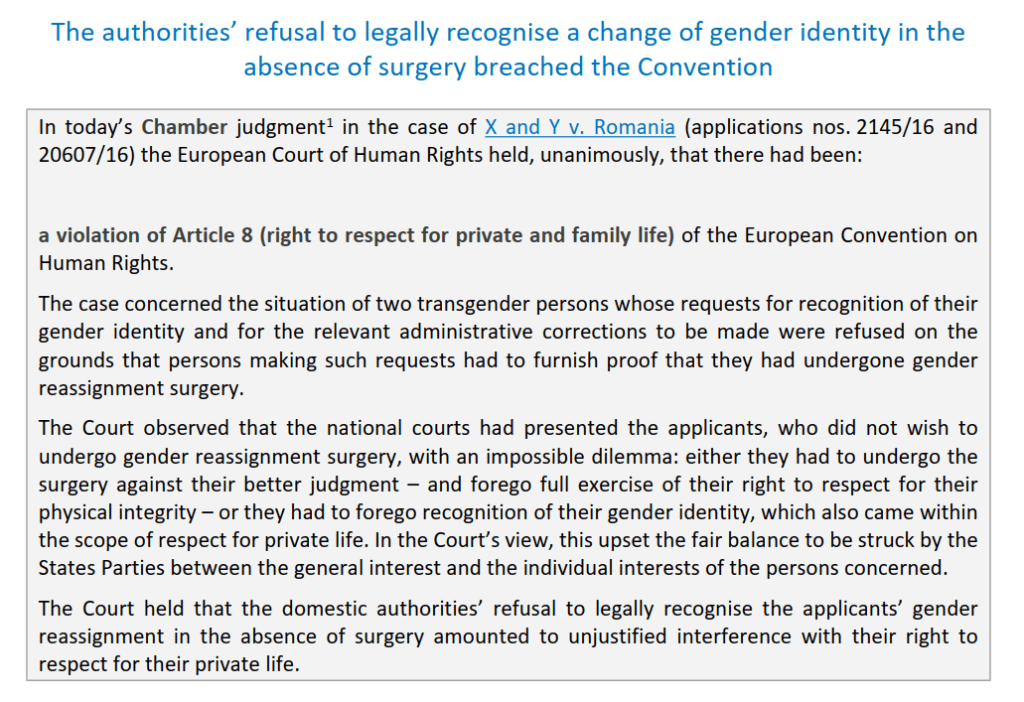

Once again, the ECtHR has strengthened the rights of trans people. The case was brought by two trans men from Romania (no compulsory surgery)

Once again, the ECtHR has strengthened the rights of trans people. The case was brought by two trans men from Romania (no compulsory surgery)

See: https://hudoc.echr.coe.int/app/conversion/pdf/?library=ECHR&id=003-6910029-9279612&filename=Judgment%20X%20and%20Y%20v.%20Romania%20-%20refusal%20by%20authorities%20to%20record%20a%20change%20in%20sexual%20identity%20without%20surgery%20breached%20the%20Convention.pdf

USA: Alabama law requiring surgery for transgender individuals to change sex on driver’s license unconstitutional

USA: Alabama law requiring surgery for transgender individuals to change sex on driver’s license unconstitutional

Alabama’s policy requiring that transgender people show proof of sex reassignment surgery in order to change the sex designation on their driver’s license was found to be unconstitutional, courts ruled Friday.

Under the Alabama Law Enforcement Agency’s (ALEA) Policy Order 63, transgender individuals could only get a license that accurately reflected their gender after they had sex reassignment surgery, “regardless of whether the surgery is necessary, desired, safe, or within the financial means of the individual,” said the complaint. The ALEA argued that this rule would ensure consistency in state records and provide a paper trail that could explain discrepancies between the sex listed on a person’s birth certificate and driver’s license. But the court held that “‘administrative ease and convenience’ is not a sufficiently important justification for a state policy based on sex.”

Forcing transgender individuals to present a license with a sex designation that does not match the way they present creates the potential for harassment. US District Court Judge Mayron Thompson cited statistics of violence related to inaccurate driver’s licenses:

One-quarter of all transgender people who carry identification documents that do not match their gender have been harassed after showing these documents. One in six has been denied services and more than half have faced harassment or assault from a law enforcement officer who learned they were transgender.

Thompson found the policy violated the Equal Protection Clause of the Fourteenth Amendment because it “treats people differently based on the nature of their genitalia, classifying them by sex.” Laws that separate people based on protected categories are subject to a higher standard of scrutiny, and the government must provide legitimate justifications as to why that law was necessary.

The post Alabama law requiring surgery for transgender individuals to change sex on driver’s license unconstitutional appeared first on JURIST – News – Legal News & Commentary.

Failure to adequately investigate and punish attack on a lesbian in Croatia is a violation of ECHR

Failure to adequately investigate and punish attack on a lesbian in Croatia is a violation of ECHR


Posted: 14 Jan 2021 02:38 PM PST – (c) Paul Johnson – http://echrso.blogspot.com/

The First Section of the European Court of Human Rights has today given its judgment in Sabalić v CroatiaThe case concerns Ms Pavla Sabalić’s complaint about a lack of an appropriate response of the Croatian authorities to a homophobic act of violence against her.The factsOn 13 January 2010, Ms Sabalić was physically attacked in a nightclub in Zagreb where she was with several of her friends. The attack ceased only after one of the Ms Sabalić’s friends used her gas pistol to frighten off the attacker. The police report records the incident as follows:“While they were in the nightclub [Ms Sabalić] was approached by an unidentified man who started flirting with her but she was constantly refusing him. After the nightclub closed they were all standing in front of it and the man continued pressing [Ms Sabalić ] to be with him. When she said that she was a ‘lesbian’ he grabbed her with both of his arms and pushed her against a wall. He then started hitting her all over her body and when she fell to the ground he continued kicking her.”  The Zagreb Police Department was informed of the incident and two police officers immediately responded at the scene. The police soon identified the man as M.M. through the licence plates of a car he had used for fleeing from the scene. He was immediately apprehended and interviewed.Ms Sabalić was examined in the accident and emergency department. The examination indicated a contusion on the head, a haematoma on the forehead, abrasions of the face, forehead and area around the lips, neck strain, contusion on the chest and abrasions of both palms and knees. The injuries were qualified as minor bodily injuries.Proceedings after Ms Sabalić’s attackFollowing the incident the police interviewed Ms Sabalić and M.M., and the other participants in the event in connection with M.M.’s physical attack.The police instituted minor offences proceedings in the Minor Offences Court against M.M. for breach of public peace and order. Before the Minor Offences Court, M.M. confessed to the charges against him. No further evidence was taken and Ms Sabalić was not informed of the proceedings. The Minor Offences Court found M.M. guilty as charged of breach of public peace and order and fined him 300 Croatian kunas (approximately 40 Euros).After having realised that the police had failed to institute a criminal investigation, Ms Sabalić lodged a criminal complaint with the Zagreb Municipal State Attorney’s Office against M.M. for the offences of attempted grave bodily injury, motivated by hate crime, and the criminal offence of discrimination.On the basis of Ms Sabalić’s criminal complaint, the State Attorney’s Office ordered the police to investigate the allegations. This led to rulings by the domestic courts that M.M. had already been prosecuted and no further action would be taken.Complaint to the CourtMs Sabalić complained of a lack of an appropriate response of the domestic authorities to the act of violence against her, motivated by her sexual orientation. She relied on Articles 3, 8 and 14 of the Convention.Article 3 + 14 complaintThe Court stated that the treatment suffered by Ms Sabalić, which was “directed at her identity and undermined her integrity and dignity” (§ 70), must necessarily have aroused in her feelings of fear, anguish and insecurity reaching the requisite threshold of severity to fall under Article 3 of the Convention. On this basis, the Court found Article 3 of the Convention applicable to Ms Sabalić’s complaints.

The Court recalled the established principles of its case-law on Articles 3 and 14 of the Convention concerning the State’s procedural obligation when confronted with cases of violent incidents triggered by suspected discriminatory attitudes, including those relating to the victim’s actual or perceived sexual orientation.

In applying its established general principles, the Court noted that at the relevant time the domestic legal system provided protection to individuals from hate motivated violence, including crime motivated by the victim’s sexual orientation. However, the Court felt it did not need to examine the domestic legal framework since Ms Sabalić did not complain specifically in that respect. Rather, Ms Sabalić’s complaint was of a procedural nature relating to a lack of an appropriate response of the domestic authorities to the violent hate crime against her.

Focusing on the procedural aspect of the State’s obligations, the Court observed that following the physical attack against Ms Sabalić in the nightclub the police immediately responded at the scene and that, at the initial stages of the proceedings, the domestic authorities were confronted with prima facie indications of violence motivated or at least influenced by Ms Sabalić’s sexual orientation.

The Court observed that the minor offences proceedings did not in any manner address the hate crime element to the physical attack against Ms Sabalić nor was M.M. indicted or convicted of any charges related to violence motivated by discrimination. The Court stated that it could not “overlook the fact that M.M.’s sentence in the minor offences proceedings was manifestly disproportionate to the gravity of the ill-treatment suffered” by Ms Sabalić (§ 110).

The Court stated that both the failure to investigate hate motives behind a violent attack and failure to take into consideration such motives in determining the punishment for violent hate crimes amounted to “fundamental defects”. The domestic authorities failed to remedy the impugned situation and, in particular, they failed to offer Ms Sabalić the appropriate redress.

The Court therefore unanimously found “that by instituting the ineffective minor offences proceedings and as a result erroneously discontinuing the criminal proceedings on formal grounds the domestic authorities failed to discharge adequately and effectively their procedural obligation under the Convention concerning the violent attack against the applicant motivated by her sexual orientation” (§ 115). On this basis, there had been a violation of Article 3 under its procedural aspect taken in conjunction with Article 14 of the Convention.

Partly concurring opinion of Judge Krzysztof Wojtyczek (First Section President)Judge Wojtyczek raised the concern that, in essence, the Court had implicitly established – whether or not it so intended – that M.M. committed an act which may be characterised as a criminal offence, that M.M. is guilty of this offence, and that a much more severe punishment should have been imposed upon him by the domestic courts. Judge Wojtyczek stated that this raised serious questions about M.M.’s fundamental rights.Brief commentThis is an important judgment which further evolves the Court’s jurisprudence on the interplay between Article 3 and Article 14 of the Convention in respect of hate crime committed on the basis of sexual orientation. It restates the principle that states are under a procedural obligation to investigate hate motives behind a violent attack and to take into consideration such motives in determining the punishment for violent hate crimes. It specifically establishes that states must use the most appropriate criminal law to deal with such serious offences of hatred on the grounds of sexual orientation, and not “downgrade” them to minor offences. 
The Court’s jurisprudence has evolved rapidly and it is important to remember that it was as recently as 2012 that the Court held, for the first time, that the ill-treatment of an individual on the grounds of sexual orientation amounted to a violation of Article 3, alone and in conjunction with Article 14, of the Convention. This is remarkable because individuals in Europe have been arguing since 1959 that forms of ill-treatment based on sexual orientation amount to a violation of Article 3. Dr Silvia Falcetta and I have written a history of Article 3 and sexual orientation discrimination here. Establishing that discrimination against individuals on the grounds of sexual orientation is a violation of Article 3 is important. Article 3 is an absolute right and, as such, provides no qualifications that can be utilised by a state to justify treating people differently on the grounds of sexual orientation. I have argued that Article 3 should be utilized more widely to address degrading treatment suffered by gay people, including failures by the state to provide adequate recognition of same-sex relationships (see here). Today’s judgment is an important reminder of the value of Article 3 of the Convention in holding national authorities to account in respect of their duty to combat hate crimes directed at people on the basis of their sexual orientation. 

Germany: Two mothers on Paula’s birth certificate? Rainbow family fights discrimination in court because of need for social mother to adopt proper child

Germany: Two mothers on Paula’s birth certificate?Rainbow family fights discrimination in court because of need for social mother to adopt proper child

A rainbow family in Lower Saxony no longer wants to accept discrimination – and is suing for equal treatment with heterosexual families.

Read: https://www.queer.de/detail.php?article_id=37906&pk_campaign=Nwsl

Germany: Law on Transgender Persons – Ten years ago, the Federal Constitutional Court declared the sterilization requirement unconstitutional

Germany: Law on Transgender Persons – Ten years ago, Federal Constitutional Court declared the sterilization requirement unconstitutional

Since 2011, “permanent inability to reproduce” is no longer a prerequisite for trans people to be allowed to change their gender registration. To date, however, the federal government has not removed the discriminatory passage from the text of the law.

Read: https://www.queer.de/detail.php?article_id=37893&pk_campaign=Nwsl

South Africa: Lesbian couple forced to take legal action after sperm donor tries to claim parental rights

South Africa: Lesbian couple forced to take legal action after sperm donor tries to claim parental rights

A woman holding her pregnant belly

A Johannesburg couple are litigating against their sperm donor, who is demanding he be recognised as father (Envato)

A lesbian couple in South Africa have been forced to take legal action against their sperm donor, who is demanding parental rights to their child.

Read: https://www.pinknews.co.uk/2021/01/13/lesbian-parents-sperm-donor-child-parental-rights-court-challenge-south-africa/

USA: Colorado updates definition of common-law marriage to include LGBTQ+ couples

USA: Colorado updates definition of common-law marriage to include LGBTQ+ couples

The Colorado Supreme Court updated the definition of common-law marriage to include LGBTQ+ individuals with three rulings handed down on Monday. The decisions also retroactively recognize same-sex common-law marriages entered into before the 2015 Obergefell v. Hodges decision.

Common law marriages are relationships that resemble marriage but lack official records to verify that union. Whether a common law marriage exists depends on a couple’s “mutual consent … to enter the legal and social institution of marriage, followed by conduct manifesting that mutual agreement.”

Colorado courts previously used a list of factors called the Lucero test to judge whether a couple’s conduct signified a common-law marriage. These factors included cohabitation, joint bank accounts and “use of the man’s surname by the woman or by children born to the parties.”

Justice Monica Márquez explained that “the gender-differentiated terms and heteronormative assumptions of the Lucero test render it ill-suited for same-sex couples.” She also recognized that customs traditionally associated with marriage “have become less reliable indicators of a marital relationship.” More unmarried couples are living together than before and fewer people are taking their partner’s last name, noted Márquez.

Monday’s rulings replaced the reliance on these factors. Under the new test, the most important determinant of a common-law marriage is the couple’s agreement upon the existence of a marriage. If the couple does not agree, their conduct is used to fill in the gaps. But bright-line factors will no longer make or break the existence of a marriage.

The post Colorado updates definition of common-law marriage to include LGBTQ+ couples appeared first on JURIST – News – Legal News & Commentary.