Tag Archives: history

UN experts alarmed at new Belarus law targeting LGBTQ+ and women rights

A group of seven UN experts expressed alarm on Wednesday about a new law aimed at repressing LGBTQ+ voices and proponents of human and women’s rights in Belarus.

The experts were concerned that this repression would breed further harassment and marginalization of LGBTQ+ individuals, women, and other minority groups:

This law represents a dangerous escalation. It equates legitimate human rights advocacy with an administrative offence and risks further legitimising persecution against already marginalised groups and defenders of their rights … By conflating human rights advocacy and information about sexual orientation, gender identity and reproductive autonomy with administrative offences, the authorities are fuelling prejudice and legitimising discrimination.

The experts urged Belarus officials to review the bill and to carefully consider all of the concerns expressed before enacting the law.

On April 2, the Council of the Republic of the National Assembly of Belarus approved a law that prohibits the distribution of “propaganda of homosexual relations, gender reassignment, childlessness, and pedophilia.” The bill imposes fines on both individuals and legal entities. Minors may also be fined or subjected to community service or administrative detention. “Propaganda” is vaguely defined in the law as the dissemination of “appealing” information that is “intended to influence citizens’ perceptions.”

The bill was a part of a broader introduction of multiple administrative offenses and the adjustment of presently existing offenses to bring them in line with current industry legislation. Human Rights Watch also said that this new bill represented yet another “blow” to LGBTQ+ people. The law inappropriately lumps together categories such as pedophilia and freedom of gender expression, breeding more stigmatization toward “non-traditional” sexual behavior classifications.

According to a recent survey, over 66 percent of queer people do not feel protected by police in Belarus in the event of a discriminatory attack. Moreover, only about 14 percent of individuals reported incidents of violence or discrimination to the police. Belarus’s new law thus parallels the events and atmosphere unfolding in Russia, whose Supreme Court has previously characterized the LGBTQ+ movement as “extremist.”

The post UN experts alarmed at new Belarus law targeting LGBTQ+ and women rights appeared first on JURIST – News.

India passes transgender rights amendment, prompting concerns over compliance with Supreme Court precedent

President Droupadi Murmu on Tuesday assented to the Transgender Persons (Protection of Rights) Amendment Bill, 2026, a measure that Amnesty International says restricts the ability of transgender and gender-diverse individuals to self-identify. Aakar Patel, chair of Amnesty International India’s board, criticized the law, stating: “This regressive law dilutes safeguards and deepens state intrusion into the lives of transgender people.”

The Transgender Persons (Protection of Rights) Amendment Bill, 2026, was passed by voice vote in both houses of Parliament on March 25, completing its legislative approval process. Opposition leaders raised concerns over the expedited process and urged that the bill be referred to a standing committee for broader consultation with stakeholders. Under the amended framework, transgender individuals are required to undergo a series of official verification procedures before their gender identity can be legally recognized by authorities. 

The amendment introduces a narrower definition of “transgender,” limiting recognition to specified socio-cultural categories and biological variations. It also removes a separate definition of intersex persons, grouping them within the broader transgender category. Additionally, the law establishes criminal penalties for “compelling,” “forcing” or “alluring” a person or child to present as transgender, with punishments extending up to life imprisonment.

Legal observers note that the amendment departs from principles articulated by the Supreme Court in NALSA v. Union of India of 2014, in which the Court recognized gender identity as a matter of personal autonomy and affirmed the right to self-identification without mandatory medical intervention.  The new framework replaces the Court’s recognition of self-identification with a system requiring certification by a medical board and subsequent recognition by a District Magistrate, raising concerns among critics about increased state oversight and potential inconsistencies with constitutional protections and international human rights standards.

The legislation was enacted despite objections from a Supreme Court-appointed expert committee on transgender rights, which had recommended withdrawing the bill and conducting further consultations with affected communities. The committee explicitly asked the government to withdraw the bill and engage in meaningful consultation with transgender communities. However, the government proceeded with the legislation. 

Meanwhile, the Rajasthan High Court cautioned that legislative changes cannot dilute constitutional guarantees, particularly those recognized in prior Supreme Court rulings, signaling the potential for future legal challenges to the amendment.

The post India passes transgender rights amendment, prompting concerns over compliance with Supreme Court precedent appeared first on JURIST – News.

Interesting Repost: Uladzislau Belavusau, Sexual Citizenship via Free Movement [Verfassungsblog 13 March 2026 on the judgement of the Court of Justice of the EU in Shipov (C-43/24, 2026), issued on 12 March 2026]

Yesterday, in the judgment of Shipov, the Court of Justice decided how EU citizenship can shape the recognition of gender identity within the Member States. Yet not through anti-discrimination law, but through the constitutional logic of free movement. The Court of Justice held that EU law precludes national legislation preventing a Union citizen from changing gender-related data in civil-status records in relation to the exercise of free movement. While formally grounded in Article 21 TFEU and Directive 2004/38, the case raises broader constitutional questions about the evolving relationship between citizenship, gender identity, and fundamental rights in the EU. Shipov follows the AG’s “minimal intrusion” logic and reinforces its reasoning by drawing heavily on Strasbourg jurisprudence. Finally, by linking gender identity to the effectiveness of EU citizenship, even under a relatively modest cross-border link, the Court further expands the role of Union citizenship as a vehicle for protecting personal identity and dignity.

Identity documents and the logic of free movement

The judgement of the Court of Justice in Shipov (C-43/24, 2026), issued on 12 March 2026, marks another step in the gradual constitutionalisation of sexual and gender identity within EU law. The Court held that EU law precludes national legislation preventing the amendment of gender-related data – including name and personal identification number – in civil-status registers of a Union citizen who has exercised free movement. In doing so, the Court treated identity documents not merely as administrative instruments but as essential legal tools enabling the effective exercise of EU citizenship rights. If the information contained in such documents no longer corresponds to a person’s lived identity, the resulting inconsistencies may create concrete obstacles in everyday cross-border interactions, ranging from border checks to employment procedures.

The decision continues a line of cases where the Court linked questions of personal identity to the effectiveness of EU citizenship rights. Earlier judgments such as Garcia Avello (C-148/02, 2003), Grunkin and Paul (C-353/06, 2008), Coman (C-673/16, 2018), and V.M.A. (C-490/20, 2021) similarly treated matters of personal status – names, marriage, or parenthood – as capable of restricting the effective exercise of free movement. Previously, I have commented extensively about the Coman case here on VerfBlog and elsewhere (with Dimitry Kochenov).

At first glance, however, Shipov appears doctrinally unusual. The dispute concerned only Bulgarian civil-status records. Unlike the earlier cases mentioned above, it did not involve the recognition of a legal status already established in another Member State (see para. 40 of the judgment). Yet the case was not entirely internal. The applicant had exercised free movement by residing in Italy, where she underwent hormone therapy and formed a stable relationship with an Italian national. Still, the cross-border element remained comparatively thin. The dispute itself concerned the amendment of Bulgarian civil-status records rather than mutual recognition of a status already created abroad. Furthermore, the domestic legal context was shaped by the Bulgarian Constitutional Court’s interpretative decision of 26 October 2021, which held that the constitutional concept of “sex” must be understood exclusively in a biological sense.

A cautious doctrinal route

In her earlier VerfBlog analysis of the Advocate General’s Opinion, Alina Tryfonidou highlighted the careful doctrinal strategy underlying the case. Rather than imposing a general obligation on Member States to introduce gender recognition procedures, the Advocate General, Jean Richard de la Tour, adopted a more limited approach. EU law requires identity documents to enable the effective exercise of free movement. If those documents cannot reflect a person’s gender identity without amending civil-status records, Member States must allow such amendments where necessary for the exercise of EU citizenship rights.

This “minimal intrusion” logic is reflected in the judgment itself. The Court reiterates that matters of civil status remain within Member State competence. However, Member States must exercise that competence consistently with EU law when national rules affect the practical conditions under which Union citizens exercise their mobility rights (paras 37–39, 47 of the judgment).

The Court further reinforced its reasoning by drawing heavily on Strasbourg jurisprudence. Referring to Article 8 ECHR and the European Court of Human Rights’ case law on gender identity, it emphasised that States must provide accessible procedures for legal gender recognition. Bulgaria had already been criticised in ECtHR judgments such as Y.T. v Bulgaria (2020) and P.H. v Bulgaria (2022) (paras. 49-52 of the judgement).

This reliance on Strasbourg allows the Court to situate its intervention within a broader European human-rights framework rather than presenting it as a purely EU-law innovation.

The shadow of McCarthy

Despite this cautious framing, the judgment still raises questions about the limits of EU citizenship. The relatively weak cross-border element inevitably invites comparison with McCarthy (C-434/09, 2011), where the Court rejected the application of EU law to a purely internal situation.

Formally, Shipov is distinguishable because the applicant had exercised free movement by residing in Italy. Yet the case still pushes EU citizenship into terrain where the cross-border element is more contextual than structural. The Court justifies its intervention by emphasising the role of identity documents as instruments of mobility. Discrepancies between a person’s lived gender identity and official documents may create practical obstacles when interacting with authorities, employers, or service providers across Member States.

Nevertheless, the judgment might have benefited from a clearer explanation of why such a comparatively thin cross-border element suffices. Without such clarification, the decision risks appearing difficult to reconcile with the stricter logic of earlier “purely internal situation” cases. The Court’s reasoning may therefore be understood as subtly recalibrating the threshold for the cross-border element required to trigger EU citizenship protections. Rather than demanding a fully developed cross-border legal status, the Court appears willing to intervene where national rules risk undermining the practical usability of identity documents across Member States. Whether this approach represents a pragmatic evolution of citizenship jurisprudence or a more controversial expansion of EU judicial authority will likely remain a subject of debate.

Why the Court chose citizenship rather than equality

Another striking feature of Shipov is the legal pathway chosen by the Court. The dispute concerns gender identity – an issue that might naturally fall within anti-discrimination law. Yet the Court does not rely on the Framework Equality Directive 2000/78/EC or on the equality provisions of the Treaties. Instead, the judgment relies on Article 21 TFEU (the fundamental right to move and reside freely within the EU), Directive 2004/38/EC (EU Citizens’ Rights Directive), and Article 7 of the Charter of Fundamental Rights of the European Union (respect for private and family life).

This choice is constitutionally significant. Anti-discrimination protection under Article 19 TFEU typically requires legislative harmonisation, whereas free movement provisions operate directly. By framing the case through citizenship and mobility rather than equality law, the Court relies on one of the Union’s strongest constitutional tools.

From market citizenship to sexual citizenship

The broader significance of Shipov becomes clearer when placed within the evolving constitutional narrative of EU citizenship. Over the past two decades, the Court has increasingly relied on citizenship and free movement to address questions of family status and sexual identity, areas traditionally considered matters of national competence.

Shipov extends this logic to gender identity. The case illustrates what I have previously described as the emergence of EU sexual citizenship – a constitutional development in which EU citizenship becomes a vehicle for recognising sexual and gender identities across the Union. Rather than relying primarily on anti-discrimination law or harmonisation under Article 19 TFEU, the Court increasingly uses citizenship as the doctrinal gateway for protecting these identities. From this perspective, EU citizenship increasingly operates not only as a market-based status but also as a normative framework that shapes the recognition of personal identity across Member States. By addressing issues of family status, sexual orientation, and gender identity through the lens of mobility rights, the Court gradually constructs a constitutional space in which certain aspects of personal identity become indirectly protected by EU law.

Conclusion

Technically, Shipov may appear to be a free movement case. In reality, it forms part of a broader constitutional evolution. By linking gender identity to the effectiveness of EU citizenship, the Court further expands the role of Union citizenship as a vehicle for protecting personal identity and dignity. More broadly, the judgment reflects a recurring tension within EU citizenship jurisprudence: while matters of personal status formally remain within the competence of Member States, they increasingly become subject to EU constraints when they affect the practical conditions under which Union citizens exercise their rights of movement and residence. Questions of names, family relations, and now gender identity thus appear less as purely domestic matters and more as elements of the legal infrastructure that allows EU citizenship to function in practice.

Whether this development represents a cautious doctrinal adjustment or a more ambitious constitutional shift remains open to debate. What is clear, however, is that EU citizenship is increasingly shaping the recognition of sexual and gender identities across the Union – even where the cross-border element remains comparatively modest.

The post Sexual Citizenship via Free Movement appeared first on Verfassungsblog.

US Supreme Court grants emergency relief in California gender identity case

US Supreme Court grants emergency relief in California gender identity case

The Supreme Court on Monday granted emergency relief to parents challenging California school policies on student gender identity, allowing a district court injunction to take effect while litigation continues in the United States Court of Appeals for the Ninth Circuit.

In an unsigned per curiam opinion, the Court held that the Ninth Circuit’s stay of the injunction was not justified under the governing four-factor test. It found that the parents, particularly those seeking religious exemptions, are likely to succeed on the merits “of their Free Exercise Clause claim.” It further noted that the nondisclosure rules are likely trigger strict scrutiny because they substantially interfere with “the right of parents to guide the religious development of their children.” The Court concluded that parents asserting due process claims are likely to prevail, citing longstanding precedent recognizing parental authority over children’s upbringing and education.

In a dissent, Justice Elena Kagan, joined by Justice Ketanji Brown Jackson, argued that the Court intervened prematurely while the case is still developing in the lower courts: “If nothing else, this Court owes it to a sovereign State to avoid throwing over its policies in a slapdash way, if the Court can provide normal procedures.” Justice Amy Coney Barrett, joined by Chief Justice John Roberts and Justice Brett Kavanaugh, indicated that she would have granted relief to the teacher plaintiffs.

The split decision follows a legal battle between religious parents and educators in California. Two sets of Catholic parents, represented by the Thomas More Society, challenged state school policies which prevent schools from disclosing students’ gender identities to their families, arguing that they violate the First Amendment’s Free Exercise Clause and the Fourteenth Amendment’s Due Process Clause. The plaintiffs stated that these policies misled them and secretly facilitated the children’s social transition. In contrast, California argued that students have the right to privacy regarding their gender expression, particularly if they fear rejection from their families. The state asserted that its school policies and state law are designed to strike a balance between parents’ rights and the students’ need for privacy.

The case will return to the Ninth Circuit while the district court’s injunction remains in effect for the parent class.

The post US Supreme Court grants emergency relief in California gender identity case appeared first on JURIST – News.

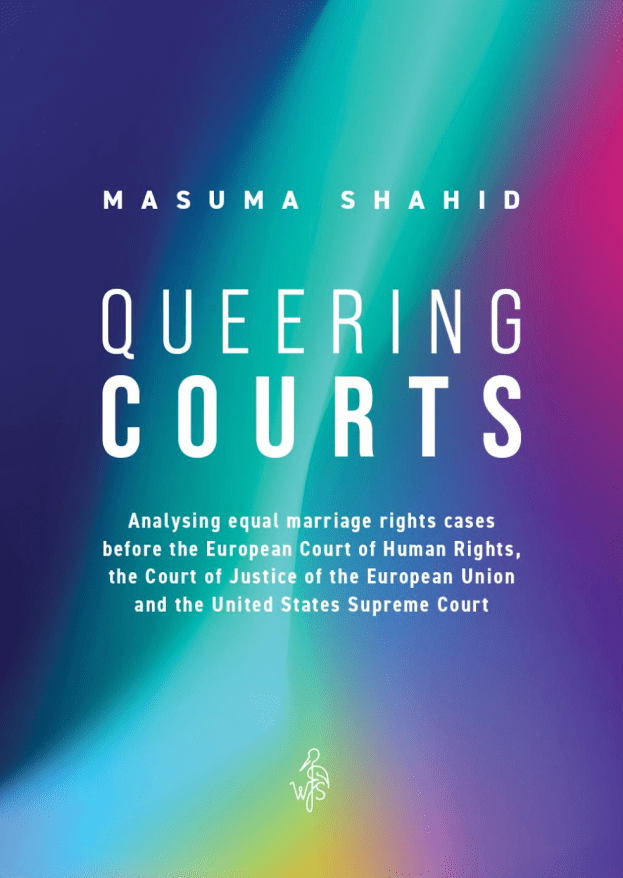
New SOGIESC publication: ‘Queering Courts’

New SOGIESC publication: ‘Queering Courts’

 The monograph ‘Queering Courts’ is now also available outside of the Low Countries through Amazon (https://www.amazon.com/Queering-Courts-Analysing-marriage-European/dp/B0GK94TXKJ/ref=sr_1_1.

New SOGIESC publication: ‘Queering Courts’

With the use of queer legal theory, ‘Queering Courts’ analyses how courts such as the European Court of Human Rights, the Court of Justice of the European Union, and the United States Supreme Court interpret and apply the notions of ‘sex’, ‘gender’, ‘sexuality’ and ‘sexual orientation’ in their equal marriage rights case law.

The research reveals that courts interpret the notions as binary constructs with the dominance in the hierarchies commonly anchored on certain heteronormative beliefs. This results in the discrimination, non-inclusivity and ‘othering’ of all that do not fall within the dominant part of the hierarchies, making them thus ineligible to enjoy ‘full’ or ‘equal’ marriage rights. While the decision-making of the courts is influenced by factors such as history, culture, religion, politics, etc., judicial self-restraint is oftentimes exercised for credibility, legitimacy, and authority reasons. The research suggests that courts should ‘queer’ their approaches for more inclusive, diverse, and universal adjudication. Until then, the enjoyment of full equal marriage rights is only for the heterosexually privileged.

– Dr Alina Tryfonidou: “Queering Courts is an exceptional and timely contribution to the literature on the equal marriage rights of same-sex couples. Dr. Shahid offers a masterful and crystal-clear analysis of the jurisprudence of three major courts – the ECtHR, the CJEU and the US Supreme Court – engaging rigorously with their case law while illuminating, through the lens of queer legal theory, how these courts understand and deploy the concepts of sex, gender, sexuality and sexual orientation. Written in crisp, accessible language and grounded in original scholarly insight, this book provides a refreshing, innovative and genuinely enlightening perspective. A delight to read and a significant intervention in the field.”

US appeals court upholds school’s policy to use preferred pronouns

US appeals court upholds school’s policy to use preferred pronouns

The US Court of Appeals for the Fourth Circuit ruled last Wednesday that
Montgomery County, Maryland, could require teachers to use students’
preferred pronouns and prohibit teachers from sharing information about
gender identity with parents.
The 2-1 opinion, written by Judge Robert Bruce King, held that the school
board’s policy requiring teachers to use the preferred pronouns of
students and not discuss gender information with parents did not violate
the plaintiff’s First Amendment rights. The plaintiff, Kimberly Ann Polk,
was a substitute teacher in Montgomery County and argued that her
Christian beliefs prohibited her from using a student’s pronouns that are
different from their biological sex. She claimed the board’s policy
violated her right to freedom of religion. The Court of Appeals, however,
found that the school board’s policy was “neutral” and of general
applicability. As such, the board’s goal of preventing discrimination and
protecting student safety was sufficient to overcome any burden on Polk’s
religion.
Plaintiff Polk also asserted the policy violated her free speech rights
by “compelling her, on condition of continued employment, to communicate
misleading messages to parents.” The Court of Appeals similarly disagreed
with this argument by stating that communicating with students and parents
is part of a teacher’s official duties. Because of this, Polk was not
acting as a private speaker when adhering to this policy, but rather a
government employee. The court ruled that, in her capacity as a teacher
and government employee, Polk did not have the First Amendment right not
to follow the policy.
This decision upholds the lower court’s dismissal of Polk’s free speech
and religion claims. Polk also asserted that the school board violated the
Civil Rights Act of 1964 by denying her a religious accommodation to the
policy. This law prohibits employers from failing or refusing “to hire or
to discharge any individual, or otherwise to discriminate against any
individual” because of their religion. The Fourth Circuit again upheld the
lower court’s denial of an injunction for this because Polk’s alleged
harms that would justify the injunction were the violation of her
constitutional rights. Because the court dismissed her First Amendment
claims, Polk could not argue her rights were violated.
This case comes against the backdrop of a divided judiciary on
transgender issues. A federal judge in California found last month that
schools cannot bar teachers from telling parents their children are
transgender. The Ninth Circuit Court of Appeals has temporarily blocked
this ruling.
The post US appeals court upholds school’s policy to use preferred
pronouns appeared first on JURIST - News.

Source: https://www.jurist.org/news/2026/02/us-appeals-court-upholds-schools-policy-to-use-preferred-pronouns/

Dangerous New Reporting Guidelines for US Annual Human Rights Reports

Dangerous New Reporting Guidelines for US Annual Human Rights Reports

The U.S. State Department recently sent new instructions to all U.S. embassies to guide in the preparation of the State Department’s 2025 Human Rights Reports. (See our LinkedIn post on this here.) As expected, they are removing the section of the annual report that covers abuses against LGBTQI+ persons. But even more alarming, they are now requiring reporting on transgender medical care as a human rights abuse involving the “chemical or surgical mutilation of children.” In short, the reports are no longer even vaguely credible on LGBTQI+ issues and are now creating an anti-rights framework to legitimize attacks against our communities.

The Council for Global Equality (CGE) has long encouraged human rights groups to report abuses to U.S. embassies for inclusion in the annual human rights reports. Over the past years, based on those local partnerships and the work of a dedicated LGBTQI+ policy team at the State Department in Washington, the U.S. human rights reports became increasingly comprehensive and were used by the United States and many other governments to formulate policy and adjudicate refugee claims. Unfortunately, based on recent instructions and the last 2024 reports, we now know the next reports will no longer be credible on LGBTQI+ and related issues, and CGE fears that the continued submission of information to U.S. embassies could create risks for the community itself. 

Given this new policy directive, we encourage groups to maintain cautious contact with trusted U.S. embassy staff, but we also urge groups to exercise extreme caution if you plan to submit information to U.S. embassies or the State Department, as we fear the information could be twisted or used against community interests. For refugee and asylum adjudication purposes only, there may be ways to submit relevant information on extrajudicial executions, torture, or cruel, inhuman, or degrading treatment of LGBTQI+ persons, but please reach out to us (info@globalequality.org) or refugee groups directly to discuss how best to present and submit that information so that it is not cited inappropriately.  

At the same time, we want to encourage all human rights groups to continue to document and share information widely on abuses targeting LGBTQI+ persons — that information is more important than ever given the current backlash.  Many of you already have robust dissemination networks for your data, including other embassies and the European Union, but please feel free to reach out to discuss how to ensure your documentation reaches the broadest possible audience. And please note that the following CGE member organizations and allied human rights groups regularly compile human rights reports that document violations against LGBTQI+ people globally, which are often useful for policymakers in Washington and beyond: Amnesty International USA, Global Justice Institute, Human Rights First, Human Rights Watch, ILGA, Outright International, Synergía – Initiatives for Human Rights, and The Williams Institute. Please reach out to those groups directly or reach out to us to help make connections to share your documentation.  

Tokyo High Court ruling upholds same-sex marriage ban

Tokyo High Court ruling upholds same-sex marriage ban

The Tokyo High Court on Friday issued the final pending appellate decision in Japan’s nationwide same-sex marriage litigation, holding that the country’s statutory framework limiting marriage to opposite-sex couples does not violate the Constitution of Japan. The court dismissed the plaintiff’s claims of breach of constitutional guarantees to equality and individual dignity. It rejected their request for damages on the basis that no constitutional injury had been established.

The ruling stands in contrast to earlier high court judgments issued between 2021 and 2024. Courts in Sapporo, Nagoya, Osaka, Fukuoka, and in an earlier Tokyo appeal found aspects of the current marriage framework unconstitutional. Several of those courts held that Article 14(1) of the Constitution prohibits discrimination based on sexual orientation and justified their decisions by Article 24’s requirement for marriage and family law to be based on “individual dignity” and the “essential equality of the sexes.” The latest decision, by contrast, concluded that the legislature retains broad discretion to define marriage, with Presiding Judge Yumi Toa affirming that provisions governing same-sex marriage ought to be thoroughly deliberated in the legislature. 

The court also rejected the argument that denying same-sex couples access to marriage infringes Article 14’s equality guarantee, holding that distinctions grounded in the current civil code definition do not amount to unconstitutional discrimination. 

Many municipalities and prefectures across Japan offer recognition through partnership certificates for same-sex couples. However, these frameworks do not provide the full legal rights associated with marriage, such as automatic parental recognition, inheritance, and spousal tax treatment.

The decision creates a direct conflict among courts, leaving Japan without a uniform interpretation of constitutional protections relating to marriage. Lawyers for LGBT & Allies Network (LLAN), which has previously translated major marriage-equality rulings, noted the significance of the divergence between this outcome and the 2024 Tokyo High Court judgment that held the ban unconstitutional.

The issue is now expected to proceed to the Supreme Court of Japan, a unified ruling would determine whether the Constitution permits or requires marriage equality and could clarify the relationship between Articles 14 and 24 in the context of contemporary family structures. 

The post Tokyo High Court ruling upholds same-sex marriage ban appeared first on JURIST – News.

Ruling of the Court of Justice of the European Union in case C-713/23 Wojewoda Mazowiecki: Member States must recognise same sex marriages lawfully concluded in another EU country when couples exercise their freedom of movement

Ruling of the Court of Justice of the European Union in case C-713/23 Wojewoda Mazowiecki: Member States must recognise same sex marriages lawfully concluded in another EU country when couples exercise their freedom of movement

Article 20 and Article 21(1) TFEU, read in the light of Article 7 and Article 21(1) of the Charter of Fundamental Rights of the European Union,

must be interpreted as precluding legislation of a Member State which, on the ground that the law of that Member State does not allow marriage between persons of the same sex, does not permit the recognition of a marriage between two same-sex nationals of that Member State concluded lawfully in the exercise of their freedom to move and reside within another Member State, in which they have created or strengthened a family life, or the transcription for that purpose of the marriage certificate in the civil register of the first Member State, where that transcription is the only means provided for by that Member State for such recognition.

__________________________________________

The Network of European LGBTIQ* Families Associations (NELFA) welcomes today’s ruling of the Court of Justice of the European Union in case C-713/23, which confirms that Member States must recognise same sex marriages lawfully concluded in another EU country when couples exercise their freedom of movement.

The case concerned two Polish citizens who married in Germany and asked for their marriage certificate to be transcribed into the Polish civil register. Polish authorities refused, citing domestic law that bans marriage for same sex couples. The Court found that this refusal violates EU freedom of movement and the right to private and family life, making clear that Member States cannot deny the marital status that couples have legally acquired elsewhere in the Union.

The judges confirmed that such recognition does not force a Member State to introduce marriage equality in its national legislation. What it does require is equal treatment in procedures that already exist. If a country provides a single route to recognising foreign marriages, it must apply that route without discrimination based on sexual orientation.

NELFA strongly welcomes this decision. It affirms what we have been saying for years. Rainbow families must not lose their rights when crossing borders inside the European Union. Our members span countries with very different legal systems, and we constantly see the harm caused when children and parents move from a country that recognises their family to one that denies it. Today’s ruling sends a clear message that EU law stands firmly on the side of family unity and legal continuity.

This judgment also highlights the urgency for many Member States to update their laws and administrative procedures so they no longer create obstacles for LGBTIQ* families. The Court’s reasoning mirrors what civil society, legal experts and the European Court of Human Rights have repeatedly stressed. In 2023, the Strasbourg Court held that Poland failed to provide any legal framework for same sex couples, reinforcing the need for structural change.

NELFA will continue to advocate for full recognition of rainbow families across the EU, including parenthood recognition, access to parenthood rights, and the removal of discriminatory barriers in cross border situations. This ruling is another strong building block that moves Europe closer to a Union where all families are treated with dignity and respect, everywhere.

For media inquiries: info@nelfa.org

See: https://nelfa.org/2025/11/25/nelfa-welcomes-landmark-eu-court-ruling-on-cross-border-recognition-of-same-sex-marriages/

Find the judgment here: https://curia.europa.eu/juris/documents.jsf?num=C-713/23

US Supreme Court declines to revisit same-sex marriage decision

US Supreme Court declines to revisit same-sex marriage decision

The US Supreme Court declined to hear an appeal on Monday that sought to overturn the decade-old landmark decision legalizing same-sex marriage.

The appeal was filed by Kim Davis, a former Kentucky county clerk who refused to issue marriage licenses to same-sex couples in 2015, defying a court order.

Davis asked the Supreme Court to reconsider Obergefell v. Hodges, which legalized same-sex marriage nationwide. She argued that the ruling unconstitutionally violated her right to practice religion freely under the Free Exercise Clause. Hearing the first appeal of the case, the US Court of Appeals for the Sixth Circuit held that, in this instance, her First Amendment rights could not be violated in her capacity as a public official.

“When Davis denied Plaintiffs a marriage license, she was wielding the ‘authority of the State’—not ‘function[ing] as a private citizen,” Judge Helene N. White, nominated by former President George W. Bush in 2008, wrote.

Davis also sought to reverse a verdict that required her to pay more than $100,000 in damages, $246,000 in legal fees and $14,000 in expenses to the couple whom she denied a marriage license. The Sixth Circuit affirmed the trial court’s judgment against Davis in March.

Obergefell held that denying same-sex couples the right to marry “demeans” and “stigmatizes” them, “diminish[es] their personhood,” and “subordinate[s] them.”

“Their hope is not to be condemned to live in loneliness, excluded from one of civilization’s oldest institutions. They ask for equal dignity in the eyes of the law. The Constitution grants them that right,” Justice Anthony Kennedy wrote in the landmark opinion.

Several organizations celebrated the Supreme Court’s decision not to hear Davis’s appeal. In a statement Monday, the ACLU wrote: “Our freedom to marry remains the law of the land.” The Human Rights Campaign wrote: “Love is (still) love… We won’t let up. We will keep fighting until all of us are free.”

The post US Supreme Court declines to revisit same-sex marriage decision appeared first on JURIST – News.